
Publications & Resources
Our faculty, students and researchers work together everyday to contribute to a better world by grappling with urgent problems we are facing in India. We conduct rigorous work to produce high quality learning resources and publications to contribute to public discourse and social change. Here, we feature a sample from our work for everyone to access. You can explore featured resources, policies, and the latest publications from the University.
To explore all the work of our University, please visit our publications repository.

- Published
- Authors
Abstract
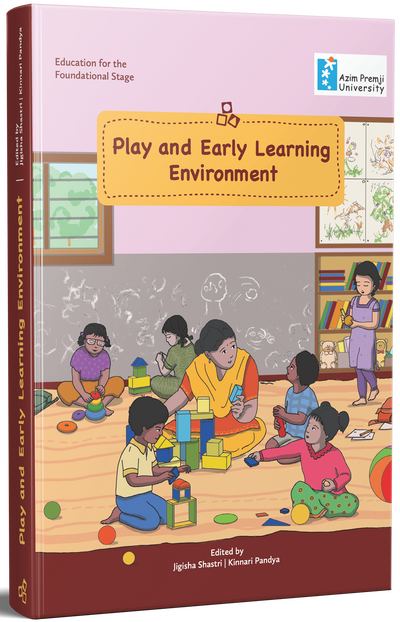
Play and Early Learning Environment is the first in the series on Education for the Foundational Stage. This thematic volume is a collection of articles on concepts, practices and programmes on play and early learning environment. The papers in the volume provide rich insights on what playful learning looks like in the foundational years in diverse Early Childhood settings and illustrates the ways in which we can develop playful and inclusive learning environments for children.
Editors:
Links
Article
The “Global Learning Crisis”: The Classroom View from Kanchipuram, India
in Comparative Education Review
Article
- Published
- Authors
Abstract
“Global learning crisis” narratives, in focusing on the “proximate determinants” of the crisis, represent a welcome “classroom turn” in international education and development. Extant learning crisis literatures are problematic, however, as their homogenizing gaze distorts how teachers and students co-constitute classrooms as locally meaningful learning spaces. Drawing on anthropological approaches in comparative education, this article addresses the “learning crisis” in a middle-school classroom in a weavers’ neighborhood in Kanchipuram. Constituted in an elaborate “notebook economy,” this classroom was an inventive response that not only accommodated students’ material cultures and social-educational disadvantages but also affected their belonging in a resource-scarce public education system. If the learning it afforded was disdained in “learning crisis” narratives, it was nevertheless relevant for students, readily translated into educationally unintensive assembly-line jobs. In producing contempt for such classrooms, “learning crisis” narratives merely distract from — and thus entrench — the deeply unequal economic and educational development that necessitated the notebook economy in the first place.

- Published
- Authors
Abstract
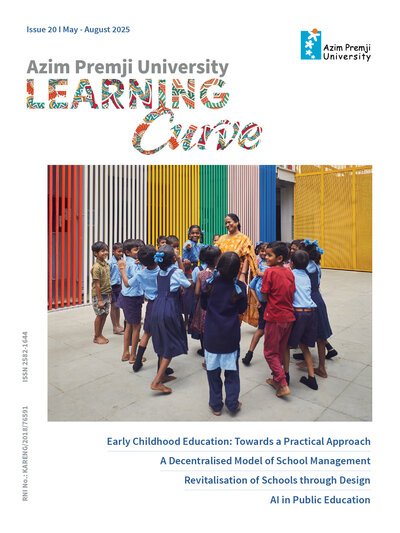
Articles featured in this issue highlight the importance of thoughtful, localised approaches to transforming India’s education system. Some examples being — Early Childhood Education: Towards a Practical Approach. The article argues for a play-based, holistic approach that supports young children as learners and individuals. A Decentralised Model of School Management explores how Rajasthan’s Panchayat Elementary Education Officer (PEEO) system strengthens local decision-making and drives school improvements. Revitalisation of Schools through Design — how smart, cost-effective design can turn classrooms into spaces that spark curiosity and support meaningful learning. AI in Public Education stresses the importance of integrating it thoughtfully, i.e., supporting educators and administrators in their work
Links
Article
- Published
- Authors
Abstract
The canvas of science education needs to be viewed in its totality to prevent the confounding of some basic issues and to enable us to evaluate the fads and fashions in educational practice. Policies and processes in education are tacitly shaped by theories in the humanities and social sciences. Inadequate understanding of these theories, or the lack of attention to uncalled-for implications of their practical import, takes education in undesirable directions. To be a good science teacher has never been easy. The teacher is a master of knowledge in science. But that is not all. She is equally committed to the principles governing the practice and communication of science.

- Published
- Authors
Abstract
This issue of the Learning Curve focuses on one of the most important periods in any individual’s life — early childhood. Whatever differences there may be on any other aspect of education, this is one area on which everyone agrees: that the years between birth and eight are the most significant and can make or break a life. So universal is this that it is equally true in all cultures. You will find focus articles by some of the most well-known and much respected educationists in the country, followed by very practical and hands-on approaches to Early Childhood Education (ECE).
Links

- Published
- Authors
Abstract
Azim Premji University attempts to explore ideas, lives and work of many social reformers, writers, thinkers and philosophers who have influenced us deeply, and fundamentally shaped our vision and philosophy. This graphic novel is on Rabindranath Tagore’s ideas and philosophy of education. Tagore is an educator for all times and his ideas are as relevant today, as they were when he lived. Tagore expresses in all his writings, that he experienced no joy while being taught by a series of teachers, or shifting from one conventional school to another. His approach to teaching grew from his life experiences. The school he set up in Santiniketan was ‘conceived to free the students’ minds and lead them to a state of creative unity where they would respect human beings, irrespective of caste or creed’. Tagore tried to inculcate the joy of learning among his students by integrating the classroom with nature. The myriad celebrations at Visva Bharati were envisaged to educate his students about the natural and human world around them, about collective action and community involvement. The dream was to foster complete human development where the unique potential of each child could flower in a happy and secure environment.
Note: Best viewed as two pages with the cover separate

- Published
- Authors
Abstract
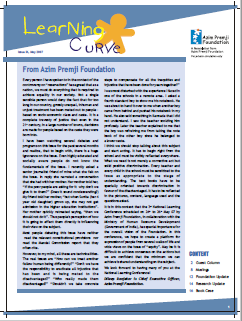
In this issue of the Learning Curve, the importance of community participation in education is explored and we read about Bindooben, a highly remarkable teacher in Gujarat. Paulo Freire’s ‘Pedagogy of the Oppressed’, in which the author delineates the incredible potency of education as a tool for liberation (genuine revolution of the people) and its capacity to dominate people, is reviewed.
Links