
Certificate Programme: Inclusive Pedagogy and Assessment
Creating classrooms where ALL children learn and thrive
Details
Introduction
Inclusive education can only be realised when classrooms are designed to respond to the diverse ways in which children learn, participate, communicate, and demonstrate understanding. However, teaching and assessment practices in many schools continue to value uniformity, often excluding learners based on language, disability, socio-economic background, or prior education. Inclusive pedagogy equips educators to move beyond and create flexible, responsive learning environments that recognise learner diversity as an educational strength rather than a disadvantage. The National Education Policy (NEP) 2020 emphasises learner-centred pedagogy, flexibility, equity, and competency-based assessment, highlighting the need for educators to build capacities for inclusive classroom practice and culture.
The Certificate Programme in Inclusive Pedagogy and Assessment is designed to equip educators with practical strategies for creating accessible and participatory learning environments for all children. Through engagement with Universal Design for Learning (UDL), Differentiated Instruction, and a systemic approach to building and sustaining inclusive learning environments, the programme supports educators in designing curriculum, instruction, and assessment processes that are responsive to varying student needs. Intended for teachers, school leaders, teacher educators, and NGO professionals, the programme seeks to strengthen inclusive teaching practices and school processes that enable every learner to thrive and feel included.
Note: Participants enrolled in the two certificates in Inclusive Education can choose two additional certificates from the eight certificates offered across the PG Diploma in Early Childhood Education and PG Diploma in Teaching Children with Learning Disabilities, to earn a ‘Diploma in Equity and Inclusion’. This flexibility enables participants to build a programme aligned with their professional interests, roles, and learning needs, while gradually working towards a broader set of competencies in education and inclusion.
Key features
- Applying inclusive pedagogical approaches such as Universal Design for Learning (UDL), Differentiated Instruction, and Culturally Responsive Pedagogy (CPR) for diverse learners
- Developing practical skills to design an accessible curriculum, adapt teaching-learning materials, and create equitable assessment practices within classroom contexts
- Gaining hands-on experience through projects and reflective practice focused on classroom participation and supportive learning environments for all children
- Setting up classroom and school processes centred around a systemic understanding of inclusive education and collaboration
- Offering a blended mode — 5 days in-person, 26 online taught sessions held on Mondays and Fridays, plenty of asynchronous resources, readings and sessions
- Partnering with Ummeed Child Development Center, a non-profit organisation known for providing comprehensive, family-centred care for children with developmental disabilities, training professionals, and advocating for inclusive education.
Who will benefit from the programme?
- Student-teachers, novice (0−2 yrs of experience), experienced teachers and NGO professionals
- Educators who want to be equipped to reach and teach ALL children in the classroom and develop sensitivities towards those who are marginalised or viewed as different or having disabilities.
- NGO professionals who seek to work with children, teachers or the school administration and leadership to ensure the goals of inclusive education are met.
- School coordinators, counsellors, support functions, and special educators who believe they play an equal role in realising inclusive education in schools
- Participants do not require any work experience. Student-teachers enrolled in a BSc/BA BEd programme are encouraged to apply.
Timelines
Last date to apply: 15 Nov 2026
Start date: 14 Dec 2026
End date: 19 March 2027
Duration: 14 weeks (December 2026 – March 2027)
In-person component: 15 – 19 March 2027
- What is the requirement to complete a Certificate?
Participants must meet the minimum attendance requirements and complete assessments with a minimum pass grade in accordance with the University guidelines for the same.
- Will this be an intensive programme?
The courses have been designed keeping working professionals and their needs in mind, the programme will require regular attendance, assignment submissions and class participation.
- How many days will I need to be away from work?
The certificate will require participants to attend in-person classes for 5 days at the Bengaluru campus. The remaining sessions will be online.
- What is the timing of the online classes on Mondays and Fridays?
The online classes on Mondays and Fridays will run for 2 hours between 4:30 and 6:30pm.
- Is attending Face to Face sessions mandatory?
Yes, attending the in-person sessions at our Bangalore campus is mandatory.
- I understand English but am less familiar with communicating verbally and in written form. Can I still enrol?
The courses have been designed to be delivered in English to cater to participants from all geographical regions. While you may, on occasion, orally communicate in your mother tongue (provided the faculty or any of your peers can translate). You will be allowed to use Closed Captions on Zoom for greater language and digital access. You will be required to submit your assignments in English.
- I am working in an NGO specifically for education, will this programme benefit me?
Yes, while the programme will discuss classroom and school contexts, NGO professionals who work with schools or support educators will benefit from learning about how inclusive education can be implemented systematically.
- I am a freelancer working in the development sector, can I join this programme?
The admission process will require you to prove your genuine interest in the area. There is no bar on eligibility as such.
- I am currently not working but have experience, can I join?
Yes. This certificate is for those who seek to work in or with schools. For the project course, it would be useful to make contact with schools in your area so that your project is situated in lived realities.
- Is the campus accessible for people with disabilities?
Yes, the University campus and some of our student residences are wheelchair access friendly.
- I have a young child; is there any facility for childcare?
The University has a crèche facility on the campus. However, we would suggest that specific requirements are discussed with us on a case-to-case basis.
- Will there be placement assistance?
There is no placement assistance envisaged after the programme.
- Will financial assistance be provided?
Financial assistance is provided on a case-by-case basis.
Course structure
Total 10 credits
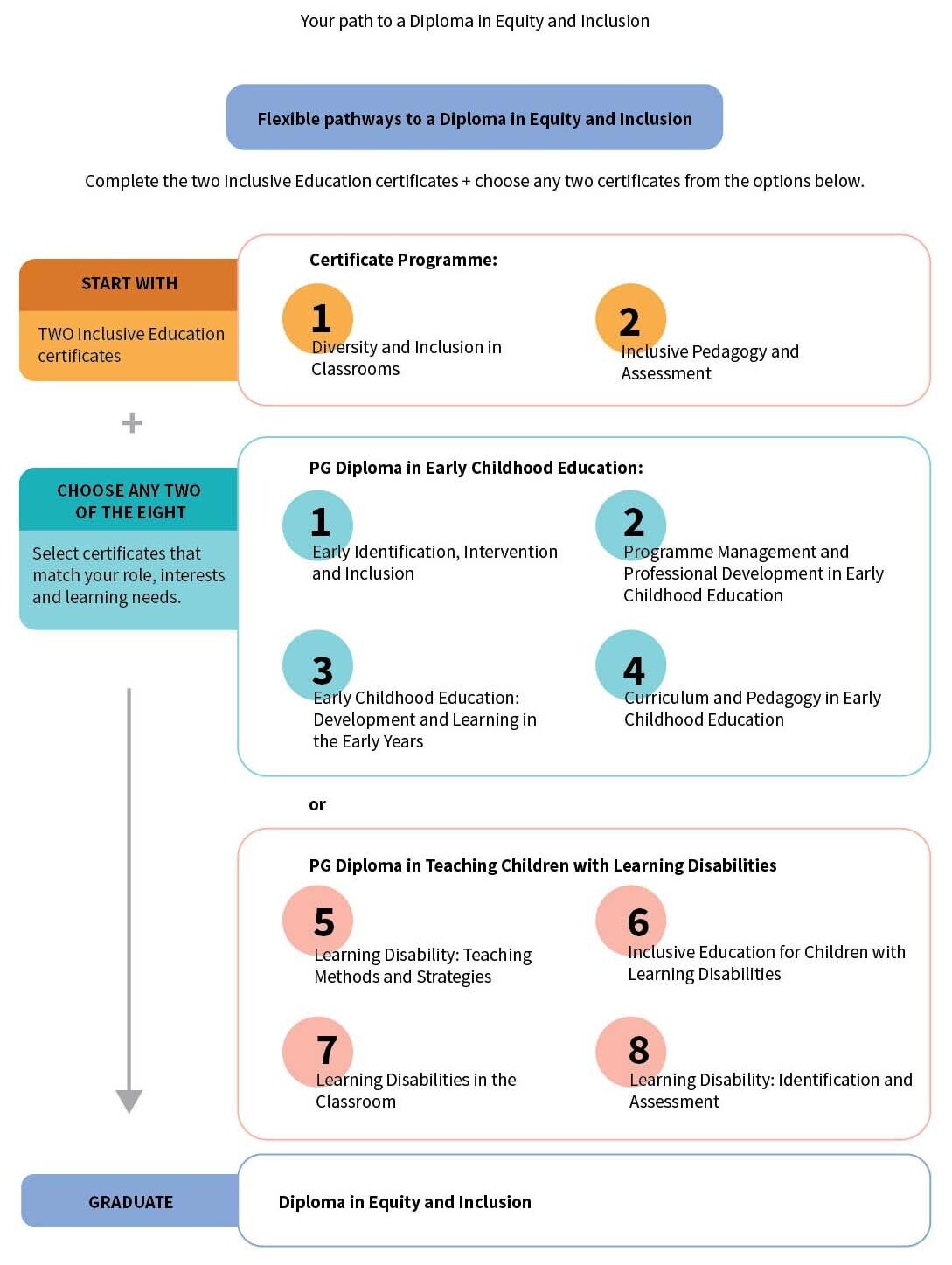
Programme Flexibility
This course explores the application of inclusive pedagogies and their implications for curriculum design, lesson planning, and assessment practices. Participants will critically engage with the theoretical foundations of Universal Design for Learning (UDL) and Differentiated Instruction, while also examining how these approaches can be meaningfully adapted to the Indian educational context.
This course examines what it means to establish and sustain inclusive practices and cultures within classrooms and schools through a systemic approach to inclusive education. Through case studies, participants will explore the roles of various stakeholders, especially of the teacher, in implementing inclusive education and understand how collaboration plays a vital role in creating supportive and equitable learning environments.
This mentored project bridges theory and practice by enabling participants to observe inclusive classroom practices in schools and develop their own ideas and interventions. Participants will engage in reflection, observation, and data collection to produce actionable reports and teaching-learning materials that can foster inclusion within the educational contexts they study.
Faculty
3 of 1 All Programme faculty →