

Certificate Programme: Diversity and Inclusion in Classrooms
Recognising the learning needs and rights of all children
Details
Introduction
Education is a powerful vehicle for social change, yet the exclusion of children with disabilities and socio-economically disadvantaged groups remains a persistent challenge. School education requires a fundamental systemic shift, moving from viewing differences as “problems to be fixed” to recognising them as aspects of the human condition and part of the learning process. By bringing about small changes in content, teaching methods, and structures, we can ensure every child, regardless of background, ability or identity, feels equally valued in the classroom and the overall experience of teaching and learning is improved. The NEP 2020 recognises the need for all educators to be trained in Inclusive Education as a means to fulfil the goal of providing quality education to all citizens, a fundamental right in our country.
The Certificate Programme in Diversity and Inclusion in Classrooms is designed to support an educator’s journey of becoming an inclusive practitioner. Whether you are a student-teacher pursuing your BEd degree, a novice teacher, an experienced educator, school administrator, school coordinator or NGO professional working directly with children, teachers or schools, this programme provides the essential tools to transform the classroom into an equitable, participatory environment where every child truly belongs, and where student diversity is seen as a strength.
Key features
- Understanding the socio-cultural, economic, dis/ability and neurological diversities that exist in the classroom
- Developing philosophical as well as practical tools that help in making inclusive education a reality in your classroom and school
- Gaining practical knowledge and experiences through hands-on project work situated in school and classroom contexts
Offering a blended mode — 5 days in-person, 26 online taught sessions held on Mondays and Fridays, plenty of asynchronous resources, readings and sessions
This programme is run in partnership with Ummeed Child Development Centre, a non-profit organisation known for providing comprehensive, family-centred care for children with developmental disabilities, training professionals, and advocating for inclusive education.
Who will benefit from the programme?
- Student-teachers, novice (0−2 yrs of experience), experienced teachers and NGO professionals
- Educators who want to be equipped to reach and teach ALL children in the classroom and develop sensitivities towards those who are marginalised or viewed as different or having disabilities.
- NGO professionals who seek to work with children, teachers or the school administration and leadership to ensure the goals of inclusive education are met.
- School coordinators, counsellors, support functions, and special educators who believe they play an equal role in realising inclusive education in schools
- Participants do not require any work experience. Student-teachers enrolled in a BSc/BA BEd programme are encouraged to apply.
Timeline
Duration: 14 weeks (August – November 2026)
Last date for application
- –
Programme duration
- –
In-person component
Programme Structure
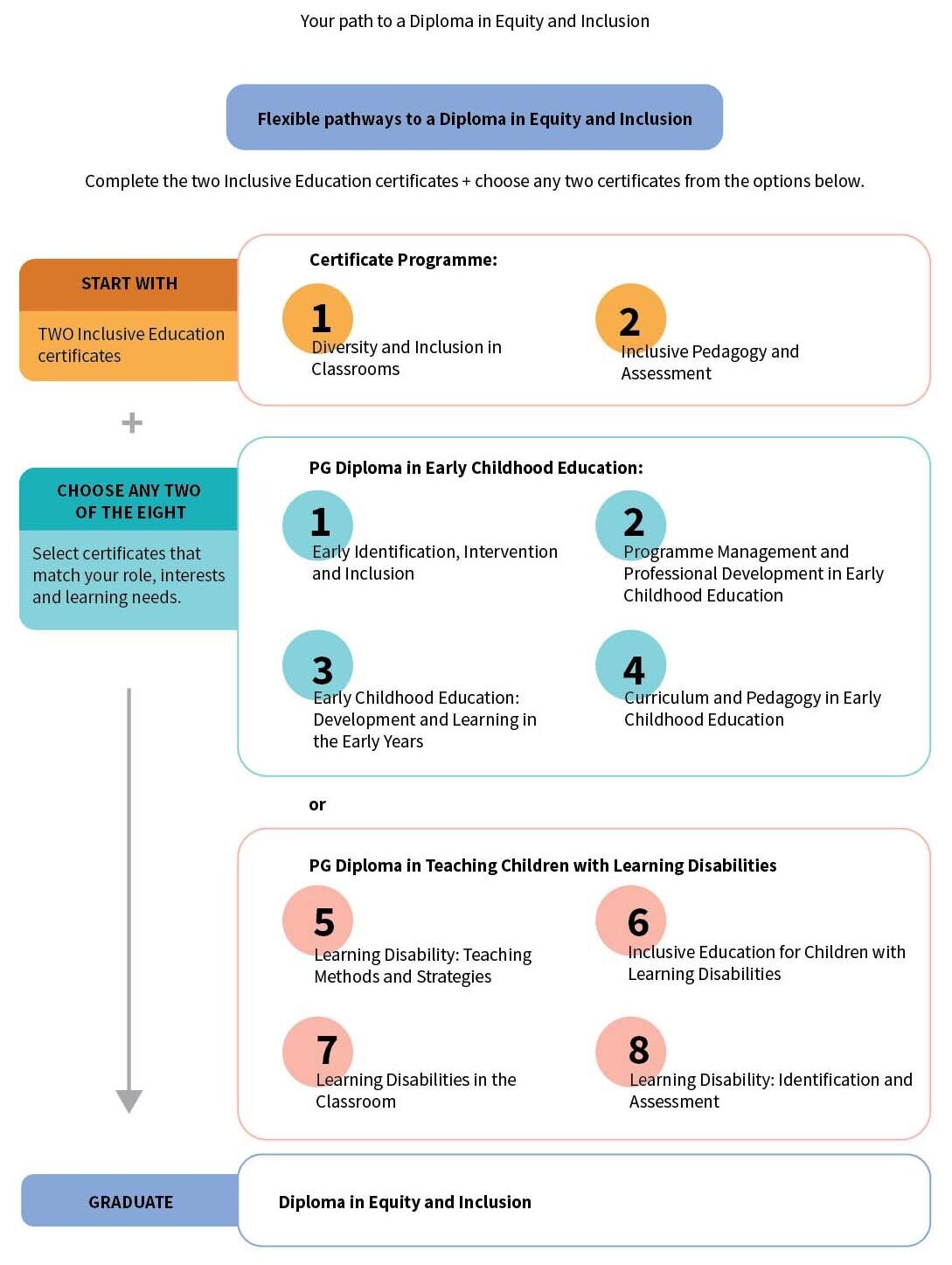
Programme Flexibility
Total 10 credits
The course explores disability and neurodiversity at the intersections of socio-cultural, economic, and linguistic diversity found in the Indian classroom. Participants will recognise deficit-based models in order to develop systemic, reflexive practices needed to build truly inclusive and responsive classrooms and schools.
The course traces the evolution of inclusive education from global frameworks to Indian policy, bridging theory with practical application. Using tools like the NCERT Index for Inclusion, participants will learn to assess school and classroom environments and develop systemic solutions needed to support the growth and inclusion of all learners.
The mentored project bridges theory and practice by allowing participants to explore diversity and inclusion through hands-on fieldwork and independent study. Participants will engage in deep reflection and data collection to produce actionable reports and materials that can foster inclusion in the contexts they study.
- What is the requirement to complete a Certificate?
Participants must meet the minimum attendance requirements and complete assessments with a minimum pass grade in accordance with the University guidelines for the same.
- Will this be an intensive programme?
The courses have been designed keeping working professionals and their needs in mind. The programme will require regular attendance, assignment submissions and class participation.
- How many days will I need to be away from work?
The certificate will require participants to attend in-person classes for five days at the Bengaluru campus. The remaining sessions will be online.
- What is the timing of the online classes on Mondays and Fridays?
The online classes on Mondays and Fridays will run for 2 hours between 4:30 and 6:30 PM.
- Is attending in-person sessions mandatory?
Yes, attending the in-person sessions at our Bengaluru campus is mandatory.
- I understand English but am less familiar with communicating verbally and in written form. Can I still enrol?
The courses have been designed to be delivered in English to cater to participants from all geographical regions. However, you may, on occasion, orally communicate in your mother tongue (provided the faculty or any of your peers can translate). You will be allowed to use closed captions on Zoom for greater language and digital access. Assignments need to be submitted in English.
- I am working in an NGO specifically for education. Will this programme benefit me?
Yes, while the programme will discuss classroom and school contexts, NGO professionals who work with schools or support educators will benefit from learning about how inclusive education can be implemented systematically.
- I am a freelancer working in the development sector. Can I join this programme?
The admission process will require you to prove your genuine interest in the area. There is no bar on eligibility as such.
- I am currently not working but have experience, can I join?
Yes. This certificate is for those who seek to work in or with schools. For the project course, it would be useful to make contact with schools in your area so that your project is situated in lived realities.
- Is the campus accessible for people with disabilities?
Yes, the University campus and some of our student residences are wheelchair-access friendly.
- I have a young child. Is there any facility for childcare?
The University has a creche facility on the campus. However, we would suggest that specific requirements are discussed with us on a case-to-case basis.
- Will there be placement assistance?
There is no placement assistance envisaged after the programme.
- Will financial assistance be provided?
Financial assistance is provided on a case-by-case basis.
Faculty
4 of 2 All Programme faculty →