
Back to High School: An Outreach Effort by Scientists
Entertaining close to 350 high school students with science sounds like a tall task, but a group of faculty members from Azim Premji University rose to the challenge, writes Nandita Jayaraj.
Details
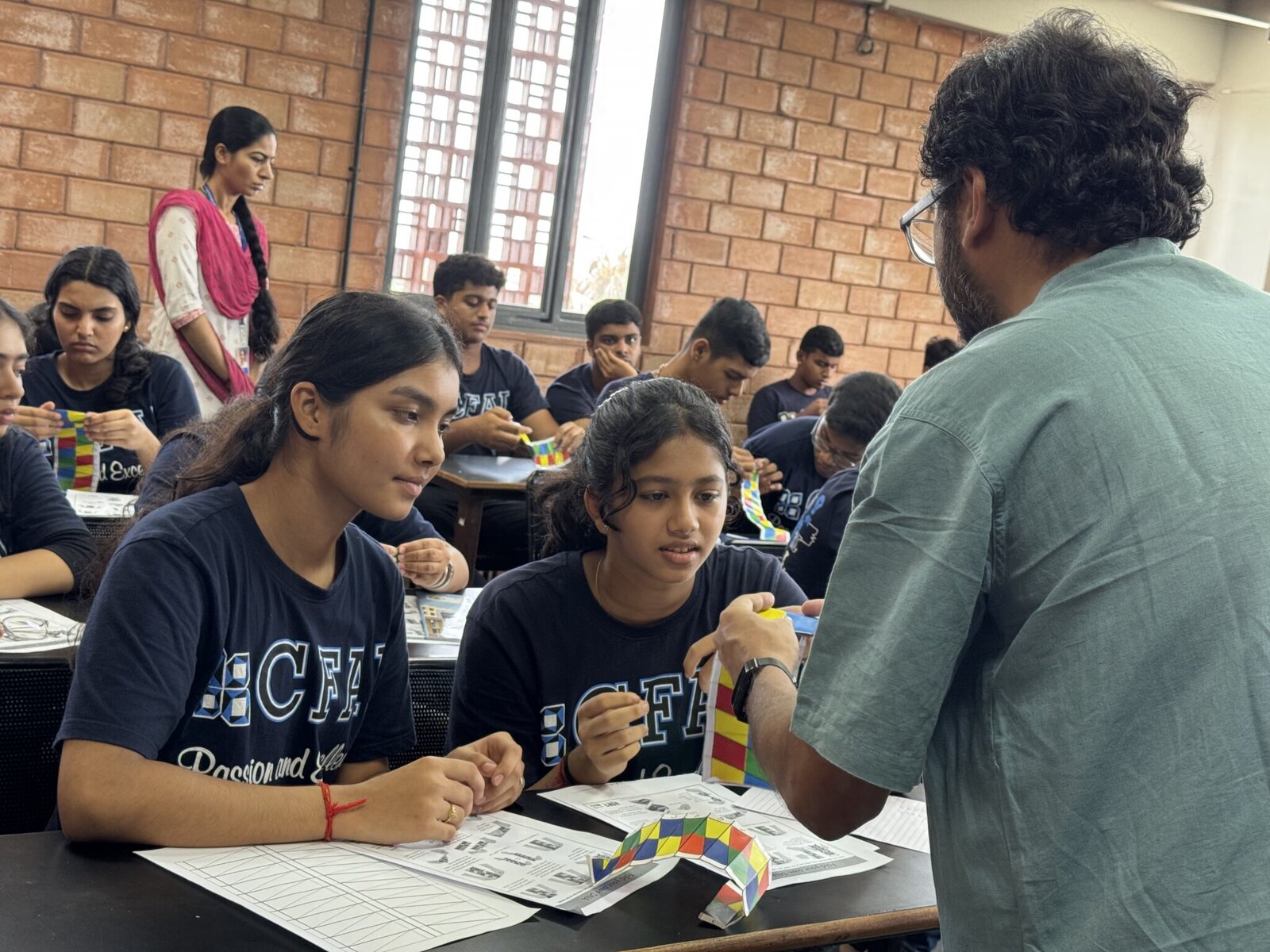
Diptarup Nandi facilitates his session where students used origami to create the double helical DNA structure.
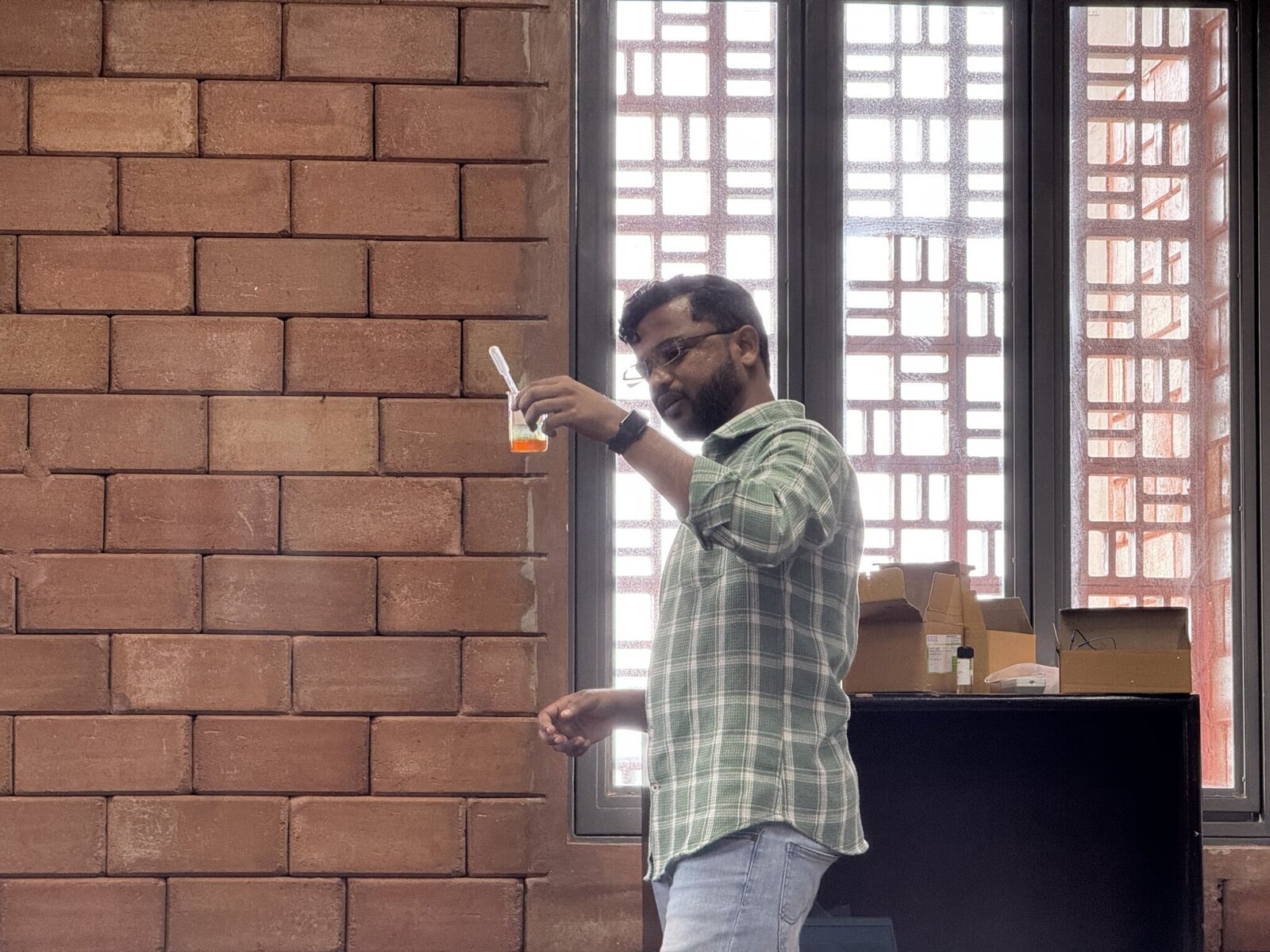
On 14 June 2025, 9 faculty members from Azim Premji University spent the day at Centre for Advanced Learning (CFAL), a high school in Mangaluru. Over the course of the day, over 300 Grade XI students got the opportunity to experience a slew of hands-on workshops covering topics ranging from antibiotic resistance and organic dyes to air pollution and DNA fingerprints. The broad idea of the workshop, according to Srikanta Dani who delivered the orientation speech, was to give these students a glimpse of the university’s approach to teaching.
Srikanta, for example, did this by introducing students to their own fingerprints. Being already familiar with the basics of Mendelian genetics, he found that they tended to correlate every bodily trait, including their finger print to genetics. One of the students, who had an identical twin, was fascinated to find out that they would not share a fingerprint. “Thumb prints provided enough fodder to discuss developmental processes, variation within a sample versus the population,” he said. “I wanted to bring to them a notion of “time and space” and “cumulative effects” of genes and environmental interactions.”
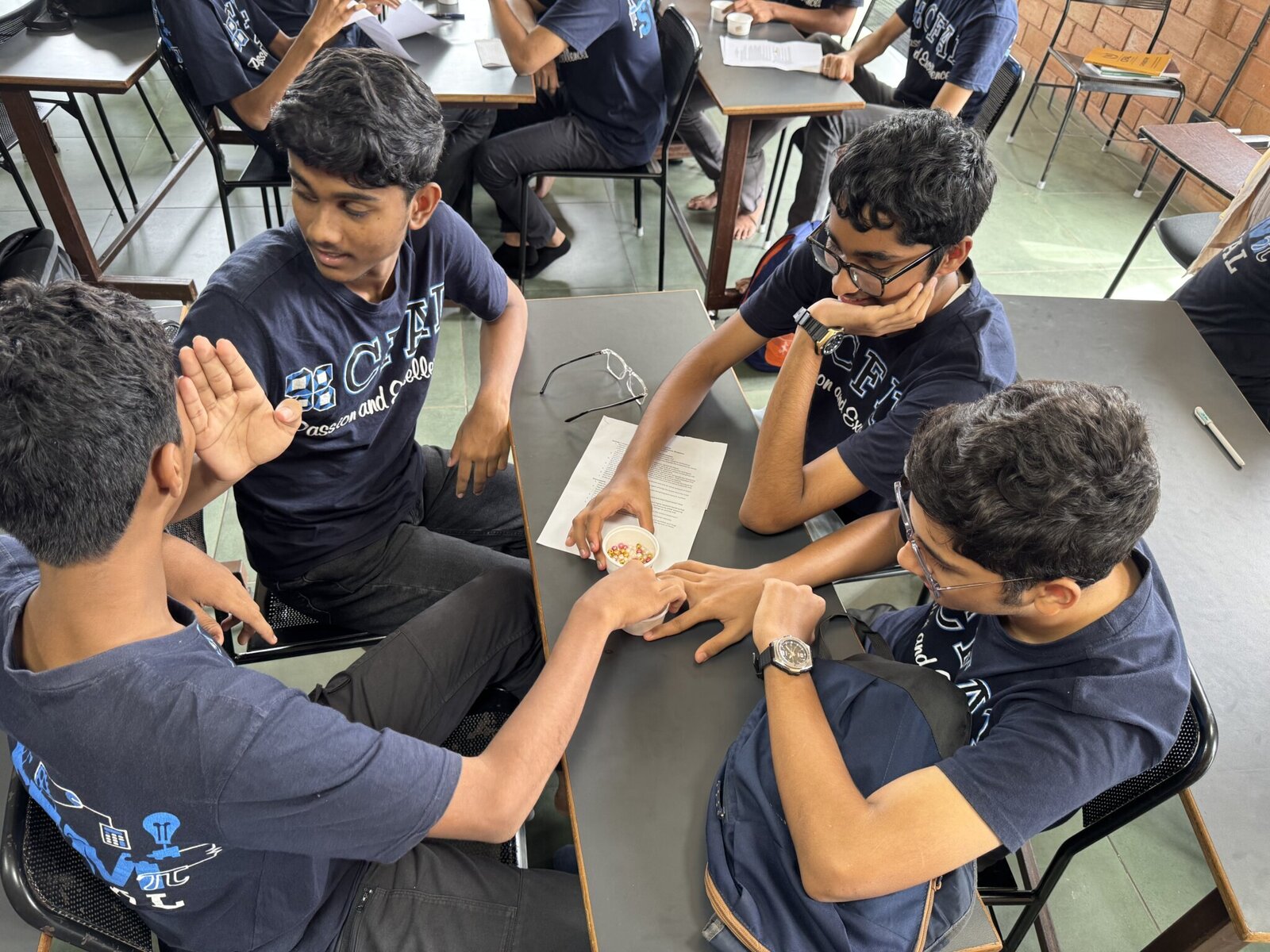
Students huddle in groups while carrying out Beena DB’s activity on antibiotic resistance.
While Srikanta tried to break the eleventh graders away from their formulaic, predictable, and mathematical picture of genetics, in a neighbouring room, his colleague Beena D B was handing out paper cups containing pink, gold and white beads to her batch of students. The teenagers craned their necks and followed her instructions step by step, possibly wondering if they had walked into a craft class by mistake. This was actually a clever activity Beena had devised to convey the emergence of antibiotic-resistant bacteria and its implications for public health.
A rare opportunity
It’s rare for students to be taught complex concepts using actual props to touch and feel, but the effectiveness of this strategy was apparent. Beena was impressed when one student raised their hand to suggest that bacteriophages (a type of virus that kills bacteria) be used to treat illnesses instead of antibiotics. “While the student wasn’t fully aware of the complexities involved in phage therapy, his attempt to connect classroom learning to a real world issue was impressive,” she said. “It’s this kind of inquisitiveness that reminds us why outreach to young minds is so important: it encourages critical thinking and helps them see science as dynamic and problem-solving in nature.”
“While a student wasn’t fully aware of the complexities involved in phage therapy, his attempt to connect classroom learning to a real world issue was impressive. It’s this kind of inquisitiveness that reminds us why outreach to young minds is so important: it encourages critical thinking and helps them see science as dynamic and problem-solving in nature.”
Though researchers and teachers of university students by profession, all the faculty members agreed that occasional exchanges with school children can be immensely beneficial. For Antara Das, it was about giving them an honest idea of what scientific research can look like. During her neuroscience session, she gave them a peek through a microscope at fruit flies, the model organism that she uses in her research into epilepsy and sleep disorders. She was struck to observe that students were linking this new knowledge with their personal experiences of sleep patterns and neurological conditions.
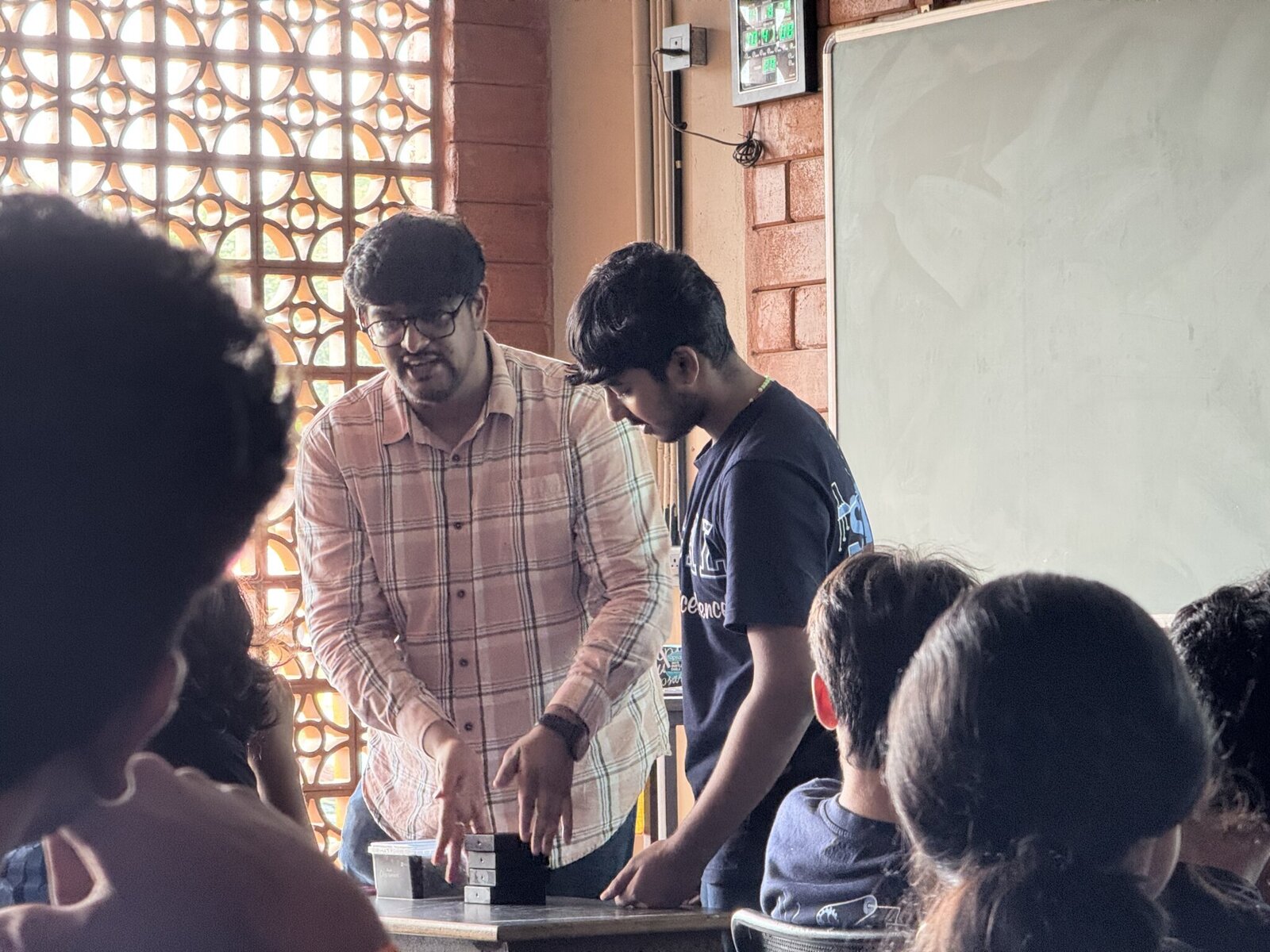
Unfortunately, most schools limit students to a small number of science experiments due to time and resource constraints. Occasional workshops like these become precious opportunities for them to observe something novel. When Akshith S, an academic associate, asked participants about visualising magnetic fields, the high schoolers were quick to invoke the popular iron filings experiment. But what about electric fields? As he expected, this question was met with silence. Akshith proceeded to demonstrate how electric fields could be visualised using rava and castor oil. “This is not a popular experiment, not even at the college level. But they were able to prove that electric fields do exist.”
Bridging the disconnect
Though it’s more evident from the participants’ point of view, the benefits of such outreach extends both ways. Though besotted by his field of evolutionary biology, Diptarup Nandi acknowledges that a life in research can sometimes be restrictive. “Specialised research and focussed courses, even at the undergraduate level, sometimes creates an intellectual disconnect with some of the most fundamental, basic concepts that motivated us to take up research in a particular field,” he said. In contrast, he was exhilarated by the raw excitement of school students. “It also gives us a sense of the changing landscape of school education.”
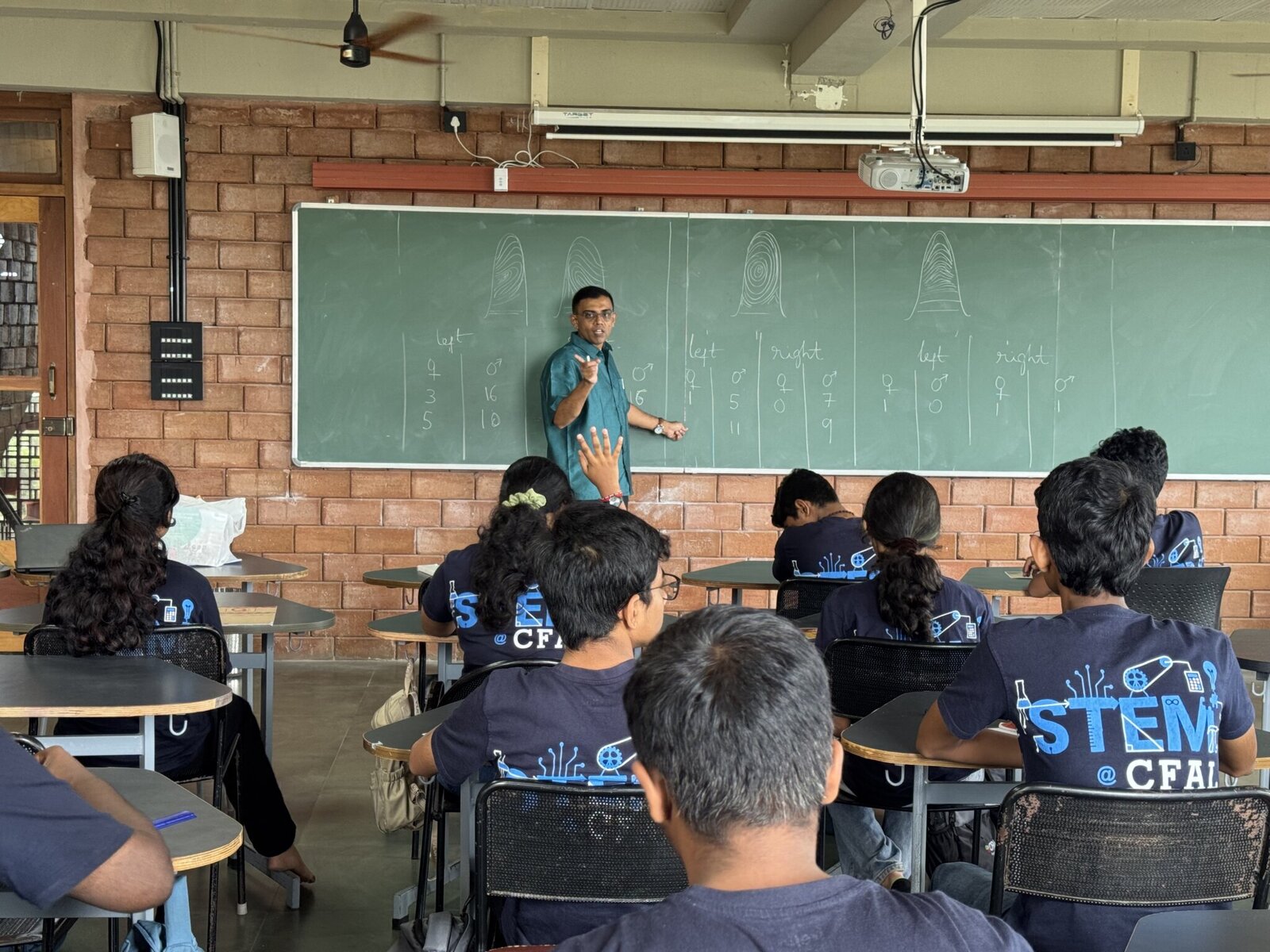
Srikanta Dani in the midst of a classroom-sourced data exercise that he used to discuss fingerprints.
Vignayanandam Muddapu got a taste of this ‘raw excitement’ every time he invited volunteers to demonstrate simple psychological experiments during the workshop. There was a steady supply of boys and girls eager for a chance to attempt the various tests that Vignan conducted to introduce them to concepts in psychology such as short term memory, cognitive conflict, illusions and attention filtering. In an age where high schoolers are oversaturated with engineering and medicine-oriented education, this exposure to psychology must have been refreshing.
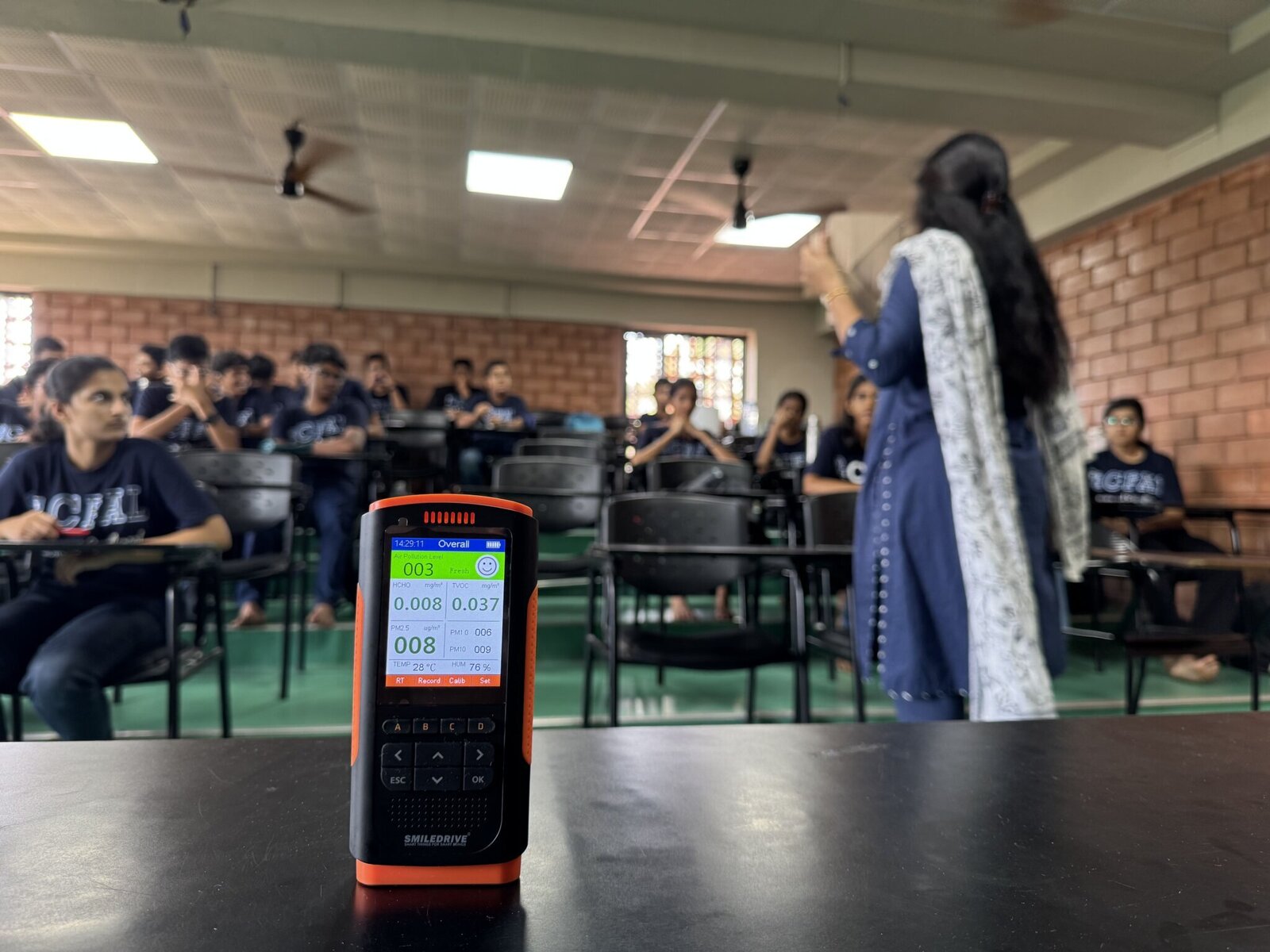
An air quality monitor displays statistics in real time, while Manisha Mishra sparks a dialogue about air pollution with the high schoolers.
The schedule was jam packed and the classrooms got chaotic at times, admitted Prachi Gupta after conducting back-to-back sessions on plant adaptations, involving an interactive card game. Nevertheless, if there’s one thing she took away from the experience, it was that “a bit of controlled chaos is sometimes okay when it leads to active, joyful, and meaningful learning.”
About the members
Antara Das, Beena D B, Diptarup Nandi, Manisha Mishra, Prachi Gupta, R Vignayanandam Muddapu, Sathish C G and Srikanta Dani K G are faculty members at Azim Premji University.
Nandita Jayaraj is a science communicator, journalist, and author and is currently a Communications Consultant at Azim Premji University.
Images by Nandita.