
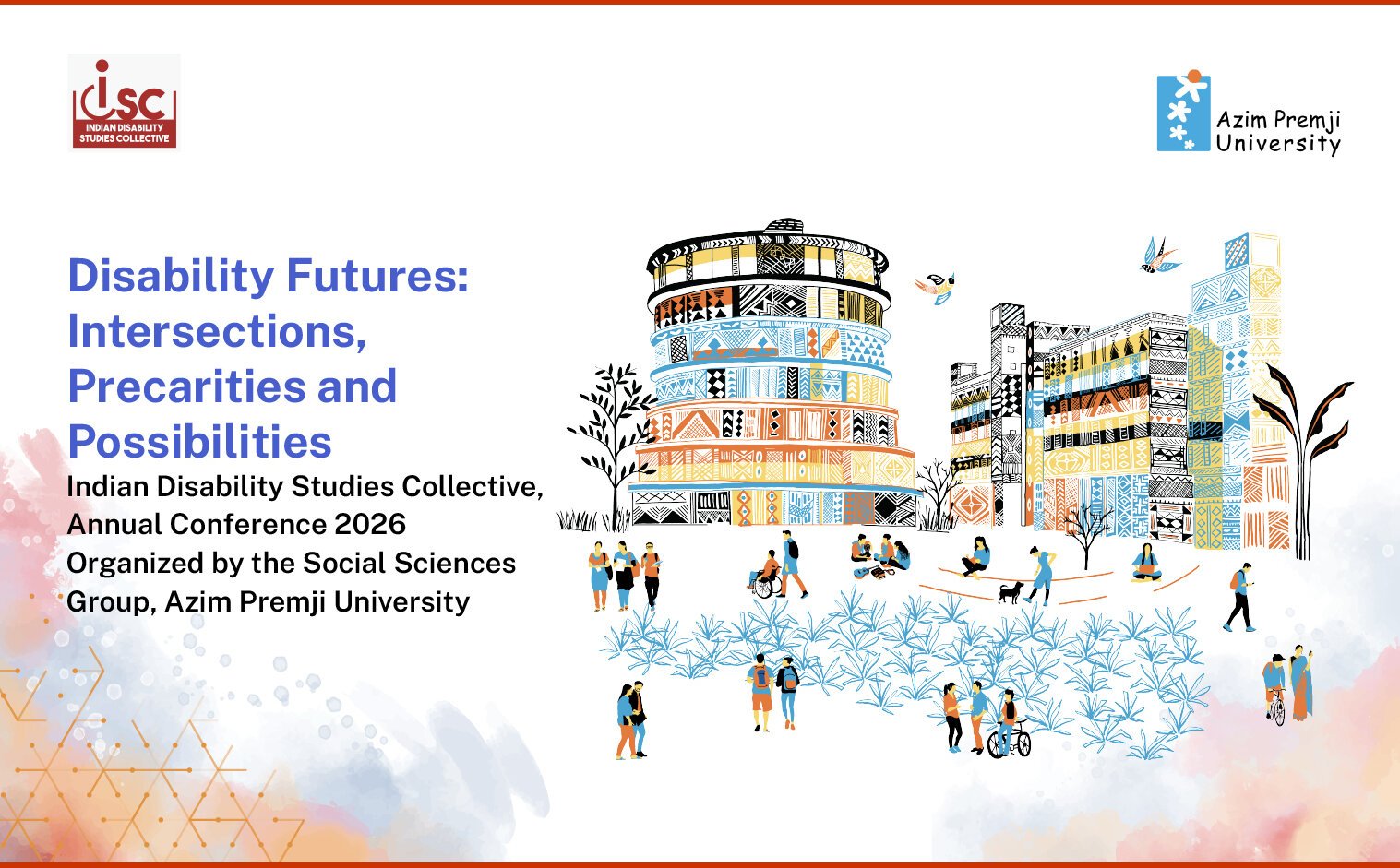
Disability Futures: Intersections, Precarities, and Possibilities
Indian Disability Studies Collective Annual Conference 2026, organised by the Social Science Group, Azim Premji University in association with IDSC to be held at Azim Premji University, Bengaluru
Details
About the conference
In recent decades, disability in India has evolved into a crucial site of social, political, and theoretical engagement. Moving away from the medical model, disability activism and scholarship have embraced the social and political/relational models, which emphasise the role of ableist structures and contextual meanings of impairment. This shift has informed significant legal and policy developments, including India’s ratification of the UNCRPD (2006) and the Rights of Persons with Disabilities Act (2016). Yet, despite such progress, disabled persons — especially from marginalised caste, class, and gender backgrounds — continue to face systemic exclusion and stigma. Inclusion, therefore, remains an ongoing challenge requiring interdisciplinary and intersectional dialogue.
In this socio-political, cultural context, it is important to pay attention to disability futures as it reimagines disability not as a deficit but as a generative site for envisioning alternative worlds and more inclusive social imaginaries. Drawing on crip theory, decolonial perspectives, and intersectional analysis, it asks fundamental questions about whose futures are imagined and valued. While these frameworks expand the horizon of disability politics, they also demand critical attention to material inequities shaped by capitalism, colonialism, and conflict.
The Indian Disability Studies Collective Annual conference, 2026 titled Disability Futures: Intersections, Precarities, and Possibilities seeks to explore these tensions and possibilities, envisioning futures grounded in justice, belonging, and transformative care.
Day 1
Venue: Gurudutt Auditorium
- –
Registration
- –
Opening remarks
Meghana Rao , Azim Premji University
Tony Kurian , Azim Premji University
Inaugural address
Kade Finnoff , Azim Premji University
Someshwar Sati, Indian Disability Studies Collective & Kirori Mal College, University of Delhi
IDSC report and website launch
Arunima Chanda, Indian Disability Studies Collective and Birsa Munda College, University of Delhi
Rimjhim Bhattacherjee, Indian Disability Studies Collective and Udaynarayanpur Madhabilata Mahavidyalaya
- –
Panel 1: Care and Belonging
Chair and discussant: Meghana Rao, Azim Premji University
Tuhisha Ghosh & Stuti Goswami, The Assam Royal Global University; Care, Community, and Emotional Labour in Sarmistha Pritam’s Sun on My Face
Shubha Ranganathan, Indian Institute of Technology, Hyderabad & Bindulakshmi Pattadath, Independent Researcher; The future of autism care in urban India: Of interdependence, personhood, and belonging
Arathi Saleef & Dr Raisun Mathew, Chinmaya Vishwa Vidyapeeth, Deemed to be University; "Relational Futures of Disability: Questioning the Problematization of Singlehood"
- –
Tea break
- –
Panel 2: Disability, Policy, and Practice in India
Chair and discussant: Sanjay Jain, National Law School of India University
Dr Irfan Rasool Najar, Christ Academy Institute of Law and Sneha, Legal Associate, Settle Immigration Inc., Canada; From Legal Inclusion to Administrative Exclusion: Neurodivergent Persons and the Implementation of Disability Reservations in India
Sachu R Sunny, Centre for Development Studies; Evidence on disability prevalence in India disaggregated by caste, gender, age and geography
- –
Lunch break
- –
Panel 3: State Power and Disability
Chair and discussant: Vijay Tiwari, The West Bengal National University of Juridical Sciences
Sachendra Pratap Yadav, Amit Upadhyay & Shilpaa Anand, BITS Pilani, Hyderabad; Move Over Human Rights! Recovering Disability Futures for Half Encountered People
K. K. Prahalad & Nivedita Krishna, Pacta; Governing Disability in Digital India: A Governmentality Analysis of the Unique Disability ID (UDID) System
Rimjhim Bhattacherjee, Udaynarayanpur Madhabilata Mahavidyalaya; Disability Poetics Witnessing Palestine
- –
Tea break
- –
Panel 4: Disability and Cinema
Chair and discussant: Anurima Chanda, Birsa Munda College
Kathiresan G. & Doreswamy, Indian Institute of Science Education and Research, Tirupati; The Thyagi Trope of Disability Representation: Explicating the Discourse of Disability in the Tamil movie Mani Osai (1963)
Ajaykumar Shukla, Jawaharlal Nehru University; Staring at Disability: Production of Ableist in Hindi Cinema from Creation to consumption
- –
Keynote Address: Dr Nandini Ghosh, Institute of Development Studies Kolkata
Tea break
- –
Play: Reunion by First Drop Change Foundation [Ray Auditorium]
Conference dinner
Day 2
Venue: Gurudutt Auditorium
- –
Panel 5: Power, Knowledge, and Critique
Chair and discussant: Shubha Ranganathan, [Indian Institute of Technology Hyderabad
Anubha Anusree, Rajdhani College, University of Delhi, Shilpaa Anand, BITS Pilani, Hyderabad, Akanksha Mehta, University of London, London, *Jiya Pandya, Yale University, & Meghana Rao , Azim Premji University; Critical Caste and Disability Studies: Alignments and Rupture
Vijay Kishor Tiwari, The West Bengal National University of Juridical Sciences; Challenging the Myth of a Caring Constitution: Reflection from Crip Hermeneutics of Suspicion
Neelaksh Pithauria, Independent Scholar; The Politics of Silence: Foucauldian Discursive Analytics as Methodology for Challenging Ableist Knowledge Structures
- –
Parallel Session I (Venue: Gurudutt)
Panel 6A: Access, Art, and Inclusion
Chair and discussant:Bhuvaneshwari. B Azim Premji University, Bengaluru
Shubha Ranganathan, Indian Institute of Technology, Hyderabad; Access beyond accessibility: The story of curating an inclusive art exhibition in India
Dr Radhika Jain, Bejoy Balagopal & Umashankar Veeravalli, First Drop Change Foundation; Playback Theatre as a Participatory Approach to Disability Awareness
- –
Parallel Session I (Venue: Ray)
Panel 6B: Accessibility, Technology, and Pedagogy
Chair and discussant: Shilpa Das, National Institute of Design
Rashmi Malhotra, EnAble India; Re/imagining Deaf CripTechno-Futures: From ‘Technologies for Deaf’ to ‘Technologies by/with Deaf
Shaswata Bandyopadhyay & Ishan Chakraborty, Indian Institute of Technology, Indore; Hands-On Humanities: Tactile Games as Accessible Pedagogical Tools
- –
Tea break
- –
Panel 7: Affective Communities
Chair and discussant: Bindhulakshmi Pattadath, Independent Researcher
Satyabrata Sahoo, Sikkim University; Embodying the Non-Visual Assistive Technologies: Studying the ‘affect’ in the Schools for the Blind
Nandana R., BITS Pilani, Hyderabad; Affective Publics/Affected Publics: Locating Disability in the Novel Enmakaje
Surbhi Nagpal, BITS Pilani, Hyderabad; Mothering Beyond Sight: Shared Responsibilities and Multisensorial Caregiving Practices Among Visually Impaired Women
- –
Lunch break
- –
Parallel Session II (Venue: Gurudutt)
Panel 8A: Inclusive Education: Lived Experiences, Practices, and Futures
Chair and discussant:
Ankur Madan, Azim Premji University, Bengaluru
Titiksha Pradip Rangari, Eklavya Foundation; Becoming, Belonging, and Futures: Lived Experiences of Disability and Inclusive Education - An Autoethnographic Inquiry
Shivpal Chawda, SOITS, Indira Gandhi National Open University; Precarious Futures: Lived Experiences of Disability in Indian Higher Education
- –
Parallel Session II (Venue: Ray)
Panel 8B: Disability, Embodiment, Gender
Chair and discussant: Rimjhim Bhattacherjee, Udaynarayanpur Madhabilata Mahavidyalaya
Sumadhura Roy & Reshma Jose, University of Delhi; Retelling Fairy Tales, Reimagining Disability Futures: A Study of Classic Fairy Tales Rewritten from the Perspective of Disabled Women from India
Barbie Kar, University of Delhi; The Politics of Re-embodiment – Understanding Disability, Corporeality, and Hegemonic Masculinity in Abhishek Anicca’s The Grammar of My Body (2023)
Riya Chawla, Malaviya National Institute of Technology, Jaipur; Echoes of Unfulfilled Desires: Phantoms of Motherhood in Still Born"
- –
Tea break
- –
Final Reflections: Panel Discussion (Gurudutt Auditorium)
Chair: Sanjay Jain, National Law School of India University
Panellists: Someshwar Sati, Indian Disability Studies Collective & Kirori Mal College, University of Delhi
Shilpa Das, Indian Disability Studies Collective & National Institute of Design
Vijay Tiwari, The West Bengal National University of Juridical Sciences
Closing remarks: Chetan S.V., Azim Premji University, Bengaluru
Contact us
You may reach out to us at disabilityfutures2026@gmail.com
The Indian Disability Studies Collective (IDSC) is the academic unit of the Shivam Sati Foundation. As a whole, the Foundation conducts various events to educate and sensitise the different stakeholders of the education system regarding disabilities and disabled persons. The IDSC, within such an agenda, tackles questions and issues of disability at an academic level. The Collective, constituting of members from across Indian universities, wishes to instill an academic culture of studying the socio-cultural and literary impacts of disability as a mode of existence. To achieve the same, the IDSC organises an international interdisciplinary conference every year to allow academic minds from across the globe to come together and initiate a discussion on the pressing issues of disability.
To become a member of the Indian Disability Studies Collective: Please register here: https://docs.google.com/forms/d/1tYQ5hZ4MMyBQi4oktRj4uhbC69ZfBJVdrfgUk0dqPME/edit
To renew your Indian Disability Studies Collective membership, please register here: https://docs.google.com/forms/d/1QObUWdMWW9R7UMW9ZGpGF62gWWUSvwwNhvAgaoLbcBQ/viewform?edit_requested=true