The Biology of Sports and Fitness: Vamshi’s Journey
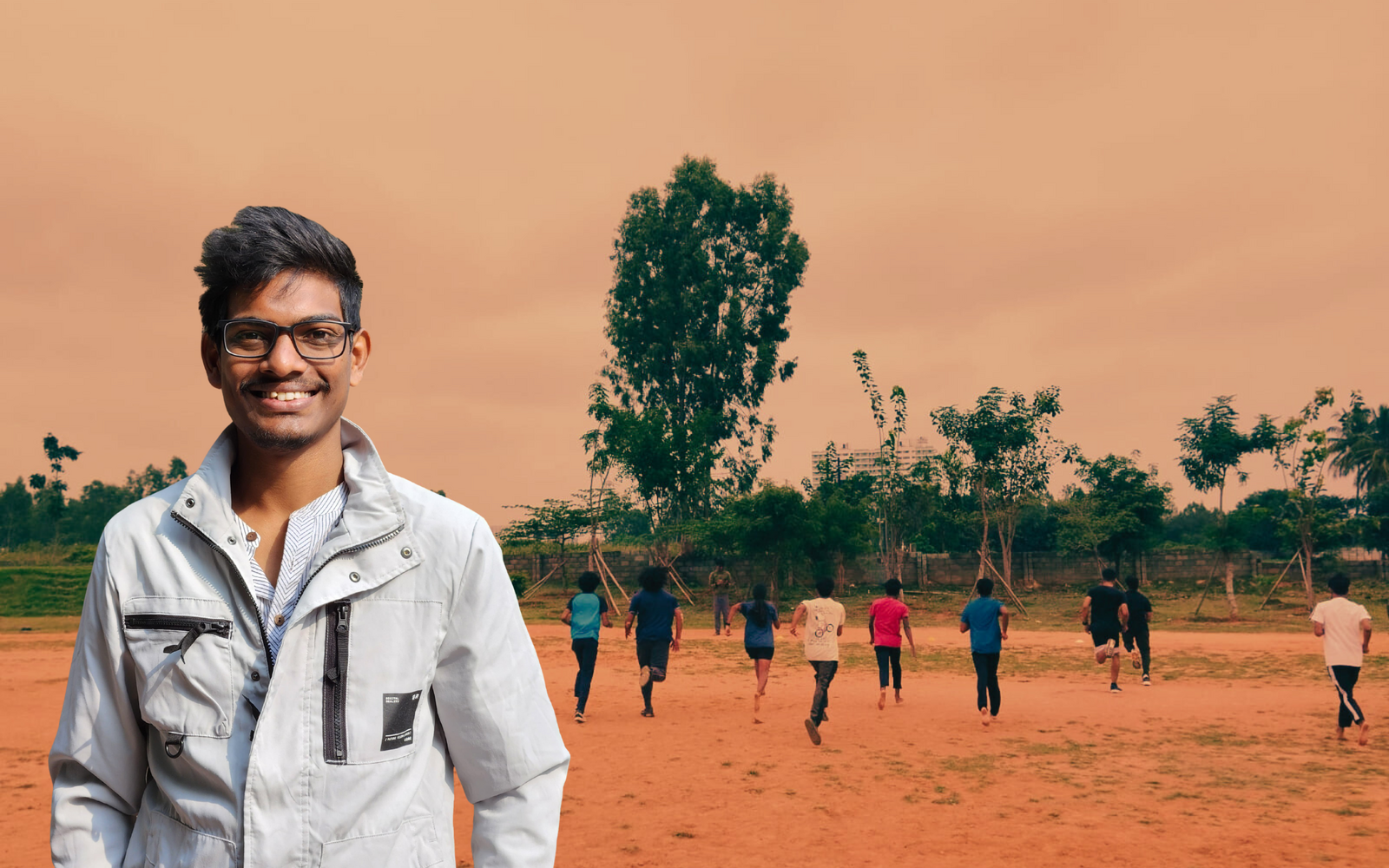
One of the first biology students at the university, Vamshi Gunda (BSc in Biology, 2016 – 19) found love in an unexpected place — sports!
Details
Having graduated with a BSc in Biology in 2019, Gunda Vamshi returned to his alma mater five years later — this time as a faculty member. One of his primary responsibilities was to teach sports and fitness courses to undergraduate students at Azim Premji University. What is a biologist doing teaching sports, one may ask. But all it will take is one visit to Vamshi’s classroom to realise that the ability to perform sports is in fact deeply entwined with human anatomy and physiology. In fact, the first course Vamshi taught after joining was titled ‘Anatomy and Physiology of an Athlete’.
The main idea of the Sports and Fitness Occupational Minor, under which these courses lie, is, according to Vamshi, to attach the practice of sport with theory. “From the beginning, Arvind Bharathi (a sports educator at the university) and I wanted to have courses in sports. Not just the practical aspect of doing sports, but also learning more about what goes on in the body when we do it, and training students to be able to teach courses in sports.” For example, students are taught about various movement skills, how children learn movement, and the skills that are needed to develop athletes. They discuss things like the age at which children should be exposed to competition and specialisation.
It will take just one visit to Vamshi’s classroom to realise that the ability to perform sports is in fact deeply entwined with human anatomy and physiology. In fact, the first course Vamshi taught after joining was titled ‘Anatomy and Physiology of an Athlete’.
The body during exercise
In one class, Vamshi asked his students to practice squats. Rather than focussing solely on form and repetitions, he added a new dimension to the workout by quizzing the students about what exactly they were feeling as they squatted. “A few seconds in, they started to feel strain on parts of their legs and buttocks. Initially, they would not know the names for these muscles but we pause and break it all down,” he says.
The students soon find out that what they are feeling are their gluteal muscles and hamstrings. Vamshi informs them that there are three of each — the gluteus maximus, the gluteus medius, and the gluteus minimus; and the semitendinosus, semimembranosus, and biceps femoris. They discuss what these muscles look like and proceed to try out other exercises that specifically target each one. “In this way, we cover both theory and practice while working out,” explains Vamshi.
This particular session took place in a classroom as it required no props and only body weight. However, many of Vamshi’s classes take place in the gym or on the grounds.
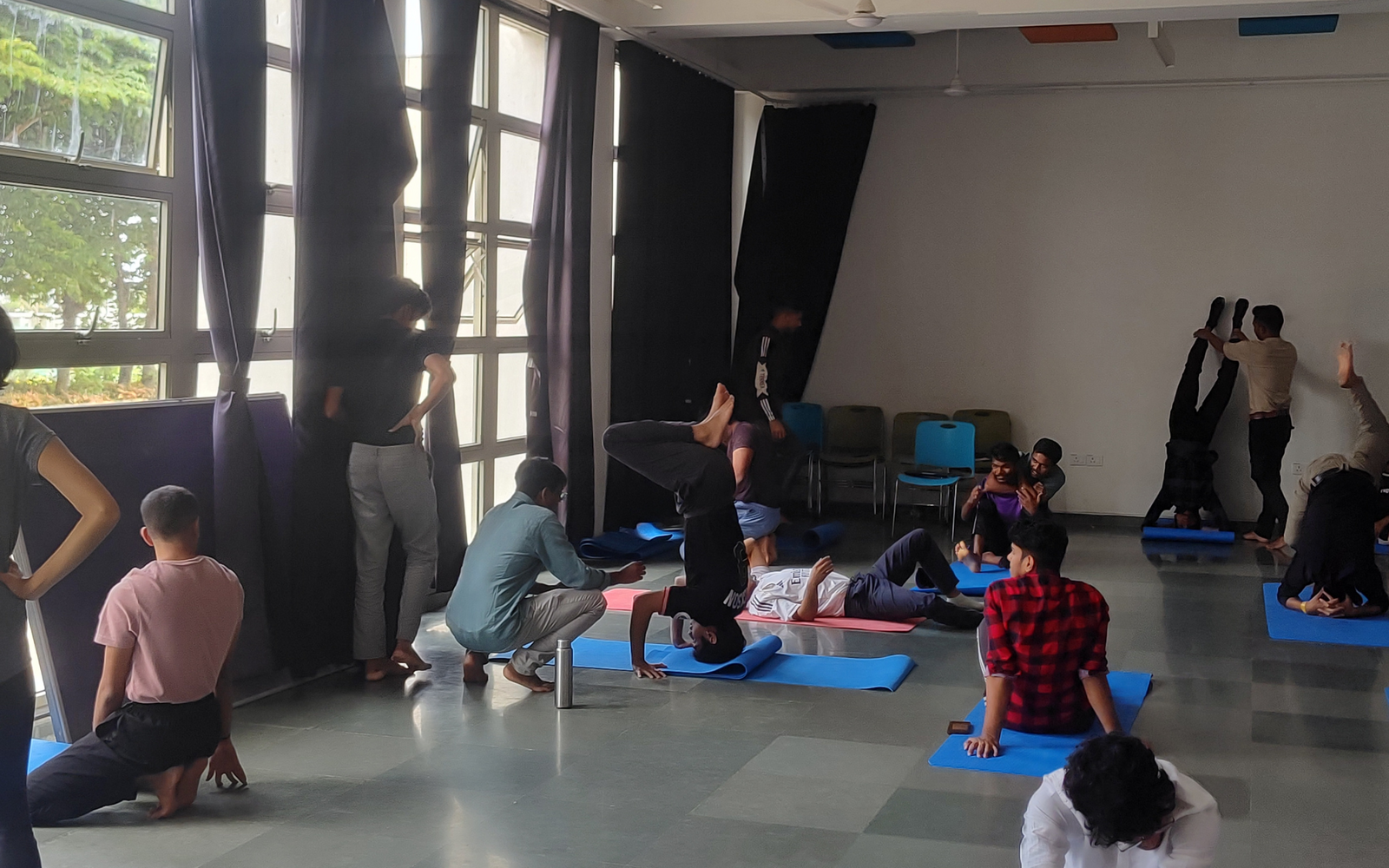
Students learn to do a headstand, as part of one of Vamshi’s practical assessments.
Image credit: Vamshi Gunda
Sometimes, he has to tackle a biological concept that is traditionally taught using a theory-heavy approach, such as the working of the cardiovascular system. Instead of relying on notes and animations on the topic that are available aplenty in libraries and on the internet, Vamshi takes his students to the campus sports grounds. There he conducts something called a beep test, where students run back-and-forth multiple times and time their runs with an audio beep. This is used to measure cardiovascular capacity and endurance, enabling them to connect their running to how the heart functions. “That’s when we go into the theory,” elaborates Vamshi. “We speak about blood flow, the anatomy of the heart, and so on.”
From science to sports
Growing up in Karimnagar in Telangana, Vamshi was always more studious than sporty. It was only when he joined Azim Premji University for his undergraduate studies that he began dabbling in running and organised sports. Most of his friends did, too. Being part of the second batch of undergraduates in a brand new university, students turned to sports as a means to socialise rather than compete. “In the first semester itself, I picked up table-tennis, frisbee and running. It was a way to participate in the community, get to know and interact with others. I liked the feeling of being with people, the team aspect of it,” he recollects. Vamshi began to take sports seriously at the university, and even started coaching others, yet he didn’t imagine that it would be a part of his future at some point. After all, sports had nothing to do with his major (biology) nor his minor (education)… or did it?
It was while studying courses as part of his education minor that he began forming connections between sports and his chosen field. “I was reading about the democratic conception of education, and came across the idea of how sport can be a tool to bring people together,” says Vamshi. Meanwhile, in his biology classes, he was learning more about the body and its working. Intrigued, Vamshi began looking deeper into the various ways biology, education and sports intersected.
By the time he was in his final year, Vamshi was convinced this was the direction he wanted his academic trajectory to take. Unfortunately, he could find no suitable sports sciences or sports physiology programmes in India, and universities offering Master’s in Physical Education (MPEd) programmes demanded that he had a bachelor’s degree in the same field. So Vamshi decided to work at a non-governmental organisation in the sports sector, instead. “There, the emphasis was to teach life skills to children from the fisher community in Chennai, via frisbee. I started getting exposure teaching sports to children, and on the side, also began playing with frisbee club teams at a more elite level,” he said. These experiences honed Vamshi’s interest in sports performance (studying biology to improve performance) and sports pedagogy (the different elements that go into teaching a sport).
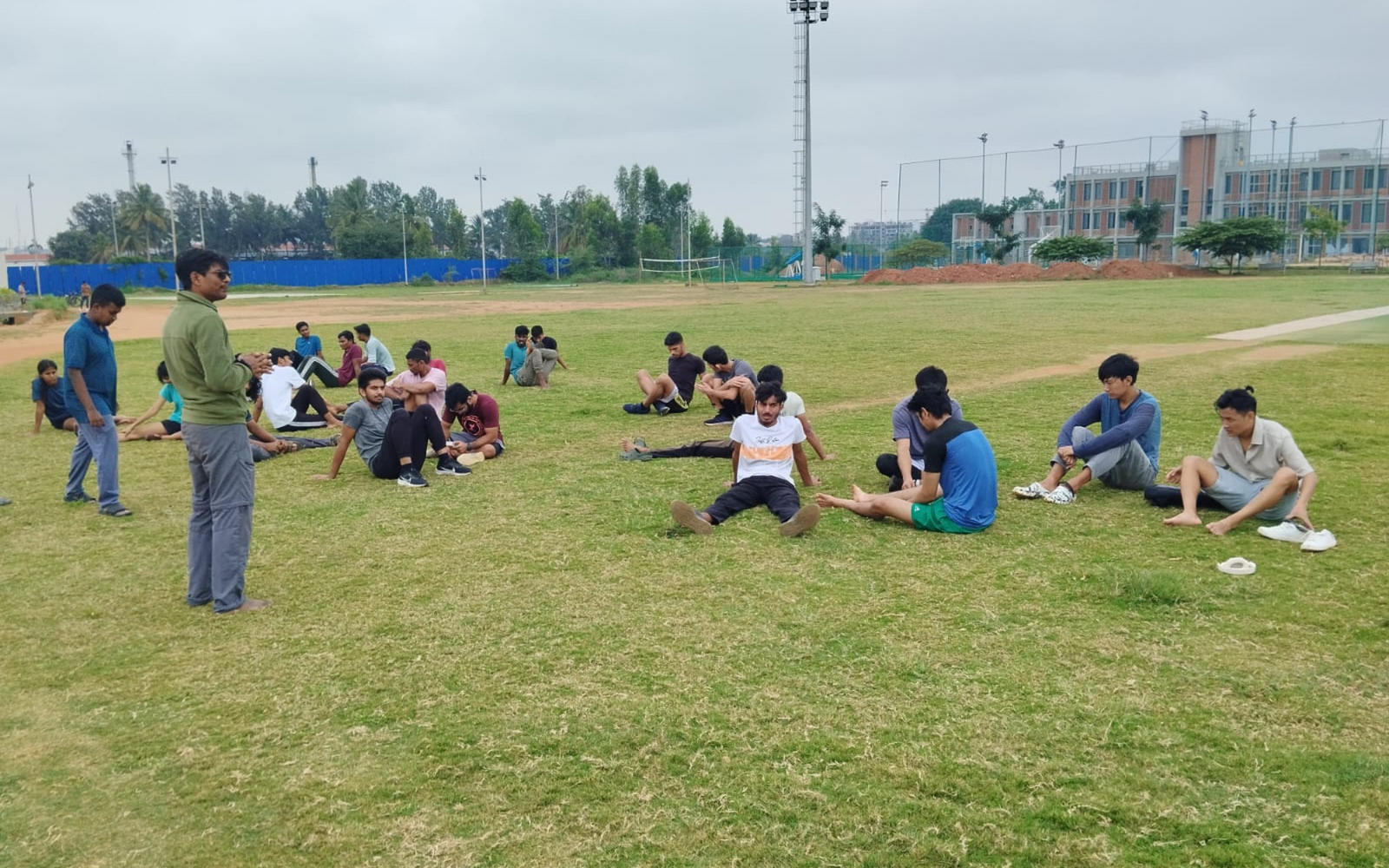
Vamshi briefs students as they recover from a series of runs that are part of a session about the role of energy systems in physical activity.
Image credit: Manoj
Gathering expertise
His pursuit for a master’s in sports science continued, and this time he expanded his search to universities abroad. Multiple universities accepted his application, but Vamshi was unable to proceed because of visa denials. Complicating matters was the pandemic, which was making it incredibly difficult to consider travelling. So when he heard that Guru Nanak Dev University (GNDU), Amritsar offered an MSc in Exercise and Sports Physiology, he jumped at the opportunity to enrol.
As it turned out, Vamshi felt totally at home there. “It never felt like I left biology, because I was studying physiology, which is a part of biology, right? I learnt about the effects of different physiological systems, how climate affects physiology, sports physiotherapy and psychology,” he says. His thesis explored the effect of strength training and endurance training on post-activation potentiation. As soon as he graduated, he returned to Azim Premji University to put into practice all he had been studying — surely, a full circle moment in the life of this young sports educator.
“You don’t have to have experience playing sports to take up these courses. All they need is to have studied science up to Grade VIII or IX. We learn everything from scratch.”
Now on the other side of the classroom, Vamshi keenly observes how his students are taking to the sports courses being offered as part of the Sports and Fitness minor. “You don’t have to have experience playing sports to take up these courses. All they need is to have studied science up to Grade VIII or IX. We learn everything from scratch,” he reassures.
Universities and sports
The minor has become quite popular, to the relief of Vamshi, Arvind and Dhruva Desai, who currently run the occupational minor. While some students are already fitness enthusiasts, others have consciously chosen to incorporate more physical activity in their lives. In terms of gender, Vamshi does not see a major gender gap, but he does believe that girls and women receive less exposure to sports and are sometimes discouraged by the idea that men are physically stronger. “Sometimes it’s a barrier for them, but when they actually attend the classes, they realise that even boys are more or less on the same level,” he observed.
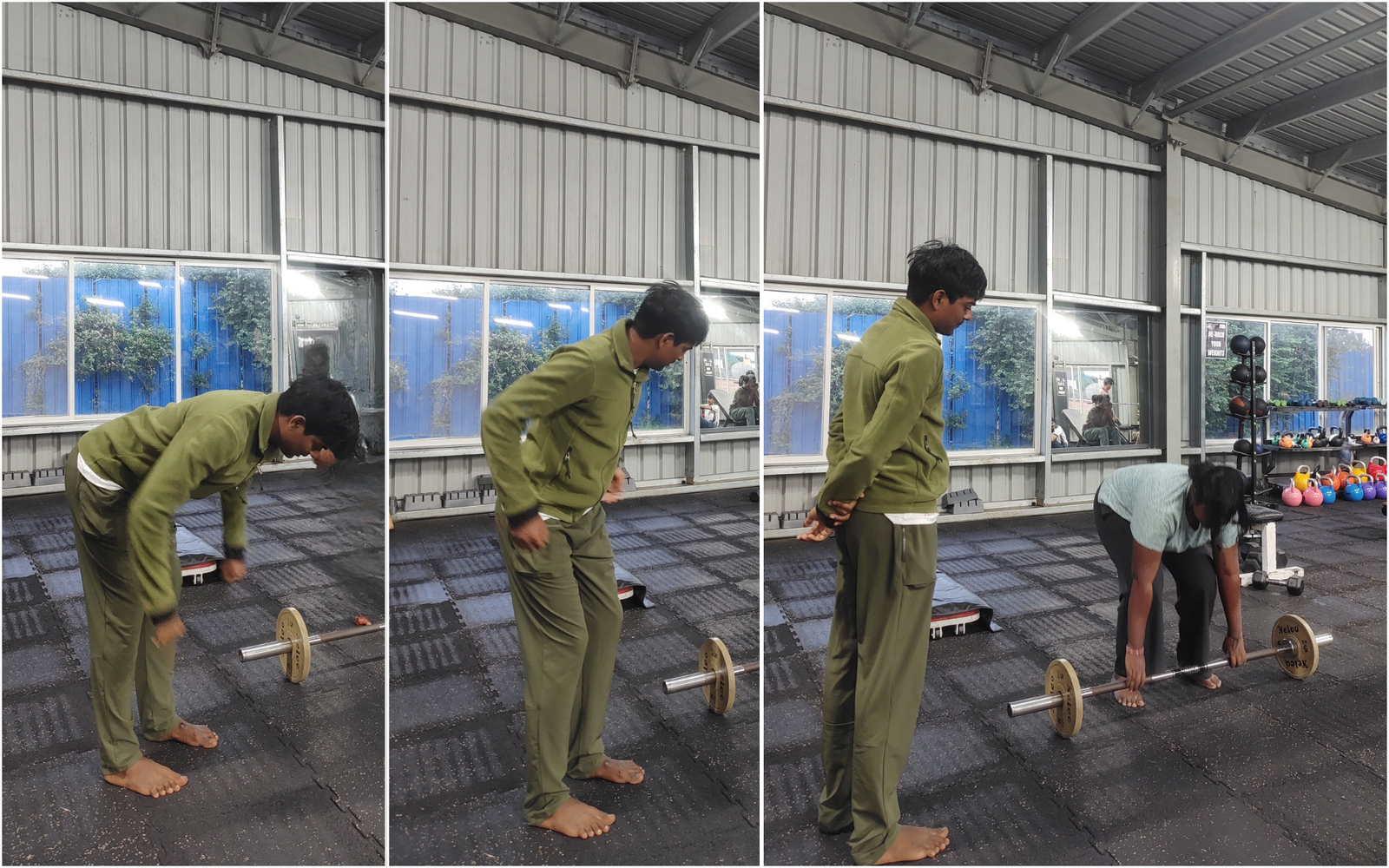
Vamshi corrects a student’s posture as she performs barbell rows.
Image credit: Student
With time, Vamshi is growing more and more convinced about the critical importance of sports in a university ecosystem. A few may excel in competitions, but even if not, it is bound to keep most mentally and physically fit. Perhaps for a section of students, sports may even help draw connections with their own chosen majors and research. But the first and foremost role of sports, at least for Vamshi, is to bring people together.
That said, as the university scales up in size and population, Vamshi has realised that it takes work to make sure sports continues to foster community in the way it did back when he was a student. “It’s very tricky because just as sports has the power to bring people together, it can also divide them. I have seen myself that sometimes, groups that start playing a sport become more exclusive with time, especially when the competition becomes more intense. Sometimes, the divides can become difficult to bridge,” he admitted. “For this, we need multiple systems actively pushing them to be together.”
Looking ahead
“Anatomy and Physiology of an Athlete” is just one of the courses in the minor that Arvind and Vamshi have designed. Others include “Embodied Learning” where students will delve into the idea of bodily intelligence, “Advanced Practice — Strength and Conditioning” and “Building Communities Through Team Sports”. While the curriculum is all set, Vamshi, Arvind and Dhruva anticipate that they will need to continuously refine and tighten aspects of it. Firstly, they will be keeping an eye on the theory-practice balance and making sure it’s optimal. “We want to pitch these courses to students at a level where they are feeling challenged. It shouldn’t be so easy that they lose focus.”
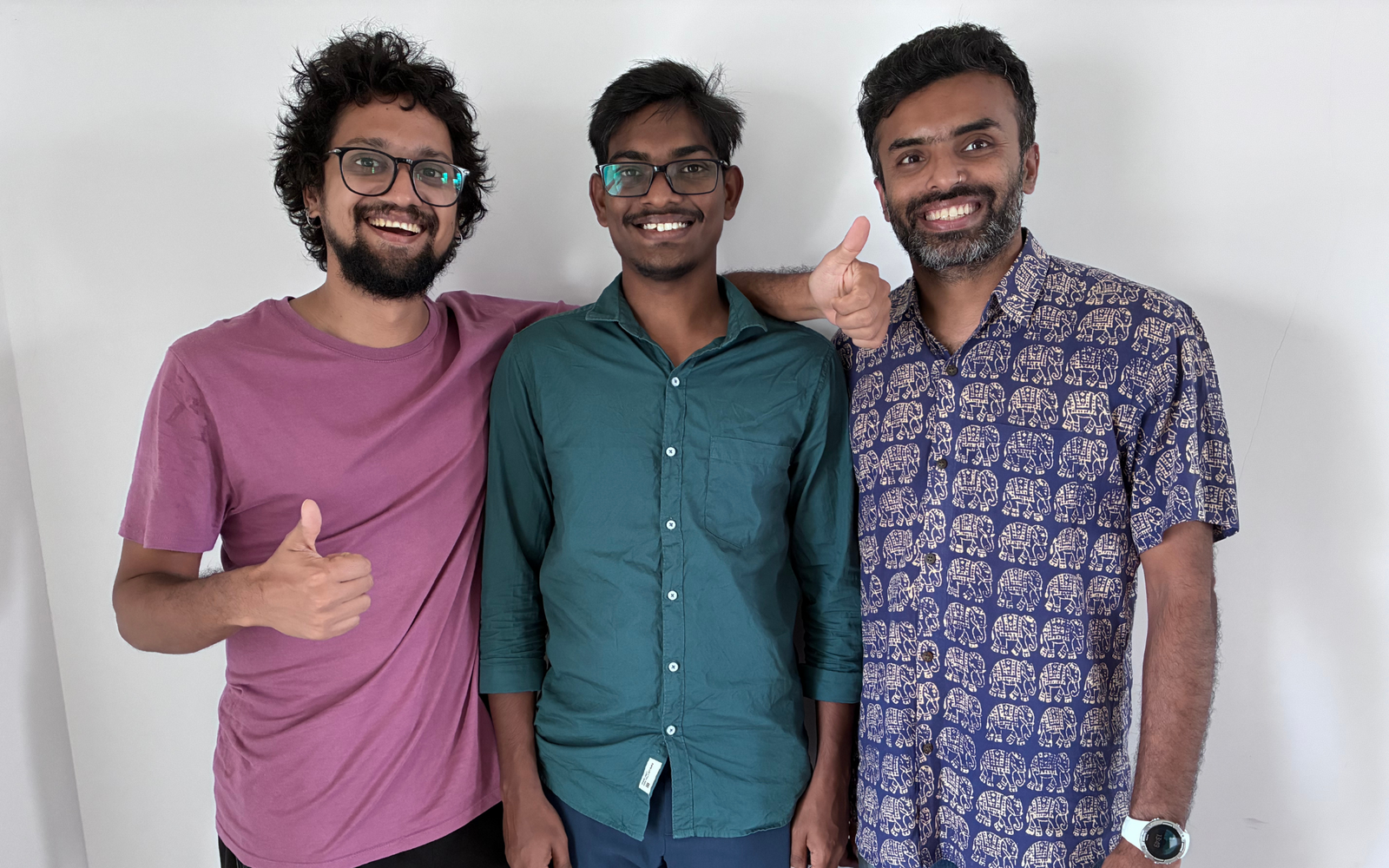
Dhruva Desai, Vamshi Gunda and Arvind Bharathi work together on the Sports and Fitness occupational minor.
Image credit: Saurabh Singanapalli
Has years of studying sports changed the way he performs sports? “Definitely!” Vamshi laughed. “On one hand, I am thinking too much before I do sports… so much that I wonder if I should stop thinking so much!” On the other hand, the deeper understanding he has cultivated now enables him to help others who are starting out. “Now I don’t just have questions, I have some answers too! That satisfies me.”
About the author
Nandita Jayaraj is a Science writer and Communications Consultant at Azim Premji University.