
Publications & Resources
Our faculty, students and researchers work together everyday to contribute to a better world by grappling with urgent problems we are facing in India. We conduct rigorous work to produce high quality learning resources and publications to contribute to public discourse and social change. Here, we feature a sample from our work for everyone to access. You can explore featured resources, policies, and the latest publications from the University.
To explore all the work of our University, please visit our publications repository.
Article
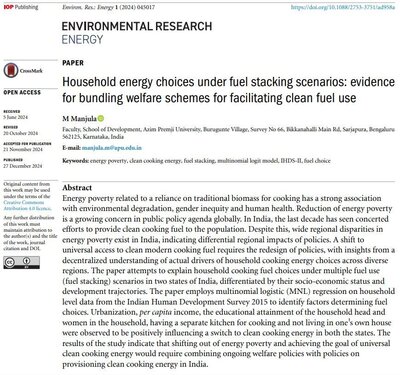
Household energy choices under fuel stacking scenarios: evidence for bundling welfare schemes for facilitating clean fuel use
in IOP Publishing Ltd

- Published
- Authors
Abstract
Energy poverty related to a reliance on traditional biomass for cooking has a strong association with environmental degradation, gender inequity and human health. Reduction of energy poverty is a growing concern in public policy agenda globally. In India, the last decade has seen concerted efforts to provide clean cooking fuel to the population. Despite this, wide regional disparities in energy poverty exist in India, indicating differential regional impacts of policies. A shift to universal access to clean modern cooking fuel requires the redesign of policies, with insights from a decentralized understanding of actual drivers of household cooking energy choices across diverse regions. The paper attempts to explain household cooking fuel choices under multiple fuel use (fuel stacking) scenarios in two states of India, differentiated by their socio-economic status and development trajectories. The paper employs multinomial logistic (MNL) regression on household level data from the Indian Human Development Survey 2015 to identify factors determining fuel choices. Urbanization, per capita income, the educational attainment of the household head and women in the household, having a separate kitchen for cooking and not living in one’s own house were observed to be positively influencing a switch to clean cooking energy in both the states. The results of the study indicate that shifting out of energy poverty and achieving the goal of universal clean cooking energy would require combining ongoing welfare policies with policies on provisioning clean cooking energy in India.
Authors: M Manjula
Links
Article
Delivering Affordable Nutrition Security through Fish: Evidence from a Rural Village in Telangana
in Indian Journal of Agricultural Economics
Article
- Published
- Authors
- School of Development
Abstract
The study explores the role of fish consumption in addressing nutrition security and malnutrition in a rural village in Telangana, India. It highlights that fish, particularly small indigenous species, provide affordable, high-quality protein and micronutrients. The study compares fish with other protein sources like poultry and livestock, finding that fish consumption significantly meets the nutritional needs of the rural population more effectively than other animal sources. India, despite being the third-largest fish producer globally, still faces challenges with malnutrition, especially among children and women. National Family Health Survey (NFHS) reports show alarming rates of stunting, wasting, and anemia, particularly in Telangana. The study demonstrates how increased fish consumption can play a crucial role in reducing these malnutrition rates by offering a cost-effective and nutrient-dense food source. The state government has encouraged fish production in Telangana through subsidies and initiatives like Pradhan Mantri Matsya Sampada Yojana. However, the research suggests that the fish distribution infrastructure needs significant improvement to increase access to fish for the broader population. The paper concludes that promoting fish consumption can be a viable strategy to combat malnutrition, improve food security, and provide economic opportunities for rural communities. Policy recommendations include enhancing market infrastructure, increasing fish production through scientific aquaculture, and raising awareness about the nutritional benefits of fish. These measures could ensure that fish contributes more significantly to achieving Sustainable Development Goals (SDG) related to hunger and malnutrition.
Authors: Gummadi Sridevi, Amalendu Jyotishi, Balaji Patturi, Matta Srinivas
Article
Impact of Interventions Supporting Girls’ Education on Early Marriage, Pregnancy and Work Participation: Evidence Synthesis
in Indian Journal of Human Development
Article
- Published
- Authors
- Mukta Gundi
- Radhika Dayal
Abstract
This article synthesises the evidence on the impact of interventions supporting adolescent girls’ and young women’s education on delaying marriage, childbearing and improving work participation. A total of 13 studies (eight from sub-Saharan Africa and five from South Asia) during the years 2000 – 2020 met our inclusion criteria. A major focus of the included studies was to reduce the schooling cost, with limited focus on strategies such as supplementary coaching, making schools girl-friendly, monitoring performance and sensitising communities about educating girls. Most studies that measured the effects on marriage and childbearing showed a positive impact. However, interventions were less successful in influencing work participation. Although a majority of studies reported positive effects on educational outcomes, fewer measured or reported positive effects on other social and health outcomes. This evidence synthesis suggests a need for studying long-term effects of such interventions on girls’ and women’s families, work and social life to inform policy. Studies that explore the varying impacts of such interventions on girls and women from different sociocultural settings are needed. Our evidence synthesis underscores the importance of making comprehensive efforts to support girls’ education in order to meet the global development commitments of ensuring equitable life opportunities for adolescent girls and young women.
Links
Article
Reflections on the Design and Application of ‘Surveypura’: A Simulation-Based Pedagogical Tool for Quantitative Research Methods in Public Health and Social Sciences
in BMC Advances in Simulation, Springer Nature

- Published
- Authors
Abstract
It has been reported from various contexts that learning quantitative methods for public health and social research is challenging for students. Based on our observations of these challenges, we designed a simulation-based pedagogical tool called Surveypura to support classroom-based learning of quantitative research methods. The tool includes a large illustration of a fictional village with 155 houses, alongside data for each of the households. The features of the houses, household characteristics, and the village have been carefully designed to give the visual feel of an actual village and better assist the pedagogical process. The tool was used by five facilitators with their master’s students at Azim Premji University in courses on social research and epidemiology. Our observations of the sessions and interactions with facilitators and students suggested that the tool supported more engaged learning of quantitative research methods in a non-intimidating manner. We believe that Surveypura can be a useful simulation-based pedagogical tool to teach quantitative research methods in epidemiology and social sciences even in other contexts.
Explore more here.