
P. S. Lokanathan
Early development economist and diplomat
By K Jothi Sivagnanam
Details
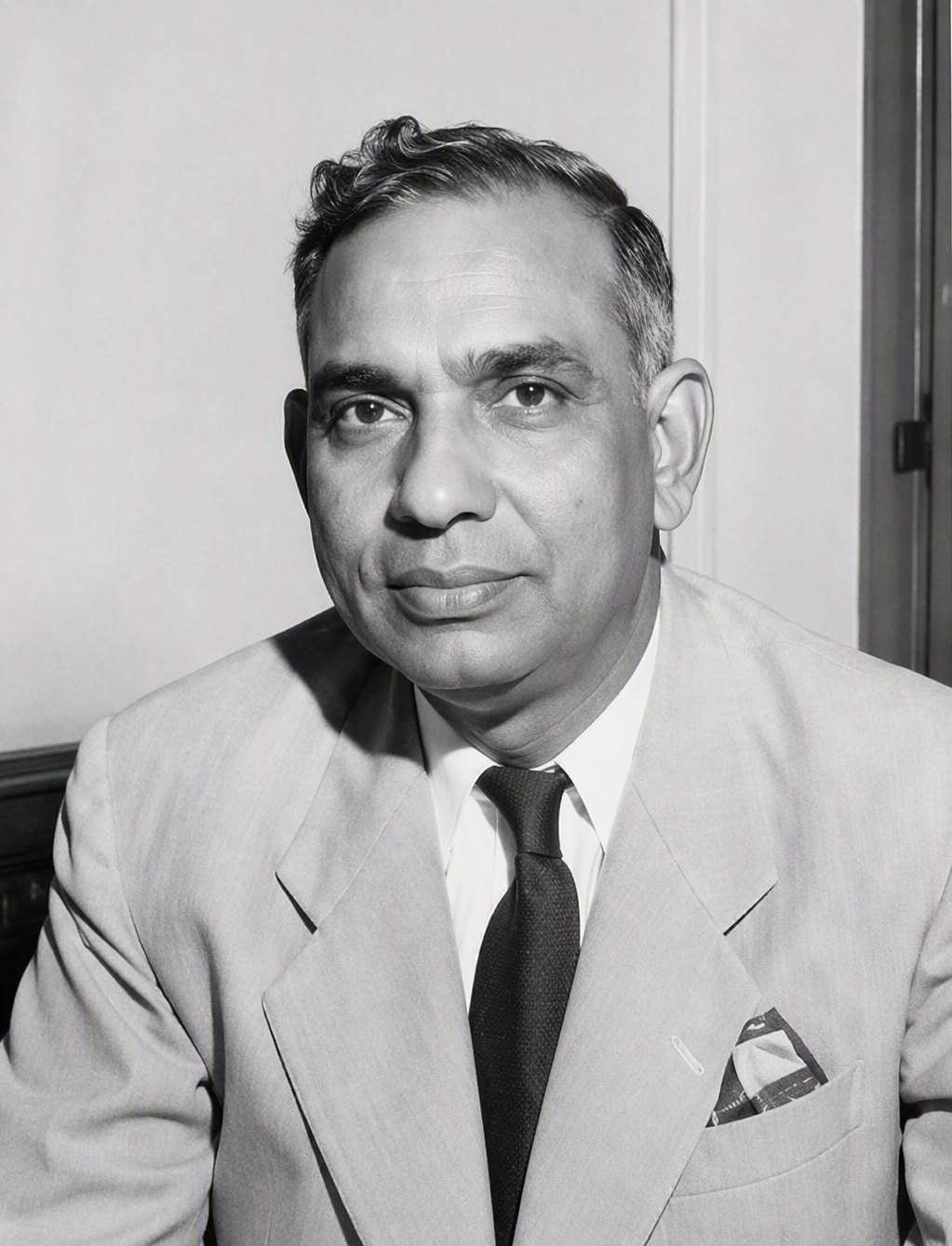
No account of Indian economic thought in the first half of the twentieth century is complete without Palamadai Subramania Lokanathan (1899 – 1970). A pioneering economist, scholar, journalist, and institution builder, Lokanathan straddled diverse domains — academia, financial journalism, international diplomacy, and national policymaking.
Lokanathan was born in 1899 into a middle-class Tamil family with a strong tradition of learning. His early education at St. Joseph’s College in Tiruchirappalli introduced him to the humanities and social sciences. From there, he proceeded to the University of Madras, where the newly established Department of Indian Economics (1915) under Gilbert Slater was pioneering empirical research on agrarian conditions, poverty, and labour.
Working under Slater left an indelible mark on Lokanathan’s intellectual formation. Slater had introduced fieldwork into Indian economics education, sending his students to their own villages of South India to document living standards, caste structures, and agrarian relations. Lokanathan participated in these studies by visiting his own village in Tirunelveli District, gaining first-hand experience of the economic realities of rural India. These formative encounters helped shape his lifelong commitment to connecting economics with social and policy relevance.
Seeking to broaden his intellectual horizons, Lokanathan enrolled in the London School of Economics where he was exposed to debates on welfare economics, institutional economics, and economic development as well as to alternative perspectives on colonialism, socialism, and the role of the state in the economy. Returning to India in 1927, he joined the University of Madras as Reader in Indian Economics, marking the beginning of a distinguished academic and professional career.
Lokanathan’s books integrated a strong empirical orientation with normative concerns about welfare, justice, and national development. Each of his works emerged at critical moments in India’s economic and political history, responding to pressing problems of labour, industry, and development.
Appearing on the eve of the Great Depression, Industrial Welfare in India was one of the earliest attempts to systematically study the conditions of Indian workers in modern industries. Lokanathan’s own scholarly trajectory focused on industrial labour and organisation, yet his work echoed Slater’s ethical concerns. He documented the lack of basic amenities in industrial centres: overcrowded housing, unsafe working environments, poor sanitation, lack of healthcare, and exploitative wage practices. He paid particular attention to the prevalence of child labour and the absence of educational opportunities for workers’ families.
In contrast to colonial administrators and economists of the time — such as Vera Anstey — who attributed India’s low industrial productivity to supposed cultural deficiencies in the labour force (lack of spatial mobility, indiscipline, and backwardness), Lokanathan argued that the structural neglect of labour welfare and exploitative practices undermined productivity and human potential. His analysis inverted colonial stereotypes, demonstrating that workers’ hardships were the product of systemic exploitation and policy failure.
This reframing positioned labour welfare both as a moral imperative and an economic necessity — essential for improving productivity and enabling industrial development. It also set the tone for subsequent debates on productivity and state regulation.
By the mid-1930s, with the Great Depression deepening, Lokanathan shifted focus to the structure of industries in colonial India. In Industrial Organisation in India, he highlighted the dominance of foreign capital, the weakness of indigenous entrepreneurship, and the absence of institutional mechanisms to coordinate industrial activity. He pointed out how British economic policies restricted Indian initiative and created a fragmented industrial landscape marked by dualism — modern enclaves alongside stagnant traditional sectors. Published amid growing nationalist calls for self-reliance and protective tariffs, Industrial Organisation in India lent scholarly weight to the swadeshi movement, advocating state intervention to strengthen indigenous industry.
In India’s Post-War Reconstruction and its International Aspects, he turned to the looming task of rebuilding India after the war, stressing the role of international cooperation and institutions. His contributions laid the intellectual groundwork for post-Independence planning and state lead development.
Lokanathan’s prominence is further evidenced by his inclusion in J. Krishnamurty’s Towards Development Economics: Indian Contributions 1900 – 1945 which “showcases Indian contributions to development economics, well before the subject became a major part of mainstream economics in the UK and the US.” Highlighting thirteen leading economists, including B. P. Adarkar, B. R. Ambedkar, V. K. R. V. Rao, and Radhakamal Mukharjee, the collection features two scholars from the University of Madras’s Department of Economics: P. J. Thomas and P. S. Lokanathan. Their work, Krishnamurty argues, addressed developmental issues with “striking relevance to contemporary economic challenges,” cementing Lokanathan’s role in shaping a distinctly Indian approach to economic thought.
Beyond academia, Lokanathan emerged as one of India’s first financial journalists. In 1943, he founded the Eastern Economist, a journal dedicated to economic analysis and policy debate, and served as its editor until 1947. He subsequently became editor of the Hindustan Times, where he used his platform to analyse wartime inflation, taxation, shortages, defence production, and the challenges of post-war recovery.
Through these writings, Lokanathan reached a wider audience, translating complex economic issues into accessible language. His clear-headed analysis earned Prime Minister Jawaharlal Nehru’s trust, reflecting his ability to translate nationalist economic ideals into practical policy advice. In this role, Lokanathan exemplified A.C. Pigou’s dictum that economics should be both “light bearing” and “fruit bearing” — offering insights as well as solutions.
Lokanathan’s career took an international turn after World War II, when he was appointed the first Executive Secretary of the United Nations Economic Commission for Asia and the Far East (ECAFE) in 1946. He served in this position until 1956, overseeing a crucial decade in Asia’s post-war recovery.
At ECAFE, Lokanathan promoted regional cooperation, data collection, and policy exchange. One of his most notable interventions was his role in Japan’s admission to ECAFE in 1952. Despite procedural obstacles, he recognised the importance of reintegrating Japan into Asia’s economic framework and acted decisively to support its application. Scholars such as Lim (2013) have emphasised how Lokanathan’s initiative helped facilitate Japan’s post-war return to Asia, underscoring his vision of regional development.
Lokanathan’s decade at ECAFE foreshadowed later regional frameworks such as the United Nations Economic and Social Commission for Asia and the Pacific (ESCAP) and the Association of Southeast Asian Nations (ASEAN). His work demonstrated the potential of international institutions to promote dialogue and cooperation in a fragmented post-colonial world.
Lokanathan’s institutional legacy spans the Reserve Bank of India, the Planning Commission, and the Madras Labour Union. His role in shaping labour policy was not bureaucratic — it was visionary. He believed that institutions must reflect the lived realities of workers, a belief likely seeded during his formative years under Slater’s tutelage.
At the National Council of Applied Economic Research (NCAER), which he helped establish in 1956 and led as its first Director-General, Lokanathan built India’s capacity for empirical research. Under his leadership, NCAER undertook techno-economic surveys across Indian states, generating critical data for the formulation of India’s early Five-Year Plans.
Beyond national boundaries, Lokanathan’s expertise was sought across Asia. He chaired the National Productivity Council (1958 – 66), represented India at the Asia Productivity Organization in Tokyo, and advised planning institutions in Cairo, Bangkok, and elsewhere. He was also a member of the Planning Commission’s panel of economists, the Export-Import Advisory Council, and the National Savings Advisory Board.
Lokanathan’s wide-ranging contributions were recognised by numerous honours. He was elected an Honorary Fellow of the London School of Economics and was awarded the “Most Noble Order of the Crown of Thailand” by King Bhumibol Adulyadej for his services at ECAFE — an unusual honour for a UN official.
At the Golden Jubilee celebrations of NCAER, Prime Minister Manmohan Singh remembered Lokanathan with admiration, emphasising his role in linking economics to social purpose. Singh quoted A.C. Pigou to capture Lokanathan’s legacy:
“I knew Dr. P. S. Lokanathan when he came back from ECAFE Secretariat and took over the first Director-General of this great Institute. And when I reflect on what he stood for, I am reminded of what A.C. Pigou wrote in his Economics of Welfare, that economics is “light bearing” but it is also “fruit bearing”. The purpose of the study of economics is not to provide settled answers to unsettled or difficult questions, but sometimes to warn economists and the world-at-large how not to be misled by the clever governments.”
Lokanathan’s contributions to industrial economics and labour policy remain foundational. Yet it is his ethical compass that gives his legacy its enduring relevance. In an age of automation and digital acceleration, Lokanathan’s insistence on human dignity offers a timeless reminder: true progress serves people — not merely production.
Lokanathan, P. S. (1929). Industrial welfare in India. University of Madras.
Lokanathan, P. S. (1935). Industrial organisation in India. G. Allen & Unwin.
Lokanathan, P. S. (1937). Southern India: Its Political and Economic Problems. The Economic Journal, 47(185), 144 – 146.
Lokanathan, P. S. (1946a). India’s post-war reconstruction and its international aspects. Indian Council of World Affairs.
Lokanathan, P. S. (1946b). Industrialization in India (No. 10). G. Cumberlege.
Lokanathan, P. S., & Saigal. (1947). Industrial labour in India. Indian Council of World Affairs.
About the author
K. Jothi Sivagnanam is Former Professor, Department of Economics, University of Madras and former Member (Full Time) of the State Planning Commission, Tamil Nadu.
In the sense of the natural sex imbalance at birth being more amplified in India than elsewhere↩︎
In the sense of the natural sex imbalance at birth being more amplified in India than elsewhere