
From Barren Lands to Green Commons: How Communities Revived their Grazing Lands in Bhilwara
By Rajan Kumar Singh | July 2026
Details
At around 7:30 on a windy evening, after feeding her children and in-laws, 48-year-old Kanchan pulls her chunari (veil) over her face and walks to the village milk collection centre — locally called the dairy — near her home in Dhaphda, a village in Bhilwara district’s Karera block. She carries milk from her two cows and a buffalo, earning around INR 9,000 a month. What makes this modest income possible lies beyond her courtyard — in the grazing lands of the neighbouring village Thana, where her cattle find fodder through much of the long dry season. For Kanchan and hundreds of others, these commons quietly sustain a way of life.
A decade and a half ago, this would have been unimaginable. The grazing lands were barren, rocky stretches stripped of grass and leaves. Keeping cattle was a costly gamble and for nearly four months each year, male members and shepherds would travel over 500 kilometres to the Malwa region of Madhya Pradesh in search of pasture. What now appears routine — selling milk at the village dairy each evening — was, not long ago, out of imagination. In those years, with little to sustain livestock and few alternatives, many households in Dhaphda turned to cutting rocks from the surrounding hills — the village’s degraded charagah (grazing land) — and selling them for construction. With agriculture repeatedly failing, it had become the only reliable source of income.
In 2008, however, the newly formed Charagah Vikas Samiti (CVS), a village institution responsible for managing the commons and headed by the elected ward member, of neighbouring Thana asserted its claim over these hills and began efforts to regenerate them. Rock cutting was stopped. What followed was a bitter and prolonged conflict between the two villages, escalating from failed negotiations to physical clashes, police cases and a drawn-out legal battle.
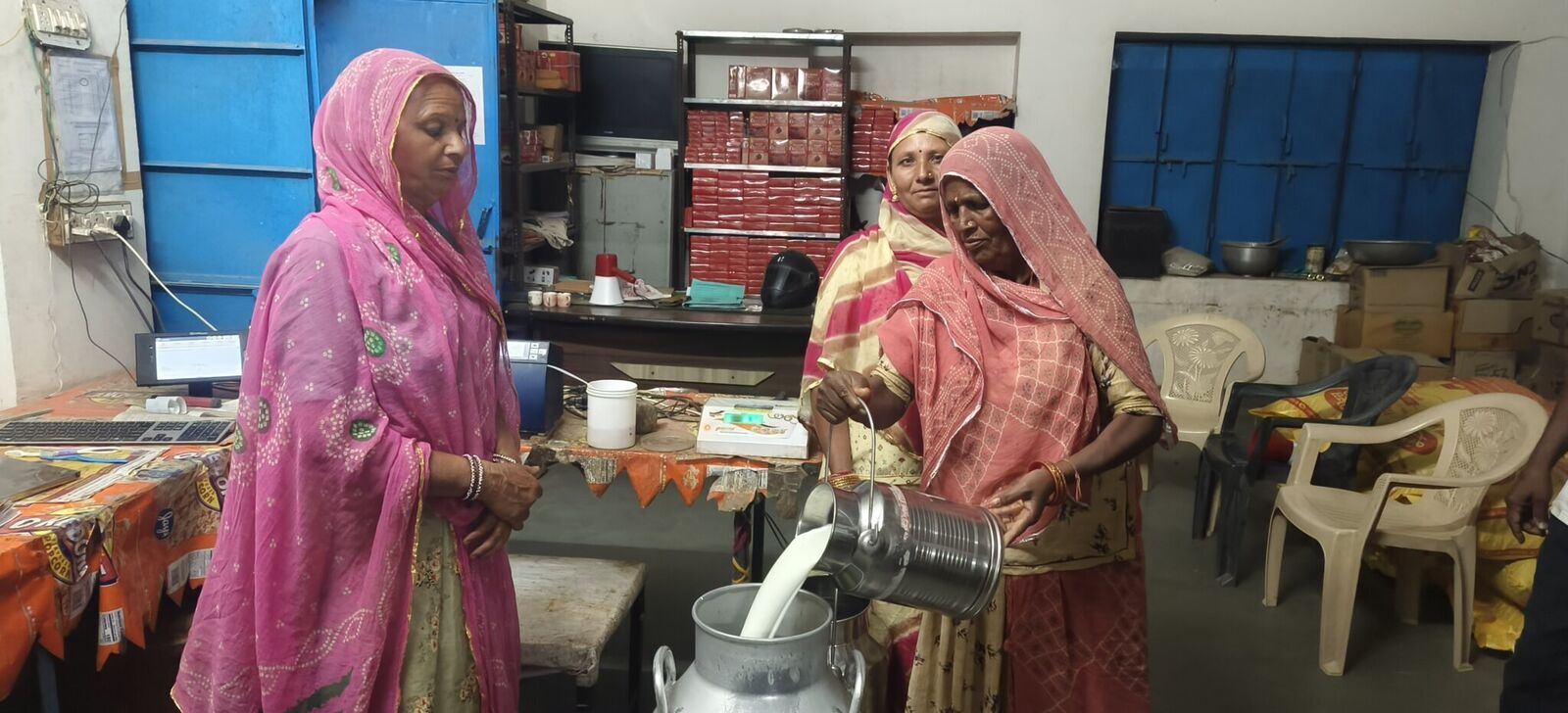
Kanchan (centre) waits her turn as another villager delivers milk at the collection centre in Dhaphda village.
Kanchan’s in-laws, the family that now runs the dairy and nearly every household in Dhaphda opposed the move. For them, rock cutting was not just an occupation but a means of survival in the absence of cultivable land. Many were fiercely resistant — some even resorted to violence. The anger stemmed from a sense of ownership: the hills lay closer to Dhaphda and for years no one from Thana had claimed them. Few could have imagined then that the same community resisting the regeneration would eventually benefit from it — perhaps even more than Thana itself, given Dhaphda’s closer proximity to the revived grazing lands. Inspired by the transformation, Dhaphda later reclaimed and regenerated its own 125 bigha (1 bigha = 0.25 Hectares) charagah, located a little farther from the village
Community reclaiming commons: Their kakad
As repeated crop failures pushed Thana’s households into distress, migration became a routine. Around this time, Balu Lal heard of efforts in nearby villages where degraded charagahs were being restored, reviving livestock rearing and dairy incomes. Rather than leave the village in search of work, he and his friend Shankar Lal turned to their village’s common grazing land, locally known as “kakad” or “shamlat” — a cluster of low hilltops shared with neighbouring Dhaphda. The hills had once supported grazing but had long since turned barren. Stone was increasingly being quarried from their slopes by people from the neighbouring village.
Around 2007, Balu Lal and a small group of villagers, with facilitation from the Foundation for Ecological Security (FES), formed a CVS to reclaim and restore the land. Households began contributing INR 5 a month and efforts to demarcate and protect the commons got underway. Initial enthusiasm, however, soon faded and mobilisation weakened. As the group worked to revive the effort, they discovered that parts of the land they had long assumed belonged to Dhaphda were, in fact, recorded as Thana’s charagah. Reclaiming it would not be straightforward.
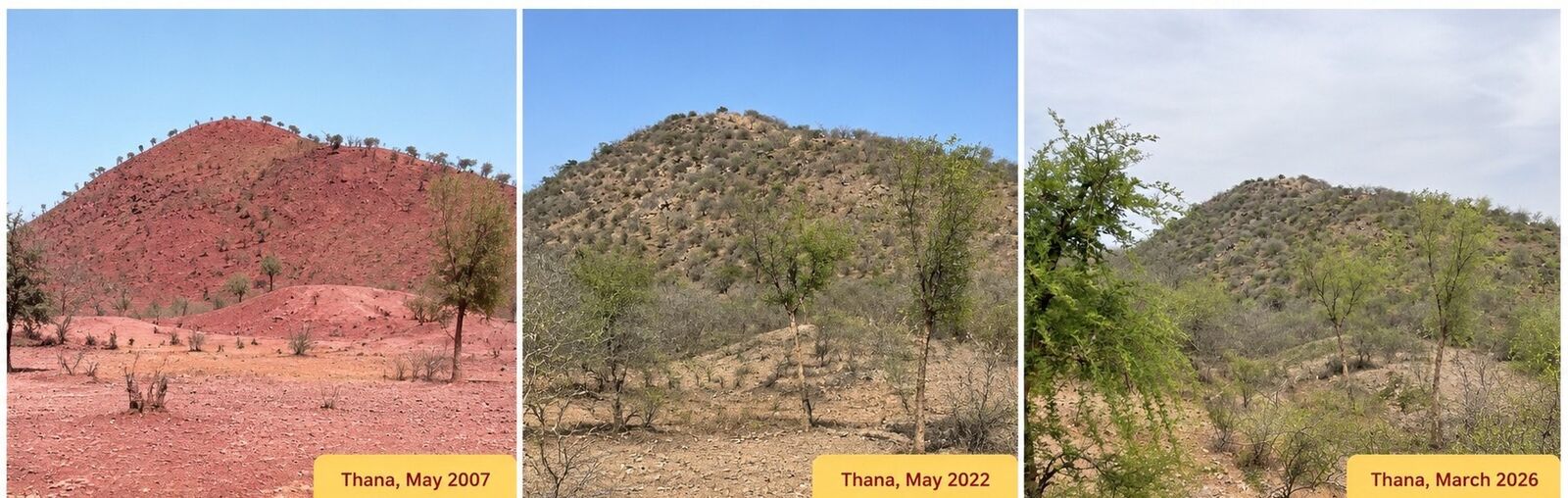
Thana village charagah in May 2007, May 2022 and March 2026.
The group set out to restore nearly 40 hectares — about 210 bighas — of degraded commons, bring 138 bighas of Bilanama land under charagah and reclaim encroachments. What followed was not just a development effort, but a prolonged struggle. It took nearly three to four years of administrative and legal battles for Thana’s claim over the land to be formally recognised. But recognition did not translate into control. Efforts to reclaim encroached land from Dhaphda triggered repeated confrontations, drawing in the police and district administration. People were injured and seven villagers were jailed. “What had begun as an effort to restore grazing land had turned into a bitter struggle over ownership and rights,” shared Babu Lal.
It was at this point that women stepped in. For months, they took the lead — standing guard, working on the land and helping sustain the movement. Gradually, the work resumed. Boundaries were rebuilt, trenches dug and the first signs of regeneration began to appear on hills long written off as barren.
Twenty kilometres away, a different confrontation unfolded in Nareli. Soon after taking office, the Sarpanch (elected head of the Gram Panchayat), a dairy farmer and advocate of charagah regeneration, pushed for the removal of encroachments from hundreds of bighas of charagah land. The eviction, carried out by the administration with police support, triggered fierce resistance and threats to his life, but he persisted.
Several micro check dams constructed in Thana’s charagah helped revive around 25 previously dry wells, enabling irrigation across 180 to 200 bighas. Crops such as wheat, gram and mustard — once considered unviable — are now being cultivated.
Neighbouring Chansen confronted a different threat when a granite mining company secured the transfer of 200 bighas of charagah land despite rules prohibiting such diversion of commons. Villagers and local leaders spent nearly two years fighting the move — from the tehsil to the state secretariat in Jaipur — before the land was eventually restored to the commons.
At Richhi Ka Badiya, a dispute with a neighbouring village over the commons left deeper scars, fracturing social relations. Roads were blocked, communication broke down and even family visits during weddings, births and deaths ceased. At one point, villagers from both sides, armed with traditional weapons, gathered at the charagah as the police prepared for a lathi (baton) charge. The conflict stretched over three years and cost villagers INR 4 – 5 lakh in community contributions before the land was finally secured.
In Suliya, however, reclaiming the commons was only part of the challenge. Alarmed by widespread tree felling and bird trapping nearly two decades ago, Balu Gurjar turned his attention to protecting the kakad. He filed First Information Reports (FIRs) against 29 villagers for illegal tree cutting and another for trapping and killing birds. During a police search, officials recovered bird-trapping nets filled with feathers from a suspect’s house. Legal proceedings against some continue even today. The backlash culminated in a hookah-pani band (ostracising) against Balu Gurjar’s family, but he refused to back down.
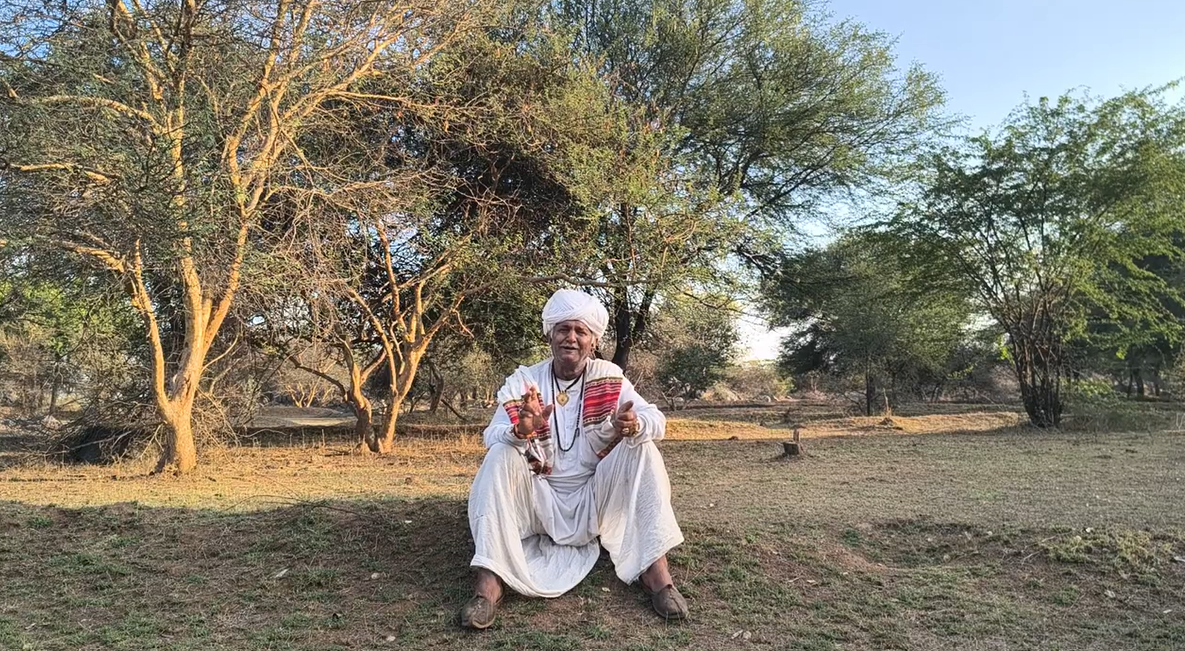
Balu Gurjar in Suliya’s restored charagah, once completely barren.
The paths differed from village to village. Across this part of Mewar, the commons are no longer slipping quietly out of use. They are being contested, reclaimed and slowly restored.
Community management and the rules of the kakad
Across villages in Bhilwara, reclaiming the commons was only the beginning. Preventing them from slipping back into degradation required a different kind of effort — one built on rules, contributions and collective enforcement.
The process usually begins with the formation of a CVS. The early years are devoted to restoring the land — reclaiming encroachments, building boundaries, undertaking water conservation works such as trenches and contour bunds, plantation during the monsoon and restricting grazing for several years. In Thana, the charagah remained completely closed to grazing for nearly eight years.
Such efforts require sustained investment, often raised through “Ugai”—a long-standing practice of compulsory community contribution. Public schemes such as MGNREGA (Mahatma Gandhi National Rural Employment Guarantee Act) have helped finance boundary construction, water conservation and plantation, but day-to-day protection remains a community responsibility. Most villages employ a paid chowkidar, whose wages are covered through household contributions. As the commons recover, villages establish rules governing their use. In Thana, the charagah is opened for grazing for eight months a year and closed during the monsoon. Households pay INR 100 per cow or buffalo and INR 200 per goat or sheep for a grazing season. Attendance at CVS meetings is mandatory and arriving drunk attracts a fine of INR 1,100. Carrying an axe into the kakad, cutting branches or grazing during restricted periods attract severe penalties. Fees and fines generate INR 50,000 – 60,000 annually, helping pay guards and maintain the commons.
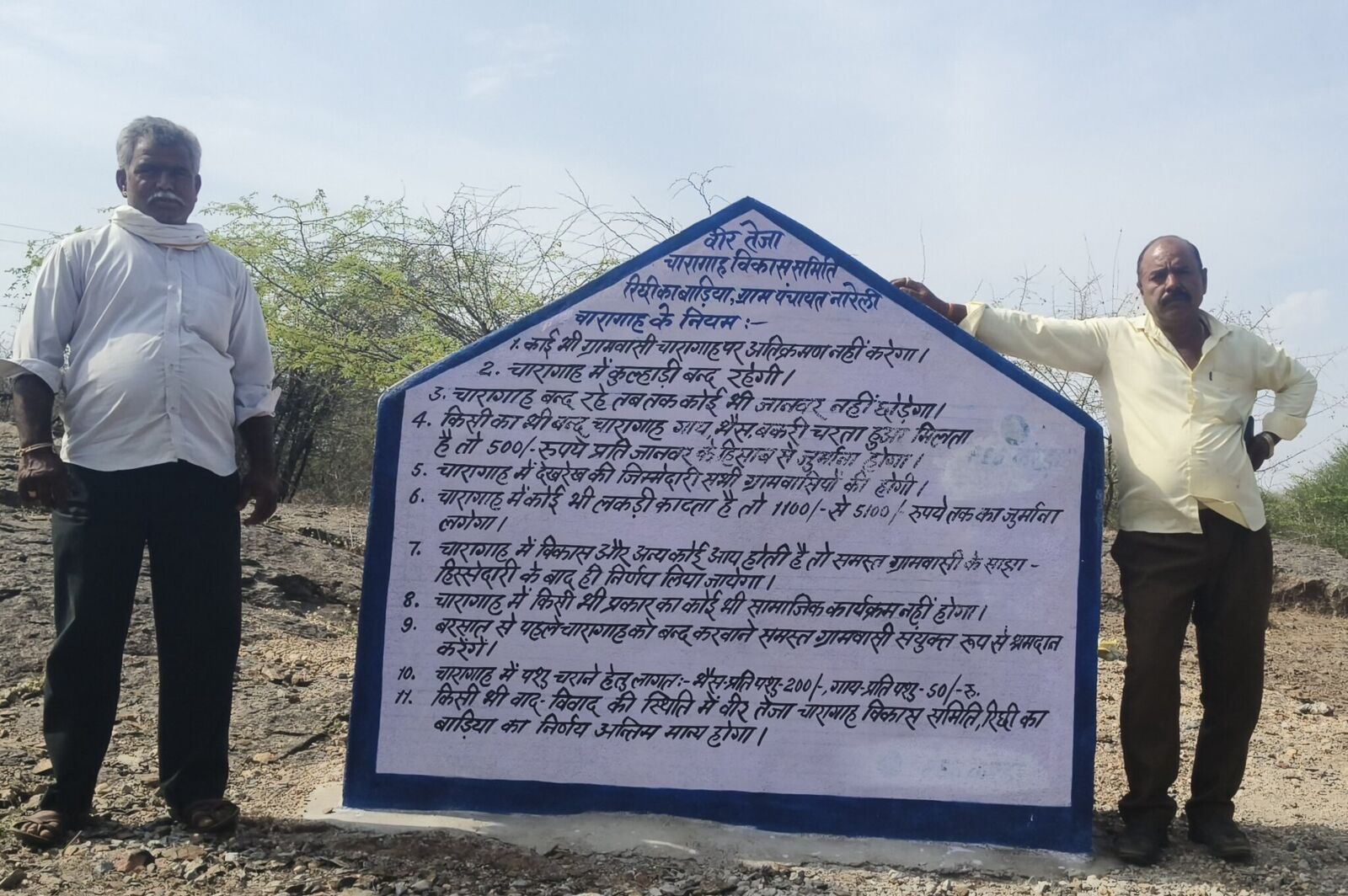
Karan Solanki (left), treasurer of the Charagah Vikas Samiti, Richhi Ka Badiya, beside a stone plaque listing the charagah rules.
At Richhi Ka Badiya, the rules are painted on a wall inside the regenerated charagah. Social gatherings are prohibited and penalties for tree cutting range from INR 1,100 to INR 5,001. Since goats and sheep are barred during the initial years, collecting babul pods (papdi), a key fodder, costs INR 50 per tree.
While the specifics vary from village to village, the underlying principle remains the same. The revival of commons here is as much institutional as ecological, sustained by rules that communities collectively make, finance and enforce.
MGNREGA and the making of the commons
In Nimbheda Jatan, the sarpanch calls it “Maa NREGA” — a mother scheme that, in her words, gave new life to the charagah. Across villages in Bhilwara, similar sentiments surface repeatedly. Communities may have led the struggle to reclaim commons, often through conflict and sustained mobilisation, but rebuilding them required labour, money and continuity on a scale few villages could mobilise on their own.
Demand from villages for such works remains strong, with up to 40 percent of MGNREGA funds directed towards charagah development.
Much of what charagah restoration required aligned closely with the scheme’s design. Trenching, contour bunding, plantation and boundary construction across hundreds of bighas could all be undertaken under MGNREGA. “When we started, we depended on support from FES and contributions from villagers, which could only cover a fraction of the work,” Balu Lal said. “Once MGNREGA came, we had the labour and resources needed to take up restoration on a much larger scale.”
Today, charagah development features prominently in village planning across much of the region. According to Sarjit Yadav, the Village Development Officer in Nareli, “demand from villages for such works remains strong, with up to 40 percent of MGNREGA funds directed towards charagah development.”
The approach was also reinforced by the state government. In 2012, the Rural Development and Panchayati Raj Department directed districts to identify charagah lands and integrate their development into MGNREGA plans alongside other water conservation works. The decision followed the success of community-led charagah regeneration initiatives facilitated by FES, first in Bhilwara and later across scores of villages in adjoining districts, in the early years of MGNREGA.
The scheme is not without its frustrations. Villagers spoke of delays in approvals and wage payments and of the effort required to navigate administrative procedures. A woman in Thana acknowledged these constraints but placed them in perspective. “Payments do get delayed,” she said, “but this is our own work. What we gain from the charagah is much greater than the inconvenience of waiting for wages.”
In many ways, MGNREGA became the vehicle through which the region’s charagah revival gathered momentum. By assuring labour and public investment, it made restoration financially feasible and helped turn scattered village efforts into a much wider movement. Without that assurance, many villagers suggested, few communities would have risked embarking on the long and often contentious process of reclaiming encroached or diverted commons at such scale.
The simple science of rejuvenation
“If animals keep entering, nothing will grow,” Ishwar Lal, a community leader and Panchayat Resource Person from Hira Ka Badiya, said.
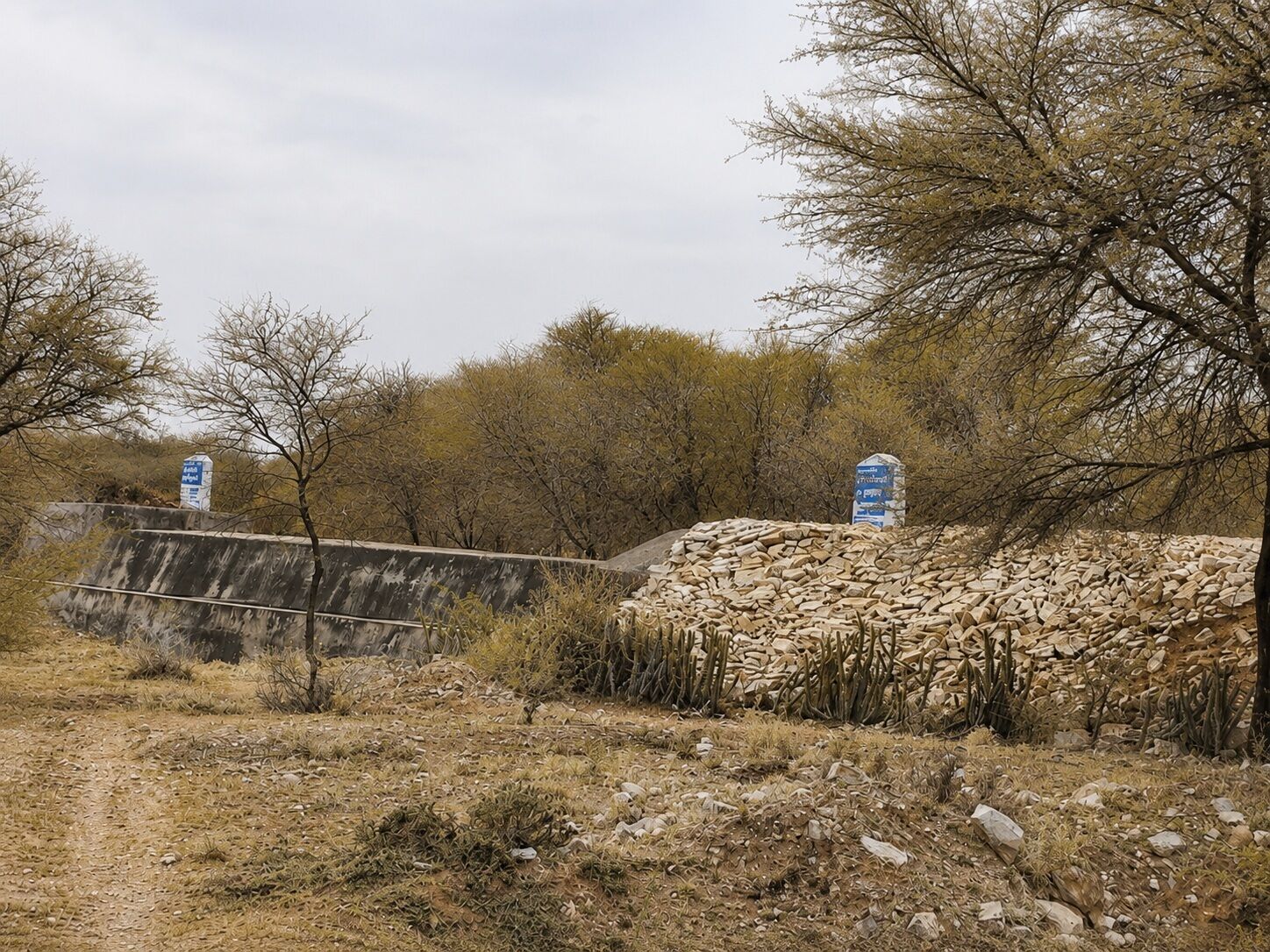
An anicut check dam in the Manoharpura charagah, supporting green cover and fodder availability during summer.
That simple principle lies at the heart of charagah restoration. Before trees are planted or water structures built, the land must first be protected. Villages typically secure the commons through stone boundaries or cattle protection trenches (CPT) reinforced with dense thorny cactus (thor).
Once protected, the landscape is prepared to hold water. Contour trenches are dug along natural slopes to slow runoff and allow rainwater to seep into the soil. Along drainage lines, check dams and gabion structures reduce erosion and trap sediment, while ponds and other water-harvesting structures capture rainwater and help recharge groundwater.
Only then does plantation begin. Pits are prepared in advance and, with the arrival of the monsoon, saplings and seeds are planted while grasses are sown along bunds to stabilise the soil. A commonly used approach is the “one plus three” technique: one sapling is planted along with three seeds in the same pit so that if the sapling fails, one of the seeds may survive in its place. Indigenous species such as babul, khejri (Ghaf) and ber (Indian Jujube) are generally preferred.
The restored land is then kept closed to grazing for at least five years. During this period, periodic nidai (weeding) and godai (soil loosening around plants) help support growth until vegetation becomes established. The process is slow and often years pass before visible change appears. But as moisture returns and vegetation thickens, the land begins to hold itself together again — less through constant intervention than through the ecological conditions that have been rebuilt.
In recent years, local knowledge has increasingly been supplemented by formal planning tools. In some areas, communities are using the Composite Landscape Assessment and Restoration Tool (CLART), developed by the FES. By combining information on slope, soil, geology, drainage and land use, the tool helps identify where trenches, check dams and water-harvesting structures are likely to be most effective.
Charagah changing livelihoods: Livestock, goats and fields
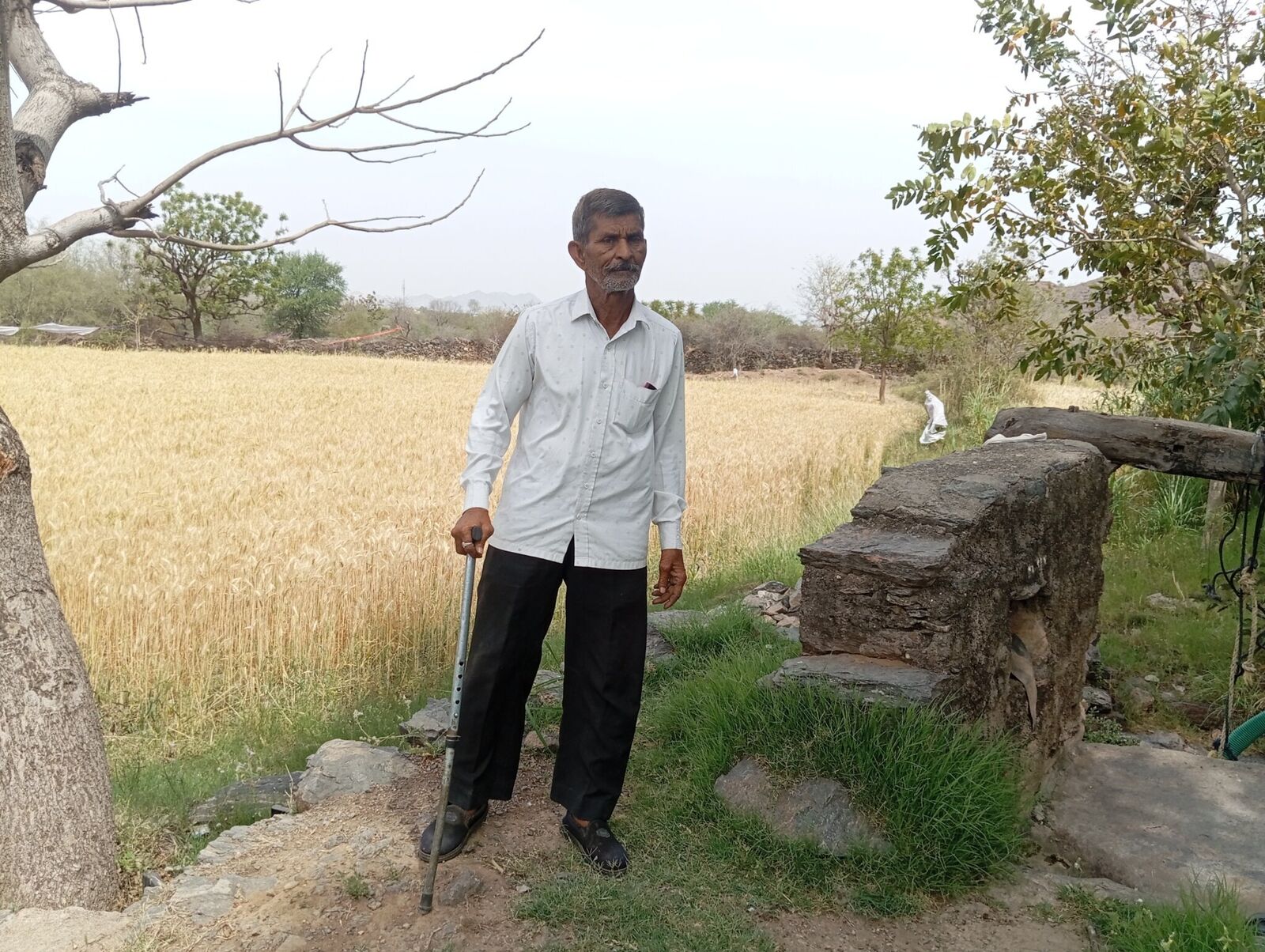
Shankar Lal in front of standing crops at Thana, sustained by water conservation in the village charagah.
The revival of charagah has transformed the economics of livestock rearing. “When we used to send our cattle to Malwa for four or five months, it was very costly,” Shankar Lal from Thana said. “Dry fodder was expensive and many households reduced or stopped keeping cattle.”
With local grazing and fodder now available for much of the year, those costs have fallen sharply. As per an estimate, 15-hectare charagah supports nearly 475 to 500 cattle including goats and sheep, across about 120 households. Purchasing an equivalent quantity of green fodder from the market would cost a household roughly INR 4,800 to INR 5,000 a month during the eight-month grazing season, adding up to nearly INR 40,000. Livestock rearing, once in decline, has become viable again. Dairy production has increased and most villages now have milk collection centres. Villagers estimate that two to three cattle can generate a monthly income of INR 10,000 to INR 12,000.
Goat rearing has expanded alongside this. Often described locally as a “living ATM”, goats serve as a readily liquid asset. Ishwar Lal from Hira Ka Badiya recalled a recent example. “A neighbour needed INR 60,000 for his son’s college admission. They sold four goats and managed it. Earlier, this would not have been possible — there was not enough fodder.” In Thana, the CVS provides small loans to women to purchase goats.
Traditional shepherds have benefited as well. “Earlier, we had to take our herds far for grazing every day,” said Amarajee from Jaswantpura, who now brings his animals to Manoharpura.
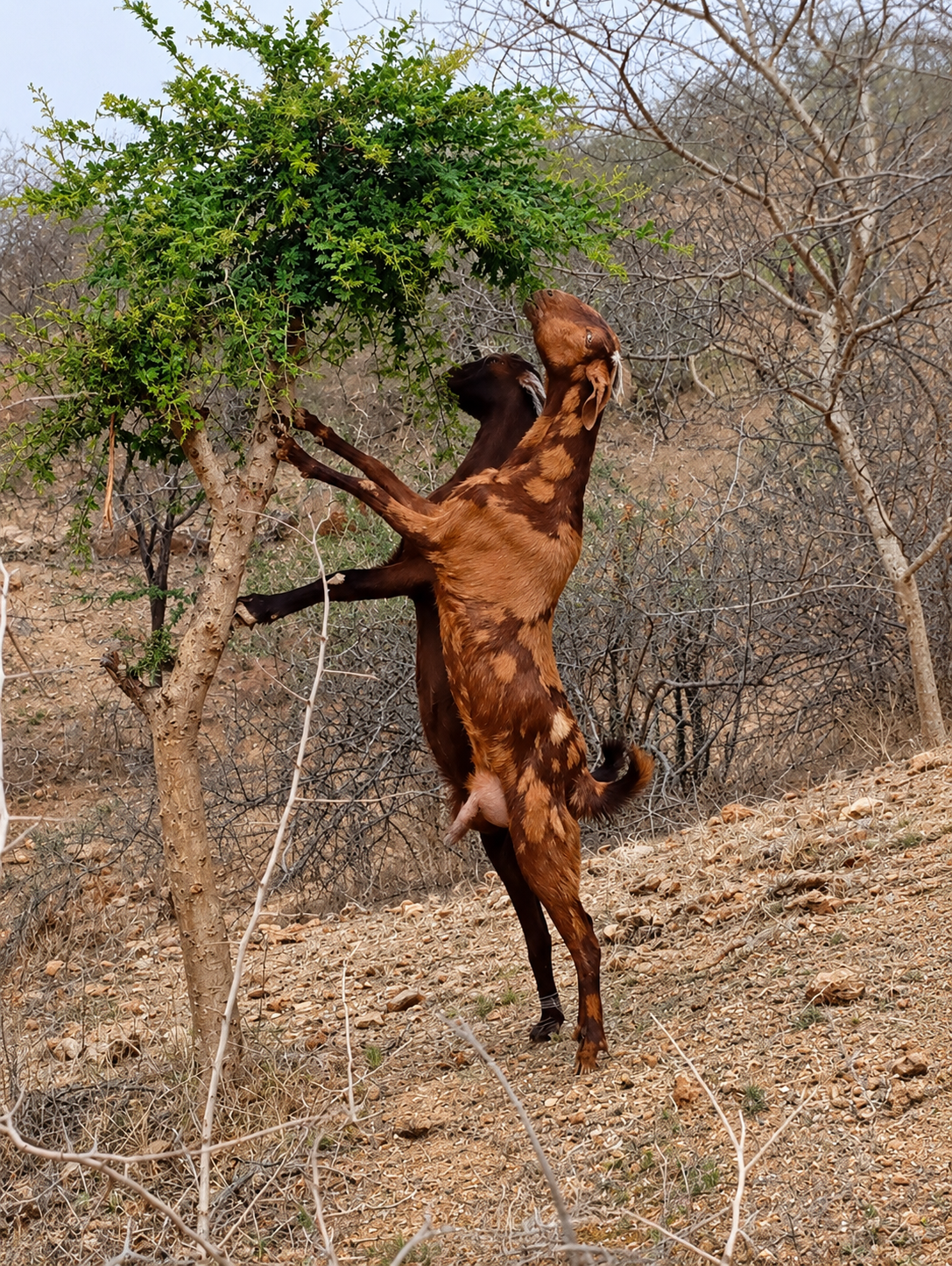
Goats grazing in the Thana village charagah.
“Here, there is water from the anicut and enough feed, so we bring them here regularly. It has become much easier to manage the herd and we have been able to increase their number.” Standing on the edge of the kakad, Sadul Singh from Dhaphda pointed towards the hills. “Earlier, it was barren — just rock. Now there is greenery, trees and enough fodder.”
The effects are visible beyond livestock. Water conservation structures built within charagahs have helped recharge nearby wells. In Dhaphda, Ladu Singh Rawat explained, “several micro check dams constructed in Thana’s charagah helped revive around 25 previously dry wells, enabling irrigation across 180 to 200 bighas. Crops such as wheat, gram and mustard — once considered unviable — are now being cultivated.”
Charagah development has also generated local employment through MGNREGA, allowing villagers to earn wages while working on their own commons and reducing the need for seasonal migration.
What had begun as an effort to restore grazing land had turned into a bitter struggle over ownership and rights”, shared Babu Lal.
Women, work and the commons
In this region of Rajasthan, “Hatai” is a longstanding village forum for discussion and collective decision-making. Traditionally, women were excluded from these gatherings. That began to change with the charagah movement.
Kesibai, a Dalit woman from Sanjadi Ka Badiya, recalled how women first entered these spaces. “Earlier, women were not allowed to sit in the Hatai,” she said. “But during the charagah work, we started going there, sitting and speaking in the meetings, despit resistance from a few.” Women also played a central role in reclaiming and protecting the commons. In villages such as Sanjadi Ka Badiya, Thana and Richhi Ka Badiya, they were part of the front line in efforts to remove encroachments, often facing resistance and threats. “We fought for our charagah and made it encroachment-free,” said Ful Kanwar from Thana. “Then we worked under MGNREGA — building the boundary, digging trenches, making check dams and planting trees.”
Over time, this participation translated into a more sustained presence in village decision-making. Women who had earlier been excluded from discussions began asserting a role in shaping how the charagah would be managed. According to the sarpanch of Nimbheda Jatan, women now constitute a significant share of the workforce engaged in charagah development under MGNREGA.
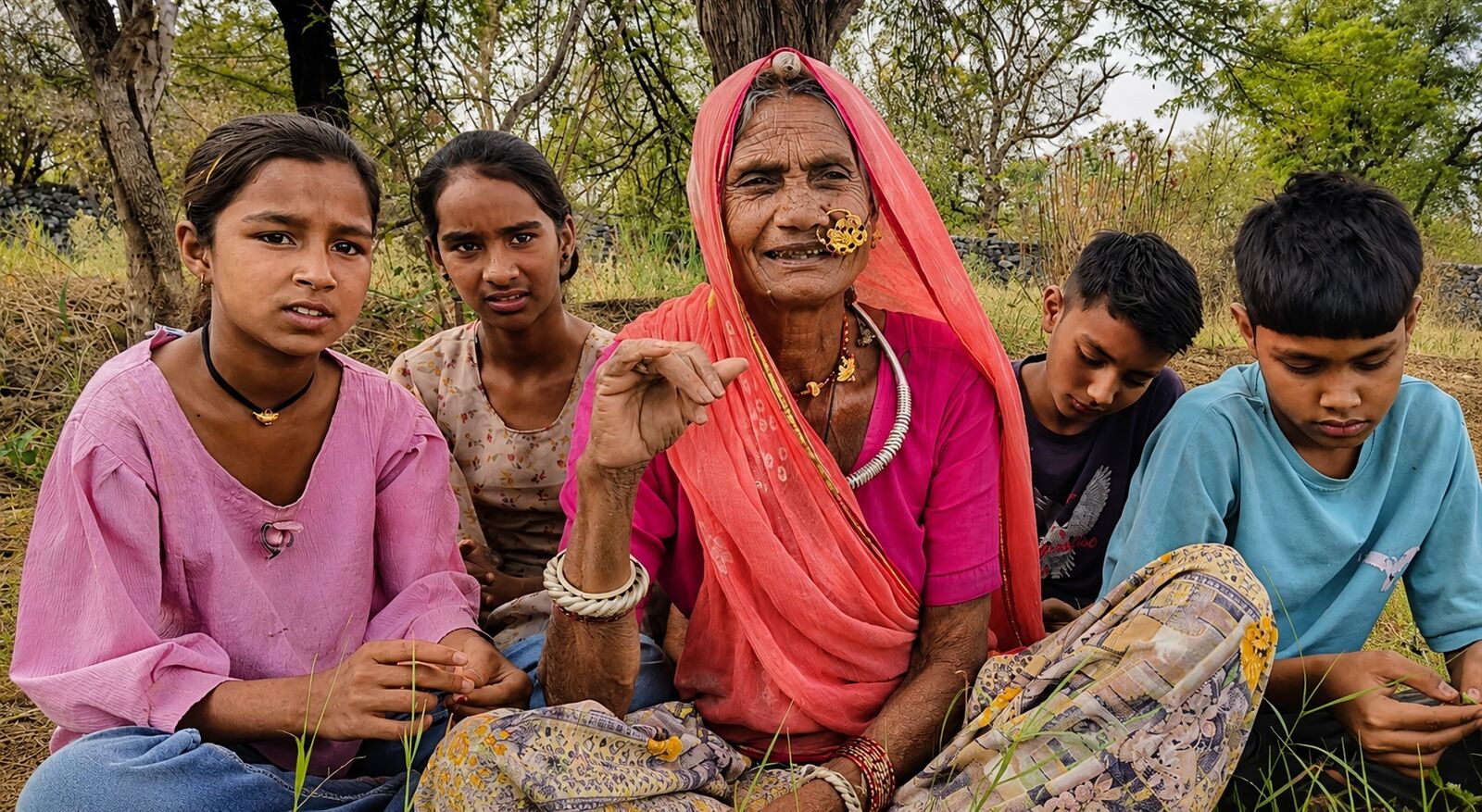
Kesibai, among the first women to champion charagah rejuvenation, with her grandchildren.
Another, less visible shift has been in children’s education, particularly for girls. Women in Richhi Ka Badiya recalled that earlier, in households where livestock was still maintained, children often missed school because they were responsible for grazing animals or caring for younger siblings while adults were away with cattle. In several villages, including Richhi Ka Badiya, enclosed charagahs have altered this routine. Animals are taken to the grazing land in the morning and brought back in the evening without requiring someone to remain with them throughout the day. As a result, children are less tied to grazing responsibilities and girls are less likely to be kept back for caregiving. Villagers said school attendance has become more regular.
Tara Devi from the village shared, “Animals are taken to the grazing land in the morning and brought back in the evening without requiring someone to remain with them throughout the day. As a result, children are less tied to grazing responsibilities, girls are less likely to be kept back for caregiving, and children now attend school much more regularly than before.” The transformation remains uneven, but it has begun to alter both who works on the commons and who speaks for them.
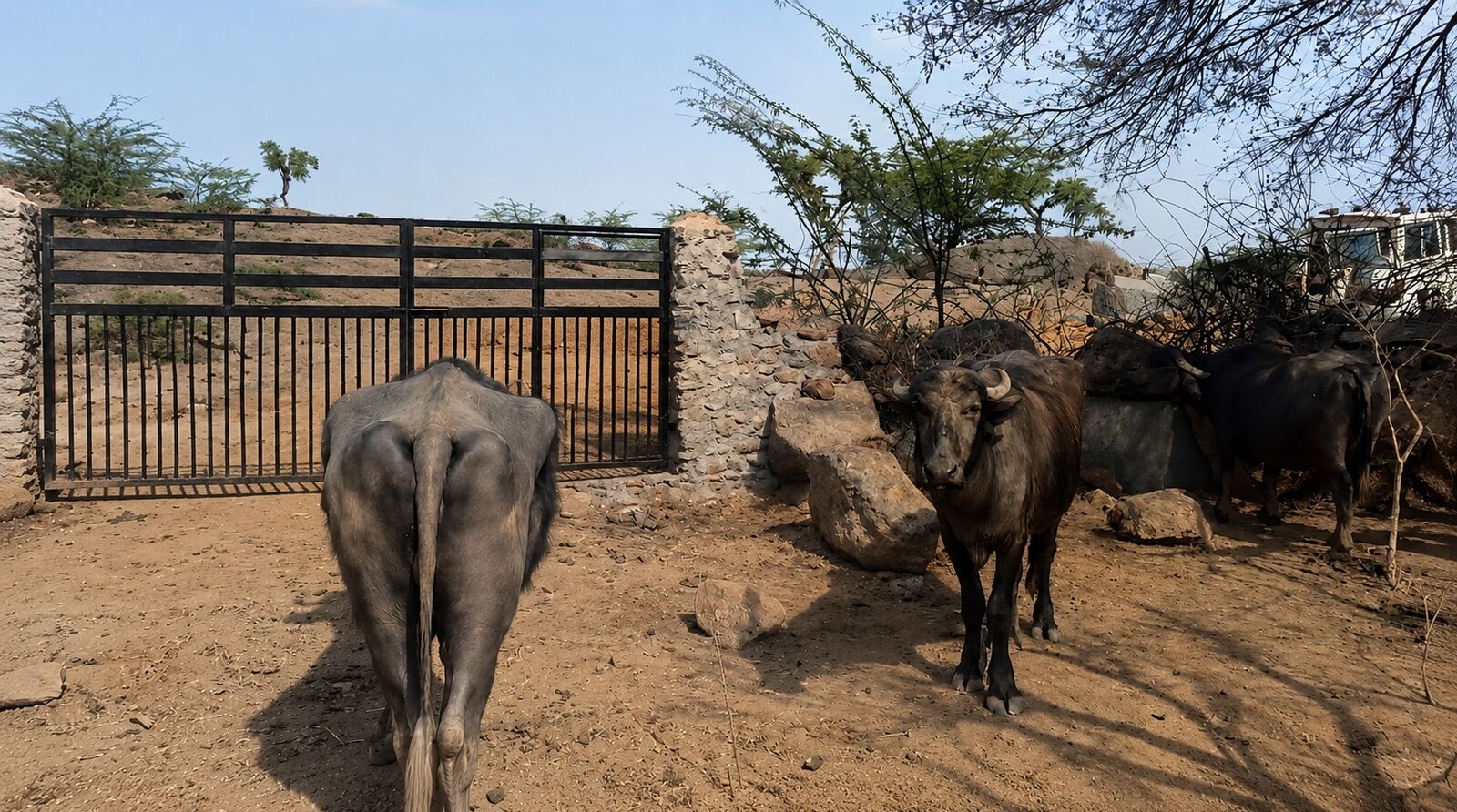
Buffaloes waiting at the gate of the Richhi Ka Badiya charagah after grazing.
Commons and caste
The charagah has also created spaces where caste boundaries appear less rigidly enforced. In villages where access to land and resources has historically followed social hierarchies, reclaiming and managing the commons has required participation across communities. Suresh Chandra Bhil, secretary of the Suliya Charagah Vikas Samiti, pointed to this shift. “There are 17 communities in our village,” he said. “But in this work, everyone came together — worked on the land and now uses the kakad.”
Across the villages visited, a similar pattern emerged. While caste hierarchies have by no means disappeared, villagers repeatedly described the commons as a space where they were less rigidly enforced. Access to the charagah and participation in its management appeared to be shared across communities in ways that were less common before.
Ecological impact
“Earlier, there was nothing here except rocks and barren ground,” people in Suliya said while walking through the charagah. Today, large parts of the commons are covered with babul, khejri and other native trees. Similar changes are visible across Thana, Nareli, Richhi Ka Badiya and Manoharpura, where formerly exposed grazing lands now carry visibly thicker vegetation.
The contrast becomes clearer when enclosed charagahs are compared with adjoining open commons. Inside the protected areas, native species such as khejri, babul, hingota (Desert date), kumtha (Gum acacia) and ber appeared not only as mature trees but also as saplings and young regeneration. In the adjoining open commons, vegetation remained thinner and more uneven. Ecological assessments by the FES recorded substantially higher plant diversity inside regenerated charagahs. In Thana, for instance, the number of plant species increased from 14 in the open commons to 24 inside the enclosed charagah, while in Chansen it rose from 6 to 20. The differences were equally visible in biomass and fodder availability. In Thana, fodder biomass more than doubled — from 1.88 tonnes in the open commons to 4.02 tonnes inside the regenerated charagah. In Sanjari Ka Badiya, it increased from 1.55 tonnes to 7.43 tonnes. The figures suggest that sustained protection and regulated grazing have significantly improved the productive capacity of the commons.
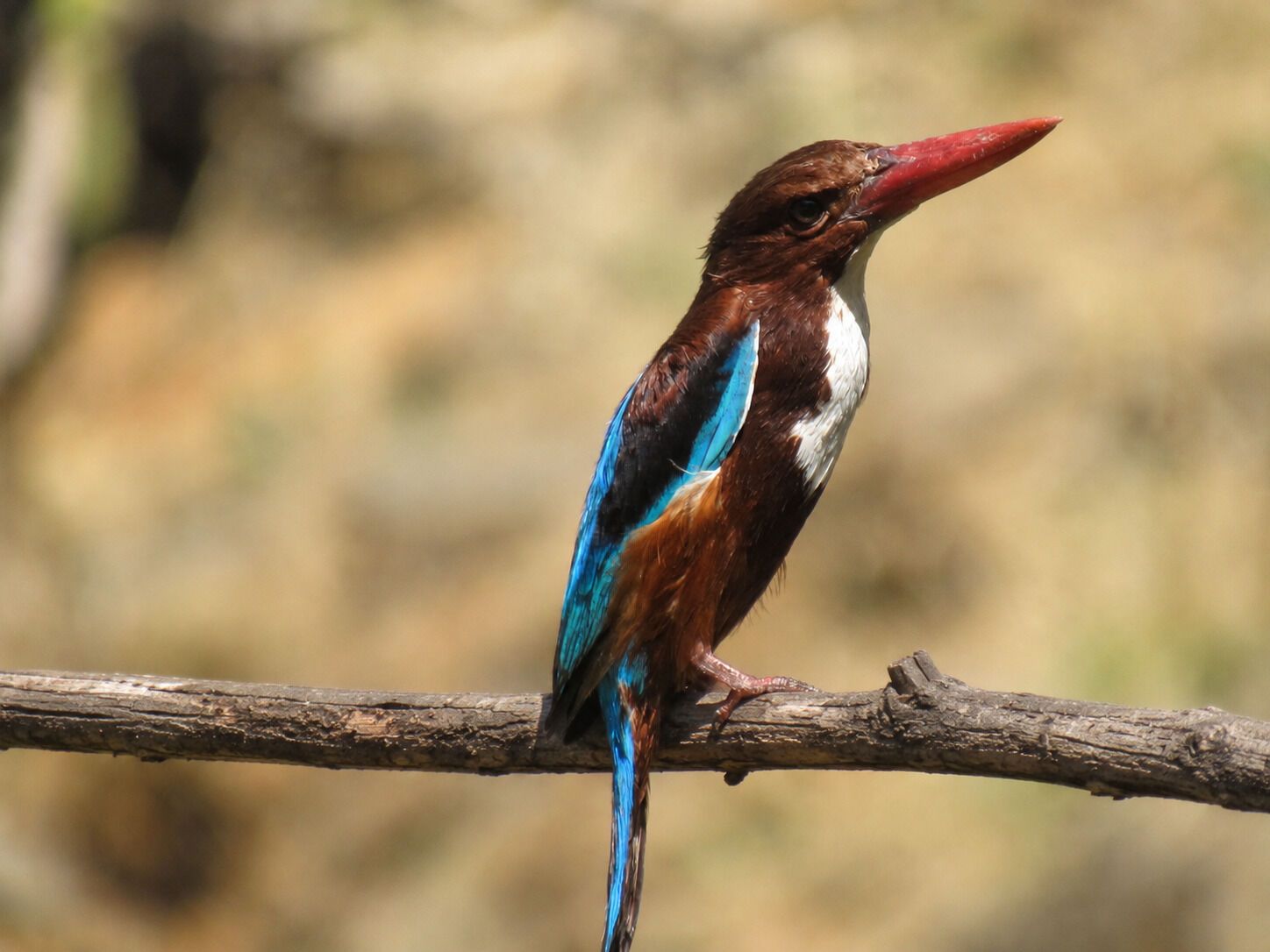
A white-throated kingfisher in the charagah of Thana village. Image credits: Dileep Sing Solanki
Villagers also spoke of birds and wild animals gradually returning to the landscape. In Thana and Richhi Ka Badiya, residents pointed to the increasing presence of blue bulls, peacocks and birds such as spotted doves, Jacobin cuckoos and kingfishers around the charagahs and newly created water bodies. Many said these species had become far less visible when the commons were barren and degraded.
Across villages, residents also linked charagah regeneration with rising water levels in nearby wells. In Suliya, Pyarelal Khatik recalled that until a few years ago people often had to walk long distances for drinking water. “After the charagah was revived, water returned to our wells,” he said. “Now we no longer have to carry water from far away.” Together, these changes have improved the commons’ capacity to sustain vegetation, wildlife and water.
Larger mobilisation, institutional support and the challenges ahead
About 26 percent of Rajasthan falls under commons, including 16.6 lakh hectares of pastures and grazing lands — about 5 percent of the state’s area. Yet encroachments, deforestation and the erosion of collective protection have left large stretches barren and contested.
Over the last two decades, particularly after the expansion of MGNREGA, charagah regeneration has spread from scattered village efforts to a movement spanning thousands of villages across Rajasthan. Institutional support has followed. In 2017, the Banjar Bhumi evam Charagah Vikas Board mandated Charagah Vikas Samitis at gram panchayat, block and district levels to support restoration efforts. More recently, the Rajasthan government earmarked ₹5,000 crore for charagah development in its 2026 – 27 budget.
In Karera block, the Paryavaran evam Jan Chetna Manch brings together village-level Charagah Vikas Samitis as a block-level federation, helping communities navigate land records, demarcation disputes and administrative processes. Its newly announced chairperson is Ladu Singh Rawat from Thana’s neighbouring village, Dhaphda — the same man who once fiercely opposed and at times violently resisted, the regeneration of Thana’s charagah. Today, he is among the region’s strongest advocates of charagah restoration, a measure of how deeply attitudes towards the commons have changed.
Yet the story is far from uniformly one of recovery. Gopal Sharma, a retired nayab tehsildar and the federation’s treasurer, said nearly 35 bighas of charagah land in his own village, Manoharpura, remains under encroachment, some of it recent. “Without support from the entire village, it becomes difficult,” he said, noting that many households have moved away from farming and livestock and no longer see much value in the charagah. Across many villages, the declining participation of younger generations due to migration for education and employment presents another challenge to sustaining and strengthening these efforts.
Restoring degraded commons across Rajasthan’s nearly 46,000 villages remains an enormous task, one that could take decades. Yet across southern Rajasthan, a quiet green movement is slowly triggering its own white revolution — through fodder, livestock and communities reclaiming the commons.
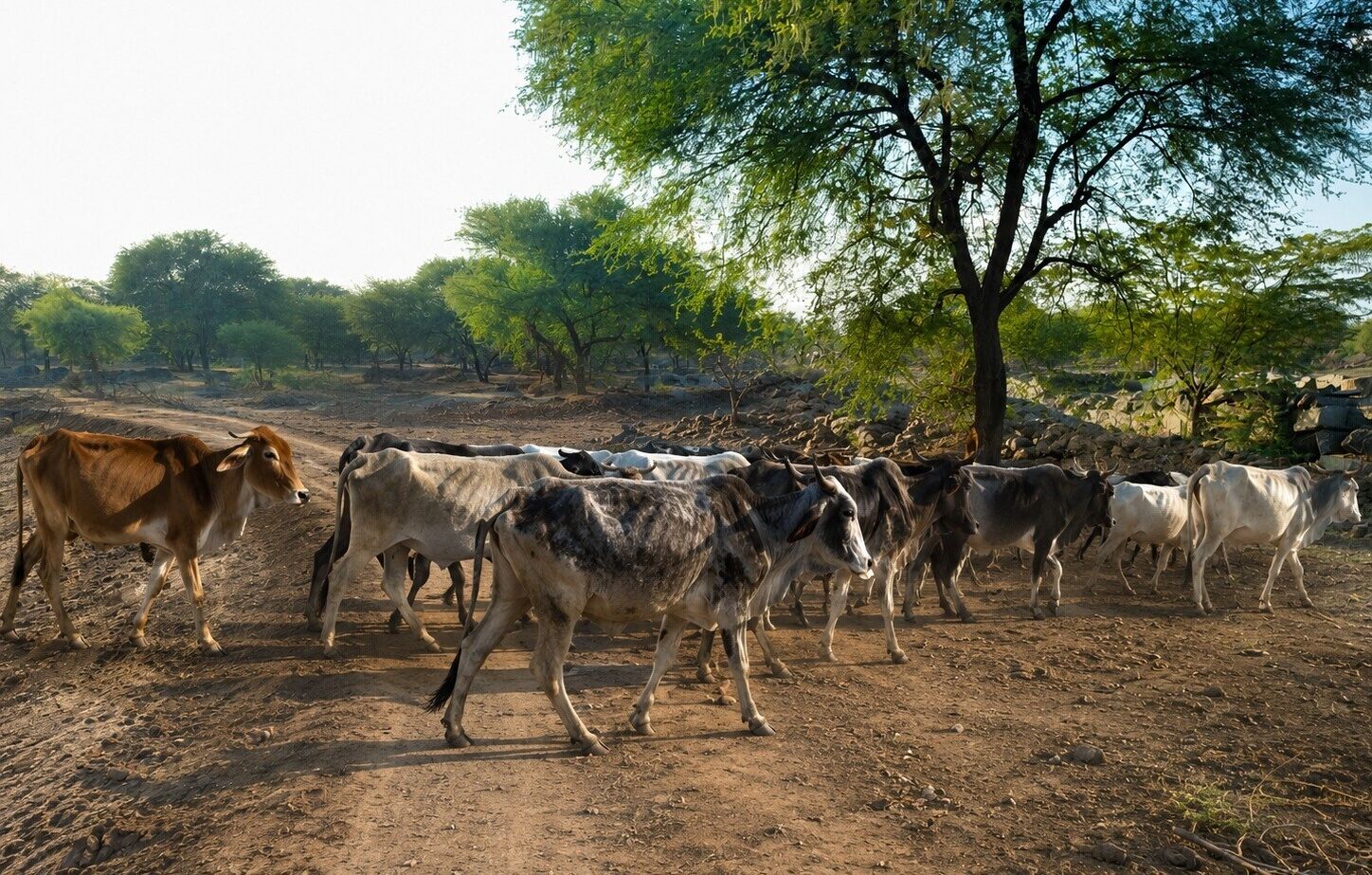
Featured Image: Cattle in a charagah at Bhilwara, returning after grazing.
Images by Rajan Kumar Singh
About the author
Rajan Kumar Singh is a faculty member at the School of Continuing Education University Resource Centre, Azim Premji University.
About the series
This series will spotlight local democratic practices from across the country that demonstrate innovation, effectiveness and good governance.
This work is facilitated by the Centre for Local Democracy, Azim Premji University.
The Centre for Local Democracy supports the work of Azim Premji Foundation and others working on deepening and widening local democracy across India. The Centre enhances the work done in rural, forest, PESA and urban settings through educational programmes, documentation, dissemination of good practices and research in emerging thematic areas.