
Whispers of the Mangroves
Book Title: Down by the Mangroves
Author: Sheela and Praba
Illustrator: Padmasree Murali
Publisher: Penguin (paperback, ₹350)
Reviewed By: Madhuri Ramesh
Details
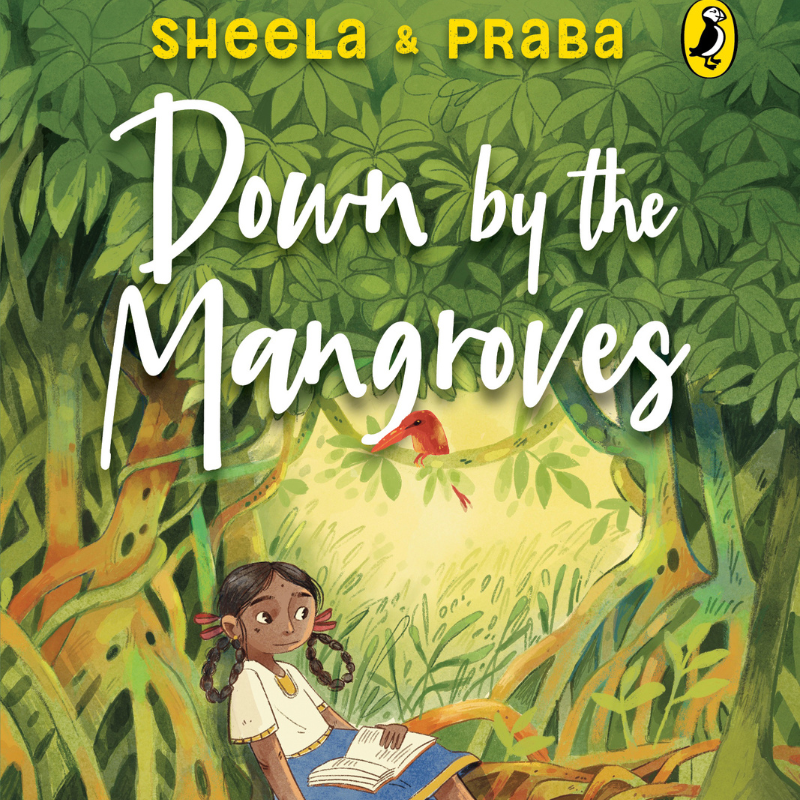
Down by the Mangroves, written by Sheela (Preuitt) and Praba (Ram), is a well-crafted story of a young girl, Moyna, who lives in a village in the Sundarbans with her parents and two little goats, Rani and Mishti.
The Sundarbans, as most of us know, are the largest mangrove forests in the world and they are an important habitat for numerous species of birds, fish and animals, including the iconic Bengal tiger. In addition to this biodiversity, the Sundarbans also hold great economic and cultural significance for rural communities who live in this region. This interconnected socio-ecological system forms the setting of this book. The authors’ STEM training and their understanding of this unique landscape is evident in the way the book is replete with references to the birdlife, tidal calendars and cyclones of the region alongside descriptions of typical village life (such as people going to collect honey, prawns and crabs) and the legend of Bonbibi (the goddess of the Sundarbans). However, the book is much more than a romantic portrayal because it introduces the reader to the challenging subject of human-wildlife conflict from the perspective of people who experience the pleasures and risks of living close to nature. Since such conflicts are frequently covered in the news these days, this book is a timely intervention that does an admirable job of unpacking the subject for a young reader.
The main plot revolves around an encounter between Moyna’s father and a Bengal tiger, and the impact this has on Moyna and her mother. In tracing the consequences, the book bravely tackles the emotional dimensions of what it means to live in such landscapes without becoming too heavy for its intended readers. The narrative flags a little in the middle but picks up when Moyna finds a poignant strategy that gives her the courage to go back to school. The book highlights the importance of friendship in dealing with life’s ups and downs through the character of Sumi, Moyna’s best friend. The authors lighten the narrative with the banter between the two friends. They also introduce many songs and poems from this region, which almost makes one imagine a musical play based on the book.
The descriptions are minimalistic but evocative, and invite the reader to slow down, enter the story and exercise their imagination. For example, describing the landscape after a spell of rain, they write: Puddles stood in the sun as if brown matka chai had been poured on the ground. What is particularly impressive is that the authors have managed to retain this evocative style even when describing emotions. For instance, in one part of the story they highlight Moyna’s emotional turmoil with these haiku-like lines: Outside — everything screamed. Inside — quiet. The illustrations by Padmasree Murali are delicately drawn and fit well with the style of the narrative. I particularly liked the animated classroom scene in Moyna’s school on page 31.
Overall, this book does a wonderful job of introducing young readers to the complexities of living in forest areas, close to wild animals. It also serves as a gentle starting point for difficult conversations on experiencing and dealing with fear and grief. It is this multidimensional storytelling that makes the book a real gem that deserves to be read widely.
About the Reviewer:
Madhuri Ramesh researches nature-society relations, mainly inclusive, interdisciplinary approaches to conservation and sustainability. She has written two books on the Kadar people of the Anamalai Hills —Walking is a Way of Knowing and Speaking to an Elephant. She is also a faculty at Azim Premji University.