
Tak-Tak Treasure
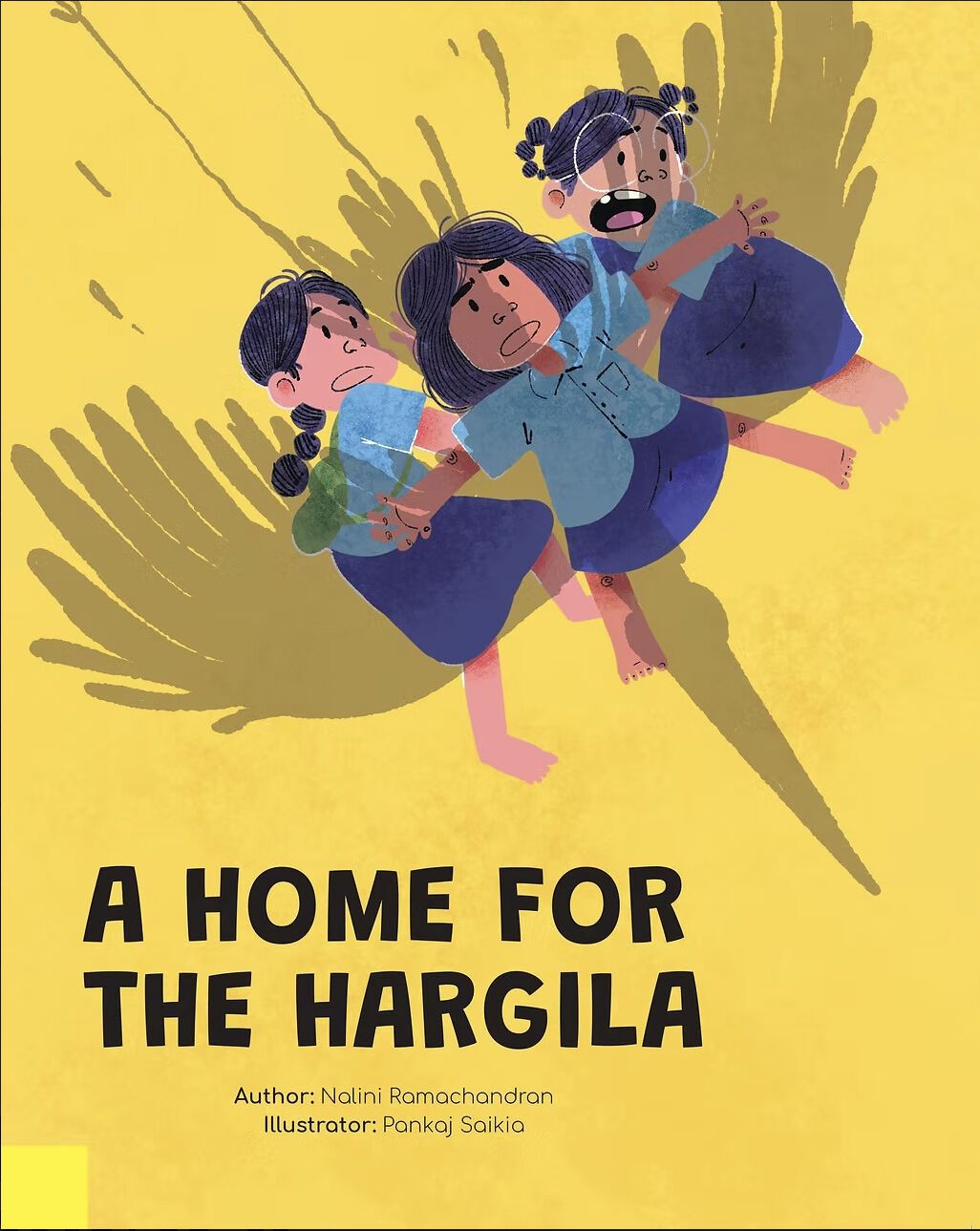
Book Title: A Home for the Hargila
Author: Nalini Ramachandran
Illustrator: Pankaj Saikia
Publisher: Room to Read (paperback, available to read for free on the Literacy Cloud)
Reviewed By: Sangeetha Menon
Details
It takes a village to raise a child. And sometimes, it’s the children who can help show the village a better way forward. That’s the sentiment I was left with after reading Nalini Ramachandran and Pankaj Saikia’s graphic narrative, A Home for the Hargila.
Set in a fictional place called Tak-Tak village in (what seems to be) Assam, we meet three young girls who are classmates and friends — Pakhi, Kakoli and Haseena. We see how different life is for each of them, and the problems they face from sudden rains and flooding in their respective areas. It doesn’t help that the village weatherman Mausam Mamu comically (and tragically) can’t get the forecast right anymore.
One day, as the three girls walk back home from school, they run into a snake. Before they can react, a large bird grabs the snake and flies away. Shocked and intrigued, the girls go and ask the elders in the village about what they saw. That’s when they learn about Tak-Tak village’s long-lost shining star, the Greater Adjutant Stork, locally known as the Hargila. The story that follows is about the various attempts the girls make to help the Hargila return to Tak-Tak village.
To give context here, the Hargila or bone-swallower is a kind of stork mostly native to Assam. You will also find it in Bihar and parts of Cambodia. They are scavengers and help clean up carcasses and decaying organic matter. In doing so they also prevent the spread of disease. The International Union for the Conservation of Nature has classified this bird as ‘Near Threatened’. This has mostly been due to hunting as well as the destruction of their habitats and nesting grounds.
It is not always easy to convey the message of conservation to young readers, especially when a book focuses on a particular kind of creature, because then it runs the risk of becoming heavy with information. However, the author does a wonderful job of providing just enough information about the Hargila to arouse curiosity. At no point does the portrayal of the plight of this stork seem forced. I found myself going down a rabbit hole of research about this bird after reading the book, and it’s likely that children will do this too.
The author takes inspiration from the celebrated wildlife biologist Dr Purnima Devi Barman and her Hargila Army, an all-women conservation initiative focusing on protecting the Greater Adjutant Stork. You will find several instances in the book that borrow from this initiative, like the wearing of stork-shaped headdresses and using artwork to spread awareness about the bird. The name ‘Tak-Tak’ village is also a clever wordplay on the ‘Tak-Tak-Tak’ call that the Hargila Army uses to mimic the stork’s signature sound.
My main gripe with the book is the part which talks about tall trees in the village being cut down, destroying the stork’s nesting site. The way this is resolved seems tad too convenient and simplistic. I wonder if the story would have worked better had the book explored the myth of the stork delivering newborn babies and how that was incorporated in creating awareness about the Hargila.
Pankaj Saikia has done a wonderful job with the illustrations. He hails from Assam and his understanding of the terrain and socio-cultural dynamics shine through. The images are vivid and engaging. I especially liked the way he has portrayed the different ways in which each girl lives, even though they belong to the same village. I also appreciate how the images and text touch upon themes like migration and class with sensitivity and realism.
At the end of the book there is a note about the Greater Adjutant Stork and Dr Barman’s Hargila Army. There is also a list of questions that can help children engage further with the different themes explored in the story. The book doesn’t specify the age-group it is meant for, but I believe it would work well for children eight years and above.
About the Reviewer:
Sangeetha Menon a.k.a. ‘The Moody Marshmallow’ is a writer, editor and podcaster. She works in children’s publishing.