
Carri-on Capers
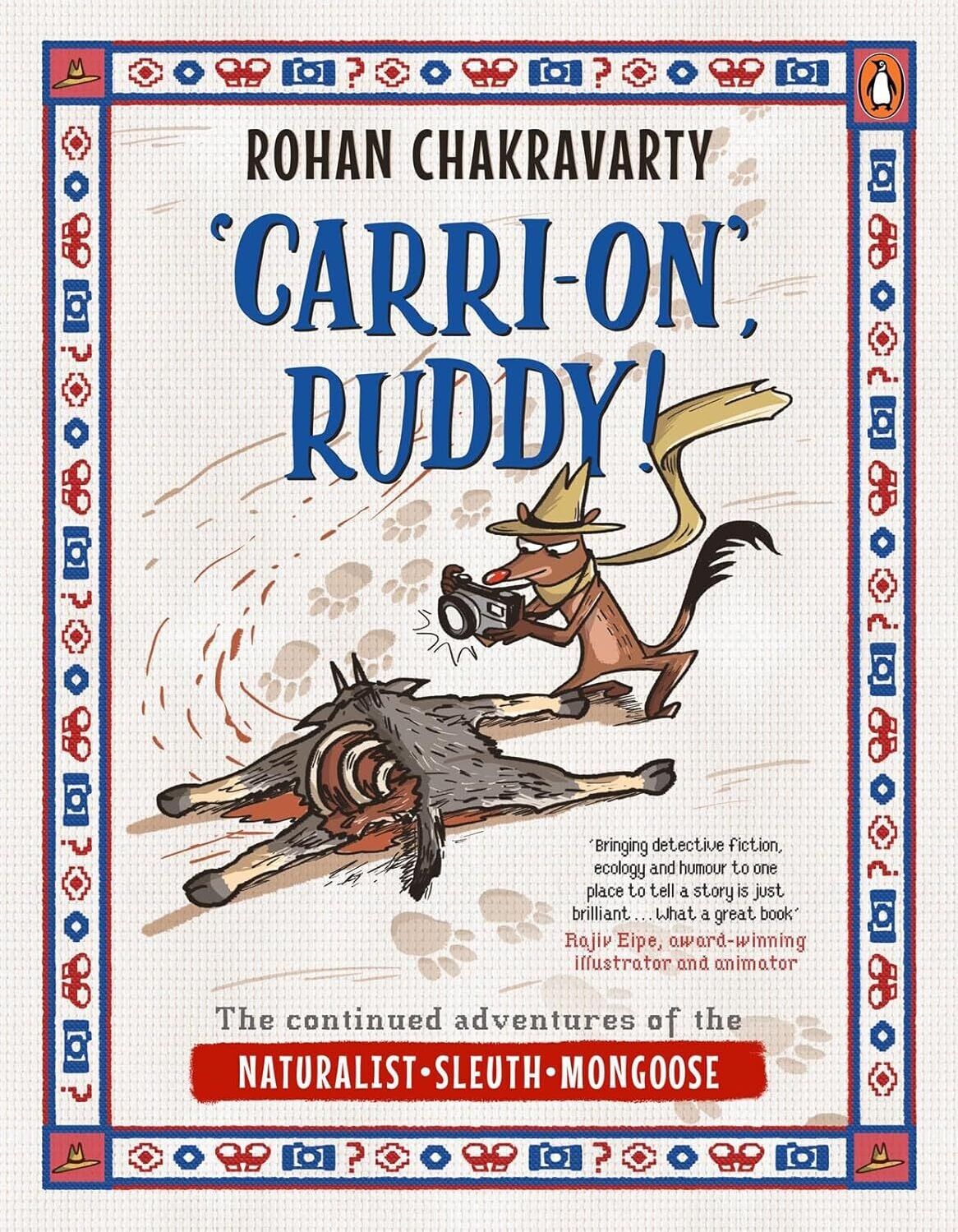
Book Title: ‘Carri-on’, Ruddy!
Author: Rohan Chakravarty
Illustrator: Rohan Chakravarty
Publisher: Penguin (paperback, INR 499)
Reviewed By: Nadia Nooreyezdan
Details
Before diving into Carri-on, Ruddy!, it helps to know that Rohan Chakravarty has spent years making wildlife funny. Best known for his long-running comic series Green Humour, which has reached readers across the globe, the wildlife cartoonist and illustrator has a knack for translating complex ecological ideas into visual gags featuring memorable characters without ever losing scientific accuracy. This second book in the ‘Naturalist Ruddy’ series builds on that talent.
Instead of explaining the natural world like a textbook, Chakravarty cleverly turns it into detective stories told through lively comic panels. His protagonist is Kanha Tiger Reserve’s “most inquisitive denizen”, Naturalist Ruddy — a Ruddy mongoose with an excellent nose for mysteries and a detective hat called Hatson. Ruddy travels across India investigating what appear to be crime scenes, discovering that the answers lie in the natural interactions between animals and their environments. Blood-spattered feathers, trees with strange markings, insects behaving suspiciously, and seemingly impossible encounters between predators and prey become clues in a series of delightfully constructed investigations that make the natural world feel every bit as gripping as a cosy murder mystery.
Whenever Ruddy’s tail “curls up into a question mark”, as Chakravarty charmingly puts it, he cannot resist poking his red nose into the matter. One mystery begins with bird droppings that seem to vanish into thin air before Ruddy realises they are in fact Tonica moths, camouflaged to resemble droppings in order to avoid hungry predators. Another opens on what Ruddy excitedly describes as an old-fashioned murder scene: feathers scattered across the forest floor, speckles of fresh blood, and alarmed birds calling overhead. Ruddy considers thirteen feathered suspects, methodically ruling them out by examining hunting habits, migration patterns, and feather shapes before consulting his friend, molecular biologist and forensic expert Dr Shama (a White-rumped Shama), to help identify the killer. The mysteries themselves are rooted in genuine ecological phenomena, but Chakravarty adds enough suspense and misdirection that you find yourself eagerly turning the page to see how the case will be solved.
Throughout the book, “Team Up with Ruddy” pages invite readers to help Ruddy with his investigations by solving puzzles: spotting a camouflaged Wandering Violin mantis hidden among dry leaves, deciding whether a strawberry-shaped mushroom’s vivid red colour signals danger for Ruddy who is in the mood for mushroom soup, or matching footprints in the Sundarbans’ mudflats to otters, Bengal tigers, Water Monitor lizards, and shorebirds.
Chakravarty never lets us forget that though Ruddy is a self-proclaimed nature detective, he is still very much a mongoose. “You and Naturalist Ruddy have a common craving during the monsoons,” he writes. “It’s just that for you, it’s pakoda or bhaji, and for Ruddy, it’s termites.” When Ruddy follows that craving, he stumbles upon termite mounds filled with white mushrooms, leading to a fascinating explanation of the symbiotic relationship between termites and the fungi they cultivate. These small reminders of Ruddy’s animal instincts keep him grounded in the world he is investigating rather than turning him into an anthropomorphic detective who just happens to be a mongoose.
Much of the book’s charm comes from Chakravarty’s humour, which works as effectively through the illustrations as it does through the dialogue. Ruddy is wonderfully expressive, his wide eyes, bright red nose and furrowed brow making him instantly endearing. Some of the biggest laughs come from the gap between what Ruddy thinks is happening and what nature is actually up to. Spotting what appears to be two bumblebees mating, he discreetly snaps a few photographs before walking away, “choosing to let them have their privacy — a quality lacking in most wildlife photographers these days.” Only later, while examining the photographs, does he realise the pair are not mating at all: one is eating the other. “Can marital discord really get this bad among bumble bees?” he wonders, before arthropod expert Detective Hershal Pierrot (a Red Pierrot butterfly) helpfully reveals that the predator is actually a robber fly called Laphria, which mimics bumble bees to ambush them.
Other funny moments are purely visual. Confronted with a frog emerging unharmed alongside a tarantula large enough to devour it, Ruddy imagines an absurd explanation in which the frog sports a bow tie while the spider wears a bridal veil. Coming across both hoof and claw marks on lichen covering pine trees in Kedarnath Wildlife Sanctuary, Ruddy wonders if he discovered a cross between a Yeti and a centaur — we’re graced with a picture of the creature complete with horns, arms, hooves, and a six-pack. And after foolishly poking what turns out to be a parasitic fungus, Ruddy is shown fleeing in horror with bulging eyes while frantically calling Dr Shama to ask whether any nearby herbs possess antifungal properties. Full-page spreads referencing iconic film posters and detective-style suspect line-ups are likely to delight adult readers just as much as younger ones.
The book’s strength is that it allows us to see the world the way a naturalist does, with curiosity and a willingness to be surprised. Ruddy does not know everything and never pretends otherwise. He photographs unfamiliar species and consults field guides and books, friends like Dr Shama and Detective Hershal Pierrot, along with libraries and even apps like iNaturalist. Even when he has his own theories, he examines all the evidence and solves every mystery through careful observation and collaboration. The natural world is also presented with refreshing honesty. Parasitism, predation, mating, and death are simply shown as parts of ecological relationships that have evolved over millions of years. In doing so, the book encourages children to approach nature with the same kind of openness and respect.
There are moments where the humour feels pitched a little more towards adults than children. Ruddy’s comments about vanishing bird sh*t making him feel less sh*t, jokes about bumble bees needing to be more careful on Bumble dates, and references to Norman Bates in Psycho will likely fly over the heads of younger readers. But these moments are brief and easily skimmed over.
The book closes with a final mystery where Ruddy himself is framed, which has a particularly heart-warming conclusion. And in a final epistolary section, Naturalist Ruddy rejects Chakravarty’s application to become his junior detective, listing the author’s many books and awards before concluding that his fear of house geckos and lack of mongoose-like agility make him unsuitable for the role — not to mention his dogs’ proclivity for pestering mongooses in the neighbourhood. It’s a fitting end to a book filled with warmth and wit. Carri-on, Ruddy! leaves readers with fascinating wildlife facts and perhaps more importantly teaches them to slow down and keep an eye out for the many mysteries of the natural world around us.
About the Reviewer:
Nadia Nooreyezdan is an independent writer and editor, based in New Delhi. Her work has been shortlisted for the Deodar Prize. She is currently working on a memoir about her family’s journey from Iran to India.