
Little Voices, Big Journey
Book title: The Great Nicobar Journey
Author: Tansy Troy
Publisher: Talking Cub (paperback, ₹399)
Reviewer: Dakshayini Suresh
Details
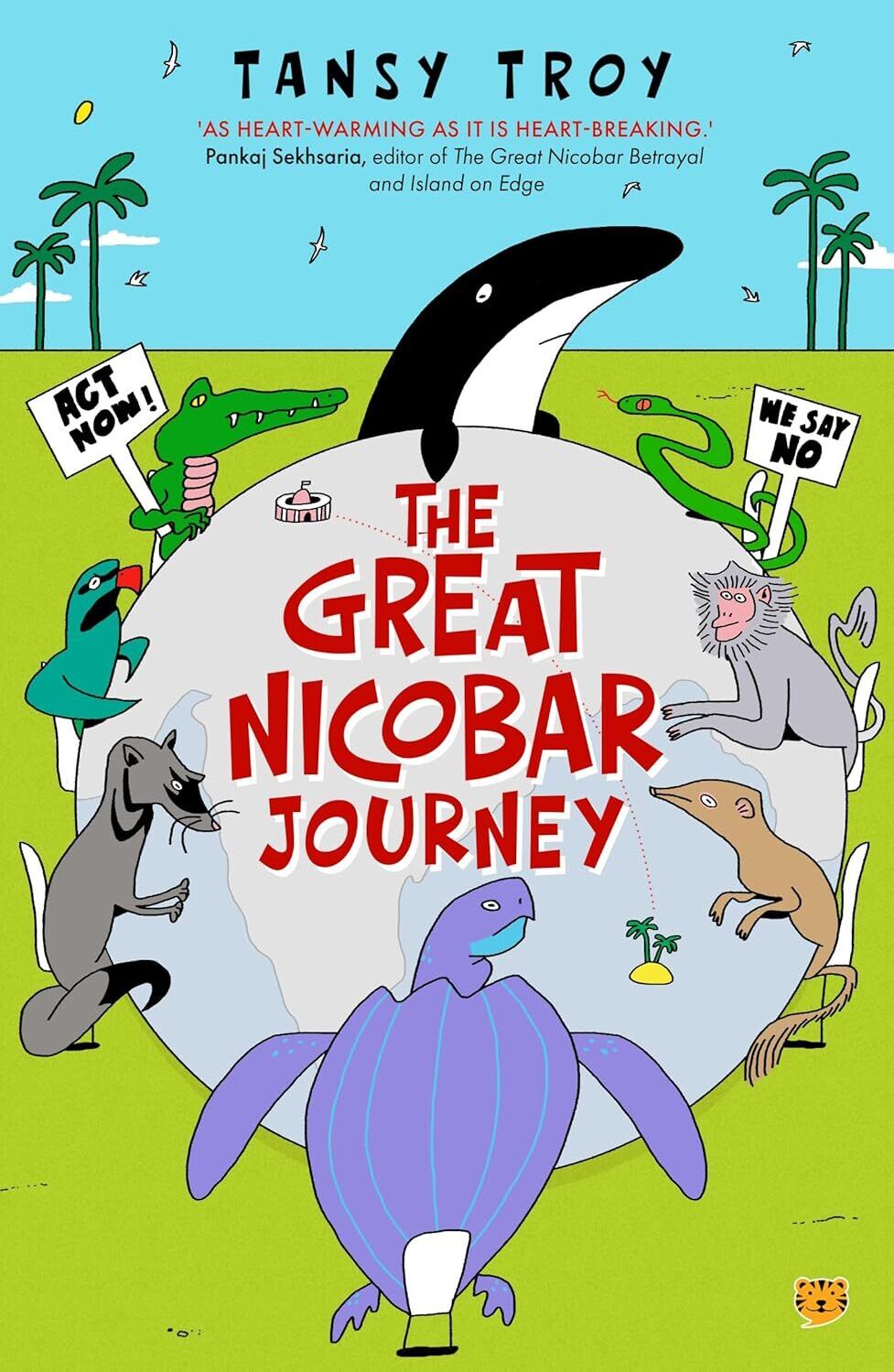
Following an urgent cross-species conference, the “birds, animals, reptiles and amphibians” of Great Nicobar decide that the only way to save their island from certain destruction is to take their concerns to the “doorsteps of the politicians”, the Sansad Bhavan. A wild and multi-talented coterie of creatures including the Nicobar Parakeet, Saltwater Crocodile, Civet Cat and Treeshrew prepare for a dangerous journey across the country to Delhi where they hope to petition the powers that be and prevent the takeover of their habitat by “huge cutting machines and earth movers”. As they climb aboard a makeshift raft and set sail to the mainland, anticipating humans, guns and the manifold challenges before them, we embark on a journey of learning about some of the rarest life forms from one of the most unique ecosystems in the country.
The Great Nicobar Island Development is an infrastructure project proposed by the Government of India, ostensibly for strategic reasons. It includes a massive port, a military airport, a powerplant and tourism outposts among others, and is set to guarantee the destruction of over 130 sq km of forest land. Although the project has speedily garnered the environmental approvals needed to proceed, concerns remain about the damage to the local ecosystem, including the felling of some ten lakh trees, not to mention the threat to several endemic flora and fauna as well as the local tribal residents, the Shompen and the Nicobarese. Writer Pankaj Sekhsaria has been leading the charge on the mainland to inform and publish, and was educationalist Tansy Troy’s inspiration to take up the telling of the pressing Nicobar story for a young audience.
Troy weaves an imaginative narrative of teamwork and the need to fight for the common good. As they travel, the animals swap stories of suffering at the hands of humans in a multispecies tongue. Obstacles on the way give the creatures a chance to support one another on this long and arduous journey to the Sansad Bhavan, which traverses many states and terrains. The animals make friends on the way, learn from a colourful cast of fauna about habitat destruction and loss of biodiversity across the country, and earn faithful allies, including two young members of the Kattunayakan tribe from the south of India, who also face a threat to their lives and livelihoods.
The story is well told and refreshingly narrated from the point of view of animal characters. Troy deploys natural voices and an easy willingness to be emotional — she does not shy away from discussing pain and suffering — making the book both engaging and warm. A pangolin talks about the poachers who tried to kill his mother. A tiger they run into on the mainland shares how she struggles to feed her cubs. Although these tales are somewhat episodic and don’t all build towards the resolution, images and descriptions are striking and fresh, and we feel like we are getting to know the animals very well. Troy builds a charming and cooperative universe with a touch of humour and whimsy, making it easy for young readers to compassionately engage with the serious subject matter. The animals’ accounts throw up valuable and undeniable questions of what it means to coexist when one species has outsized power over the lives of others.
As we follow along, adult readers might wonder anxiously how Troy plans to wrap up her tale. To pretend that there are easy resolutions to the animals’ life-threatening problems would be to slightly mislead children, soften a blow that perhaps needs to land in order for the genre of eco-fiction to really do its work, and provide hope where there might be none. However, an ending where the animals return to their home in Sambelong defeated would only make the journey feel pointless and plunge readers into hopelessness, when the aim should surely be to spur greater awareness and action. What the author comes up with is ultimately in tune with the fantastical and playful note she has struck all along. A poetic coming together of human and animal in a dance across the streets of Delhi acts like any large spectacle of public feeling. Widely reported on by news channels and influencers and too moving for the world to look away from, this moment compels the foolish, caricaturish politicians to withdraw the development plan. In this scene, the book imagines an exciting and thrumming future moment where what ties all life together wins over the motivations of profit, greed and a desire for political power.
Overall, there is no doubt that Troy has addressed a complex issue head on. By making the animals the protagonists of her story, engaging in creative world-building, and making gentle but pointed fun at the humans whose bad-faith decisions bring about environmental ruin, she succeeds in producing a tale that draws attention to the voices and claims of non-human actors in our shared world. Young readers will certainly find themselves empathising with the animals and questioning the human motives at play. However, one angle that is not sufficiently addressed in the book is that of the big business interests that drive developmental tradeoffs and fuel projects like the Great Nicobar makeover. Although Troy does not flinch from naming politicians and experts as complacent participants in the betrayal, she misses the real enemy — greed. While leaving out the nexus between business-people and those in power makes it possible for her to tell a satisfying story about representation and how non-human lives too should have a seat at the table (why, after all, do the characters go to the Sansad Bhavan?), it’s an incomplete picture of what is going on in reality. In this light, it’s especially important that when using The Great Nicobar Journey as a resource, librarians and teachers find a way to bring this element of the critique into the conversation. The antagonism between people and nature has, after all, for centuries, been mediated by the project of resource exploitation for profit.
Finally, a note on the writing style, which though pitch perfect on humour and pace, aims a little too low on vocabulary for the 10+ age-group.
About the Reviewer:
Dakshayini is a feminist educator. Her instructional experience spans age-groups and learning needs, and ranges across the areas of libraries, language, gender and social science.