
Paradise Regained
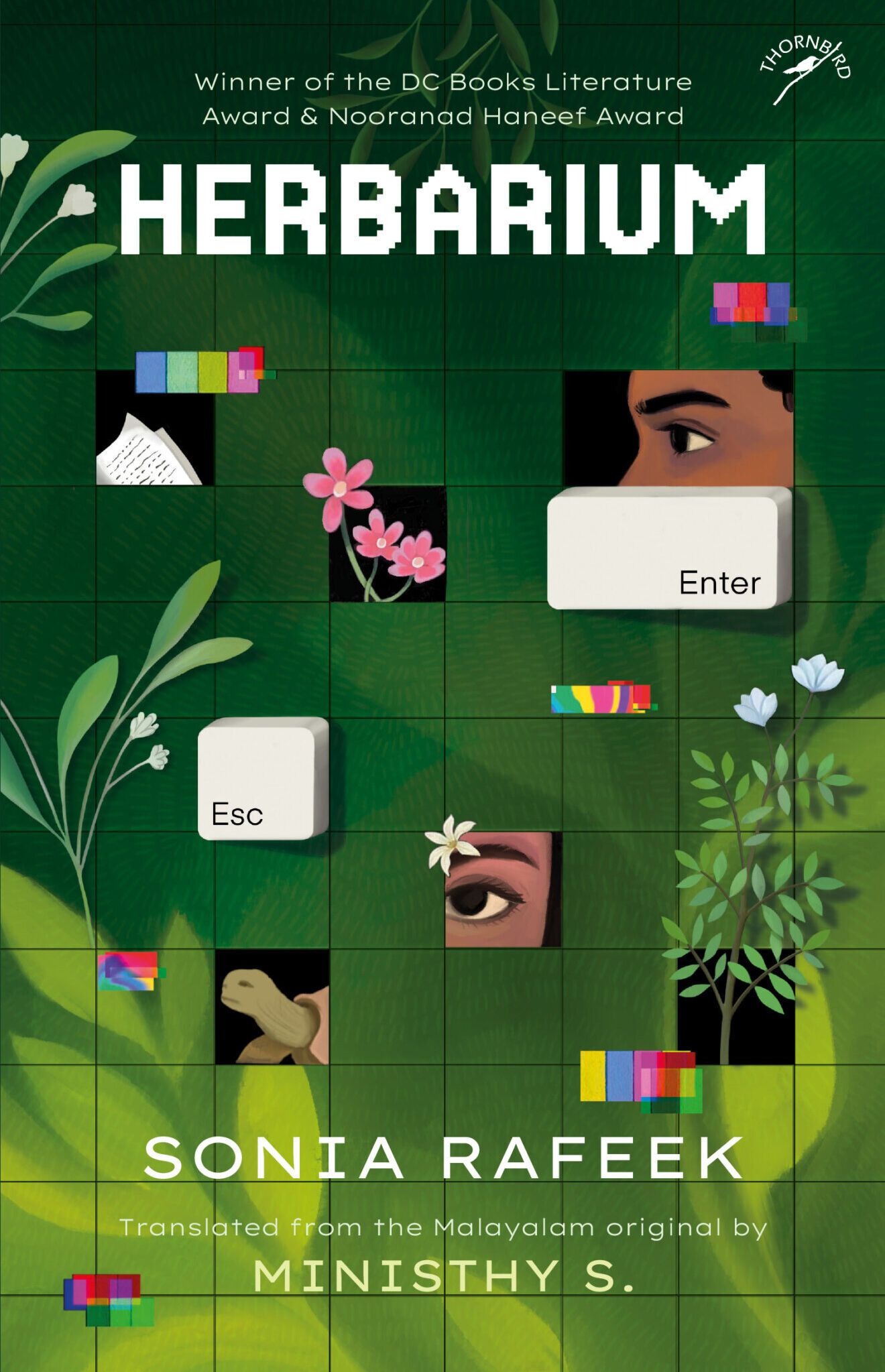
Book title: Herbarium
Author: Sonia Rafeek
Translator: Ministhy S (from Malayalam)
Publisher: Niyogi Books (paperback, ₹595)
Reviewer: Sucharita Sengupta
Details
The United Nations, that island of incurable hope walking a tightrope in a world gone awry, has masterfully articulated what so many of us have known all along — that insofar as climate change is concerned, the world is beyond redemption. Natural disasters occurring worldwide are both proof and process of the recklessness that has accompanied human ingenuity. To read a novel like Herbarium at this moment in history feels both hopeless, and yet an act of defiance. It is akin to watching the natural world collapse in painful slow motion, bringing into sharp relief the devastation being caused by human activity, with acute awareness that this damage cannot be undone. However, the zeal of the story’s young protagonists to protect and preserve the ecosystem offers hope, making readers believe that this juggernaut of destruction can be halted. Originally penned in Malayalam by Sonia Rafeek, the book has been written for young adults, the only demographic not growing up blind to the catastrophe.
Herbarium narrates the story of Tipu, a nine-year-old boy living in Dubai with his playful mother, Fatima, and a strict father, Asif. The sudden death of his mother overturns his life and he finds himself back in Kerala, the place of his parents’ origins. Although the loss and displacement disorient Tipu for a while, living with his grandmother, Nabeezath, in the lush greenery of the Malabar, allows him to discover a world filled with love and new adventures.
In Kerala, Tipu encounters his extended family, while processing hazy memories of his mother, and his father’s oscillation between grief and regret. He meets a house help with a feral personality, neighbouring families shunned by society due to caste and disability, and experiences the freedom that comes with building community at the margins where the rules start wilting. He makes new friends such as a science teacher and his daughter, Ammalu. A bundle of energy, Ammalu becomes Tipu’s playmate and partner-in-crime, and together they begin a fantastical adventure exploring their surroundings and discovering the mysteries, joys, beauty and dangers of nature. Tipu’s friends are not just the ones in his new neighbourhood and new school. He also makes friends with Anku the tortoise, originally his mother’s pet!
The novel takes the reader through the rhythms of life and society in Kerala. Far from being a simplistic tale, Herbarium does not shy away from articulating complexity. Under the canopy of greenery lies wealth and greed. Women are lonely, and yet they form unlikely bonds, staying with each other through the best and worst of times, creating intriguing backstories that lend innumerable layers to the narrative. There are no heroes, perhaps with the exception of Fatima, Tipu’s mother, who wafts in and out of the tale like a fairy, and seems to hold the world together like the Earth Goddess (Gaia). Every character has a clear role — they are rich and poor, able-bodied or discriminated against due to disability, terminal illness, caste, gender, or even occupation. But instead of imbuing them with pity, the author has portrayed them as a part of society and has succeeded in rendering their pain in the most humane way.
Nature, though, is the central character and context of this novel. From mountains and rivers to the sacred grove around which large parts of the story are built, it appears not as a backdrop of myriad human activities, but as the fount of life itself. The author’s professional training in plant pathology is put to wonderful use to describe the flora of the region, as a miracle of science as well as a work of art.
Herbarium is structured like a complex piece of embroidery, with disparate elements blending into each other to create a dazzling whole. The prose is rich with detail, full of the heaviness of emotion that accompanies the desecration of the environment, and deeply empathetic. The translation is exquisite as it conveys the intent and purpose of the original with nary a jarring note, and with the tenderness usually reserved for poetry. Winner of the DC Literature Award 2016, Herbarium is a must-read for young people as well as a wider audience.
About the Reviewer:
Sucharita Sengupta is Associate Professor at the Department of Political Science, Jamia Millia Islamia, New Delhi. She is the co-editor of The Thief’s Funeral: The Book Review Anthology of Short Stories, published by Aleph Book Company, 2024.