
Bonding over Botany
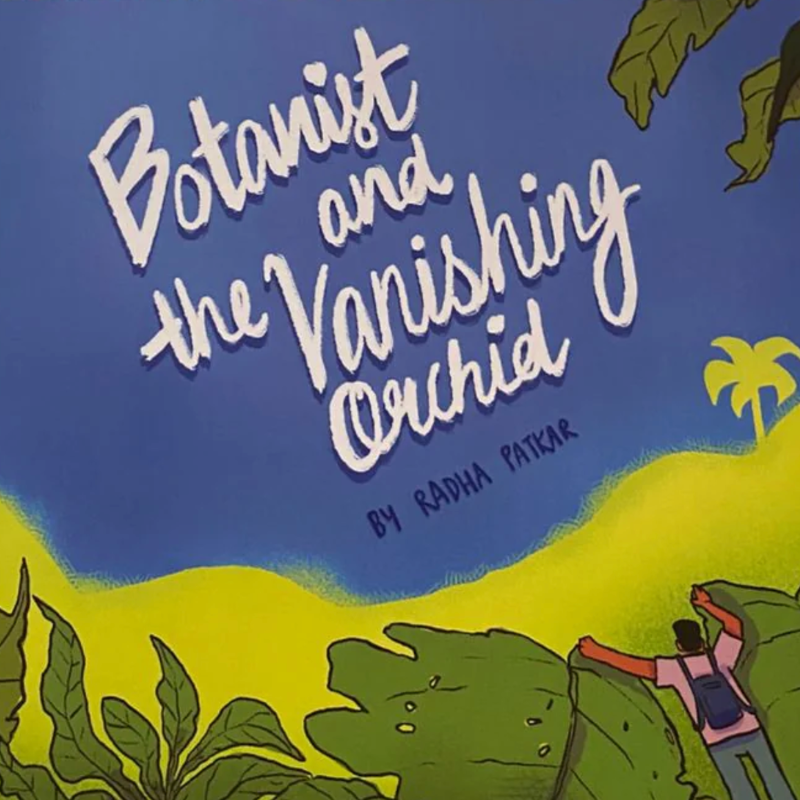
Title: Botanist and the Vanishing Orchid
Author: Radha Patkar
Illustrator: Radha Patkar
Publisher: Ashoka Trust for Research in Ecology and the Environment (paperback, INR 500)
Reviewer: Meghaa Gupta
Details
Plants are rooted. They don’t move about like animals and this lack of animation, perhaps, makes them less interesting to young readers. So, it’s not surprising to find that even though there is an abundance of children’s books on wildlife, there is a dearth in those about plants. Botanist and the Vanishing Orchid by Radha Patkar bucks this trend.
Based on a true story of the botanist R. Ganesan, this well-produced picture book takes readers into the Kalakad Mundanthurai Tiger Reserve, a biodiversity hotspot in Tamil Nadu, where Ganesan and his field assistant Ramesh are on a mission to locate a rare plant species, Symplocos. This turns into an adventure that ends with Ganesan literally stumbling upon the Yellow Lady’s Slipper Orchid — the vanishing orchid of the title, that had gone out of sight for many years. What he does with this discovery appears to be the motivation behind this book.
The set up is interesting and the colour palette is eye-catching. Readers get a fascinating glimpse into the fieldwork of botanists, as they follow Ganesan and Ramesh in the forest, but it is more of a splash rather than a plunge into the richness of this world. We learn a little bit about many different things — the work of unsung botanists, the vivid landscape of the Kalakad Mundanthurai Tiger Reserve and how plants vanish — but don’t delve deep into any of them. For a book set largely in a biodiversity hotspot, very few plants and animals are pointed out and named for curious readers, and the lack of detail in the illustrations doesn’t help.
In many ways, the story reads like an anecdote masquerading as a picture book. It narrates the experience of a botanist who accidentally finds a plant many believed had gone extinct. He is excited to share this discovery with the world, but ultimately, decides to keep it a secret. Plant-lovers are likely to appreciate this narrative where flora rather than fauna plays a starring role. But young readers, used to books about wild animals and the threats to their existence, may not understand the full import of it. Why does it matter that rare plants they may never have heard of, and may never encounter, are being found?
There is a tantalising bit of information about orchid-hunting at the end, which caught my fancy. I wondered whether this book might have worked better if it had zoomed into the story of the orchid, why it was prized and how it vanished, before narrating how it was rediscovered. This might have served its intended readers a bit better. One also wonders whether closer editing was needed — it was a bit odd to find an article missing from the title! Nevertheless, Botanist and the Vanishing Orchid is a bold attempt to draw attention to an underrepresented subject and opens a door to discussions around human-plant relations. For that, it must be appreciated.
About the Reviewer:
Meghaa Gupta works in children’s publishing and co-edits the Nature Writing for Children newsletter. She writes a column on plant histories for The Hindu Young World.