
PG Diploma in Teaching Children with Learning Disabilities
Enabling teachers to support children with varying learning needs in the classroom
Details
About 5 to 15 percent of children in classrooms in India have a learning disability. Policies mandate that all children need to be part of the regular school system, irrespective of their learning needs. But due to lack of awareness and poor implementation of the policies, children with disabilities are often forced to drop out of school. Teacher preparedness is critical for ensuring that children with learning disabilities become a part of an inclusive school system.
The Postgraduate Diploma programme in Teaching Children with Learning Disabilities aims to equip teachers to understand the nature and characteristics of the condition as well as possess the necessary knowledge to adapt the curriculum and modify teaching strategies to help the children cope with the demands of a regular school curriculum and become lifelong autonomous learners.
Enabling teachers with the required skills and knowledge helps develop competencies needed to function as effective inclusive school teachers, thereby fostering their professional growth in the workplace.
Who should join us?
This postgraduate diploma is open to practicing regular school teachers, special educators, counsellors and school heads working in private and public school systems in India.
What does the programme offer?
The postgraduate diploma is designed for school teachers and school functionaries to understand learning disability as a condition and develop skills for identification, assessment and application of evidence-based teaching methods in inclusive classrooms.
Some important features of the programme are
- This programme is aligned to the credit structure as defined by the National Credit Framework (NCrF) issued by UGC in April 2023 and aims to fulfil the need for professional development amongst school practitioners and functionaries.
- It enables to deepen the understanding about the nature and needs of students with learning disabilities and related conditions in classrooms.
- There is a deliberate focus to provide knowledge about the processes of curriculum adaptation, assessment and educational programme planning for students with learning disabilities.
- The practitioner’s ability to apply research-based teaching methods for children with learning disabilities in regular school classrooms is enabled through this programme
- The programme opens avenues for meeting like-minded people through the University Alumni network.
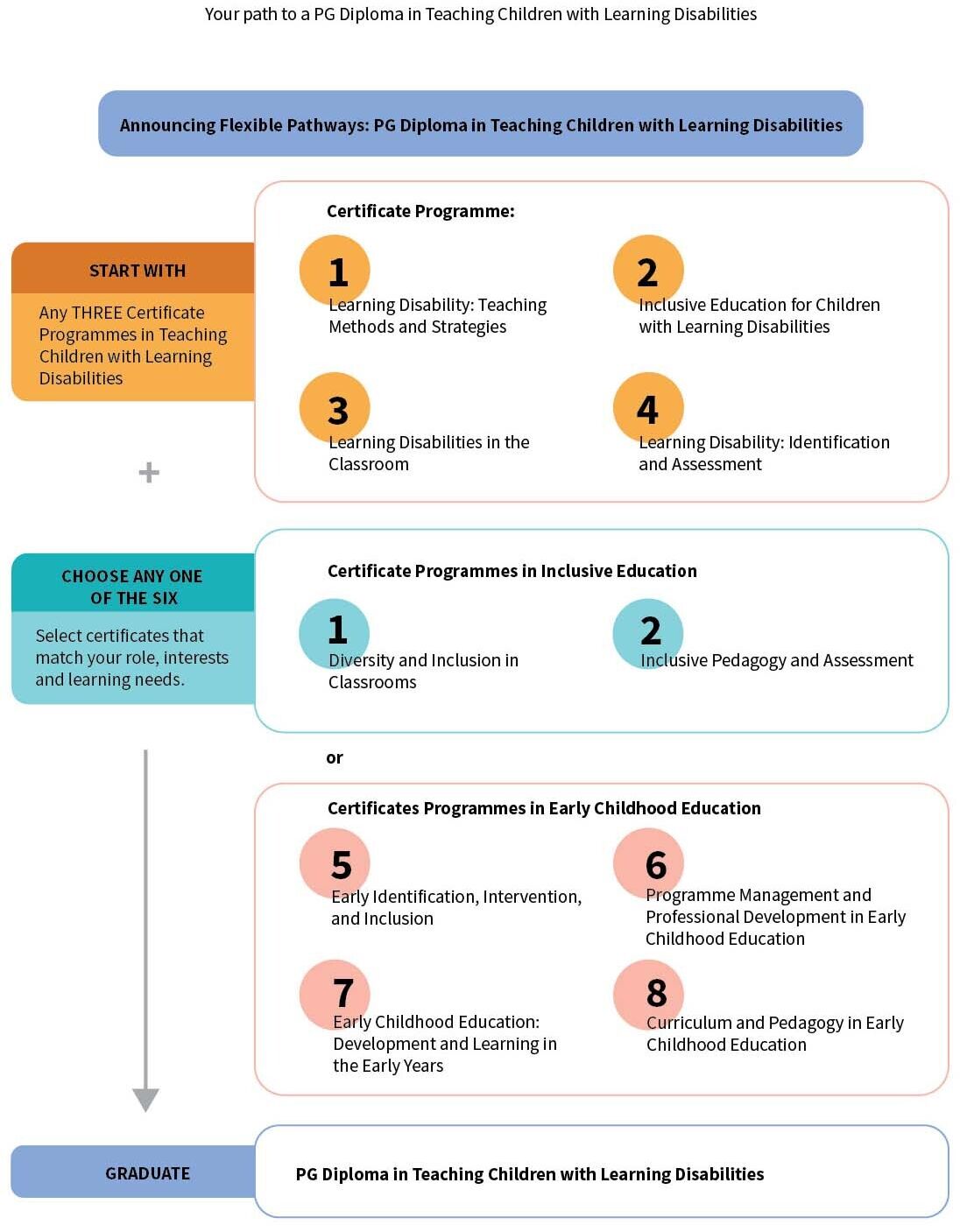
- Participants have the flexibility of joining the PG Diploma Programme or choosing one or more Certificate Programmes. If they choose only one Certificate Programme, they could do so based on the calendar.
Programme Structure
Programme Flexibility
The 40 credits, 12 months Diploma is offered in a blended mode, with online and on-campus interaction.
The PG Diploma Programme comprises four Certificate Programmes (12 weeks duration, 10 credits each) covering key aspects of Learning Disability.
Participants have the flexibility of joining the PG Diploma Programme or taking one or more Certificate Programmes.
Successful completion of the four Certificate Programmes leads to the award of the PG Diploma. The PG Diploma can be completed within a maximum period of 2 years.
In this programme the participants will learn about evidence-based practices for enhancing information processing abilities, social emotional behaviour and academic achievement of children with Learning Disabilities
Course 1: Intervention for Children with Learning Disability — An overview
This course emphasizes that the integration of professional wisdom with the best available empirical evidence in making decisions about how to deliver instruction is very important to help children with learning disability in a classroom. The course provides the participants of the programme with an understanding of the importance as well as the different perspectives and available models for evidence-based practices in intervention for children with learning disability.
Course 2: Instructional Strategies in the Curricular Areas for Children with Learning Disability
It provides guidelines to the learners in using specific teaching strategies and approaches for specific curricular areas in which children with LD face learning difficulties.
Course 3: Intervention: Social, Emotional and Behavioural Issues
The course discusses approaches to effective management of challenging behaviours within the classrooms and otherwise. In addition to creating a safe and calm learning space, participants will also learn how to deal with emotional outbursts and challenging behaviour of students. Using an empathetic lens, teachers will try to unpack the social and emotional regulation difficulties of these students by identifying the underlying skills they are lagging.
Course 4: Project based course — - Learning Disability: Teaching methods and Strategies
This certificate programme will help general education class teachers work with children having learning difficulties to help them achieve optimal learning outcomes. The courses in the programme prepare teachers to plan and apply appropriate intervention strategies in different curricular areas as well as support their social-emotional learning. It will also inform teachers to help children use learning strategies to become more purposeful, effective, and independent learners. Through this project, the participants will observe the learning environment, the curricular and pedagogical practices, teaching learning materials, and analyse how they address the needs of all children including those with learning difficulties. Some themes that will be explored in this project include teaching aids for the intervention of children with learning difficulties, including assistive technology, public awareness resources, policies regarding the accommodation of children with Learning Disability, etc. The participants will be mentored by the programme instructors.
Besides explaining the philosophy of inclusive education, this programme will develop the participants’ knowledge about Universal Design of Learning and its application, and the need for cohesive collaboration for inclusive education.
Course 1: Inclusive Education
This course deals with the philosophy and practices in inclusive classrooms. It focuses on the management of the curriculum in inclusive classrooms.
Course 2: Universal Design of Learning and Differentiated Instructions
It develops a conceptual understanding and discusses principles and guidelines for planning instruction using UDL and DI. It aims at providing a link between them and the usefulness of these techniques for working with children with LD in inclusive classroom settings.
Course 3: Collaboration and Support for Inclusive Education
This course focuses on the collaborative effort of teachers, parents and community in order to support Inclusion as an ongoing process. The course prepares teachers to work with the community and to develop capabilities to support other teachers in their schools to create inclusive school settings.
Course 4: Project based course — Learning Disability and Inclusive Education
This certificate programme is aimed at developing the participants’ understanding of inclusive education, frameworks that support the practice of inclusive education and collaboration between various stakeholders for inclusive education. The project is meant to enable the participants to reflect on these aspects by observing inclusive schools, the curricular and pedagogical practices, assessment strategies and the extent of stakeholders’ involvement. This will enable them to analyse whether or how schools cater to the diverse needs of all children. The participants will undertake field visits and gather information through interviews, surveys/questionnaires, readings. The Project will be mentored and supervised by the instructors.
- Course 1: An overview of Learning
- Course 2: Introduction to Learning Disabilities
- Course 3: Learning Disabilities and Associated Conditions
- Course 4: Project based course
Course 1: Growth and Development
The course is designed for teachers in regular classrooms as an introduction to the principles, domains, and contexts of child development. By exploring typical patterns of development across various domains like physical, socio-emotional, and cognitive, as well as the environmental and sociocultural contexts that impact children’s development, participants will gain an understanding that will enable them to recognise atypical developmental patterns.
Course 2: Screening, Identification and Assessment of Learning Disability
The course is designed for teachers in regular classrooms and will help the participants of the programme to appreciate the need for screening and identification of learning disabilities in the context of schools and classrooms. The course intends to drive home the importance of early identification, leading to better opportunities for children to adapt and reach their full potential in academic as well as non-academic areas.
Course 3: Observing and Nurturing the Whole Child
It aims to help teachers understand how their perceptions of children affect learning outcomes and children’s self-perception. Teachers will learn to observe learners in various contexts to gain a holistic understanding. It will encourage them to adopt a growth mindset and strengths-based approach when working with children.
- Course 4: Project-based Course
Programme Calendar (Tentative)*
| Certificate Programme | Programme cycle | Face to face interaction* |
|---|---|---|
| Inclusive Education for Children with Learning Disabilities | 14 Dec, 2026 — 05 Mar, 2027 | 01 Feb — 05 Feb, 2027 |
| Learning Disabilities in the Classroom | 16 Mar, 2027 — 05 Jun, 2027 | 20 Apr — 24 Apr, 2027 |
| Learning Disability: Identification and Assessment | 15 Jun, 2027 — 04 Sep, 2027 | 20 Jul — 24 Jul, 2027 |
| Learning Disability: Teaching Methods and Strategies | 15 Sep, 2027 — 04 Dec, 2027 | 26 Oct — 30 Oct, 2027 |
*Above dates are indicative and may change. Dates for the face to face classes will be re-confirmed at the beginning of each Certificate Programme.
Online class schedule — Online classes will be held every Tuesdays and Thursdays from 4:30pm to 6:30pm
Programme Pedagogy
- Online — This will be conducted through lectures, group work, workshops, presentations, readings, participation in discussion forums on Learning Management Systems, audio/video material and regular assessment.
- On-campus/face-to-face interaction — Each of the four Certificate Programmes of the PG Diploma Programme has a face-to-face component that involves one week of on-campus engagement, providing opportunities for sharing of learning through intensive group work and interaction with experts and practitioners from the field.
- The on-campus components will be held at Azim Premji University, Bengaluru.
- Registering for individual Certificate Programmes, would entail mandatory attendance in the face-to-face component for the respective certificate.
- Registering for the entire PG Diploma Programme would entail mandatory attendance in the face-to-face component in minimum of the two Certificate Programmes. The participant will have the flexibility of choosing to attend the face-to-face session or completing an alternate portfolio for the remaining two Certificate Programmes.
“The PG Diploma in Teaching Children with Learning Disabilities helped me deepen my understanding of quality, child-centred learning. It strengthened my leadership lens, helping me design reflective, inclusive learning spaces and guide my team toward continuous professional growth rooted in research and child-centred practice. The blended structure, rich peer learning, and campus immersions allowed me to study alongside work seamlessly.”
Related Stories


The Allure of Self-Diagnosis of Attention Disorders
Bhuvaneswari B, drawing from her extensive experience as both a professional clinician and a teacher, emphasises the critical importance of obtaining a proper diagnosis.
Faculty
4 of 5 All Programme faculty →