
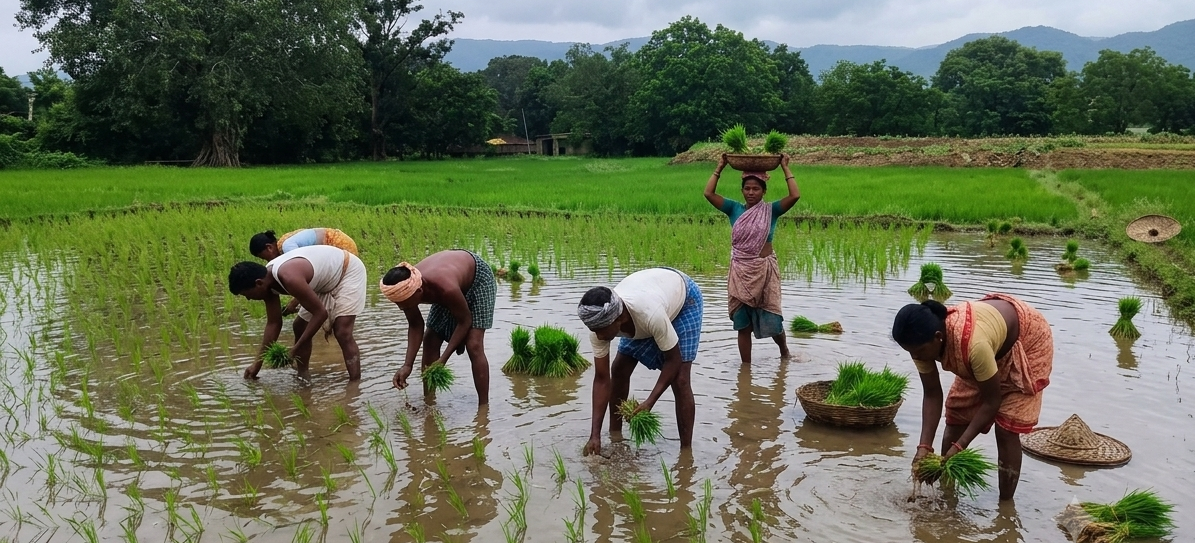
Sustainable Agriculture: Perspective, Practices and Applications in the Field December 2026 Batch
Rethinking agriculture for resilient rural livelihoods
Details
Sustainable agriculture is both a science and a practice, spanning the social, biophysical, ecological, and economic sustainability of farming systems yet no commonly accepted definition exists. Its meaning has been shaped largely by political and scientific discourse, with little room for farmers’ own experience, and the sector remains fragmented by ideology, differences in local agroecological and farming contexts, institutional challenges to adapt practices and transition at steady pace, and the continued pull of green revolution methods. This calls for a nuanced understanding grounded in science, local realities, and farmers’ experience.
CSOs and government extension personnel play a critical role here, working directly with smallholder farmers, women’s groups, and marginalised communities underserved by formal institutions. But sustainable agriculture is knowledge and skill intensive; it demands reading ecological processes, understanding soils and crops as living systems, and applying science to local conditions across soil health, seed systems, bio-inputs, crop planning, pest and weed ecology, water management, and integrated farming, all contextualised within farmers’ socio-economic realities. Field teams, often from diverse backgrounds with limited agroecological exposure and working within project-based, resource-constrained structures, struggle to build these capacities.
This points to the need for structured learning spaces that combine conceptual clarity with field-based learning moving beyond ideology to help practitioners understand the science, principles, and limits of different approaches, and translate these into locally relevant, season-specific practice.
This 9‑day residential course designed in association with CSA, Hyderabad, meets this need through a rigorous, practice-grounded exploration of diverse approaches combining knowledge sessions with field activities, participatory exercises, village visits, simulation games, and reflection, so participants connect science with practice, resolve open questions, and build conviction to champion this emerging field.
The 9 days will cover a range of themes, with each theme explored through four sessions.
| Day | Theme |
|---|---|
| 1 | Foundations of Sustainable Agriculture: Concerns, Discourses & Principles |
| 2 | Soils: Formation, Diagnosis, Health Monitoring & Nutrient Budgeting |
| 3 | Farming Systems: Crop Management, Regenerative Agriculture, IFS |
| 4 | Water Management & Seed Systems |
| 5 | Session break: Simulation games, films and extracurricular activities |
| 6 | Pest – Disease – Weed Management |
| 7 | Agro-Ecosystem Analysis & Bio-input preparation practicals |
| 8 | Field immersion |
| 9 | Training, Extension & Farmer Collectives |
| 10 | Field Action Plan / Project Presentation |
Who should attend?
It is intended for practitioners, thematic leaders, programme managers, KVK scientists, and extension personnel working with minimum of 3 – 4 years of experience in natural resource management, extension services, agricultural livelihoods, or rural development.
Eligibility and selection
All applicants are required to have a functional working knowledge of both Hindi and English, along with basic practical experience in farming or agricultural practices.
Important dates
Last date to apply
Last date for fee payment
Pedagogy
The course will be transacted through interactive sessions, lectures, small group activities, videos, hands on exercises, observatory learning in KVK farm, farmer testimonials, case stories, exposure visits, simulation game, etc.
Medium of instruction: A mix of English and Hindi. The course will be conducted face-to-face only. Course materials will be available in English.
Course faculty
The course will be facilitated by the faculty members of Azim Premji University and resource persons from Centre for Sustainable Agriculture, Hyderabad.
Sumit Sow, Prabhat Kumar Jha and Binju Abraham (Azim Premji University, Ranchi)
Guest faculty from Centre for Sustainable Agriculture, Hyderabad
Ramanjaneyulu G V
As Executive Director of the Centre for Sustainable Agriculture (CSA), Hyderabad, which he founded in 2004, he leads agroecology and natural farming programmes that work across soil science, farmer enterprise, markets, and public policy. CSA partners with state governments, farmer collectives, universities, philanthropic foundations, and international agencies to scale low-input, high-return farming and build farmer-owned institutions that can sustain these systems. He works towards building food systems where farmer knowledge, farmer institutions, and farmer economics are placed at the centre rather than at the margins.
Gowri Sankara Rao
He is a Team Lead at the Centre for Sustainable Agriculture, Hyderabad, and works on agroecological farming systems, bioresource centres, and integrated livelihood models to strengthen farmer livelihoods and food security. He has extensive expertise across seed systems, agricultural research, public – private partnerships, and the development sector. He has played a key role in translating public research into scalable farmer-impact solutions through the PPP model.
Uday Kiran Viswanadhuni
He currently works with the Knowledge Management Team at the Centre for Sustainable Agriculture, Hyderabad. In addition, he works as a Consultant Agronomist for large-scale farm development projects in Andhra Pradesh and Telangana.
For more details of these course faculty, visit https://csa-india.org/
Certificate of participation
The participants will be awarded a Certificate of Participation after successfully attending all the days and submitting assignments.
Fee Structure
| INR 12390 | For individuals from non-partner organisations |
|---|---|
| INR 1770 | For individuals from partners of Azim Premji Foundation, including Field Practice Partners of Azim Premji University. |
The fee is inclusive of GST.
Registration fee is not applicable for government employees.
Small NGOs (below INR 5 crore annual budget) can apply for fee waiver.