
Old Bhopal: Reading a City’s History Through Its Heritage
A walk in the city inspires students to view monuments through the lens of their own disciplines
Campus
Bhopal
Details
A monument can tell us about the people who built it, the traditions they drew upon, and the times they lived in. But its story does not end there. The ways in which people use a historical space today can tell us just as much about its place in the life of a city.
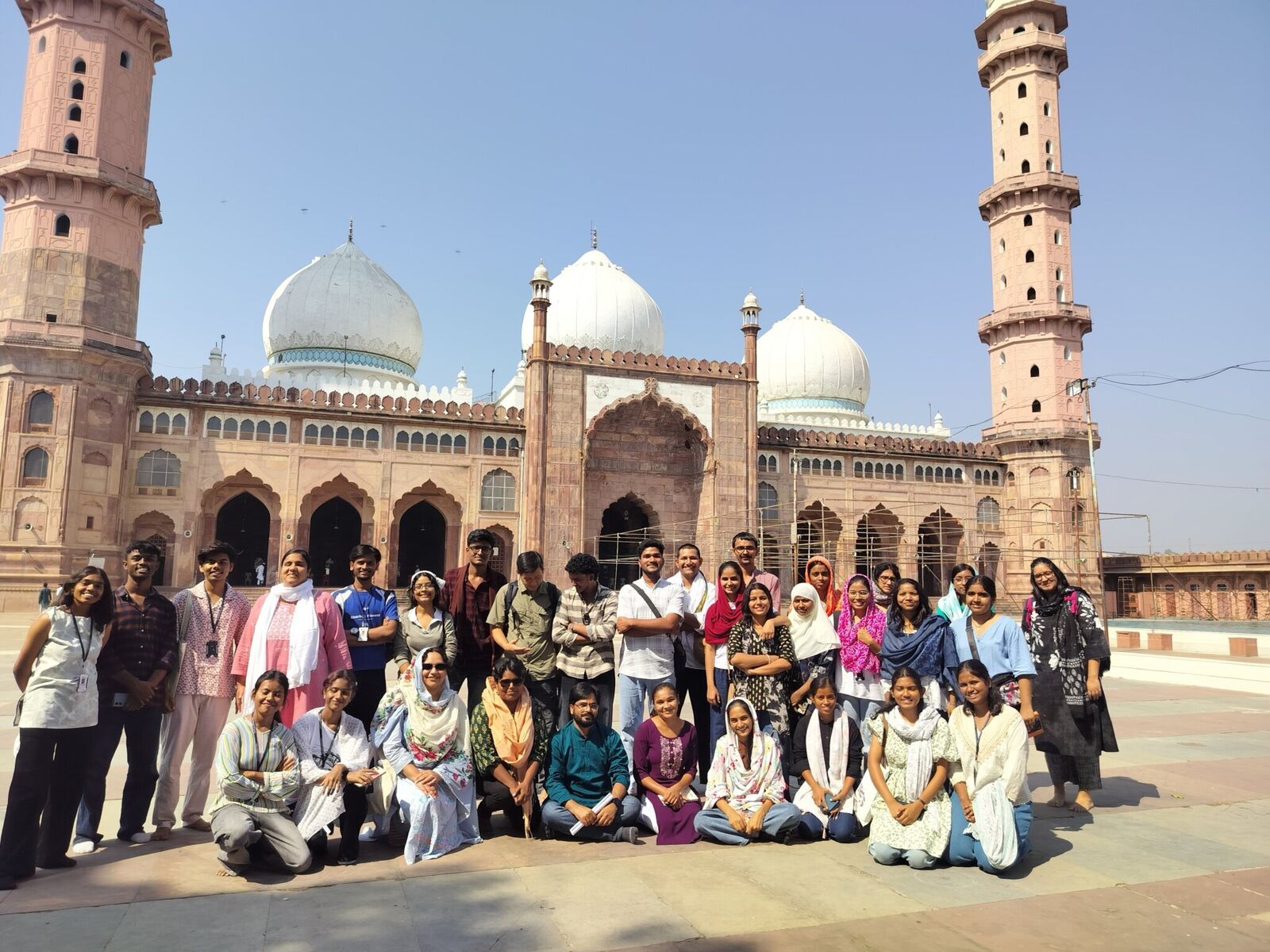
This was one of the ideas that came through during a heritage walk in Old Bhopal organised for undergraduate students of Azim Premji University on 24 October 2026. Students from Biology, Social Science, Economics, English, and History took part in the walk, accompanied by faculty members of History. The large group was divided into smaller ones, allowing students to spend time at the sites, ask questions, and discuss what they were seeing.
The walk covered five monuments: Kamlapati Mahal, a testament to the city’s Gond queen; Gauhar Mahal, a symbol of Bhopal’s cultural refinement; Moti Masjid, an architectural gem; Badwale Mahadev Mandir, an ancient historical site; and Taj-ul-Masjid, among the largest mosques in South Asia.
At these sites, the students looked beyond the familiar histories of palaces and places of worship. They were interested in the architecture, the influences behind it, the beliefs associated with these spaces, and the ways in which they continue to be used.
More than what meets the eye
At Taj-ul-Masjid, students explored the different elements of mosque architecture. These included the mihrab, a semi-circular niche in the front wall pointing towards the qibla; the minbar, a raised pulpit from which the khatib delivers the khutbah; the iwan, or vaulted hall; the sehan, or courtyard; the hauz, or ablution tank; and the minar and gumbad. They also looked at decorative features such as arabesques and Quranic verses.
The discussion soon moved beyond identifying architectural elements. Students wanted to know which features belonged to local, Indian, Islamic, and Persian traditions, and how the architecture responded to the climate. They asked about the meanings of the Quranic verses on the mosque walls and, on observing the zanana, a separate hall attached to the mosque, raised questions about its purpose and why women are currently prohibited from attending prayers there.
These questions brought together several ways of looking at the same building: as an architectural space, a place of worship and education, and a site with its own social and cultural histories.
Heritage is also about how people use a place
For Sawan Sahu, a second-year BA History student, one of the important takeaways from the walk was that a monument cannot be understood in isolation from the people who engage with it.
“I learnt that heritage is not formed barely because of the monument itself but because of how people interact with it.”
At Taj-ul-Masjid, Sawan noticed that the mosque continues to serve as a place of worship and education, with a madrasa within its premises. He made similar observations at Moti Masjid, which is also still used as a place of worship. At Gauhar Mahal, he saw an art exhibition featuring artists and their projects, and recalled that poetry workshops and pottery exhibitions had also been held there.
For Sawan, these uses offered another way of thinking about heritage: Historical spaces need not be kept apart from contemporary life. They can continue to be used, bringing older cultural practices and present-day activities together.
The relationship between heritage and the life of a city also caught Abhina K’s attention. A second-year BA Economics student, she was struck by how the historical sites existed within neighbourhoods where people continued with their everyday life.
Her experience also brought up questions about the condition of these sites. She was disappointed by the lack of maintenance at several places, including the Upper Lake. In her view, proper maintenance and development could help these accessible sites offer valuable insights into Bhopal’s history to future generations.
Through a lens, differently
For the students, a visit to these places brought a different dimension to what they had encountered in their courses. Anushree Kamble, a fourth-year BA History student, had heard about some of the monuments before, but found that visiting them and learning about their histories was a different experience. She was particularly impressed by Taj-ul-Masjid’s structure and architecture, and by the connections between different religions and cultures in Old Bhopal.
“I think these visits should be organised often, especially for students, because learning history by visiting these places is much more interesting, than only reading about it in books.”
The walk also gave students an opportunity to consider the city through the lens of their own disciplines. Sawan reflected on how everyday objects, homes, neighbourhoods, and the people who live in them can offer clues to the past. Abhina, meanwhile, connected the experience to questions of economics and urban planning.
Himani Deshmukh, a third-year BA English student, found that the discussions with faculty members added to her understanding of the monuments and their historical significance. Her reflections brought together the architectural, political, religious, and cultural aspects of the sites she had visited.
With students from different disciplines exploring the same places, the walk became an opportunity for shared learning and conversation beyond the classroom. Walking in smaller groups also allowed students and faculty members to interact more informally, while giving students a chance to connect with peers from other programmes.
A heritage walk can begin with a visit to a monument, but it need not end with what one sees there. In Old Bhopal, the students’ questions and reflections took them from architectural details to cultural practices, from the histories of individual buildings to the life of the neighbourhoods around them. The city became a classroom, and its heritage something to be observed, questioned and understood in the present.
Compiled with inputs from
Ghulam Ahmad Raza
Ayushi Dhawan
Yengkhom Jilangamba Singh
Charusmita Surendra Gadekar
Samia Ahmed