
Raja Jesudoss Chelliah
Fiscal and Tax Policy Moulder
By M. Govinda Rao
Details
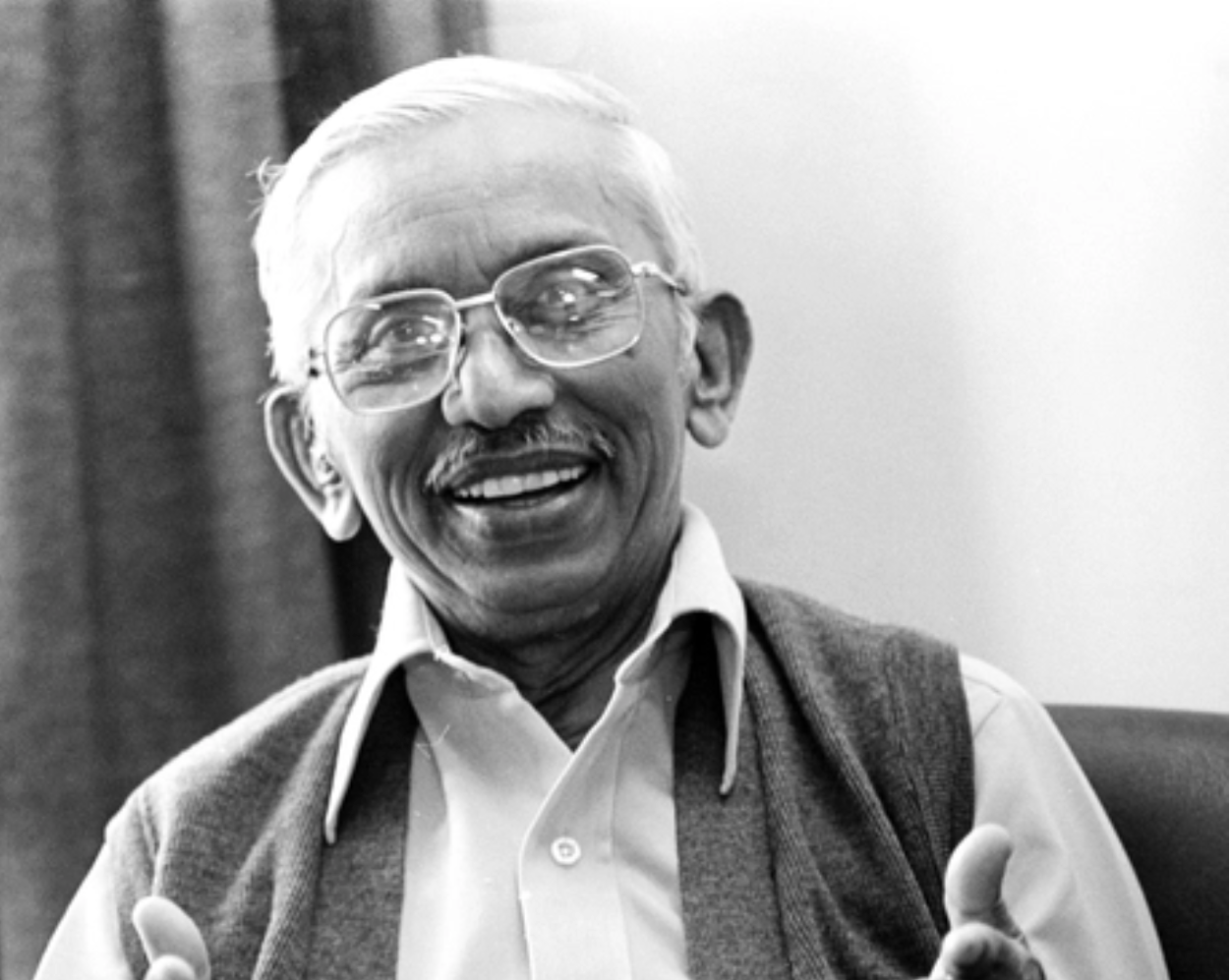
Raja Jesudoss Chelliah, (1922 – 2009) was a renowned economist who made significant contributions to research, advocacy, policy making and capacity building in fiscal policy analysis and reforms in India. He was an important cog in the 1991 wheel of economic transition in reorienting the fiscal policy frame from a planned regime to the market-oriented economy. He was instrumental in making a transition from extortionary and complicated tax system in the country to a modern tax system featuring broader base, lower and less differentiated rates and simpler and more transparent system.
As a member of the Indirect Taxes Enquiry Committee chaired by Mr. L. K. Jha, he was credited to recommending the introduction of Value Added Tax in the country, the idea which he developed more fully later in the report of the Tax Reform Committee, which he chaired. As the Chairman of the Tax Reforms Commission appointed by the Union Finance Minister, Manmohan Singh in his first reform budget in 1991, he laid the foundations for a modern tax system needed for a competitive market economy. He was a great builder of institutions and laid solid foundations for continued high-quality research in fiscal policy at the National Institute of Public Finance and Policy in Delhi.
Motivated by the need to impart quality education in economics to the younger generation in the southern part of the country, he started the Madras School of Economics, which has emerged as an important teaching and research institution imparting education in modern economics.
Raja Chelliah was born on 12 Dec 1922 at Kovilpatti town in Thoothukudi District of Tamil Nadu. After completing his M.A. in Economics from Madras University, he taught at the Madras Christian College for five years before availing a Fulbright fellowship to work for his PhD at the University of Pittsburgh in the United States. After completing the PhD, he returned to India to join the National Council of Applied Economic Research (NCAER), New Delhi for a brief period (1958 – 1960) and thereafter, he moved to Rajasthan University (1966 – 69) and later to Osmania University, Hyderabad (1966 – 1969). In 1969, he joined the International Monetary Fund and worked as the Chief of the Fiscal Analysis Division in the Fiscal Affairs Department. Convinced that there was much to be done back in India to redesign fiscal policy for the development of the country, at the behest of the then Finance Minister Mr. C. Subramanian, he returned to India to set up a major policy think tank, the National Institute of Public Finance and Policy (NIPFP) in 1976. The purpose was to interact closely with the Union Ministry of Finance, analysing the policy frame, imparting training to young professionals and advising on macroeconomic and fiscal policy issues. The mandate included assistance to state governments as well by including them also as the stakeholders. In 1984, he was called upon to head the international committee on tax reforms by Mr. Robert Mugabe, the Prime Minister of then newly independent country, Zimbabwe. He served as a Member of the Planning Commission between 1985 – 1990. When economic reforms were initiated by the Narasimha Rao government in 1991, he was called upon to chair the Tax Reforms Committee (1991 – 93). After the report was submitted, the Union Finance Minister, Dr. Manmohan Singh invited him to guide the implementation of the recommendations by appointing him as the Economic Adviser to the Finance Minister (1993 – 95). This made him the main architect of tax reforms in India, laying the foundations for a new tax system in the country keeping in view the need to restore incentives and reduce distortions. He introduced international best practices in shaping the tax system in the country.
In a career spanning almost 60 years, Raja Chelliah undertook his research on theoretical and policy issues on subjects such as concept of budget deficit, tax policy and reforms, allocative and technical efficiency in public spending, sustainability of public debt in India and intergovernmental finance. One of the widely acclaimed works of Raja Chelliah early in his career was the book Fiscal Policy in Underdeveloped Countries with Special Reference to India (1960). The book was the first systematic attempt to apply the developments in Keynesian economics to address the problems, needs, and institutional rigidities in underdeveloped, overpopulated developing economies with mixed economic systems caught in the vicious cycle of low saving, investment, and growth. It deals with the challenges of raising revenues from taxation and underlines the principles of designing and implementing the structure of taxation in developing economies. This was a seminal contribution not only to the developmental problems in India but also to a number of newly independent low-income countries striving to fast-track economic growth. He mentored a number of young colleagues in public finance research. The book he wrote with his younger NIPFP colleagues, Trends and Issues in Indian Federal Finance (Allied Publishers, 1981) and the co-authored study, Survey of Research in Indian Fiscal Federalism (1996) published by the Indian Council of Social Science Research continue to be standard references on the subject of intergovernmental finance. His focus was not confined to fiscal policy issues alone; he edited an important book on Income, Poverty and Beyond in 1999 for UNDP. Other important books he wrote were Towards Sustainable Growth: Essays in Fiscal and Financial Sector Reforms in India (Sage Publishers, 2008), Political Economy of Eradication in India and Essays on Financial Reform (Sage Publishers, 2010) and Ecotaxes on Polluting Inputs and Outputs (Sage Publishers, 2007). It is no exaggeration to state that no other economist in India has made as much contribution to the fiscal policy debate as Raja Chelliah has.
At the NIPFP he laid a strong foundation for analytical and applied research, many of them specifically addressing policy issues. His continued guidance, first as its Director, and later as its Chairman shaped it to become a major think tank in fiscal policy in South Asia. Its services are sought not only by the Union and State governments in India, but also in the neighbouring countries. Concerned about the quality of teaching and research in the universities in the southern part of the country, he started the Madras School of Economics and nursed it from infancy to maturity. Very few people will have the stamina and courage to start an institution after the age of 70, but Dr Chelliah was different. He successfully nursed it as a rare institution of excellence in teaching, particularly in areas such as environmental economics, financial economics and actuarial economics. Dr Chelliah belonged to the rare breed of economists in the country who made tremendous contribution to applied research in public finance and provided strong analytical underpinning for fiscal policy calibration. In recognition of his contributions, he was awarded the Padma Vibhushan, the second highest civilian honour in the country in 2007.
Major works
- Chelliah, R. J. (1960). Fiscal Policy in Underdeveloped Countries with Special Reference to India.
- Chelliah, R. J. (1981). Trends and Issues in Indian Federal Finance. Allied Publishers.
- Chelliah, R. J., & Sinha, N. (1982). Measurement of Tax Effort of State Governments, 1973 – 76. National Institute of Public Finance and Policy.
- Chelliah, R. J. (1991). The Growth of Indian Public Debt: Dimensions of the Problem and Corrective Measures. International Monetary Fund.
- Chelliah, R. J. (1996). Towards Sustainable Growth: Essays in Fiscal and Financial Sector Reforms in India. Oxford University Press.
- Rao, M. G., & Chelliah, R. J. (1996). Survey on Research of Fiscal Federalism in India. National Institute of Public Finance and Policy.
- Sudarshan, R., & Chelliah, R. J. (1999). Income, Poverty and Beyond: Human Development in India. Social Science Press.
- Kelkar, V. L., Shome, P., & Chelliah, R. J. (2003). Reports on India’s Tax Reforms. Academic Foundation.
- Chelliah, R. J. (2007). Ecotaxes on Polluting inputs and Outputs. Academic Foundation.
- Chelliah, R. J. (2010). Political Economy of Poverty Eradication in India and Essays on Fiscal Reform. SAGE Publications.
About the author
Dr M. Govinda Rao is the Director of National Institute of Public Finance and Policy. His research interests include fiscal decentralisation and federalism, state and local finances, tax policy and reforms, and public expenditure and management. He has served as Director of Institute for Social and Economic Growth, Bangalore and as a Member of the PM Economic Advisory Council.