Making it Through an Overstretched Secondary School System
Miriam Thangaraj’s study reveals how systemic pressures and school-level decisions shape the daily realities of secondary schooling in marginalised (Adi Dravida) youth.
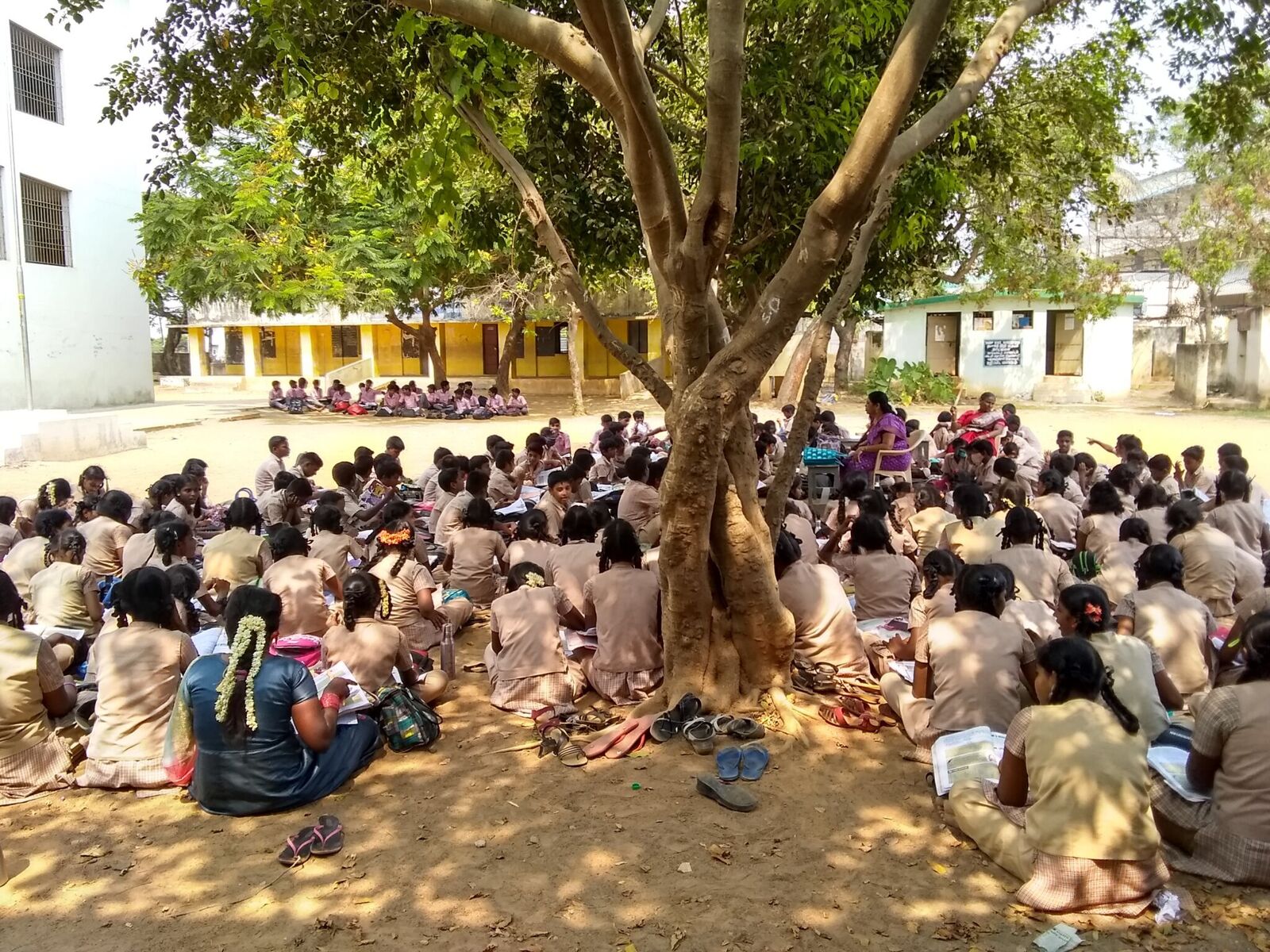
Multiple grades are clubbed together during teachers election duties
Details
For two years, Miriam Thangaraj, who teaches at Azim Premji University’s School of Education, followed a cohort of 60 students at a government secondary school in Tamil Nadu. She was observing their educational journeys through grades 9 and 10 as part of a cross-comparative global study of how marginalised students around the world were faring over the last decade, as national and local commitments expanded secondary education.
In India, the Right to Education Act 2009 mandates free and compulsory education up to 14 years. As an increasing number of students continue their education beyond the compulsory years, Miriam was keen to understand their motivations for staying in school and their experiences once they entered secondary education.
The site of her study was Pudhupur High School (name changed), one of the ‘welfare schools’ in rural Chengalpet run by the Adi Dravidar and Tribal Welfare Department. Fifty-eight of the 60 students in the cohort she observed were first-generation secondary schoolgoers. Miriam’s two-year journey of observing the everyday routines of these students and their teachers revealed how systemic pressures and school-level decisions shaped the daily realities of secondary schooling.
An overstretched system
India allocates 4.1 percent of its GDP to education. This is significantly lower than the 6 percent envisioned by the Kothari Commission in 1966, a figure that was reiterated by the National Education Policy 2020. Stagnant public spending over the years has led to structural bottlenecks, including shortages in infrastructure and teaching resources.
“The post-compulsory secondary stage inevitably bears the brunt of an overstretched system,” explained Miriam.
In India, the grade 10 board exams are seen as a defining milestone of secondary schooling. This is certainly the case at Pudhupur High School (PHS), where a majority of students are from the historically marginalised Adi Dravidar community. As one of the teachers at the school explained, being “10th-pass” offers them a sense of getthu (confidence). Equally important, the grade 10 certificate serves as a document for the students to apply for government jobs, subsidies, bank loans, and even driving licenses.
In 2022, PHS recorded a pass rate of above 80 percent, significantly higher than other welfare schools. Miriam’s attempt to understand the school’s relative board exam success revealed a curious phenomenon that emerged as a response to an overstretched system. She calls this the “9th-10th trade-off”.
One of the first challenges Miriam noticed was the immense pressure the non-instructional demands placed on teachers. They had to manage increased administrative and reporting responsibilities related to school-based public welfare schemes, while also taking on election and census duties.
Government schools like PHS lacked non-teaching support staff, leaving the teachers to sometimes double up as office clerks, computer lab assistants, and event organisers for various state programmes. The school’s healthy pupil-teacher ratio masked the extent to which teachers were being pulled away from teaching by competing demands.
In such a stretched situation, teachers had to make choices about where to direct their efforts. “As additional responsibilities ate into instructional time, classes often went untaught,” explained Miriam.
Class 9, the sacrificial year
In the face of these resource constraints, the 9th-10th tradeoff became a necessary survival strategy leading the school to divert instructional attention to grade 10 at the expense of grade 9. The success in board exams essentially depended on this trade-off. Miriam observed that throughout the academic year, grade 9 students had constant free periods, multiple mini-breaks, and only occasional and interrupted academic instruction.
“Grade 9 was a time for fun, as the students enjoyed reminding me: for kabaddi-matches, roughhousing, veet kadhai (family gossip) and competitive film-song singing,” Miriam noted.
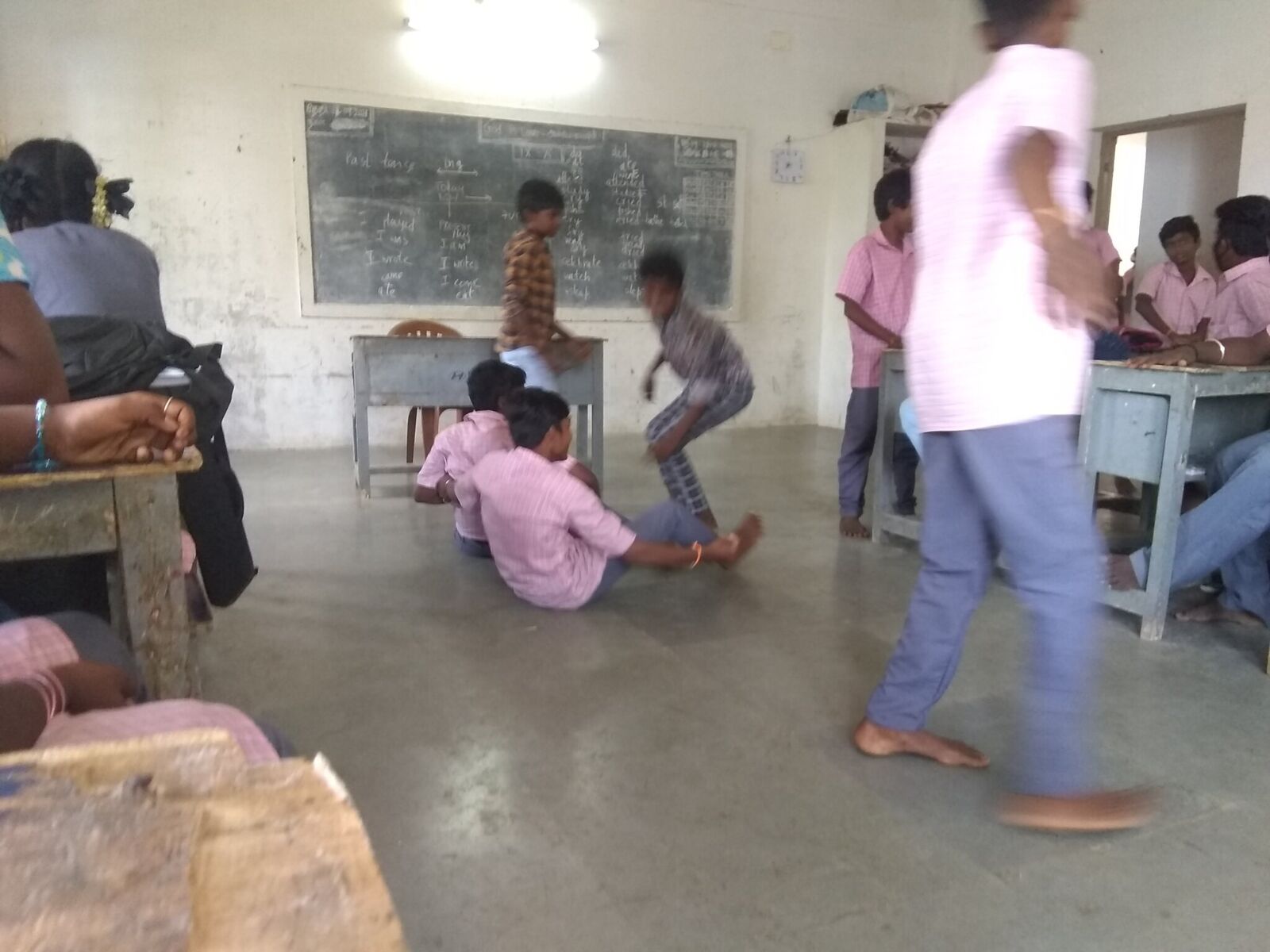
Grade 9 boys playing Kabaddi during one of their many free periods.
Once the same cohort reached grade 10, the classroom underwent a remarkable transformation. In stark contrast to the “party atmosphere” of the grade 9, grade 10 had an air of seriousness. Everyone at school rallied together. Even parents would think twice before asking their children to take on any household chores. There were special classes every morning and evening after school. Students of grade 10 were exempted from morning assembly while games, crafts and library periods were sacrificed to teach examinable subjects.
“The all-out resource-intensive push by teachers, students, and households towards a 10th-pass could be sustained only so long (in grade 10) in poorly resourced schools and communities. Ultimately, the 9th-10th trade-off enabled each other,” she explained.
Passing is separated from learning
In the face of systemic and instructional resource constraints, pushing 82 percent of the cohort through grade 10 was an impressive achievement for PHS. To Miriam, it also revealed the compromises of an overstretched school system responding to a high-stakes board exam; teaching was focused on helping students pass rather than developing a deeper understanding of subjects. The lack of subject specialists at the school (teachers handling English and science did not have qualifications in those subjects) was another challenge.
“Many students come through the primary schooling system with an uncertain educational experience and in grade 9, they had another year of freedom. Ultimately, grade 10 had to compensate for 9 years of uncertain schooling,” Miriam clarified.
One of the students assured her about the grade 10 English board exam saying, “Don’t worry, I’ll pass. Even if I can’t read, I’ll pass.” Another student added that while English was hard and he couldn’t understand much, their teacher had coached them well and he was certain they would pass the exam easily enough.
As understanding became separated from passing the exam, a lot of time was spent on strategising. Students were made to practice the correct form of exam-writing. Teachers urged students to make their answer papers easier for the examiners to read, in the hope that examiners, in turn, would be lenient in their marking. From asking them to write neatly and underline the main points, to giving them the roadmap to score the minimum 35 marks – by first attempting the multiple-choice questions worth one or two marks and finally the five-mark questions – teachers offered many tips.
In February and March, with board exams around the corner, Sundays were spent in school so students could practice exam-taking strategies with teachers. On top of it all, a third of the grade 10 students also attended tuitions in January… one final push by parents and students to perform well in the board exams.
“Despite all this intense effort by teachers, students, and even parents, students’ limited learning was likely to undermine their participation in higher education and aspirational jobs over time,” Miriam cautioned.
Teachers sought to “care”
In an under-resourced public secondary education system, the care and effort of teachers often made the difference in ensuring that students stayed in school and on track to completing grade 10.
“One of the misconceptions about government school teachers is that they are not hard-working. But at PHS, I got to witness the time and effort teachers spent on special classes, even on Sundays and holidays,” recalled Miriam. “The 9th-10th tradeoff was not only a response to resource constraints, it was also a form of teacher care towards students from marginalised contexts.”
Many teachers came from Adi Dravidar households themselves and were aware of the social significance that completing grade 10 held for these first-generation secondary schoolgoers. They viewed their exam-focused strategies as a way of ensuring these students cleared the grade 10 board exams in the first attempt. They knew very well that the demands grade 10 placed on families – the time spent away from domestic chores and paid work, the costs of study material and tuitions, etc. – could not be sustained for long.
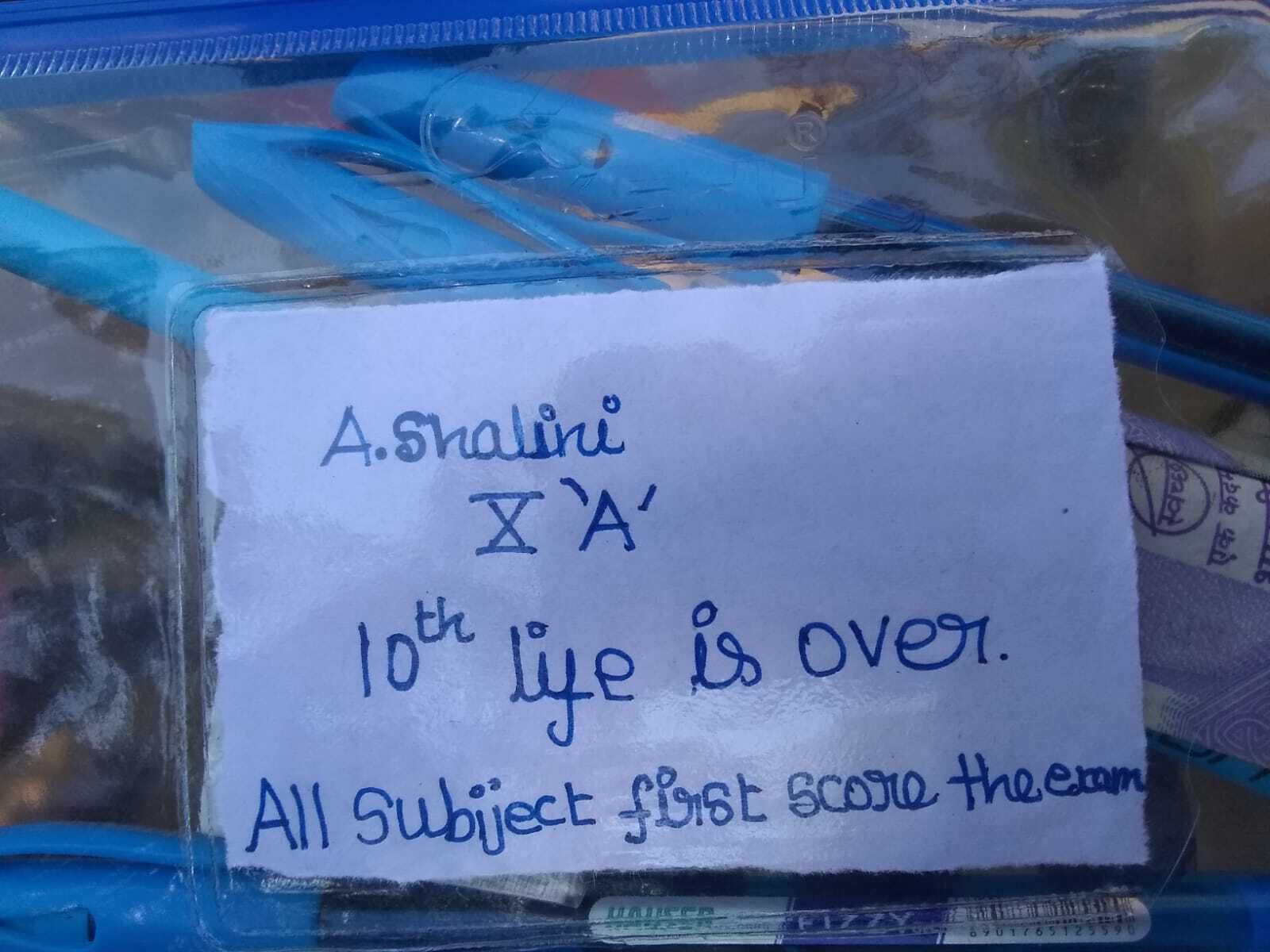
A student’s note on her pencil case captures the general mood of grade 10.
“One of the maths teachers was deeply dissatisfied with just feeding students questions and answers. But she was equally conscious of the need to make sure they get pass marks and move on quickly,” said Miriam.
Did these efforts make a difference? In 2023, only four students failed the 10th Board exam – a dramatic turnaround for a cohort in which only two students had scored above 35 percent in grade 9 the previous year. Given these results, it is not surprising that the 9th-10th tradeoff continues to persist at PHS even today.
Beyond the door of opportunity
Miriam underscores how the 9th-10th tradeoff is ultimately shaped by the choices made at the highest levels of secondary education. These system-level choices, in turn, lead to a series of decisions at the school level where teachers and schools work with limited resources and competing demands.
“The exams intensify the pressure on these students and teachers from marginalised communities to step in and make up for the government’s historical underfunding of education, secondary education in particular,” commented Miriam.
Meaningfully addressing these gaps, she feels, requires systemic interventions rather than relying on the extraordinary efforts of teachers and students at the margins.
Over the last decade-and-a-half Gross Enrollment Ratio has increased from around 60 percent to almost 80 percent at the secondary level. While the numbers seem to suggest progress, they raise the question of what secondary education delivers to those who make it through the doors.
“The promise was that secondary education was going to change their lives, especially those historically outside the system. We made a door for them to walk in but what happens beyond the door? Ultimately, the students and teachers, especially the most marginalised, are bearing the brunt of trying to make that promise work,” Miriam concluded.
Image credits: Miriam Thangaraj
About the author
Meryl Garcia is a consultant with Azim Premji University’s Research Centre. She spends her time exploring research projects across the social sciences and uncovering the stories hidden within them.