
State of Working India
Details
Reports
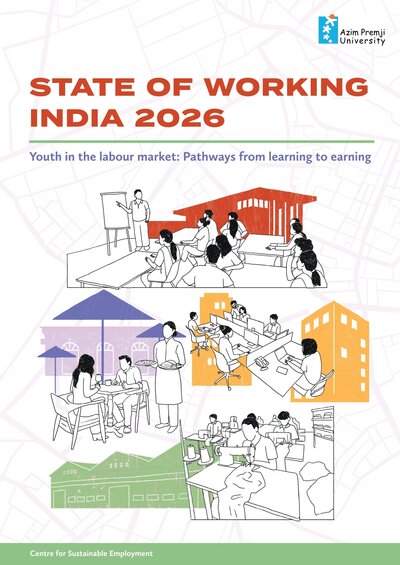
State of Working India 2026 : Youth in the Labour Market | Pathways from Learning to Earning
in Azim Premji University

- Published
- Authors
Abstract
India is nearing the peak of its demographic dividend, with the share of the working-age population expected to begin declining after 2030. On the one hand, higher education in the country has become increasingly democratised with a rapid increase in the number of institutions. Graduate salaried earnings exceed non-graduates both at the time of entry into employment and over their lifetime. On the other hand, financial barriers continue to restrict access, particularly in professional fields such as engineering and medicine. The transition from education to employment remains a major challenge. The rise in the number of graduates has not been matched by commensurate growth in graduate employment. This year’s State of Working India report traces the arc of a young worker’s transition from school or college into employment, and how this has changed in the last forty years.
Report Files
Full Report — download PDF file
Executive Summary (PDF)
Tables (spreadsheet)
Results Appendix (PDF)
All Figures (Figures 1.1−4.7, Figures 4.8−7.10 )
Figures Data(spreadsheet)
Press Release (English | Hindi | Kannada)
Media Coverage (spreadsheet)
Links
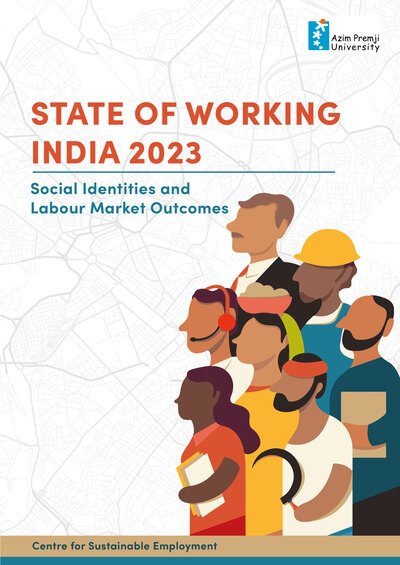
State of Working India 2023: Social Identities and Labour Market Outcomes
in Azim Premji University
- Published
- Authors
Abstract
The Indian story of economic growth and structural transformation has been one of significant achievements as well as continuing challenges. On the one hand, the economy has grown rapidly since the 1980s, drawing millions of workers out of agriculture. And the proportion of salaried or regular wage workers has risen while that of casual workers has fallen. On the other hand, manufacturing has failed to expand its share of GDP or employment significantly. Instead, construction and informal services have been the main job creators. Further, the connection between growth and good jobs continues to be weak.
Report Files
Full report – download revised pdf file, see corrections sheet for changes made to earlier version.
Executive Summary (pdf)
Results Appendix (spreadsheet)
Figure data (spreadsheet)
All figures (pdf)
Tables (spreadsheet)
Press Release (English | Hindi | Kannada)
Media Coverage (spreadsheet)
Links
- Published
- Authors
Abstract
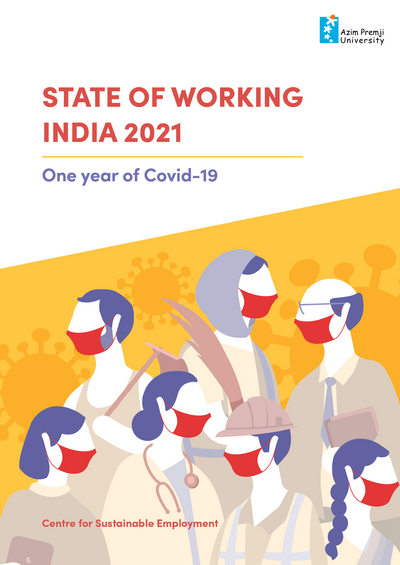
When the pandemic hit, the Indian economy was already in the most prolonged slowdown in recent decades. On top of this, there were legacy problems such as a slow rate of job creation and lack of political commitment to improving working conditions which trapped a large section of the workforce without access to any employment security or social protection.
The pandemic has further increased informality and led to a severe decline in earnings for the majority of workers resulting in a sudden increase in poverty. Women and younger workers have been disproportionately affected. Government relief has helped avoid the most severe forms of distress, but the reach of support measures is incomplete, leaving out some of the most vulnerable workers and households.
The report was released on 5 May 2021- you can watch the recording of the online event here.
Report Files
Executive Summary (pdf)
Figure data (spreadsheet)
Tables (spreadsheet)
Links
- Published
- Authors
Abstract
To contribute to the critical matter of India creating just and sustainable employment, the University has set up the Centre for Sustainable Employment (CSE), which conducts and supports research in areas of work, labour, and employment. The University is attempting to provide empirically grounded, analytical reflections on the state of work and workers in India, as well as to evaluate and propose policies that aim to create sustainable jobs. To this end the University also gives grants to create new knowledge in the above areas. It also hosts a working paper series to which contributions are invited from researchers, policy-makers, civil society actors, and journalists. The University’s CSE website is an important part of this agenda. In addition to research papers and policy briefs, it hosts government reports, as well as data and statistics on the Indian labour market. This also includes executive summary of the report.
State of Working India 2019 consists of labour market trends between 2016 and 2018, and four policy papers around the theme of employment generation.
Release event: Presentation and panel discussion
State of Working India 2019 Release Event Part One — YouTube
State of Working India 2019 Release Event Part Two — YouTube
Links

- Published
- Authors
Abstract
India is one of the world’s fastest growing economies. To be a stable and prosperous democracy, this growth must be accompanied by the creation of meaningful, secure and remunerative employment. Realising this goal requires a grounded and comprehensive overview of the state of labour markets, employment generation, demographic challenges and the nature of growth.
The State of Working India (SWI) is envisioned as a regular publication that delivers well-researched, analytically useful information on India’s labour market, by bringing together researchers, journalists, civil society activists, and policymakers interested in labour and employment issues.
The report is based on the research of CSE staff, as well as on background papers which are available online. SWI conceives of India’s ongoing structural transformation as composed of two processes — movement of workers from agriculture to non-farm occupations (the Kuznets process) and from informal activities to formal ones (the Lewis process). But it adds crucial considerations of social equity and ecological sustainability to this standard framework. In the 21st century, Lewis and Kuznets have to meet Ambedkar and Gandhi.
Report Documents
Figure Data (XLS)
Background Papers
Bijolia’s Harvest of Stone: Conditions of Work Among Quarrying Labour in Rajasthan
Gender Differentials in Expansion of Informal Enterprises
Labour Absorption in Indian Manufacturing: The Case of the Garment Industry
Hard Work, Low Pay : Work Patterns Among Rural Women in West Bengal
Understanding the performance of India’s manufacturing sector: Evidence from firm-level data
The Indian Labour Market: A Fallacy, Two Looming Crises and a Silent Tragedy
Domestic Workers and the Challenges of Collective Action in Informal Work: A comment
Individual Chapters:
Chapter Two : Who Is Looking For Work?
Chapter Three : Where Is the Work?
Chapter Four: How Good Is The Work