
Governing the Margins: Collective Rights over Forests by Gram Sabha Federation in Kalahandi, Odisha
By Sital Kumar | July 2026
Details
The Green Gold Rush
The dawn breaks early for the women in Dakibandel Village, Bhawnipatna Block in Kalahandi. A quick meal of pakhala or ragi gruel, a quick prep of collecting polyethene bags and jute sack-covered water bottles, leads to groups of them walking from their khapara thatched houses to the surrounding forest. They are on their search for the region’s Green Gold.
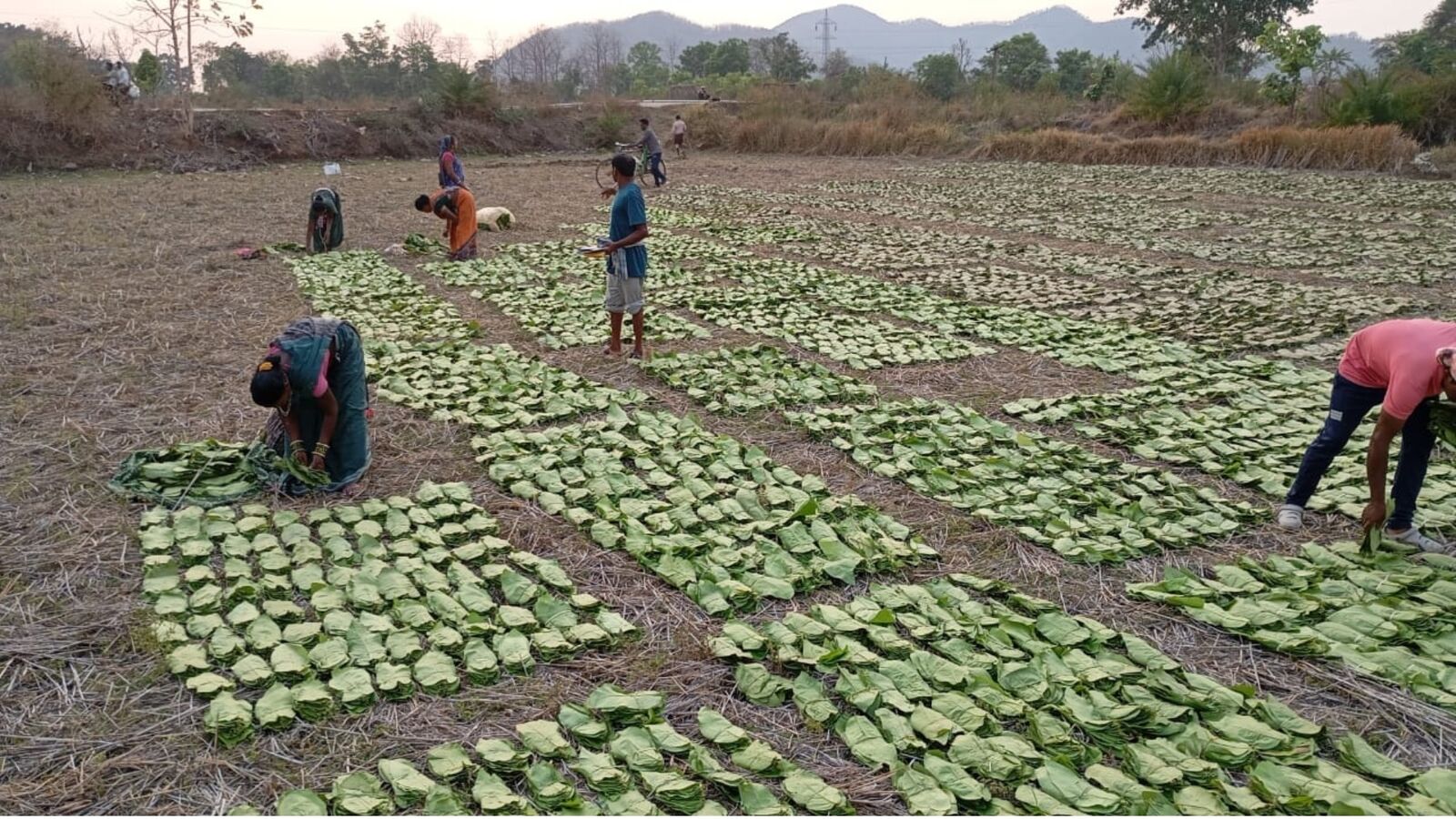
At the woodland edge of Mahua (Butter tree), Sal, Eucalyptus, and bamboo, Coromandel Ebony (Diospyros melanoxylon) plants popularly known as Kendu trees shine with a deep shade of green. Unlike their friends deep in the forest, these hardwood trees are seldom allowed to grow beyond the height of two meters. Every year, around February and March, the shrubs are trimmed, leaving only a few centimetres above the ground. After 45 fog-free, mist-free days, the Kendu shrubs bear fresh leaves ranging from light coffee to dark green in colour. And the rush begins.
The kendu leaf fields are soon bedlams of conversations, bickering, orders and songs. Standing tall amongst the 30 – 40-odd kendu leaves pluckers is Basmati Majhi, the President of Dakibandel Gram Sabha. She conveys all instructions in a loud tone for the pluckers not to cluster in one place, not to pluck small leaves, and not to strip the branches off. The work of plucking leaves and depositing handfuls of them into the polyethene sacks continues till the sun scorches at midday. Upon return, the leaves are taken out of the bags, tied into regulation bunches (keri) as decided by the Gram Sabha. The regulation bunch simply means a bunch containing the number of leaves agreed with the trader. In the afternoon, the bunches are taken to the Gram Sabha phadi (a ground to sun dry the leaves. It also works as a temporary storage area, paid for by the trader) where Basmati inspects the bunches for quality and quantity. She orders the bunches to be registered on the yellow cards that bear the seal of Kalahandi Gram Sabha Mahasangh – a district-level federation of Gram Sabhas that have been conferred Community Forest Rights under the Forest Rights Act, 2006.
“Each bunch should contain 42 palm-sized green leaves, no more or no less. The Gram Sabha collects all the leaves of a season and sells them to a trader. The trader pays for the green leaves. The trader has also appointed members from our village to sort, stack and dry the leaves, against payment for their labour,” explains Basmati. “Kendu used to sell for as low as 5 paise per dried leaf. Now, we get 14 paise for the green leaves,” she adds. The Gram Sabha issues the transit permit and arranges labour for these tasks. The traders pay the labourers directly at an agreed rate.
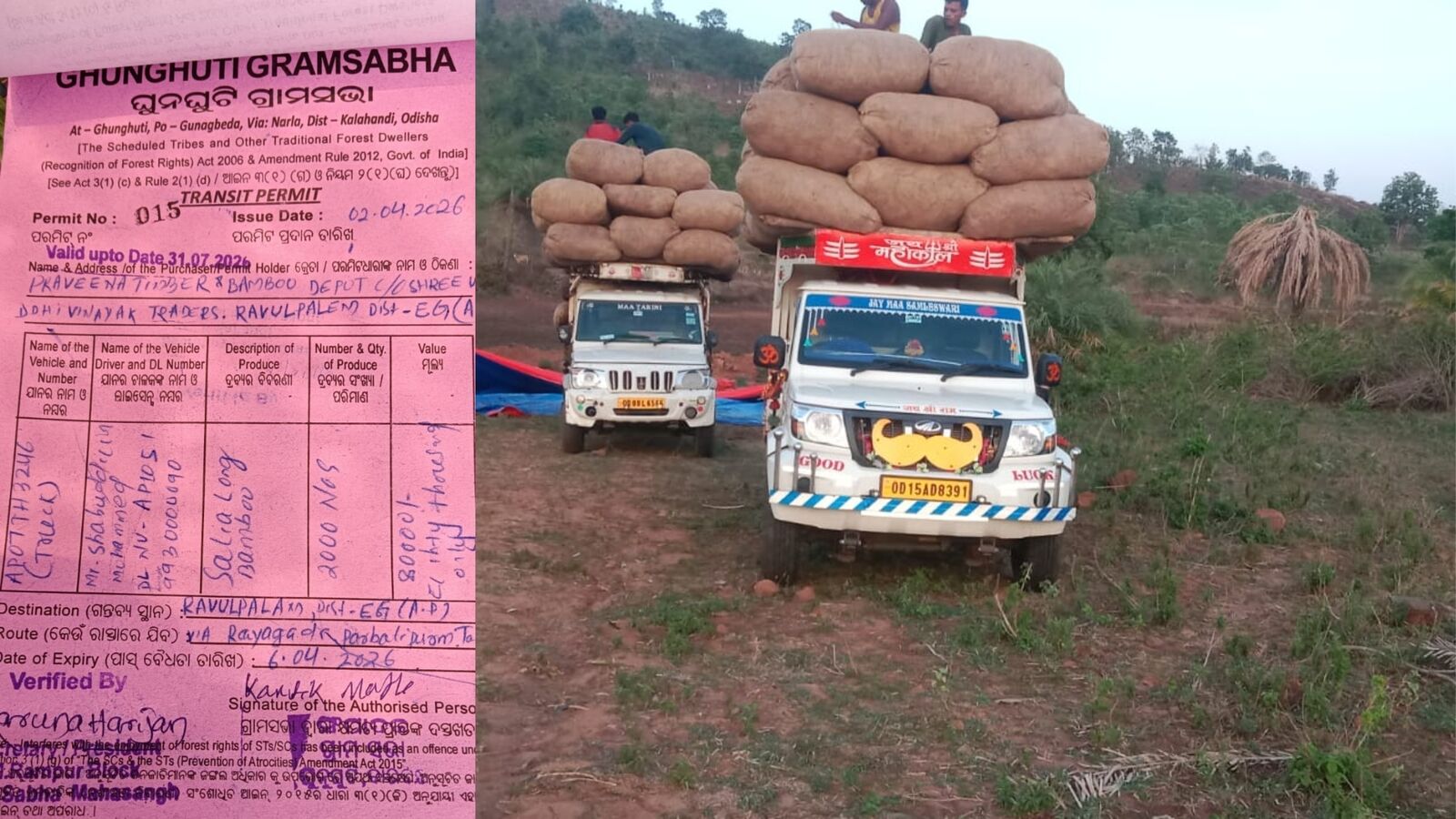
Transit Permit issued by Gram Sabha and Vehicle with Non-Timber Forest Produce.
The bunch of 42 green kendu leaves will fetch INR 5.90/-. A bulk of this, i.e., INR 5.05/- goes to the pluckers as wage under a rate decided by the Gram Sabha. The remaining 85 Paisa is distributed among the various stakeholders involved. In the year 2026, 42.5 Paisa went as remuneration to the 11 members of the Community Forest Resource Management Committee of the Gram Sabha, engaged in the trade of kendu leaves. 34 Paisa gets deposited in the Gram Sabha development fund’s bank account to meet conservation works, social welfare works and education promotion of the Gram Sabha. The accounts of the 8 active block-level Gram Sabha Mahasangh across the district shall receive 4.25 Paisa from their respective member Gram Sabhas. The remaining 4.25 Paisa is deposited with Kalahandi Gram Sabha Mahasangh (KGSM).
Kendu leaves are not the only item whose trade is controlled by Gram Sabhas. Bamboo, tamarind and Chironji (Buchanania lanzan )too are now traded by them. Kendu leaves trade forms the biggest chunk of it, though. “The annual trade of kendu leaves across our 130 – 140 Gram Sabha members ranges from INR 8 to 10 crores”, explains Jatiram Naik, the President of Junagarh Block Gram Sabha Mahasangh. “Over 9000 families across the district get an influx of cash during the non-agricultural months. This money helps the female members to take care of the household expenses”, explains Mr Naik. The Kalahandi Gram Sabha Mahasangh and its member institutions help Gram Sabhas exert their rights over the collection, storage and trade of sustainably harvested NTFPs like kendu, bamboo, tamarind and chahar as per the rights conferred under section 3 (1) © of the Forest Rights Act, 2006.
“In many institutions, problems are hidden until they become bigger,” she says. “Here, we try to discuss them openly. When people sit together, listen to each other, and find solutions collectively, the institution becomes stronger.”
Whose forests?
Kendu leaves, much like other high-value non timber forest produce (NTFP) viz. mahua flower, bamboo, sal and chahar leaves, have been a site of contestation, exploitation and confusion for years. The politics of forest lands revolves heavily around the debate of livelihoods versus conservation. Some argue that forests can never be simultaneously spaces for both, while others differ. The former advocates cordoned-off protected areas, such as national parks and wildlife sanctuaries, as well as the selective exploitation and scientific management of forests by the forest department. In contrast, the latter maintains that the social development of indigenous forest-dwelling communities does not require separating them from their habitat. Further, they argue that decentralised community-based forest governance is the best way to tackle mounting issues of rapid ecological decline, climate change and loss of species.
The former view, however, dominated the governance and management of forests for more than 150 years. Indigenous people and traditional forest dwellers have been systematically uprooted from within the forest for conservation or developmental projects in colonial and post-independent India alike. The realisation of this historical injustice finds corrections in the much-lauded Forest Rights Act of 2006. The act gives recognition to forest resources, on which these communities were dependent for a variety of needs, including livelihood, habitation and other socio-cultural needs.
The Act encompasses rights of self-cultivation and habitation, which are usually regarded as individual rights; and community rights for grazing, fishing and access to water bodies as well as stock and trade of NTFP, habitat Rights for Particularly Vulnerable Tribal Groups (PVTGs) traditional seasonal resource access of nomadic and pastoral communities, access to biodiversity, community right to intellectual property and traditional knowledge. It also provides rights to the allocation of forest land for developmental purposes to fulfil basic infrastructural needs of the community. In conjunction with the Right to Fair Compensation and Transparency in Land Acquisition, Rehabilitation and Settlement Act, 2013, the Forest Rights Act protects the tribal population from eviction without rehabilitation and settlement.
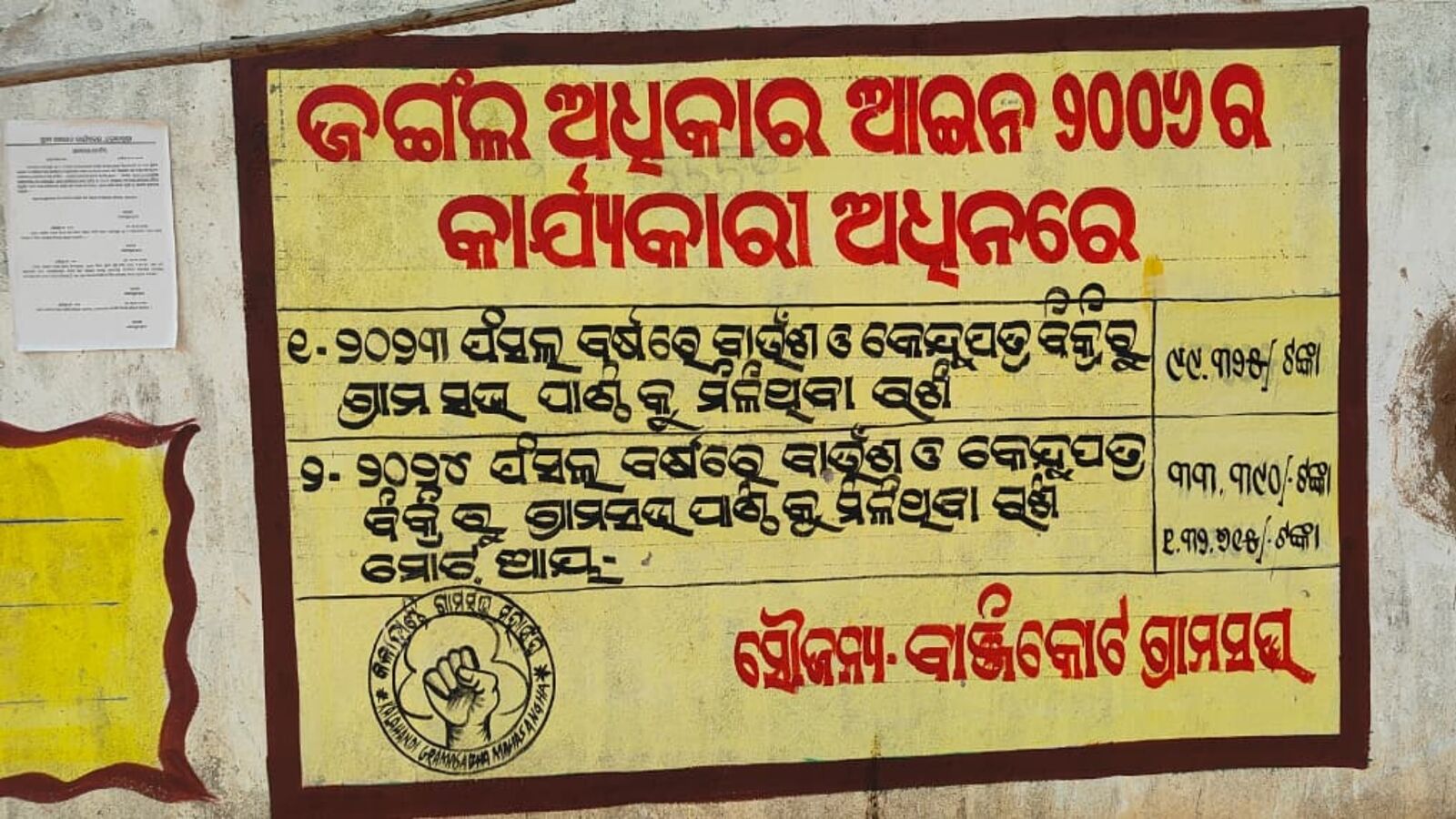
Information board commissioned by Gram Sabha displaying the revenue generation.
The Act also mandates that the Gram Sabha and rights holders conserve and protect biodiversity, wildlife, forests, adjacent catchment areas, water sources, and other ecologically sensitive areas. It also requires them to put an end to any destructive practices that affect these resources or the tribal people’s natural and cultural heritage. The Act also gives the Gram Sabha a great deal of authority, giving the indigenous people a say in local policies and programmes that affect them. “The Gram Sabhas in Kalahandi function as per the definitions of Gram Sabhas as given by the PESA Act. Though the state government of Odisha has yet to promulgate the rules of PESA, the Gram Sabhas affirm to the statutory mandate of the FRA 2006 and PESA. The Gram Sabhas, which receive community forest rights (CFR) and Community Forest Resource Rights (CFFR) titles, have developed the practice of holding their meeting in the open, where all decisions are taken. The members are those on the voter list from the village. “For the quorum to be valid, at least 1⁄3rd of the people present need to be women,” explains Mrs Kanchan Bag, a community mobiliser of KGSM.
Conflict and cooperation
“Why the federation?” A smile flashes with Mr Byasadev Majhi, the President of KGSM. “I have explained this more times than I can count”, chuckling and reminiscing about the several hundred occasions that Mr Majhi has addressed this. “When Jamuguda Gram Sabha first harvested and sold bamboo,” he recalls, “many of us felt proud, but we also realised that having a right on paper and exercising that right in reality were two very different things.” The early years of CFR implementation in Kalahandi were marked by courage, experimentation, and collective learning. Villages such as Jamuguda, Tarkabahali, Lamer, Pipadi, Bakshandi, and Dholpada began mobilising to exercise their authority over bamboo and other NTFPs after receiving Community Forest Resource titles in 2010. It took these pioneering Gram Sabhas 7 long years of deliberation, discussion and struggle between 2012 and 2018 to exercise their rights of stock and trade of the NTFPs.
Each village found itself confronting similar challenges. Government officials were often unfamiliar with the provisions of the FRA. Procedures for transit permits were unclear. Questions arose regarding harvest planning, financial management, documentation, and negotiations with buyers. Every Gram Sabha was learning through trial and error. According to Majhi, the challenge was never simply about harvesting bamboo or selling kendu leaves. It was about building entirely new institutions of local forest governance. “We were entering a new territory,” he explains. “Though FRA 2006 had given authority to the Gram Sabha, there was very little guidance on how Gram Sabhas could work. Each village was fighting its battle alone. The experience of Jamuguda became particularly influential,” he adds.
When Jamuguda village successfully secured a transit permit and sold bamboo in 2013, delegations from neighbouring villages began visiting to understand the process. Community leaders sat together discussing legal provisions, harvesting techniques, and methods of dealing with bureaucratic delays. What emerged from these exchanges was a realisation that the challenges faced by one Gram Sabha were often shared by many others. Thus, the need for a federation grew not from an external project design but from these practical realities of grassroots governance. If one village encountered an administrative hurdle, others could provide support. If one community developed a successful system for forest protection or financial management, that experience could be shared across the region.
Collective negotiation could also strengthen the position of Gram Sabhas in discussions with government departments and traders. As more villages asserted community forest rights, informal exchanges gradually evolved into structured collaboration. The first regional federation – Kanabada Bakabada Anchalika Mahasangh emerged in 2017 and 2018, among neighbouring Gram Sabhas that shared similar forest landscapes, social ties, and governance challenges in Barabandha and Dudukaranja Gram Panchayats. Mr Majhi says that this phase was a transition from asserting individual rights to collective institution building. “A single Gram Sabha can protect its forest,” he says. “But when many Gram Sabhas come together, they can protect the spirit of the law itself.” The formation of the Kalahandi Gram Sabha Mahasangha in 2018 represented the culmination of this evolving understanding. It would create systems for information sharing, support newly emerging Gram Sabhas, facilitate collective marketing of forest produce, engage with government departments, and ensure that the principles of participation, accountability, and ecological stewardship remained central to community-led forest governance.
At the block level, each Gram Sabha nominates two women and two men to the General Body of a Block level Maha Sangh. The General Body then elects a 15-member Executive Committee responsible for implementing its decisions. The Maha Sanghs of Madanpur Rampur, Lanjigarh, Bhawanipatna, Junagarh, Koksara, Jaipatna and Golamunda Blocks have established and operationalised this structure to facilitate coordinated action among Gram Sabhas.
At the district level, each Block Maha Sangh elects five women and five men to the General Body of the Kalahandi district Gram Sabha Mahasangha (KGSM), which provides overall governance in accordance with the Federation’s by laws. Additionally, each block Maha Sangh elects two women and two men to the Executive Committee, which implements General Body decisions while regularly sharing feedback, plans, and proposals for deliberation. The District Maha Sangh is led by five office bearers — President, Vice-President, Secretary, Assistant Secretary, and Treasurer, each with clearly defined, non-overlapping responsibilities. As mandated by the bylaws, both the General Body and Executive Committee meet at least four times annually. KGSM also convenes an annual Mahasabha comprising one woman and one man from each Gram Sabha. This forum deliberates on critical issues, including the reconstitution of committees, amendments to the Federation’s bylaws, and other matters of strategic importance.
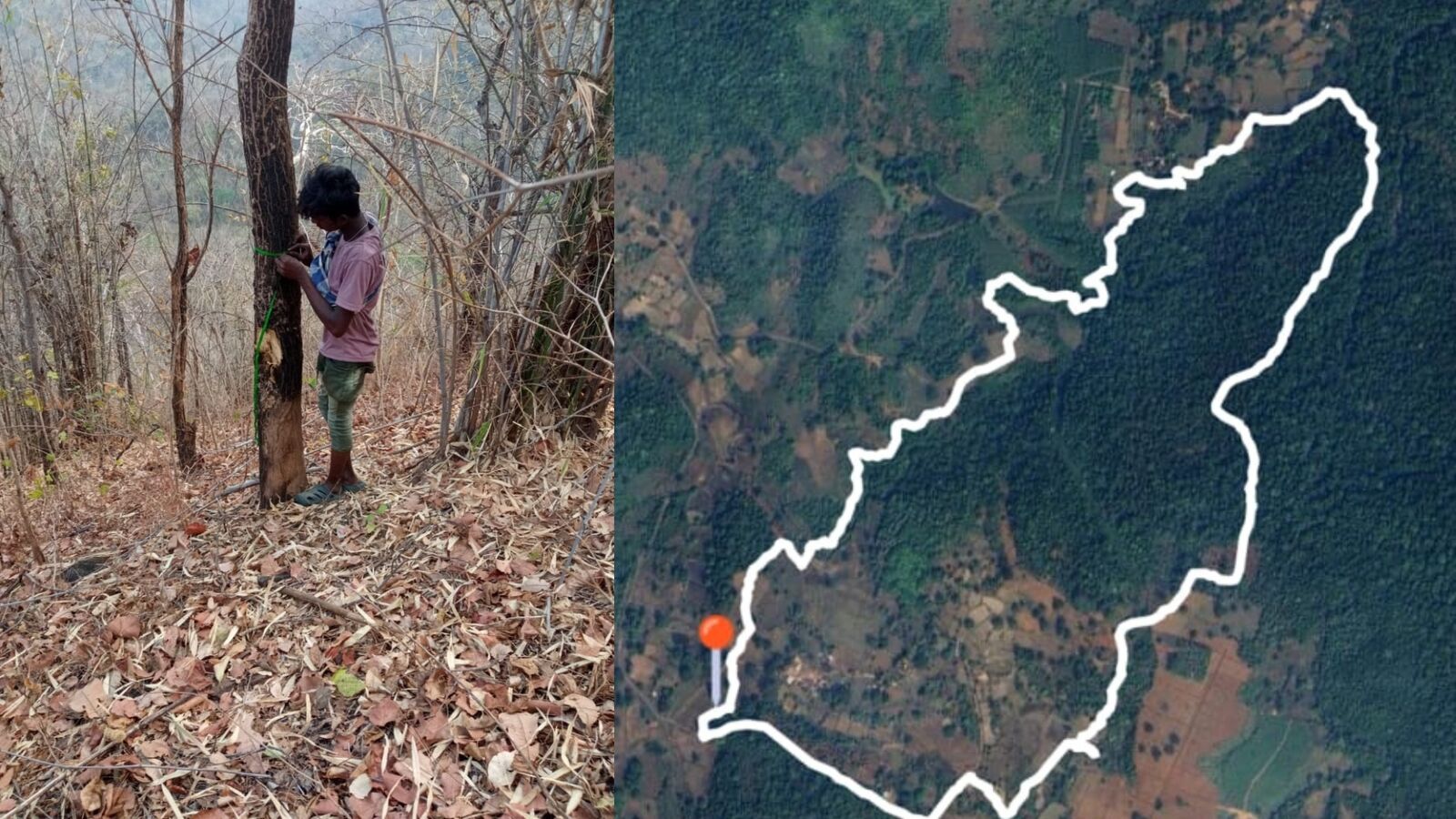
Ecological Health Monitoring and GIS mapping by youth of Gram Sabha.
Subsequently, these three-tiered Maha Sangh have become spaces for peer learning, conflict resolution, and institutional mentoring. The Maha Sangh looks after bookkeeping, logistical support, conflict management with internal and external entities and promotes good governance across all members. KGSM has minted and distributed standardised the Kendu Leaves Plucker card, Daily Trade Progress Tracker books, Bamboo stock registers, cash books, resolution books, payment registers, Ecological Health Monitoring manuals and GIS maps. KGSM conducts Gram Sabha-level, block-level, and district-level training for treasurers and members involved in trade and conservation throughout the year. KGSM, with its CSO partner, has organised exposure visits, collected best practises on conservation and created a template Community Forest Resource Management Plan for its members. The block and district federation provides a space for Gram Sabhas to mitigate their internal disputes, like boundary disputes and trade-related disputes.
Beyond internal conflicts, KGSM assists Gram Sabhas in external conflicts and misunderstandings with the forest department, district administration, and local governance bodies. The lack of awareness about FRA in general and post-CFR governance in particular leads to multiple confusions among the aforementioned actors with the Gram Sabhas. The KGSM facilitates this process by creating awareness meetings for government officials, convergence meetings, writing informative letters and resolutions, and creating demonstration rallies in the district. The KGSM has also enabled Gram Sabhas to seek out assistance from different departments to implement their CFR management plan. During illegal seizures of NTFP, KGSM has coordinated with Gram Sabhas to take legal discourses and even create scope for public dissent by holding protests and road blockades.
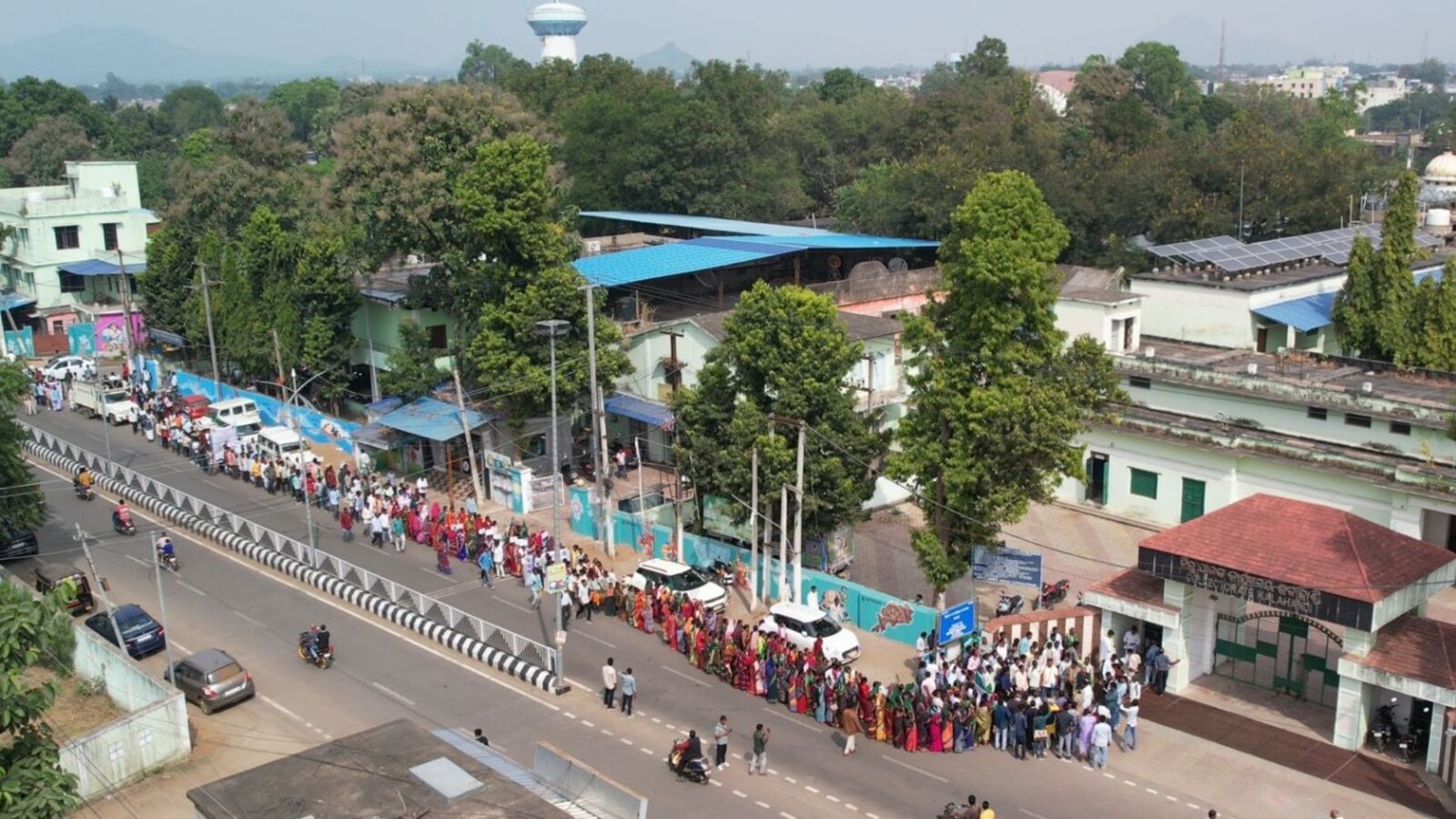
Kalahandi Gram Sabha Mahasangh organises annual demonstration rally to share complaints and suggestions to Honourable Governor and Chief Minister.
Collective governance
The structure adopted by Gram Sabhas in Kalahandi has enabled the KGSM to have significant socio-political achievements in conservation and livelihood. An important achievement in the institutional design has been the division of revenue that the KGSM has initiated and replicated among all its members. Local governance bodies have historically been mired in the questions of financial freedom. While they find themselves overburdened with work, their financial autonomy and stability have been at stake. The founding Gram Sabhas of KGSM decided on a creative solution to the financial freedom of the Federation. The portion is flexible with trading rates of the NTFPs and thus ensures that the pluckers or cutters of NTFP get the most of the revenue. This financial agreement allows each tier of the federation to operate even when the trade is not happening. The KGSM uses these funds to cover the cost of meetings, documents, account books, etc.
The KGSM has worked towards creating special opportunities for women’s livelihood security. In the years 2023 – 2024, the labour payoff to kendu leaf pluckers was a whopping INR 10 crores. With the federation-issued cards, more than 9000 women pickers have each received an average of INR 10,000/- in the two weeks of work. This excludes the labour cost for bush cleaning (which KGSM has fixed @ INR 200 per day per person), drying and sorting expenses as per the number of leaf bunches. Assuming an average of 14 days of labour, each picker earns an excess of INR 350/- a day, which is more than the daily unskilled wage of daily labour and labour earnings in MGNREGA.
Further, the Gram Sabhas pay the labour charges at regular intervals of 2 – 3 days in cash, which means the villagers do not have to travel to banks to collect their money. The money in the hands of women means increased financial autonomy, personal savings and participation in the decision-making process. Further, the mandated bylaws at different levels of the federation ensure the participation of women in the Gram Sabha and Federation meetings, enabling an inclusive and equitable local governance structure. This increased payoff, assurance of a 100 percent buyback in the Gram Sabha, and the absence of middlemen mean two things for households in Gram Sabhas: direct cash payments and avoidance of distress selling. Further, the trader purchasing the NTFP is bound by a legal contract to pay the advance amount and bear additional expenses like bush clearing, transport of bamboo down the hills, clerical allowance and even the cost of leaf drying. This means that the pluckers or cutters have a surety of their products being bought by the trader, given that the quality is assured. Collectivisation through the federations allows the Gram Sabhas to reduce the chances of dubious trade and malicious intent of middlemen and contributes to the economy of the village. The relatively higher pay has reduced long-term migration among the younger population in pockets of Lanjigarh, Madanpur, Rampur and Koksara block.
For Mr Mohan Bag, Secretary of the Lanjigarh Block Gram Sabha Mahasangha, the success of the Maha Sangh cannot be measured only in terms of income generated through the bamboo or kendu leaf trade. Equally important, he argues, is the transformation in how communities understand their responsibility towards forests “When people talk about community forest rights, they often focus on the rights,” he says. “But for us, rights and responsibilities go together. The forest gives us livelihood, water, food, and protection. If we do not take care of the forest, we cannot expect the forest to take care of us.” According to him, one of the most significant contributions of KGSM has been creating systems that ensure forest-based livelihoods remain sustainable. Across member Gram Sabhas, a portion of the revenue generated from NTFP is consciously reinvested into forest conservation and regeneration activities like cleaning, thinning, bamboo-clump restoration, native species plantation, seed ball dispersal, fire management, revival of community-based najari system, etc. Najari is a traditional system of community’s oversight on forest protection. It involves duties of members of each family to do patrolling duty over the forest.
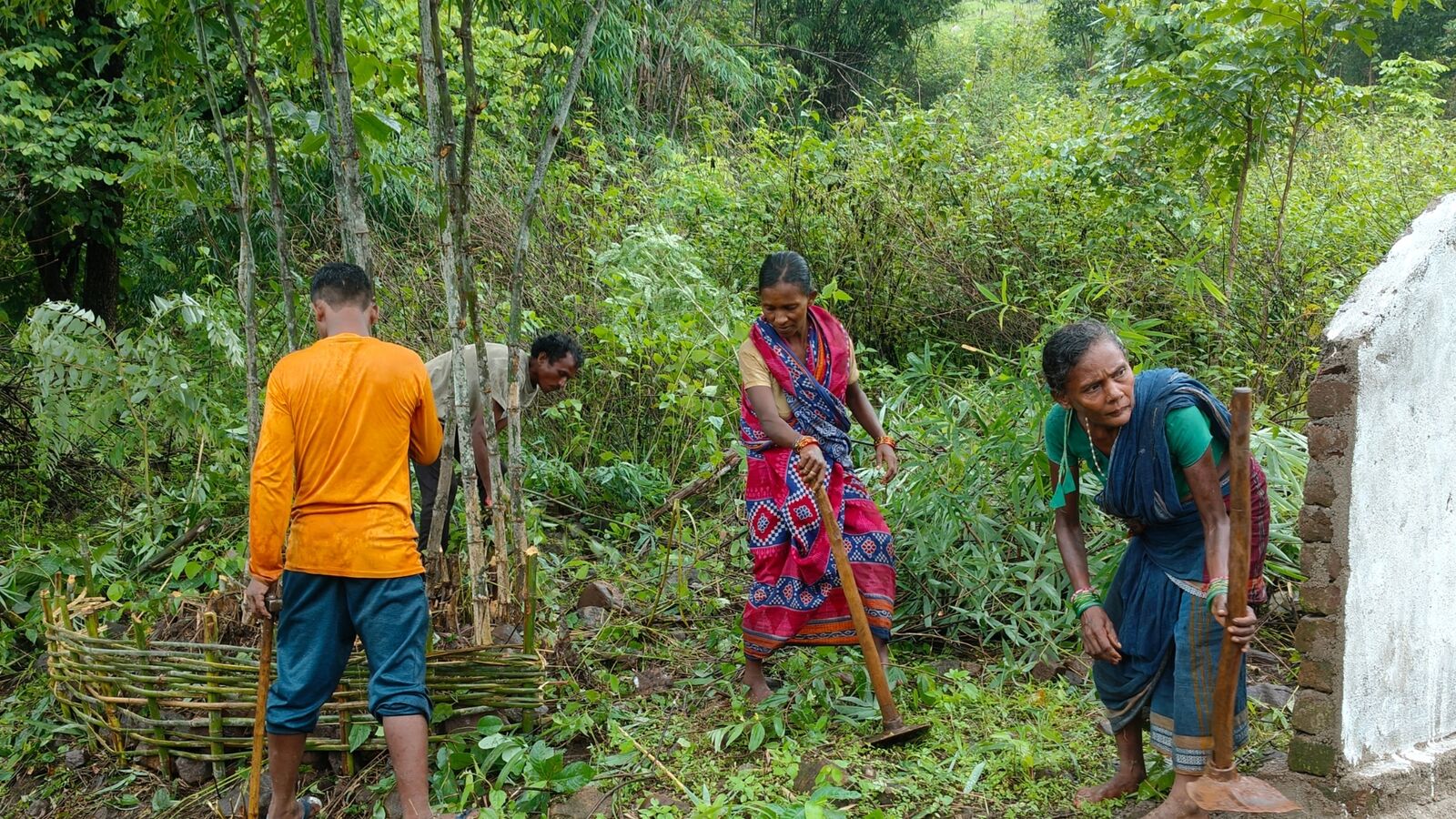
Restoration work as per Community Forest Management plan underway in Palki Gram Sabha.
Rather than treating forest produce as a resource to be extracted indefinitely, Gram Sabhas have developed practices that balance livelihood needs with ecological stewardship. In villages across Lanjigarh and neighbouring blocks, this commitment takes visible forms. Fire lines are constructed before the onset of summer. Fire Lines refer to portions of the forests being trimmed across diagonals and border areas to ensure that fire does not spread to all parts. Fire lines are an effective method to manage fire in dry-deciduous forests. Communities organise bush-cleaning drives and trim vulnerable branches to reduce the spread of forest fires. Watchmen are appointed during critical periods of Bamboo Shoot bloom, and traditional systems such as Thenga Pali, community-based rotational forest protection have been revived and adapted to contemporary needs. Thenga Pali refers to a customary forest protection tradition where a Thenga (stick) – symbolic of a guard is rotated across the households of the village, with each household sending one member to guard and protect the forest. In modern times, Gram Sabhas have revised a variation of Thenga Pali, where, instead of rotating the member, a single guard is appointed by all households, with each household contributing to the remuneration of the guard. Sometimes, the cost is borne by the Gram Sabha Development Fund (which in turn is a collective resource).
The term of the Community Forest Management Committee (CFRMC) shall be three years. After three years, the Gram Sabha shall reconstitute the Committee.
CFRMC will prepare plans and expenditure estimates for the Group Forest Rights Area and Group Forest Resources Rights Area.
It may appoint and dismiss employees and members.
If a member of the CFRMC does irregular work, disorderly conduct or neglects his/her duties and responsibilities, he/she shall be removed and a new person shall be selected and given responsibility.
Only the Gram Sabha shall take all kinds of decisions and the decision of the Gram Sabha shall be considered as the final decision.
This committee will implement the decisions of the Gram Sabha and stop activities that affect forests, wildlife and biodiversity.
“The Mahasangha does not do these activities for the Gram Sabhas,” Mohan explains. “Our role is to support them, coordinate learning between villages, and ensure that technical guidance reaches communities. The real work happens because villagers themselves feel ownership over their forests,” he adds.
For Mrs Dulam Patra, President of Gandharbaru Gram Sabha, conservation is not merely an environmental concern — it is deeply connected to community identity and intergenerational responsibility. “Our elders protected these forests for us,” she says while reflecting on the hills surrounding her village. “Today, it is our responsibility to ensure that our children inherit the same forests, the same streams, and the same wildlife.” She notes that Gram Sabha bylaws increasingly include provisions related to wildlife protection and sustainable harvesting practices. Community discussions around hunting, once considered sensitive subjects, are now banned by the CFRMP bylaws. In cases where customary practices come into conflict with conservation priorities, the Mahasangha often acts as a facilitator, creating space for discussion and consensus-building rather than confrontation. “Rules become stronger when they are discussed and accepted by the community,” Dulam observes.
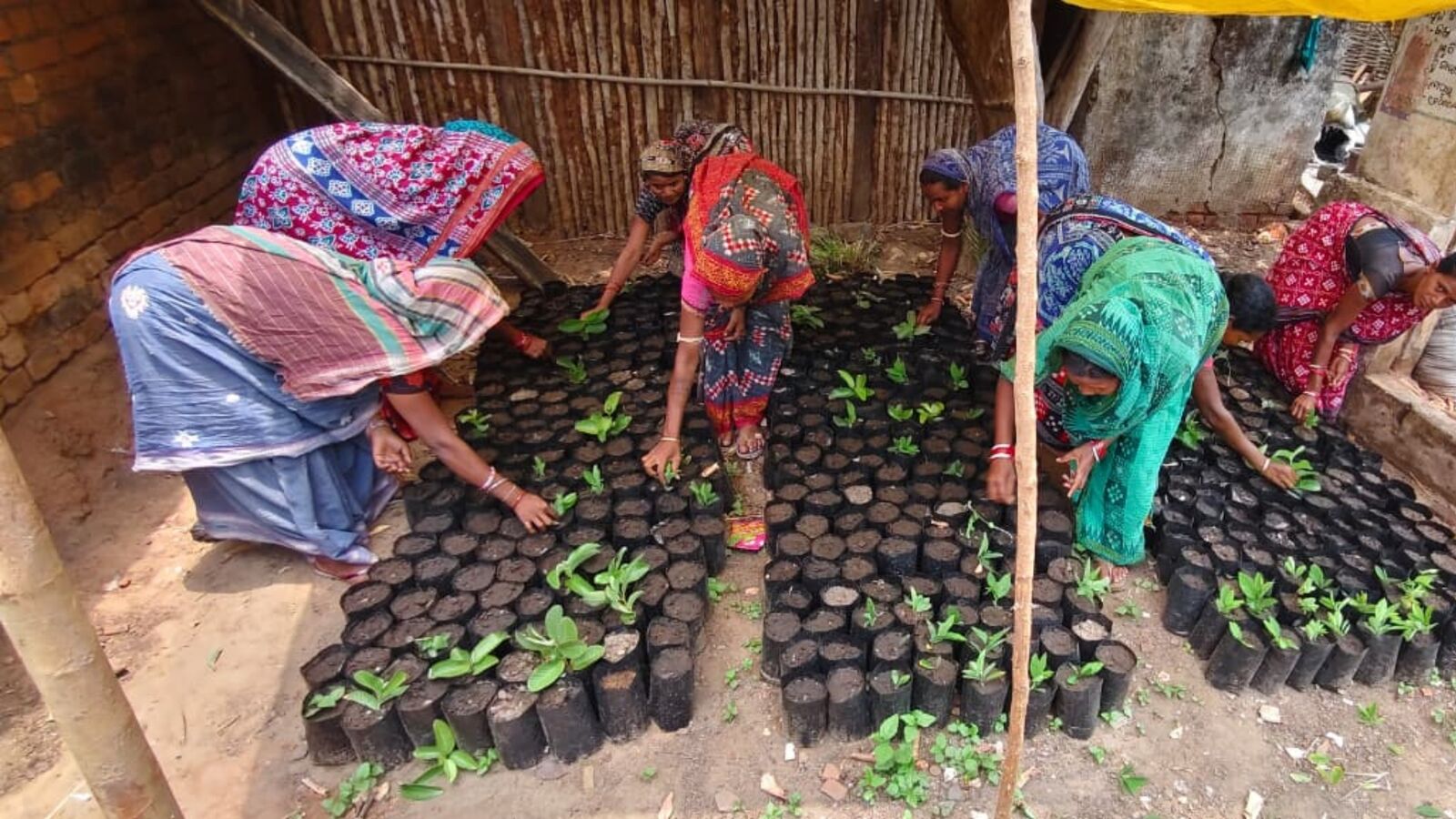
Gram Sabha managed nursery.
Beyond conservation, both leaders point to another, less visible but equally important achievement of the Mahasangh, the creation of a democratic space for accountability and institutional learning. As relatively new institutions, Gram Sabhas inevitably encounter challenges. Disagreements emerge, procedures are misunderstood, records are sometimes poorly maintained, and office bearers may make mistakes. Rather than viewing these as failures, the federation has created mechanisms through which such issues can be openly discussed and resolved. “KGSM is not only a platform for collective action,” says Mohan Bag. “It is also a platform for collective reflection.” Regular meetings at the block and district levels provide opportunities for Gram Sabha representatives to raise concerns, seek clarification, and learn from one another. Disputes can be discussed in open forums, and decisions taken through established procedures that prioritise transparency and participation. Quorum requirements ensure that decisions cannot be taken by a handful of individuals, reinforcing the principle that governance must remain accountable to the larger community. The Gram Sabha has made presence women to be half of all present, whereas the FRA only requires one third of all present to be women. Mrs Dulam Patra believes that this culture of discussion has strengthened trust among member Gram Sabhas. “In many institutions, problems are hidden until they become bigger,” she says. “Here, we try to discuss them openly. When people sit together, listen to each other, and find solutions collectively, the institution becomes stronger.”
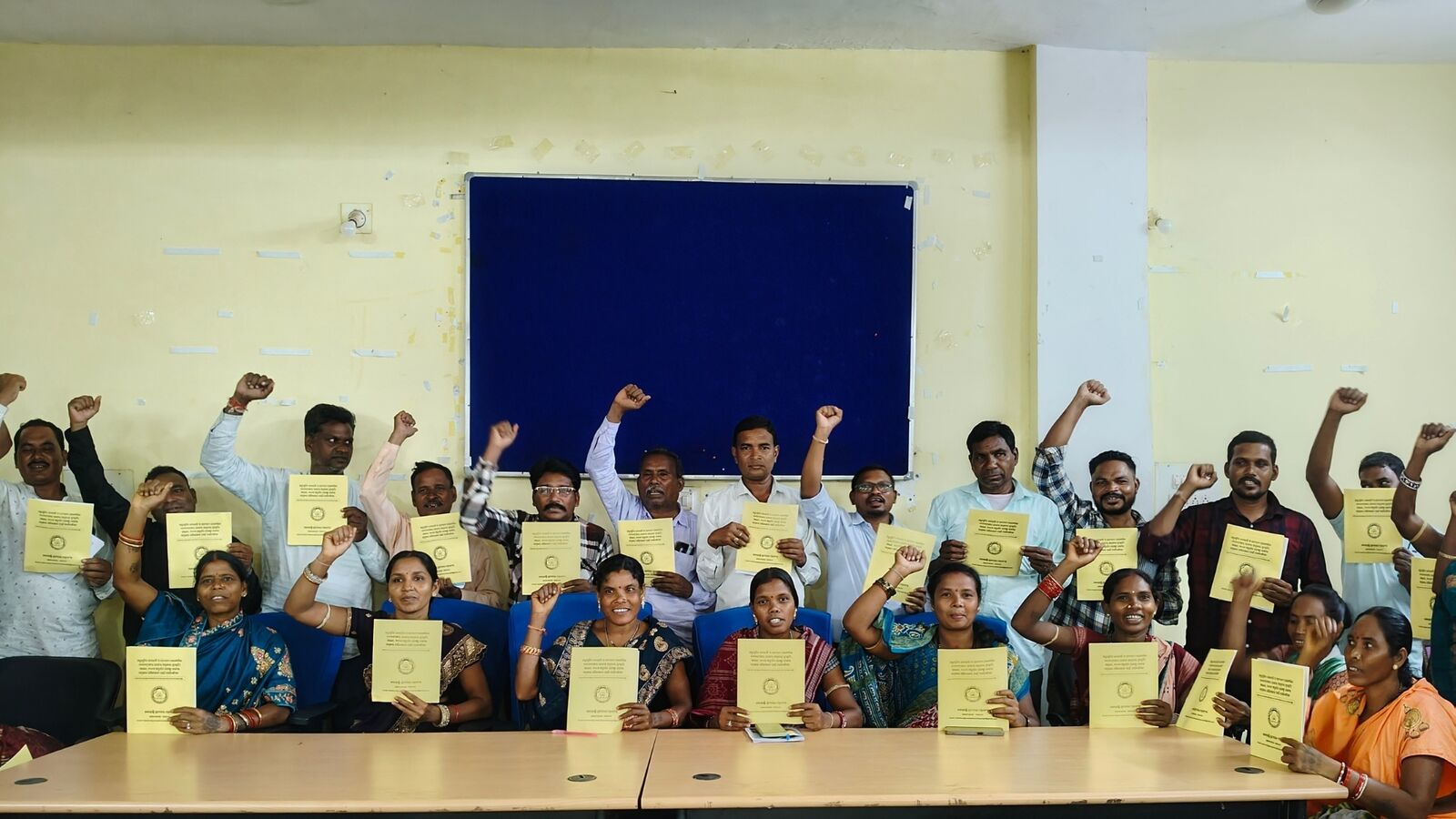
Handbook for community forest management planning released by Kalahandi Gram Sabha Mahasangh.
For Dalimba Mulikia, Treasurer of the Kokasara Block Gram Sabha Mahasangha, one of the greatest strengths of the federation lies in its ability to connect communities that were once struggling in isolation. “When the first Gram Sabhas started exercising their powers under the Forest Rights Act, every village faced similar questions,” she recalls. “How do we conduct meetings? How do we maintain records? How do we communicate with government departments? How do we respond when officials do not understand the law? Most villages were learning these things for the first time.” The Forest Rights Act had created new spaces for community governance, but many frontline officials, village leaders, and even community members were unfamiliar with its provisions. According to Dalimba Mulikia, the emergence of the federation transformed this experience. “If one village found a solution to an issue, that learning benefits many others,” she explains. “Instead of every Gram Sabha repeating the same mistakes, we began sharing knowledge. The federation became a place where people could ask questions, discuss challenges, and support each other.”
“When people talk about community forest rights, they often focus on the rights,” he says. “But for us, rights and responsibilities go together. The forest gives us livelihood, water, food, and protection. If we do not take care of the forest, we cannot expect the forest to take care of us.
- Mohan Bag, Secretary of the Lanjigarh Block Gram Sabha Mahasangha
Ultimately, the story of the Kalahandi Gram Sabha Mahasangha is one of institutional imagination, democratic resilience, and the determination to forge new forms of self-governance. The Gram Sabhas have shown that resolving the perceived conflict between human livelihood and forest conservation does not require cordoning off nature, but rather embedding its care directly into the hands of those who depend on it most. By building a transparent, multi-tiered federation that champions women’s economic autonomy, sustainable harvesting, and constitutional dialogue, Kalahandi’s indigenous communities have transformed the legal provisions of the Forest Rights Act into a lived, breathing reality.
About the author
Sital Kumar works with local communities in Kalahandi, Odisha, focusing on grassroots mobilisation and social work in collaboration with Seva Niketan. An alumnus of Azim Premji University and Ashoka University, he is deeply interested in developmental politics and civic engagement. The author wishes to thank Shubham Kacchap and Sagnik Basu (Seva Niketan) for their assistance in videography.
About the series
This series will spotlight local democratic practices from across the country that demonstrate innovation, effectiveness and good governance.
This work is facilitated by the Centre for Local Democracy, Azim Premji University.
The Centre for Local Democracy supports the work of Azim Premji Foundation and others working on deepening and widening local democracy across India. The Centre enhances the work done in rural, forest, PESA and urban settings through educational programmes, documentation, dissemination of good practices and research in emerging thematic areas.