
Air Today, Gone Tomorrow
Air pollution has proved unusually hard to write about for children — and harder still to illustrate for them. Educator and storyteller Deeptha Vivekanand follows wisps of it blowing across the landscape of Indian children’s books.
Details
When COVID struck, we all wore masks. The first few days were intensely uncomfortable— you could not breathe freely, and the flow of air we take for granted was suddenly gone. Then we got used to it, and began matching our masks to our clothes.
Air purifiers were never something anyone actively bought. Now they have become fixtures in homes across North India. Our own home has three, plus an AQI reader in the living room. In October they will whir to life, the first reading flashing bright red: 350 or higher. The five-year-old at home knows the drill: machines on, windows shut. What she does not know, and what almost nothing on her bookshelf tells her, is how the air got that way.
Air is hard to write about, and harder still to picture. A river can be a character, a tree can be hugged, a turtle followed, a lion drawn. Smog has no edge, no habitat, no face. Photograph it, and you get haze. Diagram it, and you get arrows and labels. And every honest account of where it comes from leads back to our own choices, or to choices made by people with far more power.
Going Up a Chimney
In 1984, the National Book Trust published Pollution by N. Seshagiri. It is a startling book to read today. Seshagiri writes from inside Indian cities, and assumes his reader lives in one. Have you ever visited a power station, he asks. If not, go — to the one at Indraprastha Estate in Delhi, or to Trombay in Bombay — and watch what comes out of the chimneys. The reader is prompted to engage with the problem, rather than being shown a diagram.
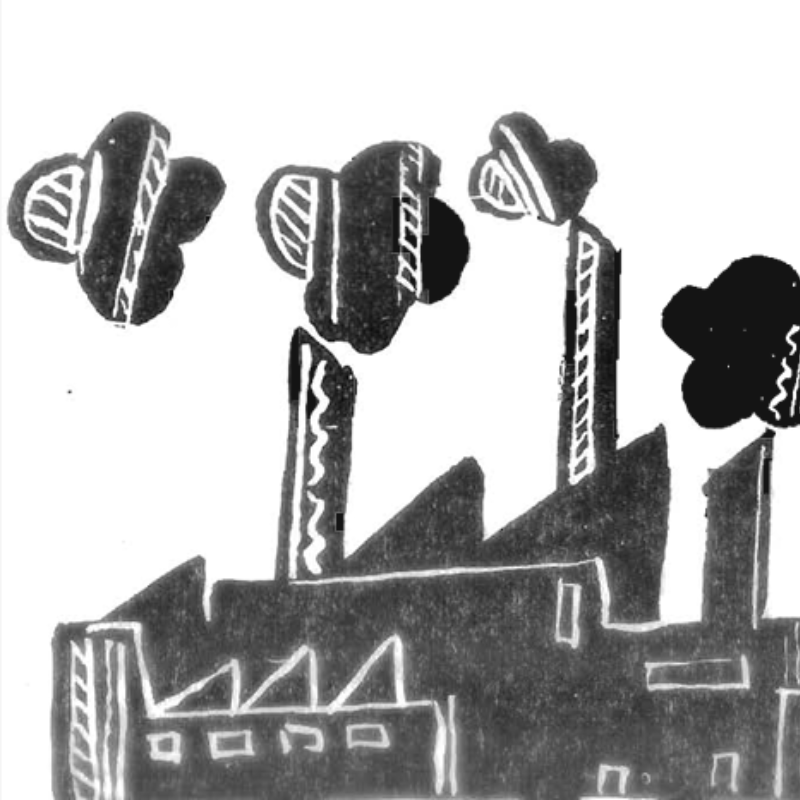
In the illustrations by Mickey Patel, Syeda Iqbal Bano and others, the air looks frightening. The cover gives it a body — a huge dark hand descending over a canopy of trees. Inside, smoke curls and billows like something alive. Chimneys loom over a single white bird with nowhere to go. A recognisably Indian street appears twice: once with trees and open sky and once swallowed by haze. The children in these pictures are small figures dwarfed by black smog, victims and witnesses of a problem they did not create.
Puzzling Out Pollution
TERI’s Green Genius Guide: What are Pollution, Smoke, Smog, and More… explains scientific concepts: temperature inversion, particulate matter, ozone, acid rain and smog. Its bright illustrations turn invisible processes into diagrams 8 – 12-year-olds can follow.
50 FAQs on Air Pollution by Sachin Bhardwaj is anchored in Indian realities: stubble burning, PUC certificates, thermal power plants, construction, plastics and indoor pollution. It is a reference book whose pages alternate between photographs and explanatory diagrams. When the book wants to show the problem, it uses photographs; when the science gets difficult, diagrams take over.
Pollution Solutions by Urmi A Goswami moves closer to the child’s world. Its opening asks: why is it sometimes not safe to play outside? Why is it unsafe to drink tap water? Why can’t we see stars at night on some nights? Four children, forced to stay indoors because of pollution, venture out to the library to find answers. Pollution begins not as an abstract environmental problem, but as an interruption to childhood.
The air-pollution chapter explains PM, ozone and AQI, then asks the child to name five things that pollute the air in her own city. A box offers things she can do: walk or cycle, use a fan, keep the AC above 26°C, switch off lights, reuse. The book names systemic sources; the child-facing solutions are mostly individual.
When Breath Becomes Air
Meghaa Gupta’s Unearthed: An Environmental History of Independent India opens its air chapter, “Smokin’ Delhi”, with nine-year-old Janaki, whose cough arrives every winter and whose doctor admits it will trouble her until the air clears. A reader in Mohali or Patna knows Janaki at once, because she has that cough.
Gupta then explains why farmers burn straw without turning them into villains: after a groundwater-saving policy altered their planting calendar, they were left with little time to clear residue before wheat could be planted, which made burning the fastest and cheapest way to prepare for sowing.
Her AQI chart is drawn as a flight of steps descending from good to severe, a small face growing sicker at each landing. It asks what it means if the reading in your city is 459 — then leaves the reader to work it out. It’s non-fiction that gently nudges the reader to think.
Every Voice Counts
Bijal Vachharajani’s cli-fi A Cloud Called Bhura, illustrated by Aindri C., gives smog a shape and a name: a brown cloud swallows the Mumbai sky, and the media christens it Bhura Cloudus. Scientists scramble for answers while the government stages a spectacularly unsuccessful publicity stunt involving a Bollywood star and a giant vacuum. Meanwhile, four thirteen-year-olds experience the crisis differently: Tammy’s family has no air conditioning, Mithil’s dog grows sicker, Amni’s parents talk of moving to Canada, while Andrew retreats into studying and Minecraft.
Frustrated by the adults’ endless talking, the children decide to do something. They organise a campaign, uncover a plot, get a lawyer, and fill Azad Maidan until a minister loses his job. The story makes a political point: bad air is not experienced equally — and sometimes the answer is not to plant a tree, but to come together. As the children discover, their voices count.
Picturing Pollution
One picture book that deserves mention is Rya Jetha and Sourav Sarkar’s A Shade of GREEN. The book’s protagonist Nayantara gets off the school bus into stagnant grey air. The AQI is 463, schools are shut, and the football match is cancelled. With her friend Aliza, she begins by dreaming of trees and fresh air, then asks a wonderfully child-like question: why not invent an artificial leaf that could produce oxygen day and night? What follows is a story about curiosity becoming scientific thinking. The girls research photosynthesis, draw their ideas, ask about catalysts and membranes, and discover that scientists are already working on artificial leaves. Sarkar’s illustrations follow the movement from suffocation to possibility.
A Hole in the Bookshelf
Almost all the books on air pollution are aimed at children aged ten and above. Yet five-to-nine-year-olds are among the most vulnerable when smog envelops the city. They breathe more air per kilo of body weight; they’re shorter, so closer to the lead at ground level, and they play outdoors.
For these children, a book cannot begin with AQI, PM2.5 or crop-residue burning. It has to begin with a story, a picture, a question they recognise. We need more picture books about the air we breathe — books that help young children see what they cannot see, understand why the sky has turned grey, and imagine that it can be different.
Come October, my five-year-old will know what the red number on the air purifier means. I would like her to have a book that tells her how it got there, because a child who knows that grows into someone who can ask for it to change and not accept the status quo. Someone, create that picture book soon, please!
Bibliography
- Pollution, N. Seshagiri (National Book Trust)
- Green Genius Guide: What are Pollution, Smoke, Smog, and More… (TERI)
- 50 FAQs on Air Pollution (TERI)
- Pollution Solutions (TERI)
- Unearthed: An Environmental History of Independent India (Penguin)
- A Cloud Called Bhura (Talking Cub)
- A Shade of GREEN (Pratham Books)
- So You Want to Know About the Environment (Red Turtle)
- The Green World: 101 Things to Know and Do to Clean the Air (Penguin)
- The Green World: The Mystery of the Nasty Grey Cloud (Penguin)