
A City Through Children’s Eyes
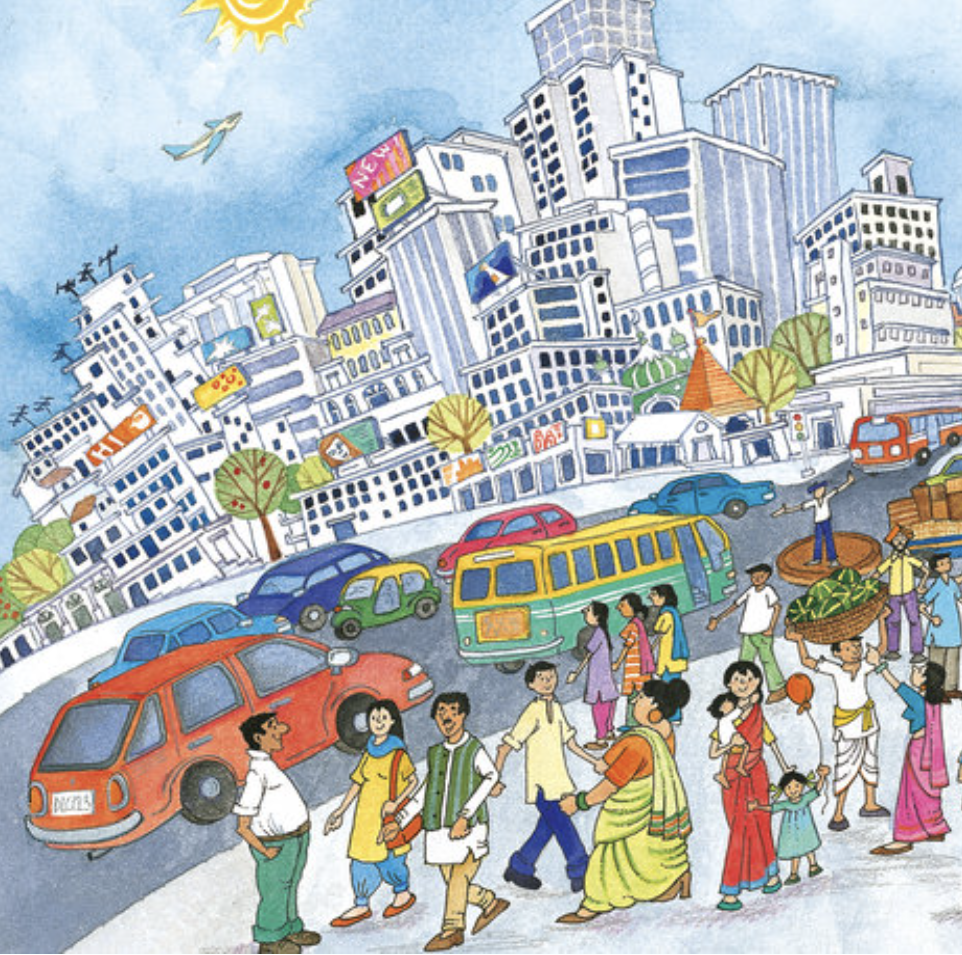
Author Saisudha Acharya treks through the urban landscape in children’s books to spotlight a sprawl of stories from skyscrapers and sidewalks.
Details
Look, I don’t know about you, but having consumed a steady diet of Enid Blyton, the city girl in me longed for woods with tall magical trees, toadstool circles and birds darting through blue country skies. I was an adult when I began to notice a magical natural world right outside my front door, in my crowded city. Fortunately, children’s books today offer young readers a chance to look at their cities afresh, and notice things they might otherwise take for granted.
The Wild Around Us
I have always been delighted by animals in children’s books that are such a familiar part of our daily lives that we almost forget that they are part of the natural world. Maharani the Cow by Christy Shoba Sudhir and Nancy Raj is a charming example. It captures the chaos of an Indian street: the noise, the faces of various drivers and pedestrians, the policemen and vendors, all instantly familiar. And at the centre of it all, the gentle-eyed Maharani, completely unbothered.
Arefa Tehsin’s Wild in the Backyard turns our attention to creatures less visible than Maharani, from the bats in trees to the insects in our homes, and sometimes, alarmingly, on us (think lice — chewing and sucking ones!). The book is full of interesting facts that have the effect of making these ordinary creatures in our midst suddenly far more fascinating than one previously imagined.
Similarly, in There’s Nothing There!, an English-Kannada picture book by Karunya Bhaskar, Roshni Ravi, Jane Sahi and Anu Mothi, Arali and her Amma notice frequently overlooked bits of nature on their routine walk home from school. Bhaskar’s bright, lively illustrations draw attention to small things that are so easy to miss in the rapidly changing landscape on the outskirts of Bengaluru.
And, if you really want to get your hands dirty, Be a Neighbourhood Naturalist by Vena Kapoor, Suhel Quader and Labonie Roy invites you to do just that! Full of activities and experiments to get children exploring the wildlife around them– Why do birds sing to each other? How do ants work together? Why do flies sit on our food? – it turns an ordinary neighbourhood into a place of discovery.
Owning Our Cities
In Out of the Way! Out of the Way!, Uma Krishnaswami and Uma Krishnaswamy lead us through the transformation of a village into a town and then into a city. We watch as a path becomes a road, traffic increases, and the landscape changes around a tree that has witnessed it all. As the village expands, organically and often chaotically, the book makes us pay attention to what happens to the things that get in the way of urban ‘growth’.
As cities grow, so do the challenges of managing waste, finding space for more homes, and ensuring that neighbourhoods remain liveable for the people and animals who inhabit them. In Varsha Seshan’s Nami & Jhalak: Stinkypur Guardians,two friends love birdwatching in their neighbourhood park, despite the frothy, smelly canal running through it. After wading through the filthy water to rescue a lapwing trapped in floating garbage, they launch a campaign to clean up the canal and park, and even protect it from a real estate developer. Similarly, in Nandita da Cunha and Priya Kuriyan’s The Miracle on Sunderbaag Street, Miss Gappi, a perfectly eccentric retired craft teacher, and young Zara transform a depressing dumpyard into a bright and colourful garden. Both books suggest that solving problems like these is not an individual act, but a community effort.
Many Cities, Many Childhoods
There is, of course, no singular urban experience, and in many children’s books, the natural world fades into the background to focus on the human one.
Machher Jhol by Richa Jha and Sumanta Dey offers a unique view of the city. Gopu sets out alone through its crowds and bustle, determined to get his grandmother to cook his sick father’s favourite fish curry. We follow him through the city, taking in its sounds, smells and commotion, without quite knowing how he experiences the world around him. It is only later that we discover Gopu is blind, and see his journey, and the city itself, a little differently.
Payal is Lost by Maheen Mirza, Shivani Taneja and Kanak Shashi shows us a city as experienced by children living in a basti (urban slum). In the story, the children of the basti are looking for their friend Payal. Payal hasn’t gone to the market to perform as a tightrope walker with her family, nor is she with her friends, collecting scraps of waste, carrying lights for a baraat or gathering branches of firewood. So, where is she? Payal is Lost is very much a story told to us from the inside, that feels lived rather than constructed.
If Payal is Lost reminds us that a city has many faces, Jamlo Walks shows how the same event can affect children living and working in the city very differently. Samina Mishra and Tarique Aziz tell the story of twelve-year-old Jamlo, a migrant worker stranded by lockdown during the pandemic, far away from her home in the village. What makes this picture book particularly powerful is how the creators juxtapose Jamlo’s experience with that of urban, middle-class children whose main experience of the pandemic was online classes from the safety of their homes.
All these books succeed in making the reader look at the city they live in differently. Suddenly, the familiar is unfamiliar and fascinating. After years of longing for Blyton’s woods, convinced that the magic was somewhere else, books like these remind me that the world outside my urban home is just as mysterious and strange, though perhaps not always as cosy.
Bibliography
- Maharani the Cow (Tulika Publishers)
- Wild in the Backyard (Penguin)
- There’s Nothing There! (Nature Conservation Foundation)
- Be a Neighbourhood Naturalist: Explore Nature with Activities and Experiments! (Indian Pitta Kids/Juggernaut)
- Out of the Way! Out of the Way! (Tulika Publishers)
- Nami & Jhalak: Stinkypur Guardians (Scholastic)
- The Miracle on Sunderbaag Street (Kalpavriksh)
- Machher Jhol (Pickle Yolk Books)
- Payal is Lost (Eklavya)
- Jamlo Walks (Penguin)
- Critters Around Our Homes (Kalpavriksh)
- Farida Plans a Feast (Pratham Books)
- Happiness City (The People Place Project)
- It’s So Hot! / Kitni Garmi Hai! (Tulika Publishers)
- Painted Walls of Malainagar (Tulika Books)
- The People of the Indus (Penguin)
- Wildlife in a City Pond (Pratham Books)
- A Suitcase for Surta (Karadi Tales)
- Sameer’s House (Tulika Publishers)
- Keshav’s Kolams (Karadi Tales)
About the Author
Saisudha Acharya studied Economics at the University of California, San Diego, and shifted from working with financial data to education. She writes to make Indian history accessible and engaging for children and designs school learning experiences. Saisudha lives in Bangalore with her family.