An Instrumental Path to Physics: Vijayakumara’s journey
From 3D printing a low-cost microscope to helping set up an attosecond physics lab, Vijayakumara’s journey in science seems to be just beginning.
Details
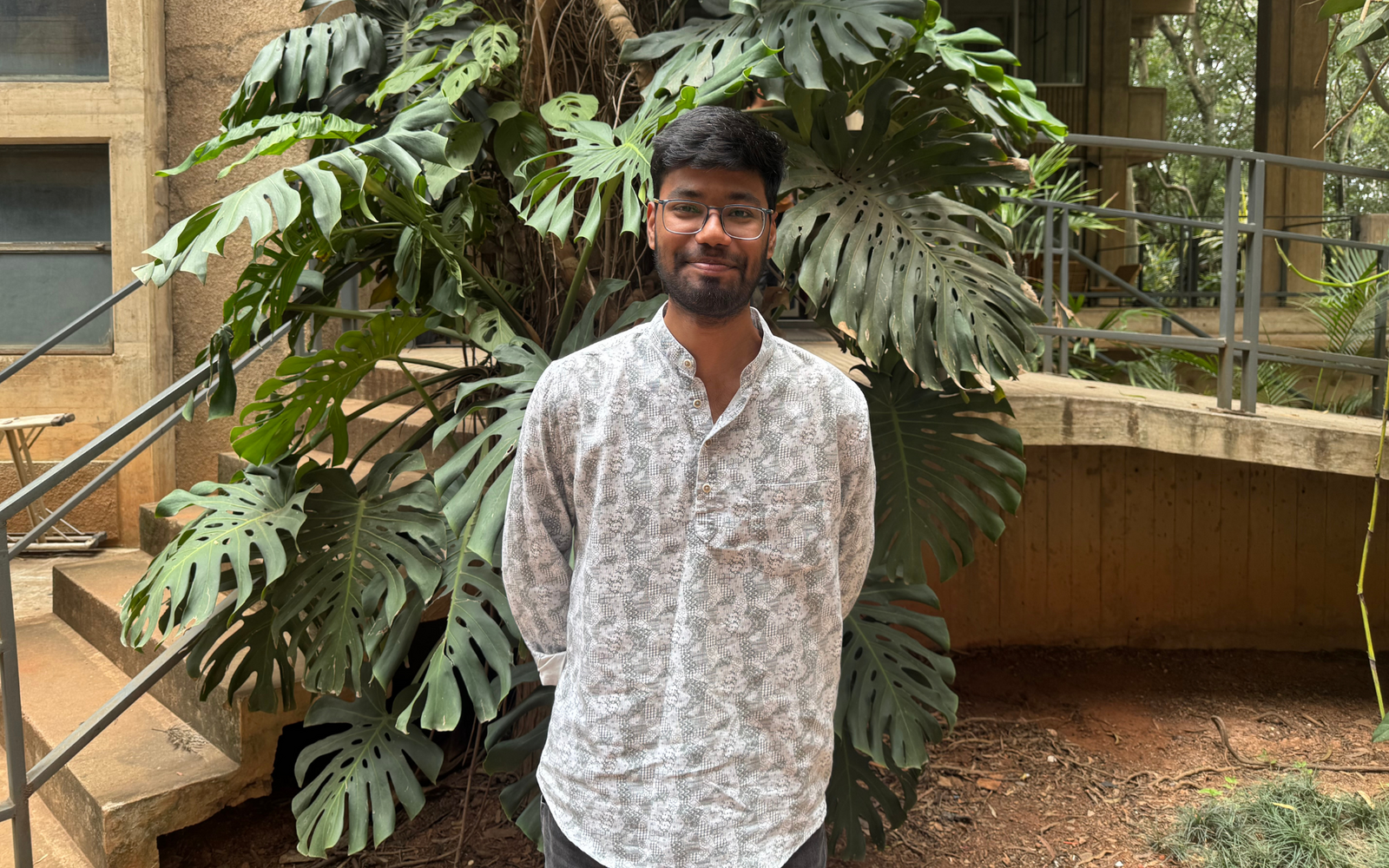
Vijay at Raman Research Institute. Image credit: Nandita Jayaraj
Never mind that it was a Saturday and a public holiday, for Vijayakumara who had recently joined the prestigious Raman Research Institute (RRI), it was business as usual. I met him outside the institute library, a shaded porch with a comfortable sofa and coffee table — perfect for long conversations about life and science.
At the Laboratory for Attosecond Sciences, Vijay is part of a team led by experimental physicist Smijesh N. that is attempting to develop something called a high harmonic generation (HHG) system. “These are lasers that produce ultra-fast pulses,” explained the young Research Assistant. “They can produce pulses of light that last for extremely short durations, typically less than a picosecond (a trillionth of a second)… and maybe even an attosecond!” The term attosecond (a millionth of a picosecond) is especially exciting for physicists these days because it forms the basis of attosecond science, a field that won Anne L’Huillier, Pierre Agostini, and Ferenc Krausz the 2023 Nobel Prize in Physics.
Why is it interesting for physicists to produce these ultra-fast pulses? Vijay eased me into his area of research with the disarmingly simple analogy of a spinning ceiling fan: “If we want to capture a photograph of the fan, we need a flash of light that’s short enough for its blades to barely move during the time, right? If we achieve that, we can get a photo of the fan where it looks stationary.” The electrons in an atom, he pointed out, move way faster than a ceiling fan. Being able to study electrons in action inside molecules during various biological processes and chemical reactions can help scientists understand how these work at the most detailed levels. To get here, we need pulses of light that are extremely short. That’s what this lab’s system wants to do.
Maths to physics to education
I found it pretty impressive that someone who just completed their undergraduate degree last year had found their way to such a sophisticated lab. It turns out that it has been quite the journey. A lover of mathematics from a young age, Vijay became increasingly drawn to physics while at school in Koppal district of Karnataka. He recollected poring over HC Verma’s famous Concepts of Physics and growing fascinated by ideas such as the constant speed of light and atmospheric electricity. “I realised that physics isn’t just about mathematics, but also about intuition,” he said.
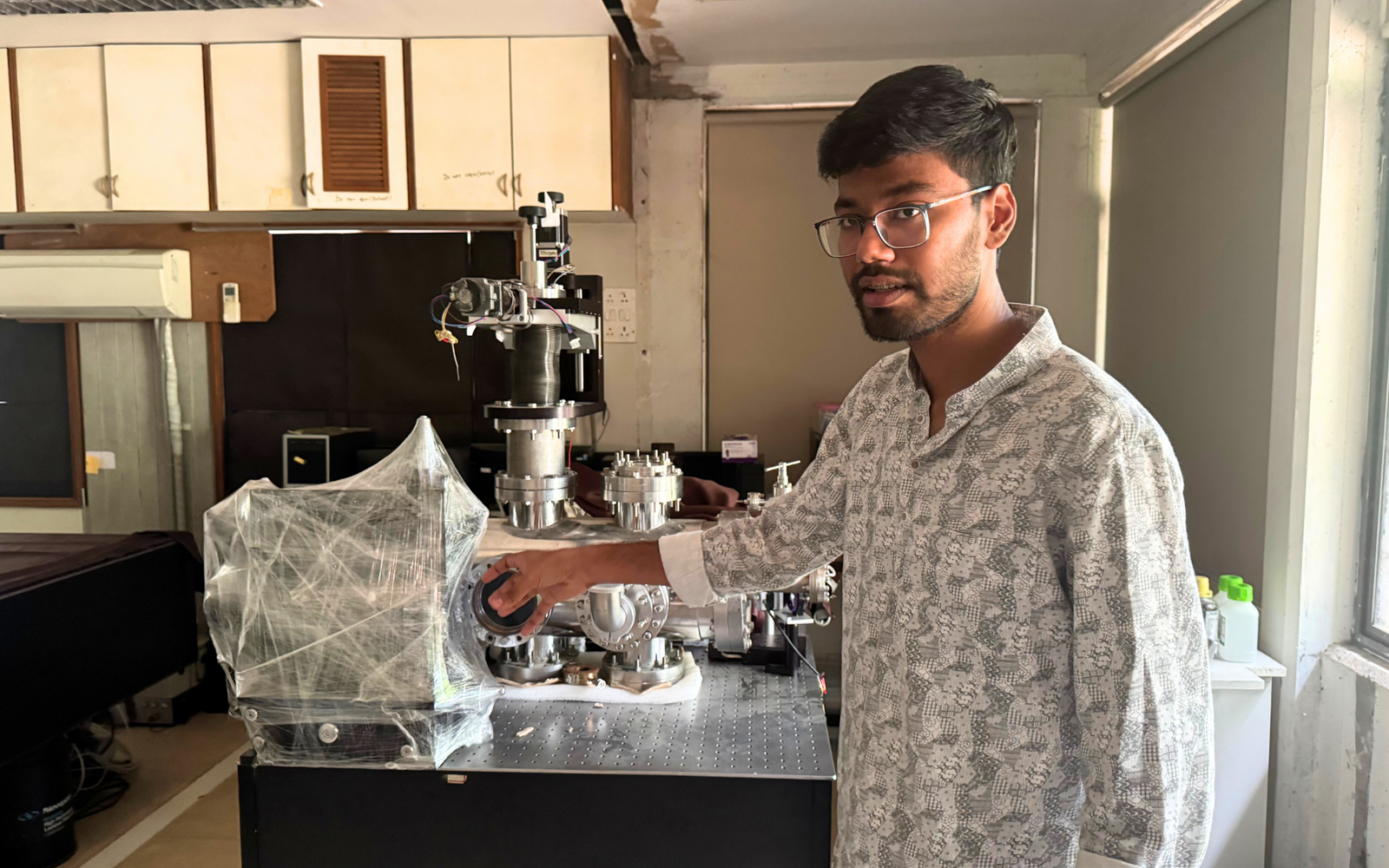
Vijay in the upcoming attosecond science lab at RRI. Image credit: Nandita Jayaraj
Like most of his classmates, Vijay too was nudged towards engineering and, in this pursuit, joined a coaching centre associated with his school. One of his teachers there was rather unconventional, he remembered. “The teachers at the centre were younger, so we could connect with them better than our schoolteachers. And there was this one teacher who encouraged us to explore different careers.”
It was then that Vijay heard about Azim Premji University and the scholarships it offered. He wondered if maybe this was a better option for him. “I preferred getting in there with a scholarship instead of getting a loan to enroll in an engineering college,” he said.
Vijay did manage to get a scholarship to the BSc in Physics programme at the university. After his first semester, he decided to augment his degree to a BSc-BEd. An extra year of studies would make him qualified to become a schoolteacher — a handy backup plan. Though he didn’t have any strong desire to become a teacher, Vijay became quite captivated by some of the BEd courses. He fondly remembered philosophy of education classes by Ramchandar Krishnamurthy where he learnt how to develop arguments and discussions. Education left a deep enough impression on him that his first job was as a STEM educator.
More than just optics
That said, Vijay did not lose focus on his original subject physics. He caught a fancy for optics which was being taught by Rema Krishnaswamy, and so he approached her for summer project opportunities. Rema was at the time in the thick of adapting the OpenFlexure Microscope for local use. This microscope is a 3D-printed, open-source microscope designed to make high-quality microscopy more affordable and accessible. Though the developers have made the design freely available to all, Rema incorporated some tweaks and replacements to make it even more ideal for our context. When Vijay came to her, she entasked him with a couple of hardware modifications that could further improve their model.
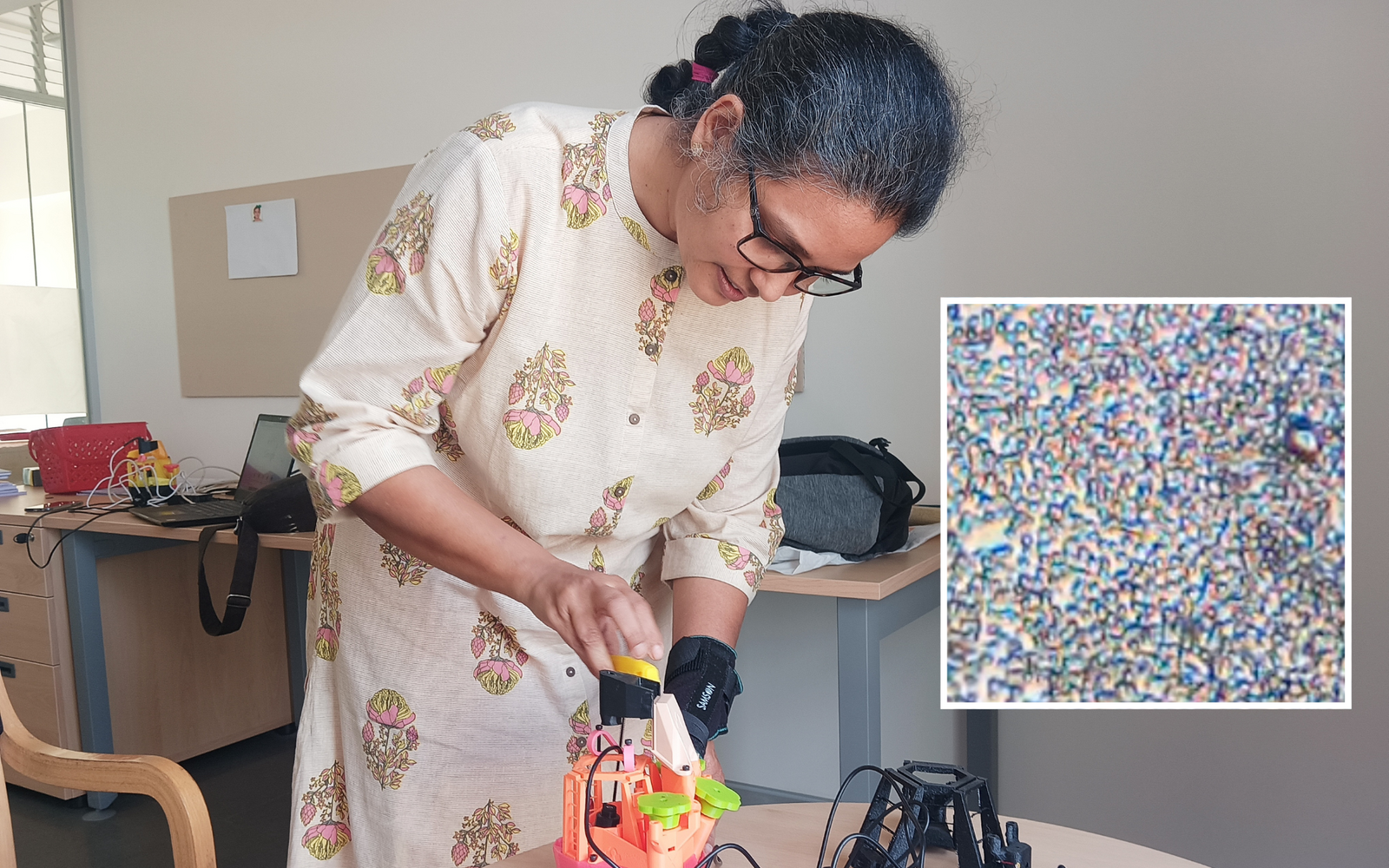
Rema assembles her OpenFlexure microscope. (inset) budding of yeast as seen through the microscope) Image credit: Nandita Jayaraj and Rema Krishnaswamy
“The original design was based on European materials and specifications,” he stated, “so certain lenses and screws were not readily available here.” Rema suggested that Vijay learn to use a free simulation software called Tinkercad to design a small ring that would hold the microscope lens in place. He came up with the design, but would it work? Only testing would tell, and for that he needed to 3D print out of the ring.
“At the time, no one was really 3D printing at college. There was an old 3D printer in the physics lab but it was left unused,” he said. Vijay decided to revive this printer so he could perfect the design in-house, before taking it to a better printer outside. With the help of Pavan, a research assistant at the physics lab, Vijay replaced the printer’s base mat and the adhesive for the base mat. The duo managed to make the printer operational, and Rema confirmed that the ring was doing its job.
After this, he designed an additional modification that helped Rema use an ordinary webcam to record images on the microscope instead of the more expensive Raspberry Pi camera used in the original design. By then, he had also learned about microcontrollers during a course by Anish Mokashi. Using these skills, he helped assemble the electronic circuit and write the code that would allow a small Arduino microcontroller to control the microscope’s motors. “As the motors moved the microscope, the webcam connected to a laptop would continuously capture images, which could then be combined to produce a larger image,” he explained.
Coming full circle and going beyond
These experiences gave Vijay a knack for instrumentation. This was what helped him secure a six-month position as a visiting student at the Laboratory for Attosecond Sciences at RRI earlier in December last year. “They were looking for someone who can automate motors, use Arduino microcontrollers and was comfortable with electronics. When I told them about this project, they realised I have this experience,” he said.
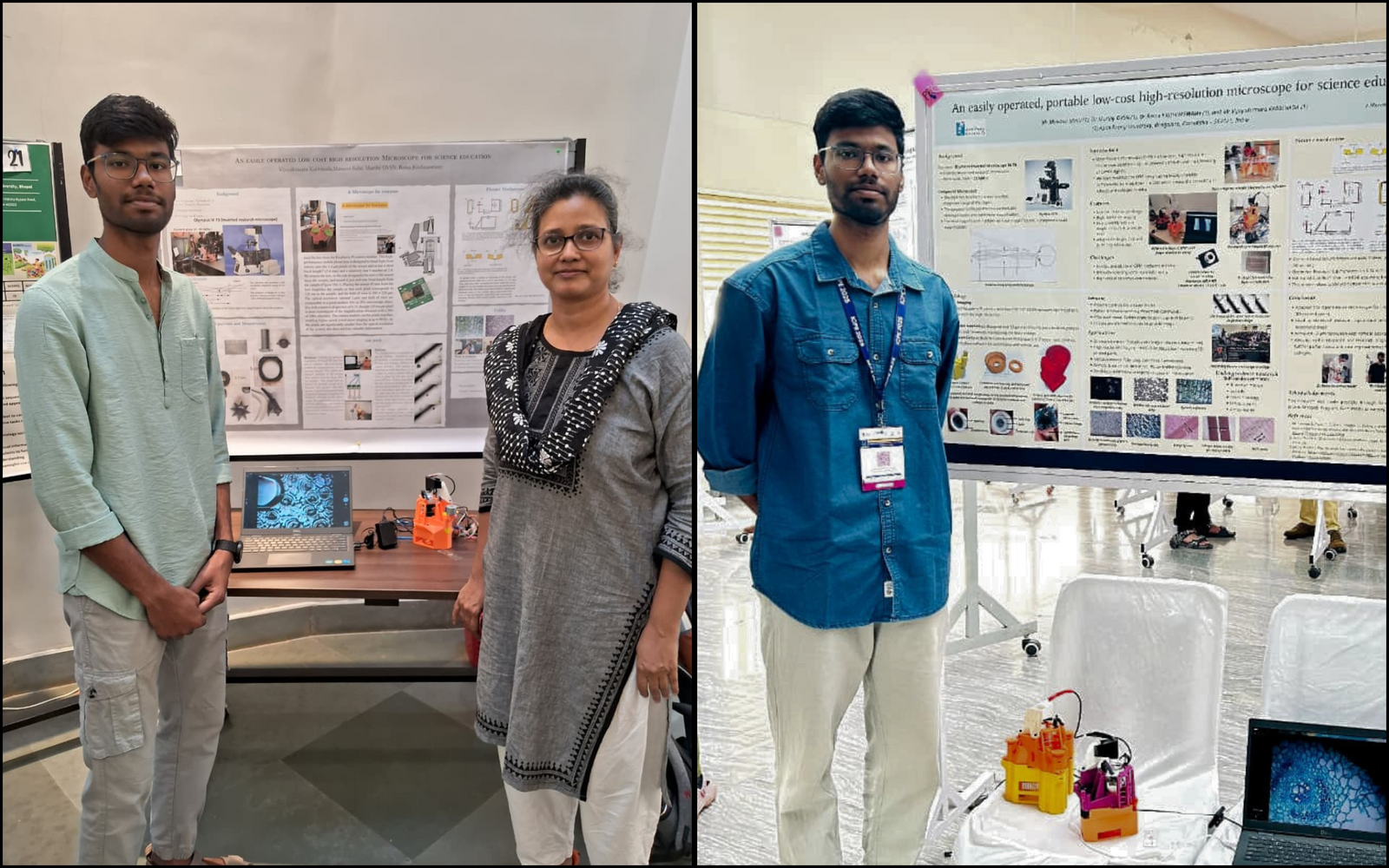
(left) Vijay and Rema in front of a poster describing their work. (right) Vijay at the ICEP 2025 conference in Ropar. Source: Vijayakumara and Rema Krishnaswamy
Last December, Vijay got the opportunity to present their work with the OpenFlexure microscope at the International Conference on Physics Education at Indian Institute of Technology, Ropar. With Rema he created a poster titled “An easily operated, portable low-cost high-resolution microscope for science education”. Since Rema was unable to attend the conference, Vijay boarded a train to Punjab to present it himself. Apart from the poster, Vijay was also carrying with him an actual working model of the microscope. “It would be difficult for them to understand how it’s made and how it works, so this way I could show them and make them curious about what we have done,” he said.
As he presented his poster to interested educationists from India and abroad, Vijay noticed someone familiar approaching. It was none other than HC Verma! The sight of the physicist and author of the textbook that inspired him on this path reminded him of how far he’d come. “It felt nice when he came up to my poster… I would have been really excited if I was back in 12th grade,” he laughed. On his long way back to Bangalore by train, Vijay got a message from his former professor Anish who had stayed behind for the week-long conference. “He informed me that my poster won a prize for Best Poster. I didn’t even know there was a competition!”
Though he was surprised to find out, looking back, Vijay realises that this work was rather special. “Most of the others at the conference had posters about how to teach physics concepts and innovative pedagogical techniques. Our poster stood out because we were building an instrument that would help education… an instrument that could be equivalent to ones that are worth lakhs.”
About the author
Nandita Jayaraj is a Science writer and Communications Consultant at Azim Premji University.