
Teacher Tales
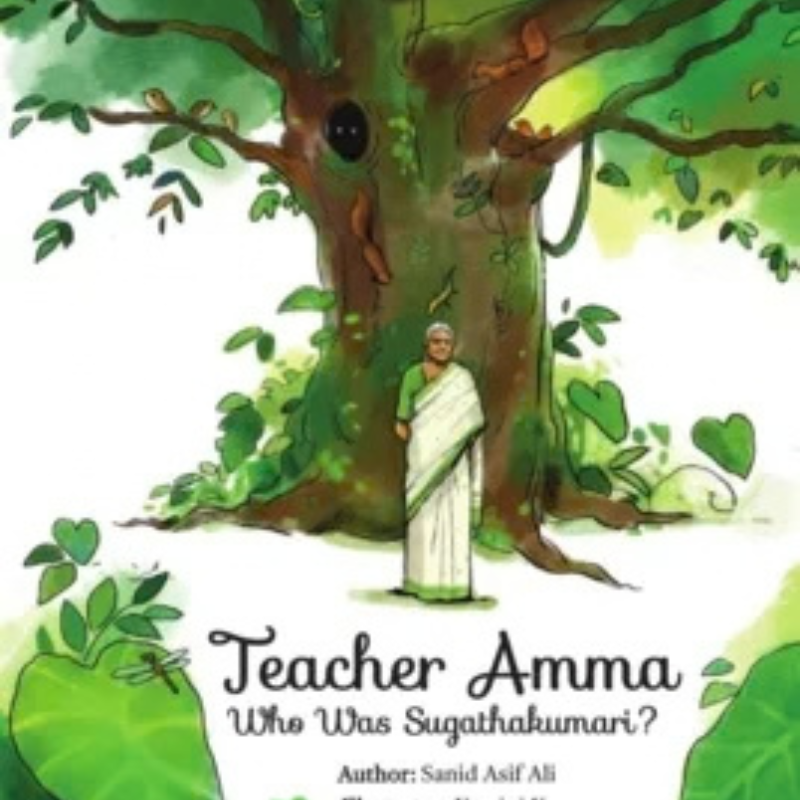
Titles: Teacher Amma: Who Was Sugathakumari?
Author: Sanid Asif Ali
Illustrator: Yamini K
Publisher: Room to Read (paperback, available to read for free on https://literacycloud.org/stories/7714-who-was-sugathakumari)
Reviewed By: Sangeetha Menon
Details
Sugathakumari is a name I’ve heard my grandparents mention in passing as a child. So, it felt like a full circle moment for me when I was asked to review Teacher Amma: Who Was Sugathakumari?, a biographical picture book about the Indian poet, activist and feminist from Kerala, who was well-known for her role in the Silent Valley protests. The protests were held to stop a hydroelectric project that would cause the destruction of the forests in the Silent Valley in Palakkad. Sugathakumari wrote articles to bring attention to the environmental fallout of the project, besides mobilising a group of writers to help further the cause. She was honoured with the Kerala Sahitya Akademi Award and multiple other awards for her poetry.
Sanid Asif Ali tells this story through a girl named Muruki who goes to meet Sugathakumari, popularly known as Teacher Amma. Narrated through dialogue, the book captures her early days as a writer and her foray into environmental activism, specifically the Save Silent Valley movement and the development of the Krishnavanam forest. The text is simple and flows coherently. I appreciate that the writer has peppered this book with anecdotes so readers get a glimpse of different aspects of Sugathakumari’s life. We see snippets of her childhood with her sister Hridaya, how she won a poetry contest but could not claim the prize, and how she helped Bommiyampadi village build Krishnavanam. Towards the end of the book, there is a timeline of important milestones in Sugathakumari’s journey, which serves as a great snapshot of her life.
Yamini K’s illustrations complement the text very well, the highlight being the faces of the people. Her portrayal of Sugathakumari is lovely and has a very close likeness. The landscape and different settings are presented well too. A special mention has to be made of the illustration which incorporates Sugathakumari’s famous appeal: We need warriors for a battle we are going to lose…will you join us? Some other noteworthy spreads are of Teacher Amma writing in Malayalam, the villagers building Krishnavanam and the fully-grown forest. The earthy palette complements the tone of the story.
I wondered if it would have worked better had the author incorporated some of Sugathakumari’s poetry into the story. For example, lines from her poem Marathinu Stuti (Ode to a Tree), which was akin to an anthem for the Save Silent Valley movement. Additionally, I would have loved to see a mention of Vaikom Muhammad Basheer’s response to Teacher Amma’s aforementioned appeal. He had sent her a contribution of Rs. 100 with a note that said: Include me too in this losing battle. This could have been such a delightful fact to include in the book. I also felt that certain sections of the dialogue between Muruki and Sugathakumari were heavy with information, which took away from the reading experience.
Overall, though, this is a great book to introduce in classrooms for conversations around conservation history. There is a reading guide of questions to help children engage further with the story. This book is also a great way to tell children about how art, specifically the written word, can be a powerful tool in creating change.
About the Reviewer:
Sangeetha Menon a.k.a. ‘The Moody Marshmallow’ is a writer, editor and podcaster. She works in children’s publishing.