
Publications & Resources
Our faculty, students and researchers work together everyday to contribute to a better world by grappling with urgent problems we are facing in India. We conduct rigorous work to produce high quality learning resources and publications to contribute to public discourse and social change. Here, we feature a sample from our work for everyone to access. You can explore featured resources, policies, and the latest publications from the University.
To explore all the work of our University, please visit our publications repository.
Article
Reasonable Accommodation and Interdependence: Revisiting the Dynamics of Disability Inclusion in Higher Education in India
in Journal of Gender Studies

- Published
- Authors
- Meghana Rao
- Shilpaa Anand
Abstract
The principle of reasonable accommodation according to Article 2 of the United Nations Convention on the Rights of Persons with Disabilities (UNCRPD) is defined as ‘necessary and appropriate modification and adjustments not imposing a disproportionate or undue burden, where needed in a particular case, to ensure to persons with disabilities the enjoyment or exercise on an equal basis with others of all human rights and fundamental freedoms’. Exploring the relationship between inclusive policies enacted in institutions of higher education in India, and their impact on those who claim accommodation, we discuss the nature of care that informs and animates such interactions. Drawing on feminist disability studies scholarship on care, particularly, Akemi Nishida’s recommendation that care is inherently collective we analyse two sets of transactions selected for study as enabling care in patronising and charitable manners, while simultaneously ignoring the politics of responding to and providing accommodations. We find that institutional responses to accommodation claims are less reflective of the socio-political and affective aspects integral to the RA principle. Instead, the focus seems to be on providing either technocratic solutions or interpreting RA claims as causing undue burden. By reading the RA principle through the lens of scholarship on interdependence, we aim to broaden the scope of adopting and interpreting the RA principle.
Links
Article
Laughter and Fieldwork in Nagaland: A Dialogue
in ACME-An International Journal for Critical Geographies

- Published
- Authors
- Dolly Kikon
- Krishnapriya Tamma
Abstract
This is a dialogue and reflection about fieldwork, laughter, and decolonising methodology. Is there a time to laugh? How and why should researchers laugh? By focusing on the Naga people in Northeast India, an Indigenous community with a deep history of militarisation, this dialogue draws our attention to the meaning of laughter, fellowship, and emotional connections. An Indigenous Naga anthropologist in conversation with an ecologist, this dialogue dwells on the meaning of laughter as sharing an experience of fellowship together. Social science methodologies are often structured on examinations, investigations interviews, fieldnotes, and observations. This dialogue opens a space to reflect on fieldwork, research, and decolonisation. Laughter, as this dialogue highlights, is about affection, solidarity, and collective vision. For any long-term relationship that one seeks to establish as a researcher, acknowledging and respecting the history of the land, adopting a community-approach, and mentoring Indigenous local scholars to lead the research among their respective communities are important steps towards decoloniality.
Links

- Published
- Authors
Abstract
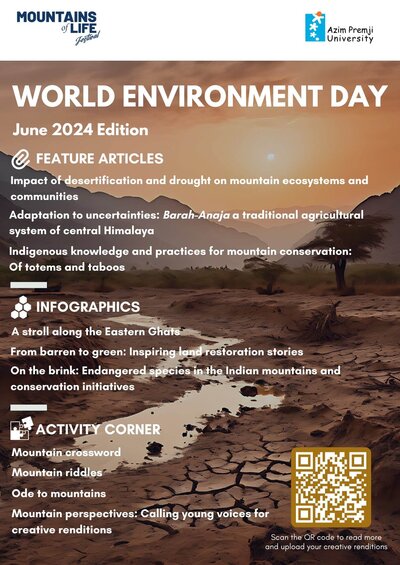
The second edition of the Mountains of Life newsletter highlights the importance of World Environment Day with a focus on land restoration and drought resilience. It features stories on the impact of desertification on Indian mountain ecosystems and communities, showcases sustainable agricultural practices like the Barah-Anaja system of Uttarakhand, and celebrates indigenous conservation knowledge. The newsletter also shares inspiring stories of unsung heroes across India working to restore barren mountain regions to self-sustaining ecosystems, explores the biodiversity of the Eastern Ghats, highlights endangered species in Indian mountains, and includes a puzzle corner for interactive learning.
Links