
Publications & Resources
Our faculty, students and researchers work together everyday to contribute to a better world by grappling with urgent problems we are facing in India. We conduct rigorous work to produce high quality learning resources and publications to contribute to public discourse and social change. Here, we feature a sample from our work for everyone to access. You can explore featured resources, policies, and the latest publications from the University.
To explore all the work of our University, please visit our publications repository.
List of Publications & Resources

- Published
- Authors
Abstract
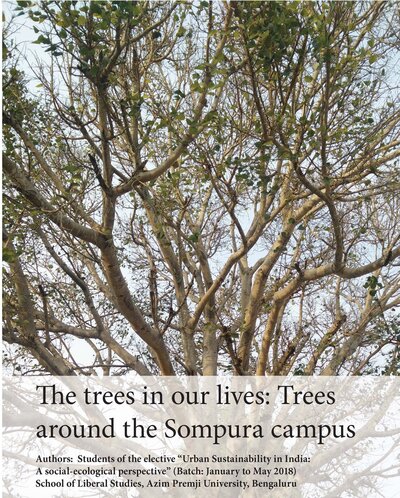
Sompura falls under Anekal taluk of Bengaluru, and the campus is located in a typical peri-urban interface with rural and urban features existing alongside each other. Thus, in this peri-urban landscape, it is not an uncommon sight to see cows saunter along paved streets followed by their herders amidst the upcoming layouts and apartment complexes. It is in this rapidly urbanising landscape, that the undergraduate students at the University who had taken the elective “Urban sustainability in India: A social-ecological perspective” were involved in an exercise to map the trees in the vicinity of the campus. In all, the students mapped 63 trees of 20 different species. The trees included both native and introduced species. The more common trees that the students identified were coconut, neem and tamarind, all of which have multiple uses. They also observed the peepal, a keystone species, in the landscape, as well as fruit bearing trees such as jamun, mango and jackfruit. The students also identified a specimen each of the Indian hog plum and the gooseberry. The ornamental flowering species they recorded included the African tulip with its bright red flowers, the more subdued pink poui, the fragrant Indian cork and the canopy of blue jacaranda. The students also identified and measured teak and casuarina that are popular plantation species grown for their wood. The canopy trees that are popular avenue trees in Bengaluru included the rain tree and Indian beech. Mesquite, an aggressive invasive, was the other species that the students could spot in the landscape. They also recorded the large leaved Indian almond and the camel-foot tree that gets its name from the hoofed shape of its leaves.
Links