
Building smart cities in the air
As Indian cities expand and race to fulfil their “smart” tag, a unique conference at Azim Premji University, Bhopal addressed the ecological and social costs of poor urban planning.
Campus
Bhopal
Details
A national conference on ecology and urbanisation is probably not an event where one would expect to bump into a group of young frisbee players. Yet, there they were: offering incisive and rarely-heard insights that jolted the audience out of their scholarly niches and into grassroots realities. This is probably what set the Nurturing Nature in Urban India conference, apart from others of its kind.
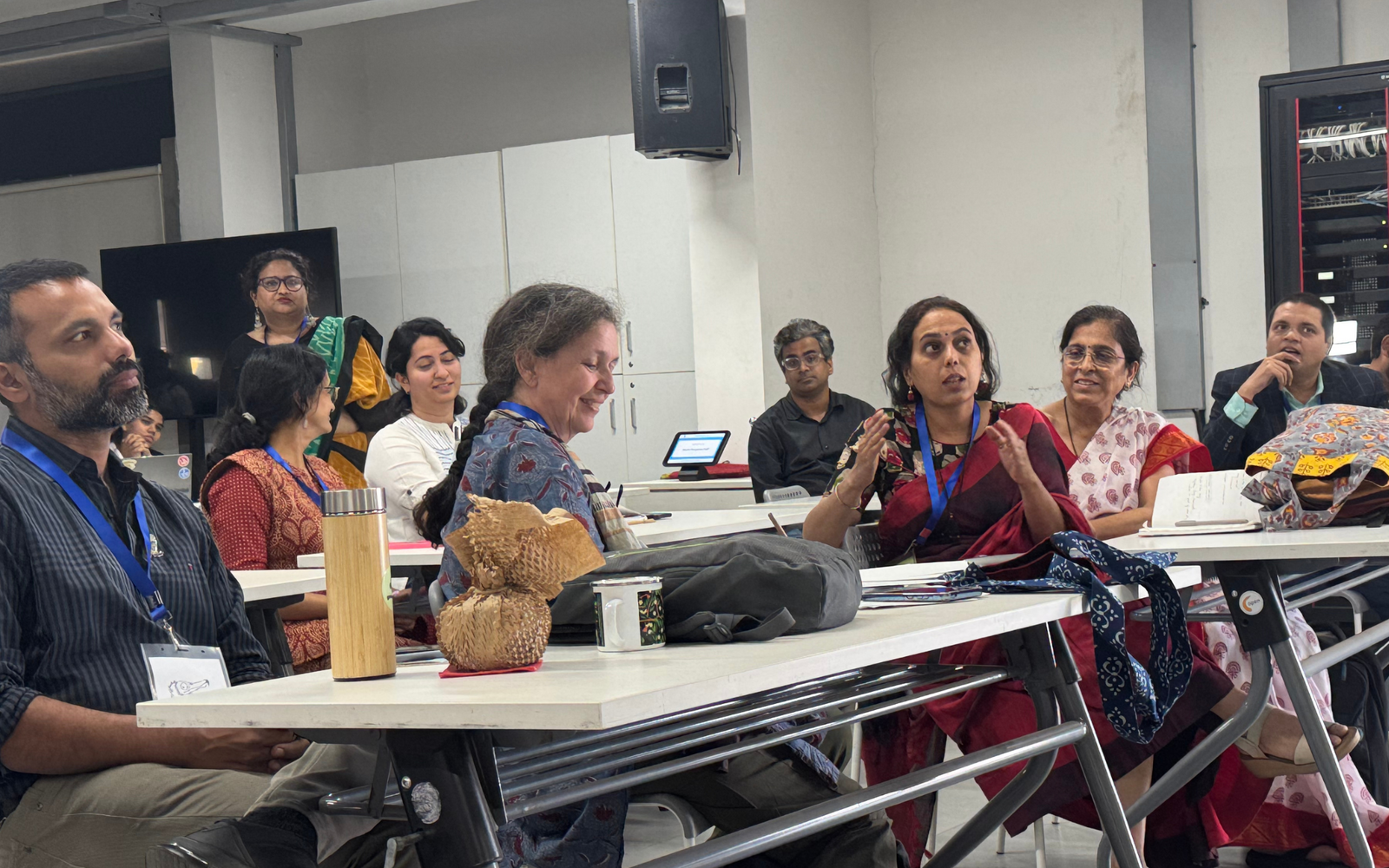
Organised at Azim Premji University, Bhopal, the conference sought to engage with the most critical questions facing a rapidly urbanising world. It brought together not just academics, but also architects, policymakers, industry stakeholders and community actors, to enable a shift in the way India’s cities are planned. “The idea is not just to preserve green spaces, but to recognise the everyday decisions that impact ecology and future ideas to build cities that are more ecologically aware,” said Ananya, during the welcome address.
About 10 years back, Bhopal joined the Smart Cities Mission by the Government of India. Since then, the city has been in flux, with many infrastructural projects taking off. The stated aim of this initiative, according to official sources, is to improve the quality of life in Indian cities through smart, sustainable solutions. The end goal is cities that are economically vibrant, inclusive and environmentally friendly. The long journey to get here, however, is coming at a steep ecological and social cost. This was one of the takeaways of a panel discussion titled “Invisible City”, which was curated to interrogate how inclusive dominant narratives about urban life and aspirations actually are.
“The idea is not just to preserve green spaces, but to recognise the everyday decisions that impact ecology and future ideas to build cities that are more ecologically aware.”
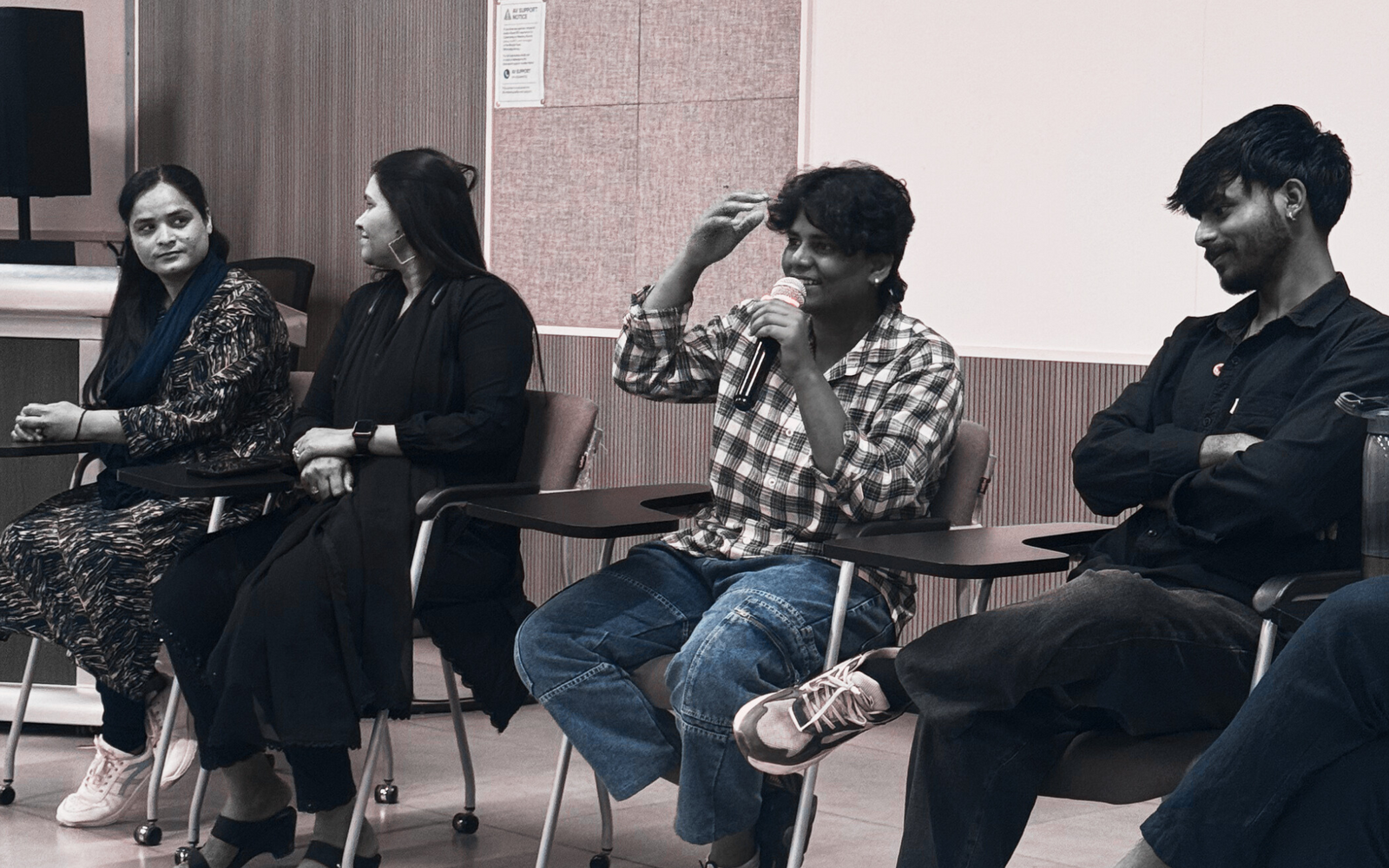
Among the panellists were Aarav, who works with young people, especially girls and queer youth, in bastis (settlements) around Bhopal through the medium of ultimate frisbee. Aarav questioned the ability of smart cities, at least the way the campaigns are being implemented today, to help the poor. Next, Rajveer Parmar, who works with theatre and sport to strengthen solidarity among youth from the Pardhi community and other denotified tribal groups around Bhopal, spoke about obstacles faced in securing a space for their ultimate frisbee teams to play sports. “The only ground we have near our basti is where garbage is dumped and segregated. Electrical wires are burnt here and it is highly polluted, yet this is where our kids play. During rains, it’s worse,” he said.
A city split in two
According to Rajveer, whenever the teams try to use better grounds next to the more affluent housing colonies, they are chased away by the residents. Sometimes, the lights are turned off such that it is too dark to play. “Is this by design? Are people bothered that we are trying to find a way to play?” he asked the audience of ecologists and city planners.
Shabnam Khan, a city-based social worker from the organisation Hunar Arts and Crafts, spoke about the impact of big infrastructural projects such as Bhopal’s upcoming metro rail on displaced families and children who go to school along the routes. “The flyover has made crossing the road on foot impossible. Girls from our families are not able to go to school because of this, but such problems are considered too small to be taken seriously,” she rued. Shabnam prodded the audience to ask themselves who the metro transport system in cities really helps. Do the people who lost homes and livelihoods get to travel in them?
“Cities have created a distance between people, splitting us into people who live in colonies and those who live in bastis,” observed Nighat Khan, from Eka. Coming from and working with women from Dalit, Muslim bastis, she urged the scholars, architects and planners in the audience to think of people who build just as much as the buildings themselves. She deplored the condition of workers who are shunted away after the building is completed, forced to restart their lives, and the education of their children.
Nighat also brought up the situation of women. “In any city, women need to be safe. They need to be seen in public spaces. Women have fought for the city, built the city. Once the ‘city of Begums’, urbanisation has pushed women of Bhopal back. How can we call it smart, clean or safe, when it’s only true for one subsection of the population?”
Besides this powerpacked panel, there was another one on ecotourism, as well as a wide range of long and short talks exploring the themes: land use and urban ecology; sustainability and policies; urban socials and pedagogy; invasive species; pollution and environmental health. In his plenary talk, Tarun Sharma, co-founder of the Dehradun-based thinktank Nagrika, highlighted with examples the role of citizen stewardship in nature conservation and urban governance.
The power of words and art
The second plenary was delivered by Sandhya Sekar, journalist and Programme Director at Mongabay India. Over the course of her session, she effectively illustrated the irony of energy poverty in villages that produce power. For example, Pavagada in Karnataka is the site of India’s biggest solar park, yet the village faces daily power cuts lasting hours at a time. Sandhya also emphasised the health toll of our heating cities on its inhabitants, with the story of former Delhi-based security guard Devi Prasad Ahirwar who has still not recovered from the severe heat stroke he suffered in the record-breaking summer of 2024.
Environmental journalism can also take another form, as is exemplified by cartoonist Rohan Chakravarty, creator of Green Humour, also present at the conference. Rohan offered behind-the-stage and after-publication insights to some of his popular cartoons and comics, making a strong case for scientists to work more closely with communicators like him.
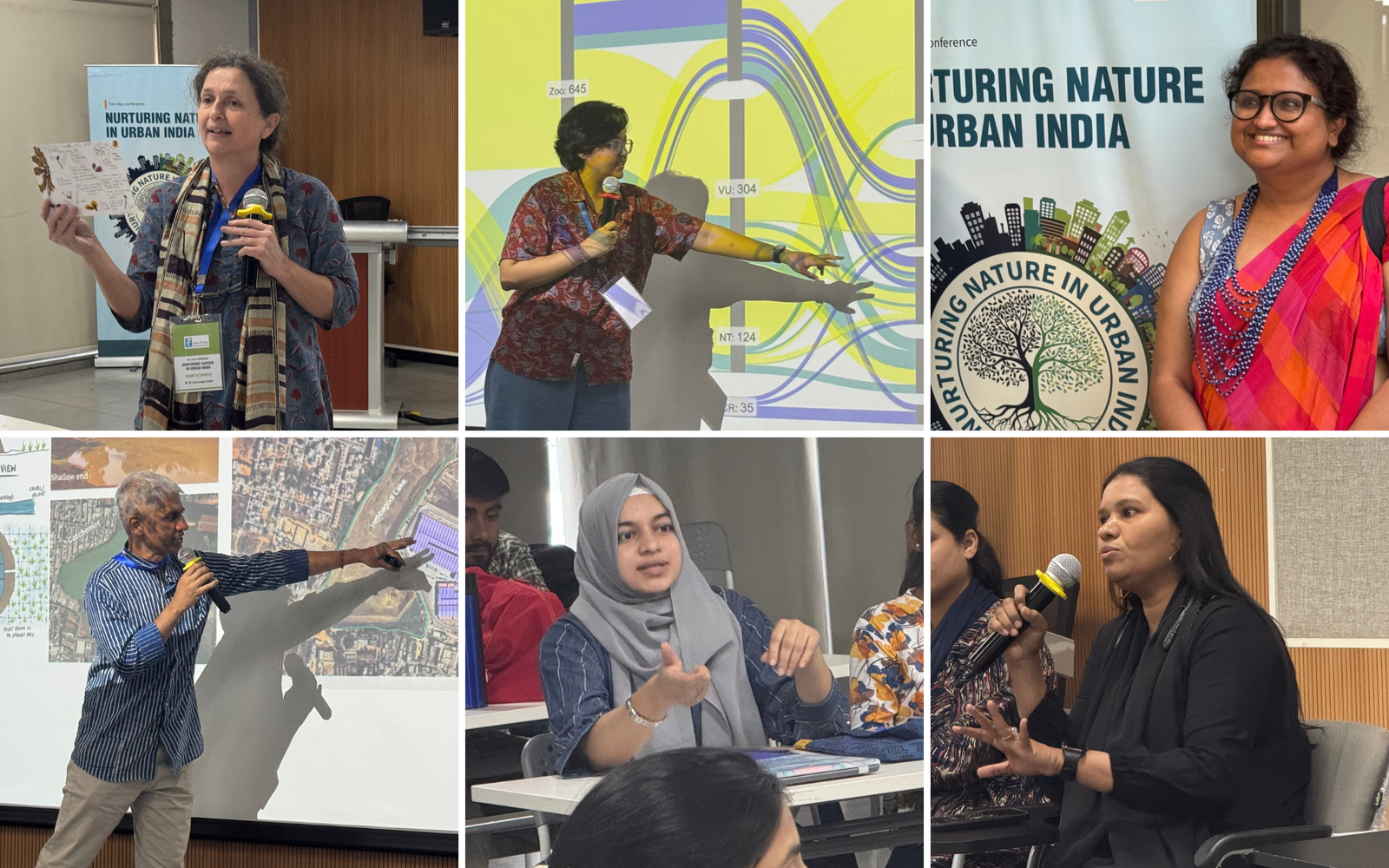
Snippets from the conference. Credit: Nandita Jayaraj
Other invited talks included Surajit Chakravarty’s provocations on the ontological position of nature in the development discourse, Benoy Stephen’s account of how his organisation Y‑Ultimate was using ultimate frisbee to build life skills in children from disadvantaged backgrounds, Devika P’s description of the activities and challenges of the Science Gallery at Bangalore, Ekta Chauhan’s perspectives of Delhi through the lens of its “urban villages”, and finally Monica Kaushik’s case for birds as strong indicators of a city’s health. Monica pointed out that while the importance of urban green spaces are now being recognised, for birds (especially insectivorous ones) it also matters how large these spaces were.
A conference like no other
While the format and topic of the conference were hardly unique, the diversity of perspectives and the nuances that came up over its course left a lasting impact on many of the participants. Sandhya Sekar wrote later that it was “quite unlike other conferences I have been to”, while Rohan Chakravarty lauded the panel members of Invisible City for highlighting civic inequalities in urban planning.
As one of the session chairs, Saurabh Popli said, “There is a need to recognise designed human environments as novel ecosystems.” While it is clear that the way cities are being designed today makes little ecological sense, the answer, according to Saurabh, lies in interdisciplinary learning. “The space between disciplines offers us the only way out of the crisis we are entering.”
The organisers are already working to keep up the momentum created by the conference. They have formed a working group which will soon start publishing a quarterly newsletter. “The idea is to have an online collaboration effort for everything related to urban research under one roof. The ultimate goal is to have more chapters of the conference,” said Ananya Mukherjee.
About the author
Nandita Jayaraj is a Science writer and Communications Consultant at Azim Premji University.