
P.C. Mahalanobis
Father of the Indian statistical system
By Pramit Bhattacharya
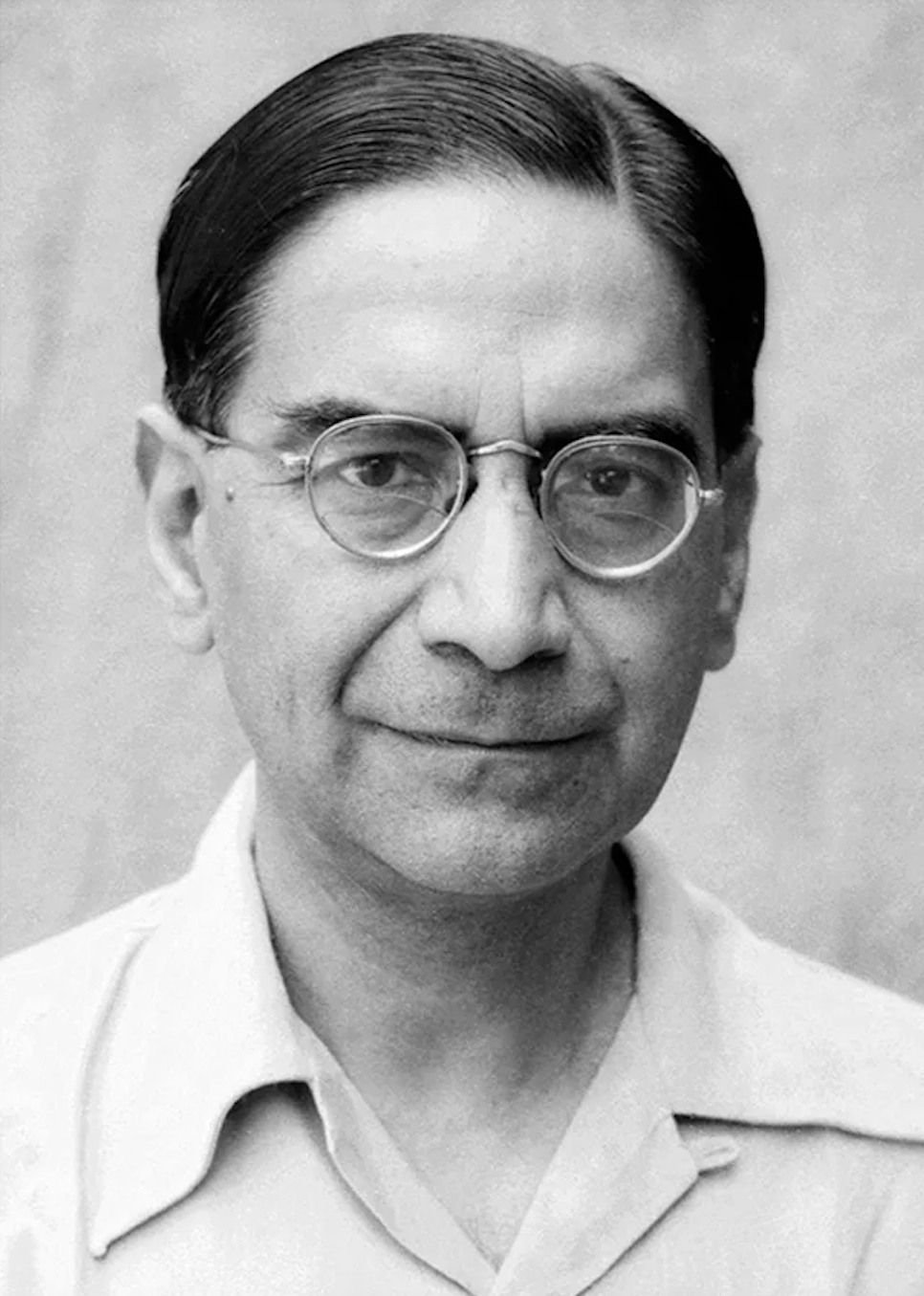
Details
When India decided to opt for a planned model of development after independence, the statistical pioneer Prasanta Chandra (P.C.) Mahalanobis found himself at the forefront of India’s efforts to fasten its growth trajectory. With the blessings of India’s first Prime Minister Jawaharlal Nehru and then finance minister C.D. Deshmukh, Mahalanobis assembled a team of global and local researchers at the Indian Statistical Institute (ISI) to provide greater rigour and empirical ballast to India’s five-year development plans1.
The Perspective Planning Division set up by Mahalanobis at the Planning Commission and the Planning Unit at ISI acquainted a new generation of economists and economic statisticians with the art and science of model-building. Some of the leading Indian economists of the post-independence period — Ashok Rudra, A. Vaidyanathan, B.S. Minhas, Jagdish Bhagwati, Pranab Bardhan, and T.N. Srinivasan — were initiated into the world of policymaking by Mahalanobis and his close associate Pitambar Pant2.
The revamp of India’s statistical system after independence owes much to the efforts of ‘the Professor’, as he came to be known in government and academic circles. Mahalanobis and his colleagues built the major economic datasets that we take for granted today – the national accounts series, the National Sample Survey (NSS), and the Annual Survey of Industries (ASI).
It was their ability to come up with ingenious solutions to practical policy problems that placed ISI statisticians at the heart of policymaking in newly independent India. An anecdote narrated years later by the statistical genius and Mahalanobis’ protege C.R. Rao exemplifies this point. Immediately after India’s independence in 1947, Delhi witnessed large-scale communal riots, and some of the displaced victims took shelter at the Red Fort. It was the new government’s responsibility to feed them. In the absence of a proper count of refugees, the government had to accept the amounts quoted by contractors for different food items they supplied to the refugee camp. Some officials suspected that the contractors were inflating the bills. They dialled ISI for help.
Since a direct census or survey wasn’t possible amid a raging conflict, the statisticians had to devise indirect methods. The only raw material they had were the bills submitted by the contractors. From those bills, the statisticians estimated the quantities of rice ($${R}$$), pulses ($${P}$$
), and salt ($${S}$$
) used per day to feed the refugees. From pre-existing consumption surveys, they derived the average consumption of these items: $${r}$$
(rice), $${p}$$
(pulses), and $${s}$$
(salt). Using the two sets of data, it was possible to arrive at three estimates of the number of people being fed at the Red Fort camp: $${R}$$
/$${r}$$
, $${P}$$
/$${p}$$
, and $${S}$$
/$${s}$$
. Of the three estimates, $${S}$$
/$${s}$$
was the lowest while $${R}$$
/$${r}$$
was the highest.
The statisticians inferred that the contractors were exaggerating the value of $${R}$$ since it was the costliest of the three items. Salt was the cheapest item and had a lower margin of profit. So they proposed $${S}$$
/$${s}$$
as the most likely estimate of the number of refugees. It was later found that the ISI estimate was close to the true number.
Rao pointed out that the ISI team did not use any ‘textbook method’ to arrive at the estimate. “The idea behind it is statistical reasoning or quantitative thinking,” wrote Rao. “Perhaps it also involves an element of art.” (Rao, 1997, pp. 145 – 6)
Many of his younger colleagues benefited from Mahalanobis’ support and his expansive vision. Yet, the Professor was not always an easy person to deal with. In his biography of Mahalanobis, Rudra referred to him as ‘the great dictator’. The renowned statistician G. Kallianpur (who later became ISI’s director) noted ‘occasional flashes of an autocratic temperament’ in him. “In the affairs of ISI, his (Mahalanobis’) word was law, the result not so much of the force of his personality as the paucity of people… who could stand up to him…,” wrote Kallianpur (1993, p. 60). “The result of such autocracy was not an increase in efficiency but a kind of controlled chaos.”
Mahalanobis was born at his family residence at 210 Cornwallis Street in Calcutta (now Kolkata) on 29 June 1893. His grandfather, Gurucharan had migrated from their ancestral village of Panchasar (now in Bangladesh) to set up his own business in the city. Gurucharan’s son Probodh Chandra (Prasanta’s father) was also a businessman. Like Gurucharan, he too became an active member of Bengal’s leading social reform movement, the Sadharan Brahmo Samaj.
Prasanta followed in their footsteps in his lifelong engagement with the Samaj. As a leading member of the Samaj’s youth wing, Prasanta led a joint campaign with Sukumar Ray (a noted Bengali writer; and film-maker Satyajit Ray’s father) to grant an honorary membership to Rabindranath Tagore. The campaign succeeded despite stiff opposition from the elder members of the Samaj3.
Mahalanobis studied at the Brahmo Boys’ School, established by his grandfather. After graduating with an honours degree in physics from Presidency College in 1912, he left for Cambridge in 1913, and came back with a Tripos degree in 1915. On his return, he began teaching physics at Presidency College.
In 1916, Calcutta University appointed a committee on examination reforms under the chairmanship of its philosophy professor, Brajendra Nath Seal. Seal reached out to Mahalanobis to help him analyse university data on students’ examination results. Mahalanobis had become acquainted with statistics at Cambridge but this was his first practical exposure to statistical methods. Like Mahalanobis, Seal was a close friend of Tagore and a member of the Brahmo Samaj4. He had studied mathematics in his youth, and believed that statistics would emerge as an important discipline in the future. Seal encouraged his younger friend to take up the study of statistics. Mahalanobis’ early statistical investigations led him to fields as varied as biometry, meteorology, and anthropometry. While he continued teaching physics at Presidency5 statistics became his passion.
By the 1920’s, Mahalanobis had set up a ‘statistical laboratory’ at Presidency College and had gathered a group of young associates to help with his research. The group’s analysis of historical rainfall and flood data helped design better flood control measures in Odisha and West Bengal6. A sizeable grant from the Imperial (now Indian) Council of Agricultural Research in 1931 led the group to set up ISI as a dedicated statistical research centre.
In 1933, ISI launched the first Indian journal on statistics. It was called Sankhya, evoking India’s ancient heritage of empirical thought7. Several path-breaking statistical and economic investigations were published in Sankhya in the years that followed. Mahalanobis’ famous work on the D‑square statistic — or the Mahalanobis distance formula — as it came to be known, was published in its pages8. Mahalanobis’ early research on this subject began while trying to find a quantitative method to ascertain the racial likeness (or divergence) of Anglo-Indians in Calcutta using anthropometric measurements. This research led him to develop a generalised method for comparing two multivariate datasets.
The results of some of the early socioeconomic surveys conducted by the leading Indian economist D.R. Gadgil were also published in Sankhya. “No statistical journal has surpassed it in excellence and scope of content,” the renowned American statistician W. E. Deming declared (1972, pp. 49 – 50) in 1972, when Mahalanobis passed away.
By the 1940s, both Mahalanobis and his institute had established a global reputation as statistical powerhouses. Mahalanobis was the lone Asian voice at the nuclear session of the United Nations Statistical Commission (UNSC), held in New York in 1946. He argued that large-scale sample surveys would become an invaluable resource for developing countries that lacked rich administrative datasets. Hence, it was important to frame global rules for conducting such surveys. Mahalanobis’ suggestion was accepted and he was asked to chair the first UNSC sub-committee on sampling.
The global manual on sampling prepared by Mahalanobis and his UN colleagues borrowed a great deal from the early field studies conducted at ISI. Some of the innovative survey practices of Mahalanobis and his ISI colleagues – such as conducting a pilot trial before launching a large-scale survey, or canvassing two independent sub-samples to monitor non-sampling errors – became part of the global survey toolkit. Statistical organisations in both rich and poor countries began using these tools to improve the accuracy of survey estimates.
In 1949, Nehru appointed Mahalanobis as the honorary statistical advisor to the Union cabinet and asked him to chair the National Income Committee. Nehru had spent long hours with Mahalanobis at Tagore’s residence on his visits to Calcutta, and came to share Mahalanobis’ concerns about the lack of adequate statistics for planning. He sought Mahalanobis’ help in revamping India’s statistical infrastructure.
The National Income Committee — which included the economists Gadgil and V.K.R.V. Rao — was asked to prepare India’s first national income estimates, and to lay down a roadmap for improving the accuracy of these estimates over time. Moni Mukherjee, an economic statistician from ISI, acted as the secretary to the committee. The committee’s report laid bare the weaknesses in India’s statistical edifice, and indicated how they could be addressed.
Mahalanobis took the lead in rebuilding the statistical system. The NSS project — initially run by statisticians at ISI — was his crowning accomplishment9. In a statistically deprived economy, it helped furnish data on a vast range of subjects: from consumption expenditure to agricultural land-holdings. Over time, NSS data came to be used to track employment and poverty levels, and to monitor the performance of welfare schemes across the country10.
Mahalanobis realised that it would take years to process the raw NSS data unless computers were deployed. Thanks to his persistent efforts, ISI was able to acquire the first digital computer in India in 195611. When questions were raised about the reliability of survey estimates, he persuaded RA Fisher to chair a committee of eminent statisticians to review the NSS system in 1957. Fisher, who was an early backer of the NSS project, held that the costs of funding NSS were outweighed by the gains. While the Fisher committee highlighted12 scope for improvements, it noted that in the matter of sample-surveys, “those from outside India must have more to learn than to teach”13.
As India’s statistical edifice was being erected, Mahalanobis was called upon to help prepare the second five-year plan (1956−61). The ISI research project on planning helped in preparing a new framework for planning. Mahalanobis’ own mathematical model of the economy in 1953 provided the intellectual scaffolding for the plan, justifying the emphasis on heavy industry and capital goods. The Mahalanobis model suggested that long-run growth rates could be raised by apportioning greater resources for physical investments, even if that meant subdued consumption growth in the short run.
Mahalanobis was formally inducted in the Planning Commission in 1955 and he remained a member till 1967. The weaknesses of the Mahalanobis model became apparent during the second plan period itself, when resources fell short of what was anticipated. Nonetheless, the practice of developing an econometric model for each five year plan continued at the Planning Commission for several decades14. The perspective planning division continued to provide long-range projections on a wide variety of subjects.
Some of the division’s alumni such as Rudra and Vaidyanathan remained vocal defenders of India’s experiments with planning. Others such as Bhagwati and Srinivasan became vocal critics of a state-directed and planned economy. In the run-up to 1991, India witnessed a fierce debate between the proponents and opponents of economic liberalisation. The ‘Professor’s boys’ remained at the forefront of this battle15.
Mahalanobis, P. C. (1930). On tests and measures of group divergence. Journal and Proceedings of the Asiatic Society of Bengal. Asiat. Soc. Bengal, 26(4), 541 – 588.
Mahalanobis, P.C. (1950). Why Statistics?. Sankhyā: The Indian Journal of Statistics, 10(3), 195 – 228. It was originally delivered as Mahalanobis’s presidential address at the Thirty-Seventh Session of the Indian Science Congress held at Pune in January 1950.
Mahalanobis, P.C. (1961). Talks on Planning. Indian Statistical Series No 14, Studies relating to Planning for National Development.
Mahalanobis, P.C. (1965). Statistics as a Key Technology. The American Statistician,19(2), 43 – 46.
Rudra, A. (1996). Prasanta Chandra Mahalanobis: A Biography. Oxford India Press.
Rudra, A. (1975). Indian Plan Models. Allied Publishers.
Menon, N. (2022). Planning Democracy: How A Professor, An Institute, And An Idea Shaped India. Penguin Random House India.
Deming, W.E. (1972). P. C. Mahalanobis (1893−1972). The American Statistician, 26(4), 49 – 50.
Rao, C.R. (1997). Statistics and Truth: Putting Chance to Work. World Scientific Publishing Co. Pte. Ltd.
Kallianpur, G. (1993). Random Reflections. In J.K. Ghosh, S.K. Mitra, and K.R. Parthasarathy (eds.) Glimpses of India’s Statistical Heritage. Wiley Eastern Ltd.
Sarcar, B.B. (1964). Acharya Brajendra Nath Seal — a Life Sketch. In Acharya Brajendra Nath Seal Birthday Centenary (1864−1964) Souvenir. Indian Statistical Institute.
Dandekar, V.M. (1953). Report on the Poona Schedules of the National Sample Survey (1950−51). Gokhale Institute of Politics and Economics publication no. 26.
Balasubramanyam, V.M. (2001). Conversations with Indian Economists, Palgrave Macmillan.
About the author
Pramit Bhattacharya is head of research at Data for India. He writes Simply Economics for Hindustan Times and Truth, Lies and Statistics for Mint.
Visiting economists from all across the globe contributed to ISI’s planning project. The visitors included economists such as Oscar Lange (Poland), Ragnar Frisch (Norway), Charles Bettelheim (France), Jan Tinbergen (Netherlands), Nicholas Kaldor (UK), Kenneth Galbraith (US), Paul Baran (US), Richard Goodwin (US), and a whole delegation of experts from GOSPLAN, the Soviet planning body. Frisch initiated work on a multi-sector programming model at ISI, among the early attempts in using linear programming for economic planning. See Rudra (1975, p. vii).↩︎
Visiting economists from all across the globe contributed to ISI’s planning project. The visitors included economists such as Oscar Lange (Poland), Ragnar Frisch (Norway), Charles Bettelheim (France), Jan Tinbergen (Netherlands), Nicholas Kaldor (UK), Kenneth Galbraith (US), Paul Baran (US), Richard Goodwin (US), and a whole delegation of experts from GOSPLAN, the Soviet planning body. Frisch initiated work on a multi-sector programming model at ISI, among the early attempts in using linear programming for economic planning. See Rudra (1975, p. vii).
Pant was a freedom-fighter who had met Nehru in jail, and worked as his secretary. Nehru sent him to ISI so that he could familiarise himself with statistics, and he became quite close to Mahalanobis. Pant joined the Planning Commission in 1956 as the head of the manpower division, before going on to head the newly created Perspective Planning Division (PPD) in 1958. While heading PPD, Pant continued to be the secretary to the Commission chairman (Nehru) and served as ISI’s honorary joint secretary. Pant served as a bridge between the country’s political leadership and its technocrats in independent India’s early years. See Vaidyanathan, Rao, Srinivasan and Bhagwati (1973, pp. 774–7).↩︎
Pant was a freedom-fighter who had met Nehru in jail, and worked as his secretary. Nehru sent him to ISI so that he could familiarise himself with statistics, and he became quite close to Mahalanobis. Pant joined the Planning Commission in 1956 as the head of the manpower division, before going on to head the newly created Perspective Planning Division (PPD) in 1958. While heading PPD, Pant continued to be the secretary to the Commission chairman (Nehru) and served as ISI’s honorary joint secretary. Pant served as a bridge between the country’s political leadership and its technocrats in independent India’s early years. See Vaidyanathan, Rao, Srinivasan and Bhagwati (1973, pp. 774–7).
Orthodox members of the Samaj did not consider themselves to be a part of Hindu society, while Mahalanobis and Tagore did not see any contradiction between being a Hindu and being a Brahmo. In a pamphlet titled Keno Rabindranathke Chai (Why We Need Rabindranath), Mahalanobis argued that the poet’s unwillingness to declare ‘I am not a Hindu’ could not be held against him. Mahalanobis quoted a leading theologian of the Samaj, Sitanath Tattwabhusan in support of his argument that the Samaj was ‘not outside the Hindu society’, but a reformed Hindu sect. See Rudra (1996, p. 7).↩︎
Orthodox members of the Samaj did not consider themselves to be a part of Hindu society, while Mahalanobis and Tagore did not see any contradiction between being a Hindu and being a Brahmo. In a pamphlet titled Keno Rabindranathke Chai (Why We Need Rabindranath), Mahalanobis argued that the poet’s unwillingness to declare ‘I am not a Hindu’ could not be held against him. Mahalanobis quoted a leading theologian of the Samaj, Sitanath Tattwabhusan in support of his argument that the Samaj was ‘not outside the Hindu society’, but a reformed Hindu sect. See Rudra (1996, p. 7).
Seal was a polymath with interests spanning mathematics, art, literature, and philosophy. In his youth, he had developed a close friendship with fellow member of the Brahmo Samaj, Narendra Nath Dutta (who came to be known as Swami Vivekananda later), and had accompanied Narendra when he first went to meet Ramakrishna Paramhansa at Dakshineswar. See Sarcar (1964). ↩︎
Seal was a polymath with interests spanning mathematics, art, literature, and philosophy. In his youth, he had developed a close friendship with fellow member of the Brahmo Samaj, Narendra Nath Dutta (who came to be known as Swami Vivekananda later), and had accompanied Narendra when he first went to meet Ramakrishna Paramhansa at Dakshineswar. See Sarcar (1964).
Mahalanobis continued to be a professor of physics at Presidency till 1948, and also acted as the college principal in his final years there. For a few years, he was simultaneously Director of Meteorology, Calcutta. See Rudra (1996, pp. 117–126).↩︎
Mahalanobis continued to be a professor of physics at Presidency till 1948, and also acted as the college principal in his final years there. For a few years, he was simultaneously Director of Meteorology, Calcutta. See Rudra (1996, pp. 117–126).
The statistical laboratory’s calculations later helped in the design of the Damodar Valley and Hirakud dams. See Ashok Rudra (1996, p. 166).↩︎
The statistical laboratory’s calculations later helped in the design of the Damodar Valley and Hirakud dams. See Ashok Rudra (1996, p. 166).
“In Sanskrit the usual meaning (of sankhyã) is ‘number’, but the original root meaning was ‘determinate knowledge’,” the editorial from the first edition said. “In the Atharva-Veda a derivative form sankhyätä occurs both in the sense of well-known as well as ‘numbered’. The Lexicons give both meanings… The same dual sense is attached to its derivative form sãnkhya which is the name of the most famous analytic philosophy of ancient India. The name of the philosophical system is explained in both ways: as a philosophy based essentially on enumeration of the categories beginning with nature or root cause. Or else a philosophy by which is revealed the adequate knowledge of reality… The history of the word sankhyã shows the intimate connection which has existed for more than 3000 years in the Indian mind between ‘adequate knowledge’ and ‘number’. As we interpret it, the fundamental aim of statistics is to give determinate and adequate knowledge of reality with the help of numbers and numerical analysis. The ancient Indian word Sankhyã embodies the same idea, and this is why we have chosen this name for the Indian Journal of Statistics.”↩︎
“In Sanskrit the usual meaning (of sankhyã) is ‘number’, but the original root meaning was ‘determinate knowledge’,” the editorial from the first edition said. “In the Atharva-Veda a derivative form sankhyätä occurs both in the sense of well-known as well as ‘numbered’. The Lexicons give both meanings… The same dual sense is attached to its derivative form sãnkhya which is the name of the most famous analytic philosophy of ancient India. The name of the philosophical system is explained in both ways: as a philosophy based essentially on enumeration of the categories beginning with nature or root cause. Or else a philosophy by which is revealed the adequate knowledge of reality… The history of the word sankhyã shows the intimate connection which has existed for more than 3000 years in the Indian mind between ‘adequate knowledge’ and ‘number’. As we interpret it, the fundamental aim of statistics is to give determinate and adequate knowledge of reality with the help of numbers and numerical analysis. The ancient Indian word Sankhyã embodies the same idea, and this is why we have chosen this name for the Indian Journal of Statistics.”
The most comprehensive research paper on the D-square statistic was authored jointly by Mahalanobis and two younger colleagues in 1937. Mahalanobis’ research on the D-square statistic had begun much earlier, in the 1920s; see Dasgupta (1993, pp. 442–59).↩︎
The most comprehensive research paper on the D-square statistic was authored jointly by Mahalanobis and two younger colleagues in 1937. Mahalanobis’ research on the D-square statistic had begun much earlier, in the 1920s; see Dasgupta (1993, pp. 442–59).
Mahalanobis had sought Gadgil’s help for conducting the first NSS round, given the latter’s expertise in conducting socio-economic household surveys. But Gadgil developed serious differences with Mahalanobis and the ISI team on the way in which the survey was being conducted, and abandoned the experiment even before the first round was completed. See Dandekar (1953).↩︎
Mahalanobis had sought Gadgil’s help for conducting the first NSS round, given the latter’s expertise in conducting socio-economic household surveys. But Gadgil developed serious differences with Mahalanobis and the ISI team on the way in which the survey was being conducted, and abandoned the experiment even before the first round was completed. See Dandekar (1953).
“We in this country, though accustomed to work in large-scale sample-surveys, were aghast at Mahalanobis’ plans for the national sample surveys of India,” wrote Deming (1972, pp. 49–50) years later. “Their complexity and scope seemed beyond the bounds of possibility, if not beyond anyone else's imagination, but they took hold and grew.”↩︎
“We in this country, though accustomed to work in large-scale sample-surveys, were aghast at Mahalanobis’ plans for the national sample surveys of India,” wrote Deming (1972, pp. 49–50) years later. “Their complexity and scope seemed beyond the bounds of possibility, if not beyond anyone else's imagination, but they took hold and grew.”
For a detailed account of Mahalanobis’ efforts to bring computers to India, see Menon (2022, pp. 82–109).↩︎
For a detailed account of Mahalanobis’ efforts to bring computers to India, see Menon (2022, pp. 82–109).
The Fischer committee’s report was later published in Sankhya.↩︎
The Fischer committee’s report was later published in Sankhya.
For a detailed description of Mahalanobis’ role in revamping India’s statistical system, see Bhattacharya (2023).↩︎
For a detailed description of Mahalanobis’ role in revamping India’s statistical system, see Bhattacharya (2023).
Ashok Rudra’s Indian Plan Models provides a lucid account of the evolution of plan models till the fifth five-year-plan.↩︎
Ashok Rudra’s Indian Plan Models provides a lucid account of the evolution of plan models till the fifth five-year-plan.
Jagdish Bhagwati described himself as one of ‘the Professor’s boys’ in an interview, see Balasubramanyam (2001, p. 140).↩︎
Jagdish Bhagwati described himself as one of ‘the Professor’s boys’ in an interview, see Balasubramanyam (2001, p. 140).