
Dwijendra Tripathi
India’s first professional business historian
By Chinmay Tumbe
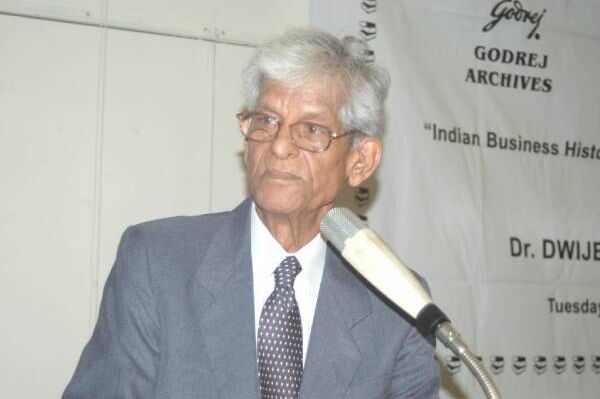
Details
Dwijendra Tripathi (1930−2018) was the doyen of Indian business history and an academic in the Economics Area of the Indian Institute of Management Ahmedabad from 1964 to 1990. Collectively, his scholarship included biographies of individuals and firms and analyses of communities and enterprises from the eighteenth century to the present. His research focus was mostly on western India though he also wrote on US and Japan.
Tripathi was born on 29 July 1930, in a remote village in Azamgarh district of eastern Uttar Pradesh in north India, still under colonial rule. He was the only student in Azamgarh district to get a First Class in the Arts stream of Class 12. He completed his BA in History, Economics, and English Literature in 1952 and his MA in History at the University of Allahabad in 1954.
His acquaintance with history, and later business history, was serendipitous. Civil services, the traditional attraction for Brahmins of that time, was not an option for him because he had seen his father, a freedom fighter and role model, being arrested in front of his eyes, imprinting a lifelong disdain for government services. One of his lifelong regrets was that he never went to jail during the freedom movement. After completing his MA, he took a job as a teacher in a college in Jabalpur in 1954. He had always been interested in American history, with strong memories of growing up reading books on Washington, Lincoln, Dewey, and the novel Uncle Tom’s Cabin in his father’s library. He applied for and received a Fulbright scholarship to pursue graduate work in history, beginning at the University of Wisconsin – Madison in 1960. He completed his dissertation in 1963 on the economic links between the United States and India in the late nineteenth century, with Richard N. Current as his adviser.
Tripathi returned to India and was briefly in Jabalpur before heading to Bombay in May 1964 as Research Officer in the Historical Research Department of the State Bank of India, that was attempting to chronicle its history. He then joined IIMA on 1 July 1964, the same day as the inauguration of the institute’s first batch of MBA students. He went to Harvard Business School (HBS), IIMA’s institutional partner in its early years, as part of the International Teachers Program in 1965, where he interacted with Ralph Hidy and the business history fraternity. HBS is widely considered to be the pioneer of business history as a discipline. The HBS and leading business historian Alfred Chandler’s approach to studying big business would influence Tripathi’s later scholarship.
Between 1964 and 1990, Tripathi had an eventful career in teaching, research, and administrative responsibilities at the IIMA. In his reflections, he lamented that there had been few doctoral students he could nudge toward business history and that the course on business history had not become popular. This he attributed to the lack of institutional support for historical work after the initial thrust provided by Ravi Matthai, a charismatic Director of IIMA, with whom he shared a deep friendship. After his retirement from IIMA in 1990, he took on a position as Senior Faculty at the Entrepreneurship Development Institute of India (EDII), until 1996.
While at IIMA, Tripathi wrote biographies, not hagiographies, of industrialist Kasturbhai Lalbhai and the firms- Larsen & Toubro and Bank of Baroda. He also wrote on the business houses of Western India that emerged in the late nineteenth and early twentieth centuries. Following Dhananjaya Gadgil’s work on the emergence of the modern Indian ‘business class’, he carved out a niche scholarship on ‘business communities’, especially the Vaishya and Jain Gujaratis. His scholarship was rooted in entrepreneurial history, stressing multifactorial models for understanding the phenomenon, and enriched by an unparalleled access to Lalbhai, a leading industrialist of his time. In the 1980s, he held four seminars on business history at IIMA leading to three important, edited volumes that continue to be indispensable in the field, especially the one on business communities. These seminars were inspired by what he had observed in international seminars in Japan, where he spent time as a visiting research fellow at the Institute of Developing Economies in Tokyo in 1985 – 1986. Much later, in 1997, he would write a comparative study on entrepreneurial history in India and Japan, just as he had absorbed himself in the 1960s and 1970s with the links between India and America, culminating in a visiting professorship at the University of Utah, Salt Lake City, in 1979 – 1980. His interests in America and Japan were in sharp contrast to the majority of historians of India, who tended to focus on Britain or the world of the Indian Ocean. He established connections with historians in other fields as he regularly attended the International Economic History Congress and Indian History Congress. He was the General President of the latter body in 2002 – 2003.
Tripathi’s major research contributions were in more than a dozen books and monographs. He founded the Journal of Entrepreneurship in 1992 at the EDII. At the age of 74, in 2004, he wrote his masterpiece, the Oxford History of Indian Business, a grand narrative on the evolution of Indian business over several centuries. Asked by a Director of the TATA group how many years it took him to write it, he replied “All my life.” When a reviewer lamented that the book’s narrative stopped in 1947, Tripathi wrote another book when he was well into his 80s, culminating in his last book, the Oxford History of Contemporary Indian Business. Here, among other things, he showed the difference in attitudes toward business between Jawaharlal Nehru and Indira Gandhi, arguing that standard critiques of the Nehruvian socialist economy were mistaken because the infamous License Raj, in his view, was mainly the product of Indira Gandhi’s reign.
Tripathi identified himself as a liberal, unpersuaded by the Marxist dogma of his times in the history discipline. He studied capitalists at a time when most historians studied labor, and considered business history to be closer to social history than economic history. His critique of colonialism was nuanced, as expressed in a paper in The Developing Economies in 1996, outlining how colonialism shaped attitudes towards technology choice and why Indian cotton mill owners lagged behind Japan in adopting new technologies, imitating outdated British technologies.
He and his wife, Saraswati, were married for over fifty years and had three children — Parimal, Tushar, and Smita. Known as ‘Dwiji’ to those close to him, he was India’s first professional business historian, who spent decades understanding entrepreneurs and firms and the choices they made, articulated through numerous case studies, articles, and books.
Major works
- Tripathi, D., & Jumani, J. (2013). The Oxford History of Contemporary Indian Business. Oxford University Press.
- Tripathi, D. (2008). Dynamics of Ascent: A Centenary History of Bank of Baroda. Oxford University Press.
- Tripathi, D. (2004). The Oxford History of Indian Business. Oxford University Press.
- Tripathi, D. (1997). Historical Roots of Industrial Entrepreneurship in India and Japan. Manohar Publications.
- Tripathi, D. (1996). Colonialism and technology choices in India: a historical overview. The Developing Economies, 34(1), 80 – 97.
- Tripathi, D. (Ed.) (1991). Business and Politics in India: A Historical Perspective. Manohar Publishers and Distributors.
- Tripathi, D. (Ed.) (1987). State and Business in India: A Historical Perspective. Manohar Publishers and Distributors.
- Tripathi, D. (Ed.) (1984). Business Communities of India: A Historical Perspective. Manohar Publishers and Distributors.
- Tripathi, D. (1981). The Dynamics of a Tradition: Kasturbhai Lalbhai and His Entrepreneurship. Manohar Publications.
- Tripathi, D. (1975). Dating the Destiny: Thirty Five Years of the Larsen and Toubro Limited. Indian Institute of Management Ahmedabad.
- Tripathi, D. (1963). The United States and India, Economic Links, 1860 – 1900. PhD Dissertation, University of Wisconsin, USA.
References
- Indian Institute of Management Ahmedabad Archives. (n.d.). Dwijendra Tripathi. https://archives.iima.ac.in/faculty/Dwijendra-Tripathi.html
- Indian Institute of Management Ahmedabad Archives. (n.d.). Dwijendra Tripathi, IIMA faculty (1964 – 1990). https://archives.iima.ac.in/oralhistory/Dwijendra-Tripathi.html
- Tumbe, C. (2018). Dwijendra Tripathi. Business History Review, 92(4), 745 – 748. https://doi.org/10.1017/S0007680519000035
About the author
Chinmay Tumbe is Associate Professor in the Economics Area at the Indian Institute of Management Ahmedabad and author of India Moving: A History of Migration. He interviewed Dwijendra Tripathi for the IIMA Archives oral history project in March 2018.