
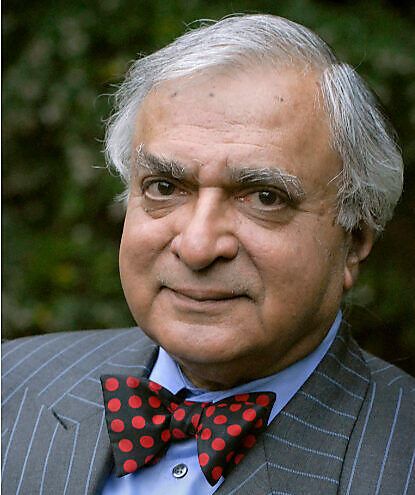
Deepak Lal
The quintessential classical liberal
By TCA Srinivasa Raghavan
Details
Deepak Lal (1940−2020) was a classical liberal who had little patience with the leftist shibboleths that have a wide audience in India, and elsewhere. For example, for about 15 years now, the world has been in a strange place, where it has transitioned from slow growth in employment, despite rapidly growing output, to slow income growth despite rapidly increasing productivity. The share of profit, therefore, has gone up, making the rich richer. So have the shares of rent and interest.
Lal, who passed away in London because he contracted Covid, would have been incensed at the advice where profits are regarded as immoral and in which the State is exhorted to take away some, if not a large part of them, as a corrective to the immorality of it all. This is an old chestnut which still has customers with a penchant for red herrings.
For several years he and I sat next to each other at the morning editorial meetings of the Business Standard, the highly intellectual business newspaper of India. The editorial board, of which I was one of the members, used to meet daily to start with, then three times a week and eventually once a week on Mondays. It was at this last phase that Lal joined us. He was a special invitee and would attend whenever he was in Delhi. He didn’t speak much but when he did it would be to make a point steeped in sound economic theory.
“It’s inefficient to introduce compassion into economics,” he once told me. He wasn’t against taxation or genuine welfare, only expropriation pretending to be the fulfilling of a moral obligation of the State to citizens. Economics, according to him, was based on reason, while politics co-opting economics was just humbug.
It was natural that being so out of step with the zeitgeist he would not be the darling of the mass of economists. But sound economic logic is hard to contradict without tying yourself up in knots. He never wasted any time on such people nor on those whose minds were already made up. In a world where mediocre economists are lionised, his brilliant light was hidden under the bushel by the economics establishment. A similar fate had befallen the redoubtable Ashok Desai, too.
Lal didn’t start off as an economist. For a little over three years, between 1963 and 1966, he was a member of the Indian Foreign Service. He told an interviewer once that after he refused to learn horse riding as a part of training, he was told he would not be able to join the Service. To which he replied “I think I’ll have to go to my Member of Parliament and say I have just been chucked out of the Foreign Service because I refused to partake in the imperialist activity of horse riding.”
He had the classic educational background: Doon School, St. Stephens College and Oxford. Happily, these institutions barely left a mark on his intellectual development and outlook. Throughout his life he kept challenging safe and comfortable orthodoxies.
He was, like many others of his time, more interested in different problems that the politicians were making even more intractable. Development was one of them, as was the enigma that India was with its economic stagnation, political choices and cultural stability. I once told him that India was like the buffalo in the village pond, undisturbed by anything, content with occasionally swishing its tail. That about describes it, he said.
His most influential work, however, was The Poverty of ‘Development Economics’ in which he said the price mechanism would get better development outcomes than state intervention. The problem of market failure, according to him, was far easier to solve than the problems created by dirigiste or state-led outcomes.
He addressed the question of what the State should concern itself with head on: resource allocation or price setting. He had no doubt at all that it should be the first. “Imperfect markets are superior to imperfect planning”, he wrote, adding that it was absolutely crucial to “get the prices right”. That phrase became popular in the 1980s and formed a critical pylon of the Washington Consensus of the 1990s. He strongly believed that development economics had done far more harm than good and that the demise of development economics is likely to be conducive to the health of both the economics and the economies of developing countries.
This might have been overstating it somewhat because without state intervention or intermediation many things would have taken longer to correct themselves. Overall, however, he was absolutely correct in his assessment that the State could not afford to ignore price signals and would, in fact, benefit from them in devising its own intervention policies.
That did however leave the examples of Japan and East Asia without an adequate explanation. Lal wasn’t fazed. He said these economies focused on getting the prices right via competition in international trade. The point he missed, in my view, was that firstly they had no choice because their domestic markets were small and because, thanks to the American security umbrella, they spent on welfare what they would otherwise have spent on defence.
His classic book aside, there is also an essay he wrote for the International Monetary Fund (IMF) about it in 1985 called “Misconceptions of ‘Development Economics’”. It becomes clear when you read it that he was talking about information asymmetry way before the rest of economics had internalised the problem. “the multitude of small bets, based on different forecasts, placed by a large number of decision makers in a market economy may be a sounder strategy. Also, bureaucrats, as opposed to private agents, are likely to take less care in placing their bets, as they do not stand to lose financially when they are wrong. This assumes, of course, that the government does not have better information about the future than private agents. If it does, it should obviously disseminate it, together with any of its own forecasts. On the whole, however, it may be best to leave private decision makers to take risks according to their own judgments.”
He thus stood in direct opposition to economists like Paul Rodenstein-Rodan who argued the case for massive state intervention, via, for example, the ‘Big Push’ theory. It wasn’t a popular view even with governments that didn’t have the resources even for small pushes. Politicians didn’t want to relinquish control. And the bureaucrats egged them on.
His other major work was called The Hindu Equilibrium. It is a two-volume book and not very easy to plough through. It also deals with a theme that the late D.D. Kosambi, mathematician, economist, historian and numismatist had delved into in the 1950s, namely, that Indian social/cultural stability and economic stagnation are joined at the hip.
Kosambi explained all this in terms of the persistence of limited trade between villages from the 8th century onwards and the consequent development and fossilisation of the caste system according to occupation. The small size of the market and the need for everyone to earn ensured that.
Lal came at the problem from a different perspective. He had no use for it as an explainer of economic stagnation because he thought neo-classical markets theories had a life that was separate from the caste system. They both existed independently of each other without any interface.
Scholars can argue till the cows come home about all this — and they all have, mostly — but one thing Kosambi and Lal would have agreed fully: the importance of trade. Both blamed its absence or its limited nature to economic stagnation. This is a classic case of a Marxist agreeing with a market fundamentalist on a subject of great importance.
Lal knew his economic theory as well as anyone else but wore that burden of specialised knowledge lightly on his sleeve. Common sense that, given the option, people and firms would act to maximise their own welfare, in whatever way it would accrue; and logic that the sum of individual utilities that had been maximised was more likely to maximise social utility than interventions by the State. This didn’t endear him to economists such as Amartya Sen who held the opposite view. Sen, fortunately for him, was more in tune with the times and Lal was gradually nudged to the margins of mainstream economics. If you mention his name in India the response often is “Deepak Lal, who?”
His advocacy of the UK leaving the European Union was noteworthy for its severe critique of the EU’s protectionist tendencies and centralised decision making. He strongly believed that Britain would benefit by shedding the shackles of EU rules of trade. But a decade after Brexit, he appears to have been mistaken. It would seem that the fault lay not with the EU but the UK.
He was also very disenchanted with central banks. He told an interviewer from CapX: “People forget the thing that Milton [Friedman] said, which people forget: the only effect fiddling around with money has, is either inflation or deflation. The real effects are washed out.” A.C. Pigou and Irving Fisher — here were two more top class economists swept aside by the gale caused by self-seeking politicians of Keynesian theory, albeit a distorted one. Common sense and logic gave way to state interventionism.
When he passed away in 2020 Lal had done the full round: academia at Oxford, development banking via the World Bank (which incidentally, he thought should be closed down because it had become an NGO), think tanks and back to academia in University of California, Los Angeles (UCLA) where he was appointed a tenured professor in 1993.
The question does need to be answered, though, because it is central to all political arrangements: how relevant is the Austrian tradition in which Lal was so firmly rooted, in the presence of mass poverty where the majority of the people don’t have the luxuries of choice? Lal’s response when I asked him this was clear: globalisation and market integration.
It’s hard to say what Lal would have made of the prevalent US government dogma that trade and globalisation are good but they mustn’t result in extreme transfers of jobs and industrial capacities. Given that this whole argument is aimed at China, it is useful in conclusion to quote him once again.
The US has what China doesn’t, he said to CapX. Freedom. “I can’t think of any centrally planned economy which has the innovative spirit, and you can’t get that in a non-market economy.” He regarded China neither as a centrally planned fish nor as a free market fowl.
But he could be quite a maverick, too, as over climate change. He believed that human beings couldn’t do much to alter a cosmic phenomenon like global warming because it was caused by sun spots, and that all this NGO-led hysteria was ultimately detrimental to the poor because it would dampen the use of cheap energy.
Major works
- Lal, D. (2018). War or Peace: the struggle for world power. Oxford University Press.
- Lal, D. (2012). Lost Causes: The Retreat from Classical Liberalism. Biteback Publishing.
- Lal, D. (2010). Reviving the Invisible Hand: The case for classical liberalism in the twenty-first century. Princeton University Press.
- Lal, D. (2004). In Praise of Empires: Globalization and Order. Palgrave Macmillan.
- Lal, D. (2003). The Japanese Slump. In Pethig, R., & Rauscher, M. (Eds.) Challenges to the World Economy (pp. 281 – 290). Springer Berlin Heidelberg.
- Lal, D., & Snape, R. H. (2001). Trade, Development, and Political Economy: Essays in Honour of Anne O. Krueger. Palgrave.
- Lal, D. (2000). The New Cultural Imperialism: The greens and economic development. UCLA Dept. of Economics Working Paper (814).
- Lal, D. (1999). Green Imperialism: A prescription for misery and war in the world’s poorest countries. Social Affairs Unit.
- Lal, D. (1999). Culture, Democracy, and Development (Vol. 5). National Council of Applied Economic Research.
- Lal, D. (1999). Renewing the Miracle: Economic Development and Asia. Institute of Public Affairs.
- Lal, D. (1999). Unfinished Business: India in the World Economy. Oxford University Press.
- Lal, D. (1998). Unintended Consequences: The Impact of Factor Endowments, Culture, and Politics on Long-Run Economic Performance. MIT Press.
- Lal, D., & Myint, H. (1996). The Political Economy of Poverty, Equity, and Growth: A Comparative Study. Oxford University Press.
- Lal, D. (1996). The limits of international cooperation. In Wood, G. E. (Ed.) Explorations in economic liberalism: the Wincott lectures (pp. 141 – 171). Palgrave Macmillan UK.
- Lal, D. (1995). The Minimum Wage. UCLA Economics Working Papers 723, UCLA Department of Economics.
- Lal, D. (1994). Against Dirigisme: the case for unshackling economic markets. Institute for Contemporary Studies Press.
- Lal, D. (1993). The Repressed Economy: Causes, Consequences, Reform. Edward Elgar.
- Lal, D. (1992). Fighting Fiscal Privilege: Towards a fiscal constitution. The Social Market Foundation.
- Scott, M., & Lal, D. (Eds.) (1990). Public Policy and Economic Development: Essays in Honor of I.M.D. Little. Oxford University Press.
- Lal, D. (1989). Nationalised Universities: Paradox of the Privatisation Age. Centre for Policy Studies
- Lal, D. (1989). The Hindu Equilibrium. Volume II: Aspects of Indian Labour. Clarendon Press.
- Lal, D. (1989). The Hindu Equilibrium. Volume I: Cultural Stability and Economic Stagnation: India, c. 1500 B.C. – A.D. 1980. Clarendon Press.
- Lal, D. (1989). The Hindu Equilibrium. Volume I: Cultural Stability and Economic Stagnation: India, c. 1500 B.C. – A.D. 1980. Clarendon Press.
- Lal, D., & Rajapatirana, S. (1989). Impediments to trade liberalization in Sri Lanka (No. 51). Trade Policy Research Centre London.
- Lal, D., & Wolf, M. (Eds.) (1986). Stagflation, savings, and the state; perspectives on the global economy. World Bank.
- Collier, P., & Lal, D. (1986). Labour and poverty in Kenya, 1900 – 1980. World Bank.
- Lal, D. (1983). The Poverty of “Development Economics”. Institute of Economic Affairs.
- Lal, D. (1980). A liberal international economic order: the international monetary system and economic development (No. 139). International Finance Section, Department of Economics, Princeton University.
- Lal, D. (1980). Prices for Planning: Towards the Reform of Indian Planning. Heinemann.
- Lal, D. (1979). Market Access for Semi-Manufacturers from Developing Countries. World Bank Reprint Series: Number 130.
- Lal, D. (1978). Poverty, Power and Prejudice: The North-South Confrontation. Fabian Society.
- Lal, D. (1978). Men or Machines: A Study of Labor-Capital Substitution in Road Construction in the Philippines. International Labour Office.
- Lal, D. (1975). Appraising Foreign Investment in Developing Countries. Heinemann.
- Lal, D. (1974). Methods of Project Analysis: A review. Johns Hopkins University Press.
- Lal, D. (1973). New Economic Policies for India. Fabian.
- Lal, D. (1972). Wells and Welfare: An Exploratory Cost-Benefit Study of Small-Scale Irrigation in Maharashtra. Development Centre, Organisation for Economic Co-operation and Development.
About the author
T.C.A. Srinivasa-Raghavan is a journalist and columnist. He has written extensively on political economy over three decades for papers such as the Financial Express, the Economic Times and the Business Standard. He is currently with the Hindu Business Line.