
Mapping Absolute Inclusion: The Lab that’s Transforming Geography Education
Ishan Chakraborty shares how incredibly moving it was to understand how the team has transformed abstract academic concepts into tangible, hands-on realities.
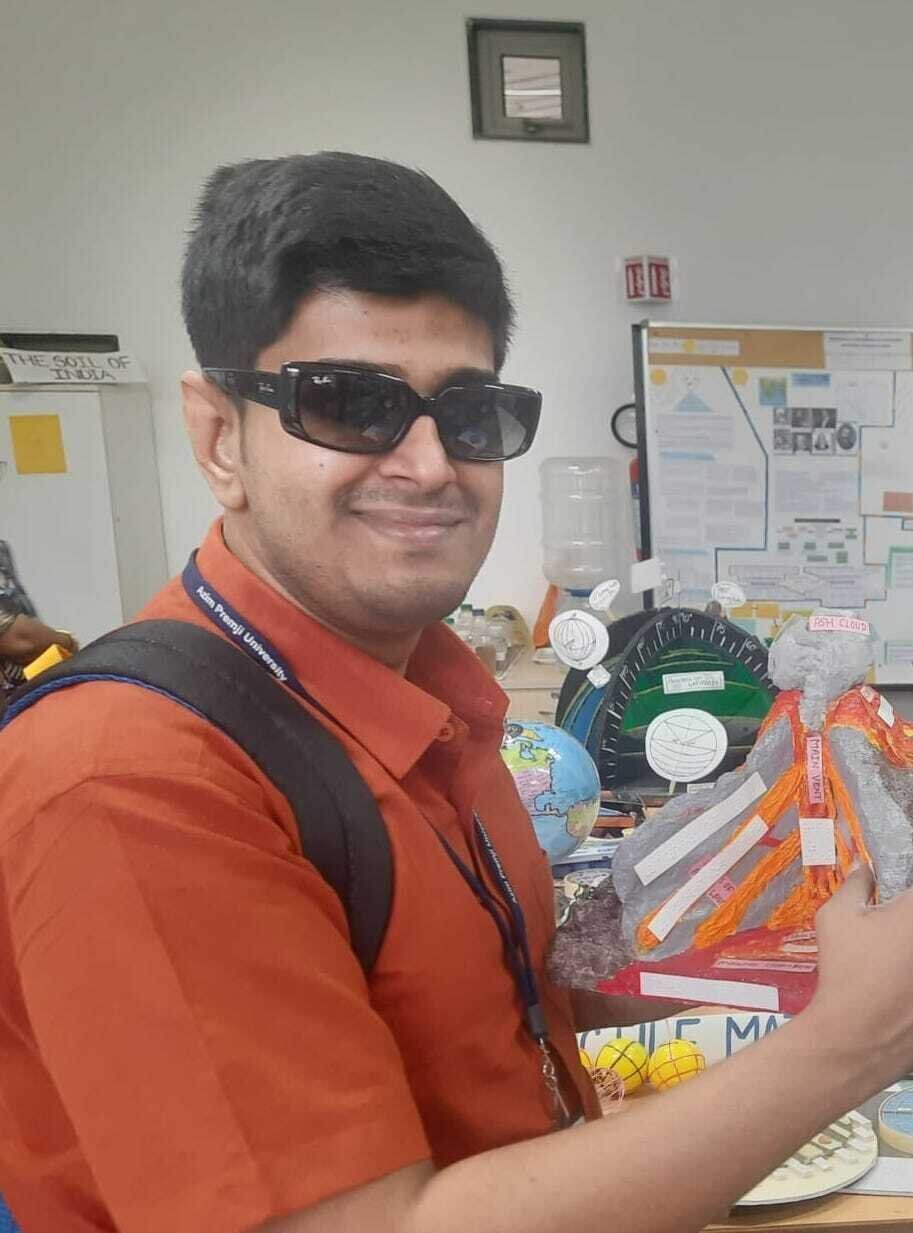
Dr. Ishan Chakraborty, Jadavpur University, Kolkata, visited the Geography lab at Azim Premji University, Bengaluru.
Details
During my recent visit (13−16 May 2026) to Azim Premji University’s Bengaluru campus, I experienced something truly extraordinary. While attending a conference on disability futures, I met Saswati Paik, who invited me to step into the University’s inclusive and accessible geography laboratory. As someone who actively practices and advocates for inclusion, I was completely blown away and amazed by what I experienced.
There is a common, unspoken assumption that subjects like geography and science are out of bounds for people with visual disabilities because they are inherently visual. This lab shatters that myth. It was incredibly moving to understand how the team has transformed abstract academic concepts into tangible, hands-on realities.
We often fall into the trap of thinking that inclusive education or tactile tools are exclusively meant for people with disabilities. By incorporating auditory and tactile elements, the models create a multisensory learning environment that makes education more engaging and effective for all students.
They have beautifully mapped out the solar system, the world map, latitudes, longitudes, and the political boundaries and neighbouring countries of India. They have even represented the complex topography of our country, from the states, rivers, and tributaries to the oceans, coastal plains, and landlocked regions.
The sheer creativity behind this makes it even more remarkable. Most of the models are built on zero or extremely low budgets, using everyday waste materials. Items that would normally be thrown away, like shoe boxes, old electronic cartons, cardboard strips, and tissue papers, have been repurposed into sophisticated educational tools. For instance, they have crafted a wonderful model of the soil strata to represent how roots of trees penetrate the various layers of the earth.
The collection also features models of the earth’s atmosphere, including the lithosphere, stratosphere, and thermosphere, alongside working models of volcanoes and tectonic plates. It was fascinating to feel how a sea, compressed from two sides, rises to form the young fold mountains of the Himalayan range. The level of dedication gave me an incredible boost of encouragement. In my own work at the Department of English at Jadavpur University, I have encouraged my students to design projects that result in similar tangible, accessible outcomes. Finding a parallel effort in a geography lab at another university felt like a validation of that path, and it gave me plenty of fresh food for thought on how to expand these initiatives.
My biggest takeaway from the visit, however, goes beyond the models themselves. We often fall into the trap of thinking that inclusive education or tactile tools are exclusively meant for people with disabilities. That is a misconception. Everyone benefits from these tools. By moving away from a purely visual focus and incorporating auditory and tactile elements, the models create a multisensory learning environment that makes education more engaging and effective for all students. Kudos to the team for putting together such brilliant and thoughtful work!
About the author
Dr. Ishan Chakraborty is an Assistant Professor at the Department of English, Jadavpur University, Kolkata. An active scholar and practitioner of critical disability studies and crip theory, he integrates these frameworks into his academic pedagogy, research projects, and institutional advocacy. His notable initiatives include supervising the creation of the first Braille graffiti on an Indian university campus, directing the production of handmade tactile maps using low-cost materials, and designing Crip Lit Cards — an accessible analogue card game. He is also involved in making cultural artefacts accessible. He can be reached at ishan.chakraborty@jadavpuruniversity.in