No Place Like the Greenhouse
Plant biotechnologist Beena D B opens up about her plans for the campus greenhouse at Bengaluru, while reminiscing about the greenhouses in her past.
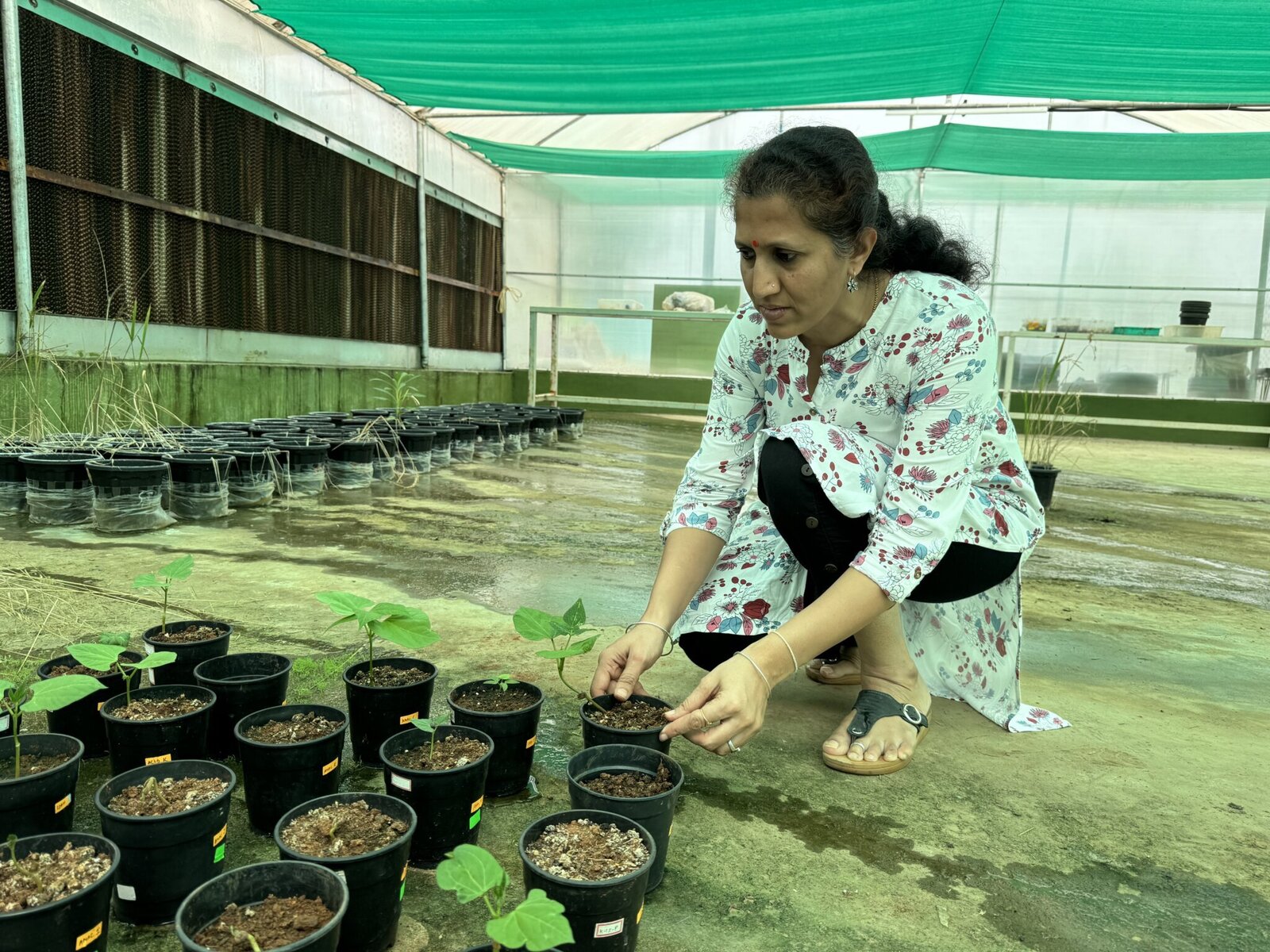
Details
During her PhD in the mid 2000s, Beena D B was devising a protocol to efficiently clone bamboo plants. There was (and is) a burgeoning demand for good bamboo from industries, and institutes such as hers were committed to deploying biotechnological tools to meet it. First, they acquired bamboo cuttings from germplasm banks in northeast India. The cuttings had been carefully selected based on their desirable genetic characteristics. Successfully cloning these plants would guarantee access to lakhs of high-quality plants that industries can use as raw materials to produce various materials such as pulp and paper.
“Just as a newborn baby is too sensitive to be exposed to extreme climates, so are young plants. It has to be gradual. Once they are hardened in a greenhouse environment, then they can be taken out, first in the shade for a few days, and then eventually you can expose them to the sun.”
But before commencing with the cloning part of her project, Beena had a more fundamental challenge ahead of her: she needed to ensure that the precious bamboo cuttings would survive in their new environment at the Institute of Wood Science and Technology (IWST), Bengaluru. Thank goodness for the greenhouse!
The word ‘greenhouse’, these days, is more commonly associated with climate change. We all know that CO2 is a ‘greenhouse gas’ and that the planet is warming up due to the ‘greenhouse effect’. Greenhouses are structures designed to maintain and regulate conditions of temperature and humidity suitable for plants to grow in. Bamboo cuttings, for example, need high humidity levels for the new shoots and roots to develop.
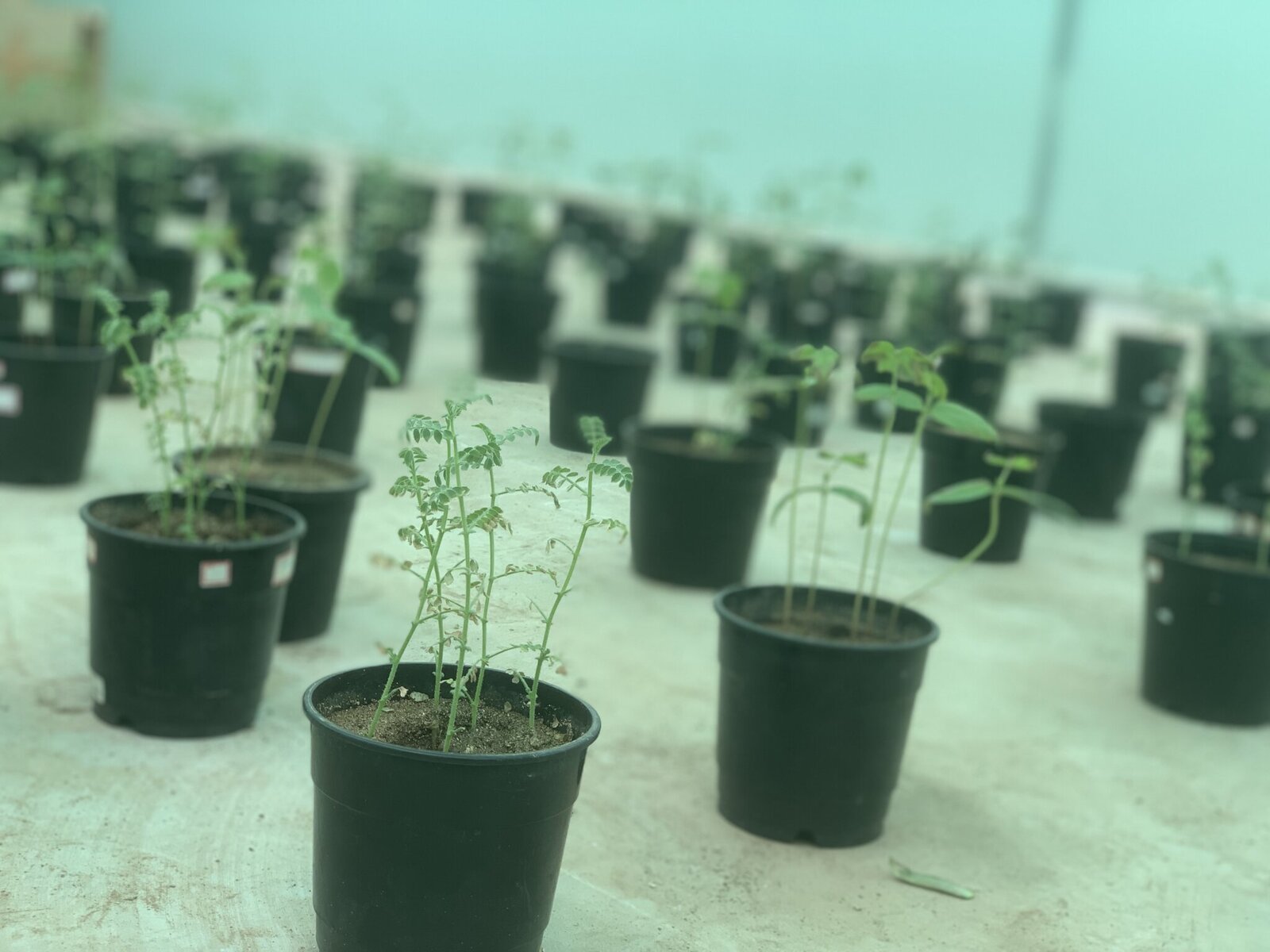
Plants being grown in the campus greenhouse as part of student experiments
Within the smaller, easier-to-control confines of a greenhouse, Beena could maintain the desired 85% relative humidity levels. The plants could then slowly be transferred outside. “You can’t transfer them to the field directly. Just as a newborn baby is too sensitive to be exposed to extreme climates, so are young plants. It has to be gradual,” she commented. “Once they are hardened in a greenhouse environment, then they can be taken out, first in the shade for a few days, and then eventually you can expose them to the sun.”
An in-house greenhouse
In 2016, Beena joined Azim Premji University as a lab manager. Here, her primary responsibility wasn’t her own research, but setting up the biology laboratory for the fledgling university. The newly designed biology course was to have courses like ‘Understanding Plants’ which involved students learning how to grow, maintain and experiment on plants.
Right away, Beena and her colleagues recognised that having an on-campus greenhouse would be of great value. “With a greenhouse, students would be able to conduct experiments properly in controlled conditions,” she said. With the efforts of Beena and her colleague Jayanti Ray Mukherjee, a greenhouse came up on the open grounds of the university campus.
The starkest feature of greenhouses is the transparent surfaces covering them. Earlier these used to be glass, but now polycarbonate sheets are more common. The transparency is to enable sunlight to pass through while protecting the plants inside from the harsh and unpredictable conditions of the outside world. Materials like glass have the property of allowing solar radiation to pass through and heat the inside of the greenhouse. This heat has now taken the form of infrared radiation, which doesn’t pass through glass as easily. That’s how greenhouses retain heat.
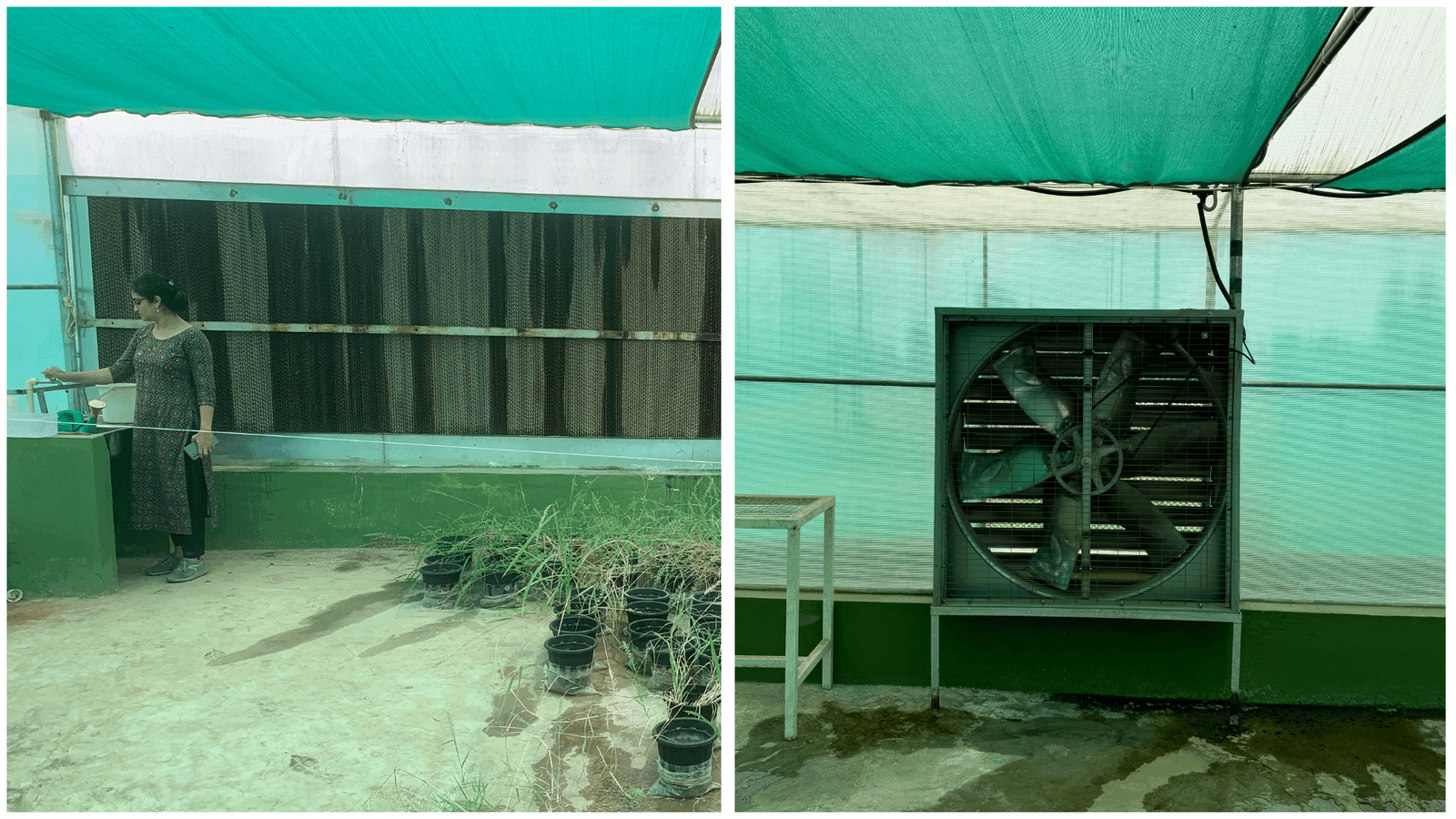
Ashily Maria George, an academic associate at the university, works in the greenhouse.
Deciding what goes in
All it takes is a couple of minutes inside the campus greenhouse for a visitor to start feeling sweaty. It’s no longer the cool, pleasant evening that it was five minutes ago. This is a sign of the heightened humidity brought about by giant humidifiers standing on either side of the vast room. They appear to be creased cardboard walls with continuous trickles of water sliding down them, reminiscent of a glass window on a rainy day. Giant exhaust fans ensure that the room remains ventilated. In the absence of ventilation, the greenhouse is likely to overheat, endangering the plants.
Some greenhouses also have foggers that activate when the temperature in a greenhouse rises above a certain point. These overhead sprinklers gently infuse water vapour in the air, cooling it and raising the humidity, without excess moisture pooling around the plant.
“At first, we thought we wouldn’t need them as the temperature in Bengaluru doesn’t usually shoot up much,” Beena said. However, this summer, she was alarmed to find that the temperature inside the greenhouse hit 47 degrees Celsius! “That’s when we realised we do need a fogger. We will install them soon.”

The campus greenhouse
Now that Beena is a faculty at the university, she has her own research projects as well as students’ honours projects underway. The greenhouse today houses paddy plants that are part of a collaborative project, rows of potted plants that her honour student Charu is testing for microplastic exposure. It is also being used by other plant biologists at the university as well as students doing various course-related projects such as to study resource allocation and competition in plants.
Beena’s colleague Divya Uma pointed out that the controlled environment of greenhouses make it possible to design a world of experiments that span beyond plant biology. She listed some possibilities off the top of her head: “An insect researcher can evaluate pollinator activity without worrying too much about external disturbance or perform carefully controlled experiments involving insect-plant interactions which are difficult to do in the field. A chemist can study the nature of volatile compounds released by leaves in the presence of caterpillars.”
It is this promise of the in-house greenhouse that excites Beena the most. “We want to open it up. We view the greenhouse as an opportunity for outreach with the rest of the university community.”
About Beena D B
Beena D B is a faculty member at Azim Premji University.
About the author
Nandita Jayaraj is a Science writer and Communications Consultant at Azim Premji University. She may be contacted at nandita.jayaraj@apu.edu.in