Chemistry vs Carbon dioxide: Challenges in a Catalytic World
Aditi Chandrasekar deploys her computational skills to tackle a familiar problem in catalytic chemistry— getting carbon dioxide to react.
Details
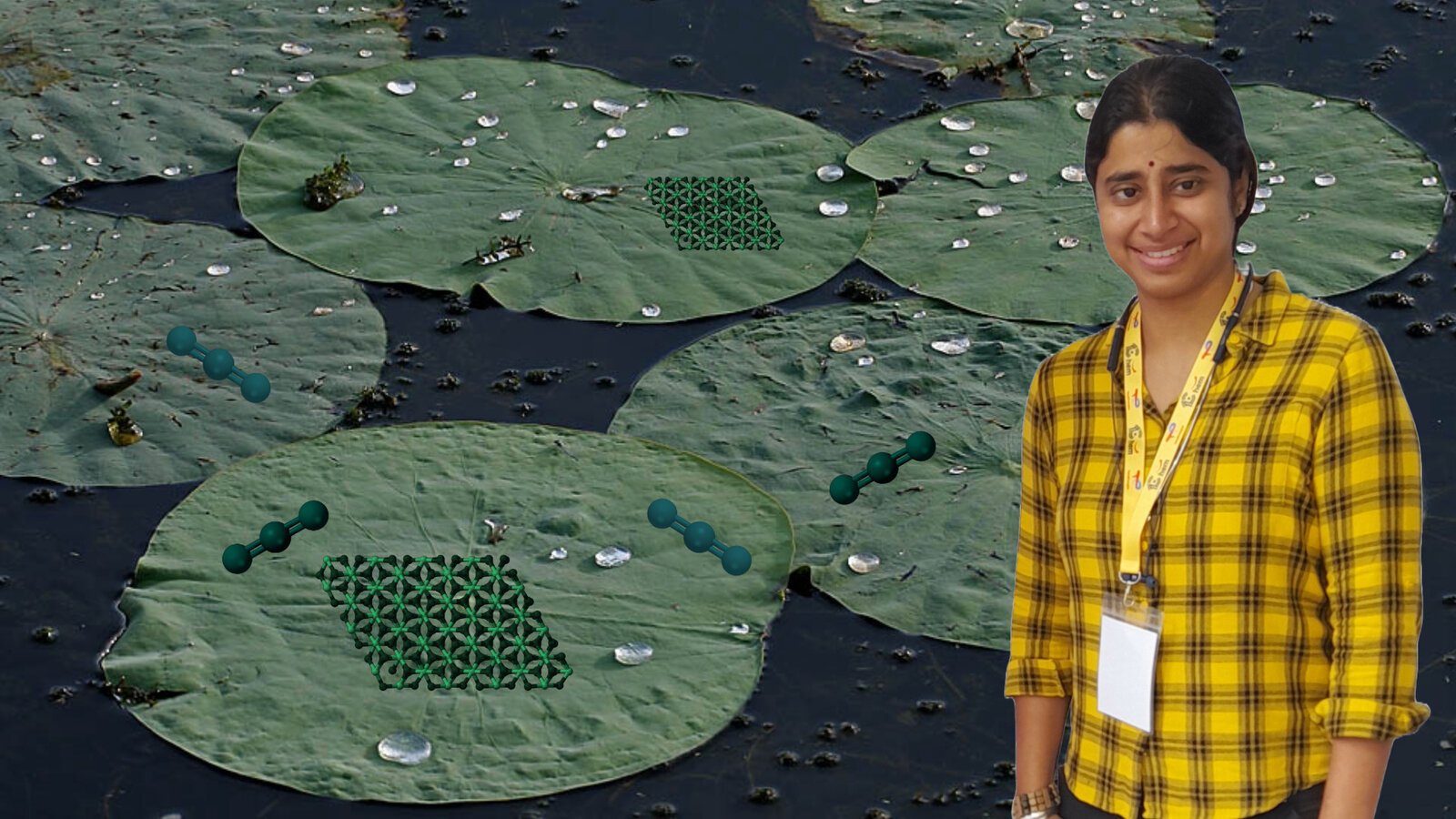
Tamarai ilai mel neer pol [Like water on a lotus leaf]
When she thinks of catalysts, this Tamil phrase extolling the virtue of detachment comes to Aditi Chandrasekar’s mind. Just as a drop of water rolls off the waxy surface of a lotus leaf intact, so must a good catalyst after a chemical reaction. “A catalyst is typically not supposed to participate in a reaction. It’s supposed to do something for you — speed up the reaction — but not get attached in the process,” explained the chemist, who is a faculty of chemistry at Azim Premji University.
For a few years now, Aditi has been collaborating with her former professor at Indian Institute of Science Education and Research (IISER) Kolkata to develop novel catalysts that can perform a particularly difficult task in chemistry: get a CO2 molecule to react. This July, she travelled to Lille, France, to present the group’s work at an international conference.
It may not be obvious to most of us, but catalysis is running today’s world. Besides driving fundamental natural processes like respiration and photosynthesis, catalysts are integral to producing compounds necessary for every aspect of our modern lives — for example, medical, pharmaceutical, automobile, food and polymer industries. Discoveries related to catalysis have won over 15 Nobel Prizes, the first being F. Wilhelm Ostwald who won for his work on catalysis, chemical equilibria and reaction velocities (1909), and the latest being Benjamin List and David MacMillan for the development of asymmetric organocatalysis (2021). It should be no surprise then that there are entire branches of scientific research centred on catalysis. The conference Aditi attended in France was even more specific. It focused on the catalytic chemistry of one family of molecules called C1 compounds.
C1 compounds, as their name suggests, comprise molecules that contain one carbon atom. There are hundreds of one-carbon molecules but C1 chemistry deals with a small set of those that are stable, abundant and industrially significant: methane (CH4), carbon monoxide (CO), carbon dioxide (CO2), and methanol (CH3OH). These four molecules are recognised today for their potential as sustainable, economic and ‘green’ feedstocks for producing high-value chemicals. One of the landmark breakthroughs that led to this realisation came nearly a century ago, when two chemists Franz Fischer and Hans Tropsch discovered a process by which a mixture of carbon monoxide and hydrogen could be transformed into various hydrocarbons for fuel needs.
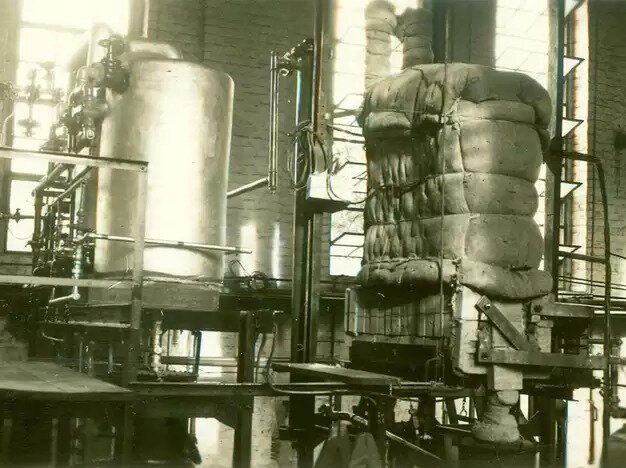
Pilot plant for the Fischer-Tropsch synthesis, 1930. Source: Historical Archives of the Max Planck Institut für Kohlenforschung
The prospect of developing a technology to potentially capture and get rid of the excess carbon dioxide gas in our atmosphere is tremendously exciting. For it to work, scientists need to identify suitable catalysts that can reduce the amount of energy it would take to get carbon dioxide to react. Aditi has an active collaboration with the team at IISER Kolkata, that is focussing on researching this further.
The trouble with using C1 compounds is that getting them to react is not easy. “Activating small molecules requires a lot of energy,” says Aditi. In the case of CO2, two double-bonds need to be broken for the molecule to participate in a chemical reaction. “These are very strong bonds because of the proximity of the atoms. So to put the molecules in a reaction pathway, we typically need the use of a catalyst.”
It is widely known that CO2 is a greenhouse gas and its rising emissions are one of the biggest hurdles in our management of climate change. So the prospect of developing a technology that can potentially capture and get rid of the excess CO2 gas in our atmosphere is tremendously exciting. We already know that CO2 can react with other molecules to produce compounds such as carboxylic acids and cyclic carbonates which are of tremendous industrial value. Cyclic carbonates, for example, are useful as electrolytes in Li-ion batteries, and can be used in the synthesis of important polymers such as polyurethanes.
On paper, this sounds like a great idea. However, for this strategy to work, scientists need to identify suitable catalysts that can reduce the amount of energy it would take to get CO2 to react. This is one of the research focuses of Prof. Venkataramanan Mahalingam’s lab at IISER Kolkata. Aditi worked here many years ago and today she has an active collaboration underway with this team. A few years back, the team designed an alumina-based catalyst and showed that it was an excellent catalyst to prepare cyclic carbonates from epoxides and CO2.
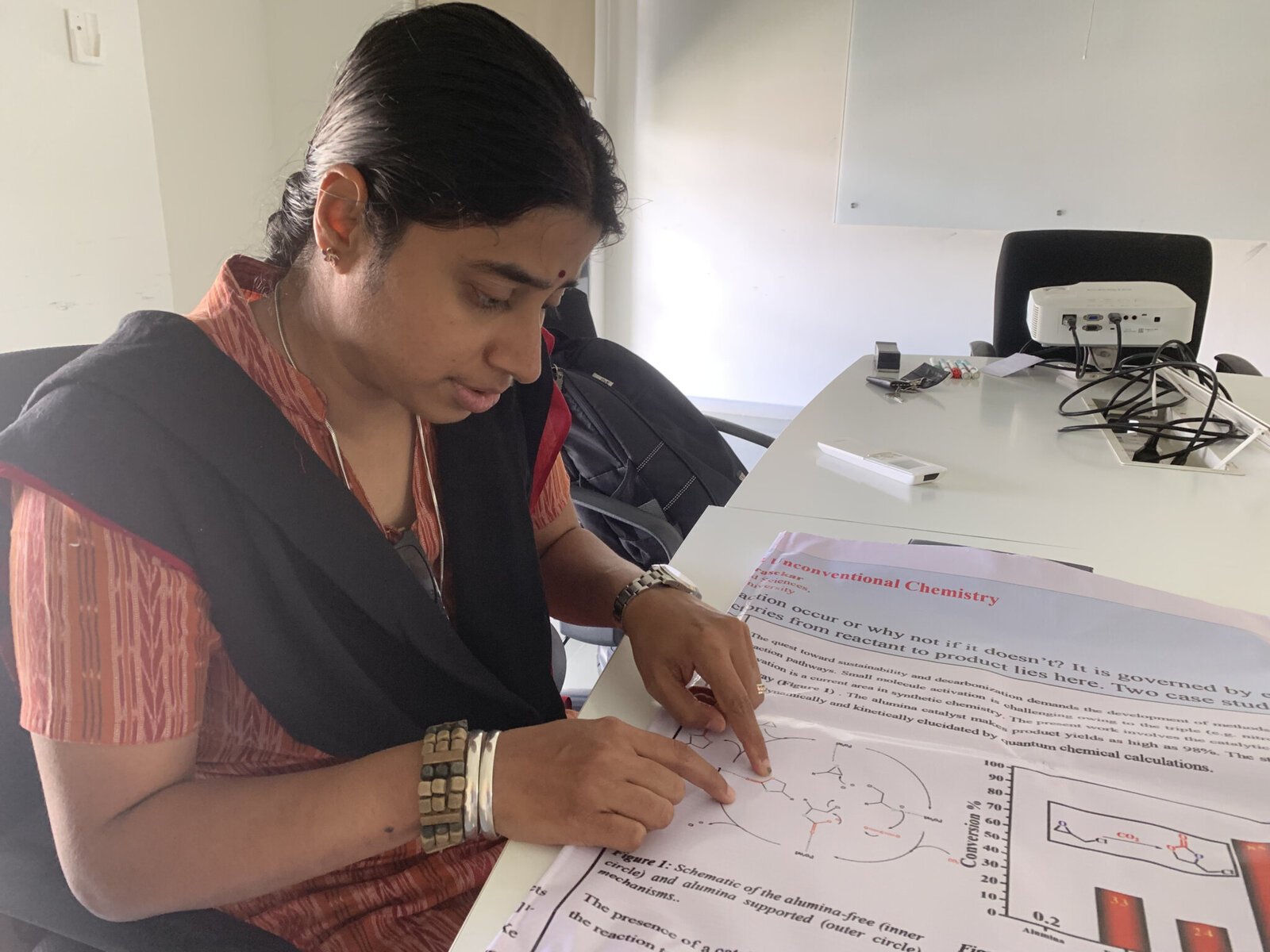
Aditi describes her work in carbon dioxide catalysis using a research poster.
Scientific teams across the world are continuously coming up with new and improved methods to activate CO2. However, most of these work only under conditions of high pressure, high temperature and with the use of harmful solvents. The Mahalingam group’s catalyst came with the advantage that it works under atmospheric pressure and relatively low temperature of 85 degrees Celsius. Moreover, it does not require any solvents. The following year, in 2023, the group made another discovery. This time they used another compound called diaspore to catalyse the same reaction. This was the work that Aditi was invited to present at the conference in Lille in July.
Importantly, both the catalysts developed by her group showed a high degree of selectivity, which means they uniquely targeted only the desired chemical pathway and recyclability (the same catalyst could be used for multiple cycles of the reaction). This means that though the catalysts are affecting the rate of the reaction, they are not getting affected themselves… Tamarai ilai mel neer pol.
When scientists set out to design catalysts for a particular reaction, not only do they have to be prepared to conduct a lot of chemical experiments in a laboratory, they also rely on computation. It is this side of the catalysis story that Aditi’s expertise lies in.
“The team doing experiments is seeing it happen — in this case, they may have seen that a particular material is working as a catalyst. But sometimes they need my help to understand why it is working. This is where computation can help,” says Aditi. Even in a simple chemical reaction like H2 + O2 → 2H2O, there is more happening than meets the eye. In the case of the chemical synthesis of cyclic carbonates from epoxides and CO2, there are several transition states fleetingly formed before we get the final product. “It is formed in a flash. You cannot isolate or trap a transition state through experiment, but you can identify it through theory. I can offer theoretical backing, explain why all this is happening, how it is happening.”
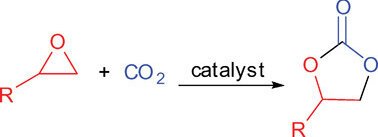
A depiction of the chemical reaction between carbon dioxide and epoxides to produce cyclic carbonates. Source: Green chemistry
If we have entered an era where carbon dioxide in our atmosphere can be captured and transformed into useful compounds, doesn’t that mean that we no longer need to stress about carbon dioxide emissions? Not by far, Aditi clarifies.
Using various chemistry softwares such as Orca and Turbomole, Aditi can find out why one particular material is working so well and another isn’t. She can theoretically predict if it could be beneficial to replace one atom with another, and advise experimentalists accordingly. “Experiments will always be important, but we have limited lab space and equipment. Computing power, on the other hand, is increasing multifold. By using computers to screen for catalysts, experimentalists will have a smaller pool of alternatives to choose from instead of starting from scratch,” she explains.
So if we have entered an era where carbon dioxide in our atmosphere can be captured and transformed into useful compounds, doesn’t that mean that we no longer need to stress about carbon dioxide emissions? Not by far, Aditi clarifies. For one, it’s challenging and expensive to isolate CO2 from large volumes of air which contains so many other gases. Secondly, proving a process works in the lab is one thing, but finding a way to make it scalable at the industry level is another.
“Also, new processes are usually patented, and if an industry wants to take it, they have to pay for it. And they will be ready to pay only when they know that it is going to work at the scale at which they want it, right?” adds Aditi. Scientists like Aditi who work on CO2 activation always point out that these technologies can never be a replacement for cutting down emissions. “This is not an excuse to go on doing what we want and being consumerist and polluting. Not at all. We are just trying to remedy some of the damage.”
As a chemist, Aditi knows only too well how intricate and complicated it is to engineer catalysis in the lab. She finds it amazing that nature is able to accomplish these chemical tasks so elegantly and seemingly effortlessly. Enzymes are the best example of this. Thousands of them are continuously at play inside us, each catalysing a very specific chemical reaction that our life depends on. “It’s like finding a particular key for a particular lock. It’s very hard to engineer, but yes, nature has done that job.”
About Aditi
Aditi Chandrasekar is a faculty member at Azim Premji University.
About the author
Nandita Jayaraj is a Science writer and Communications Consultant at Azim Premji University. She may be contacted at nandita.jayaraj@apu.edu.in