Is there a Place for ‘Best Practices’ in the Field of Development?
Adithya Pradyumna unpacks the complexity of the phrase in a world of rapidly growing developmental challenges
Details
Recently, I was invited to be part of a consultation where an international organisation was drafting their course of action on the health effects of climate change. Several sessions had been organised to identify ‘best practices’ to address the multitude of challenges posed by climate change directly and indirectly on human health in the South Asia region. For instance, injuries due to extreme weather events, undernutrition, and mental health challenges. Experienced public health professionals were invited to share their work and observations to help guide action.
After a cordial planning meeting with the event organisers, I pondered on the phrase ‘best practices’. I felt it was an interesting phrase that for some reason hadn’t caught my attention until now. This particular meeting nudged me to look into that phrase because my impression was that we were not in the position to speak about ‘best’ practices towards addressing the health effects of climate change. Action against the health effects of climate change, few and far between, have just been around for a few years at most. ‘Best’ should, at least, imply a degree of confidence and relevance.
I appreciate the usage of ‘practices’ rather than ‘practice’ – the emphasis on the plural indicates that there are potentially many practices beneficial in each context, and that there may not be one ideal way of addressing a developmental challenge.
‘Best practices’ in development literature
When I brought this up with my colleague, I was directed to some interesting reports on best practices in public health and social services. A World Health Organisation (WHO) document points out almost immediately that ‘best’ doesn’t actually mean ‘the best’. Rather, best practices indicate those techniques and methodologies that are “reliably proven to reach the desired result” in a particular context.
In a relatable vein, NITI Aayog periodically publishes a manual called Good Practices Resource Book for delivery of social services, resorting to ‘good’ rather than ‘best’. Their voluminous 2015 edition collates a “collection of practices that have been successful in achieving their identified goals and have excelled in delivering necessary social services to their intended beneficiaries”. The Organisation for Economic Co-operation and Development (OECD) guidelines further qualify the word ‘best’ by providing typical characteristics of such practices (e.g., effectiveness, efficiency, equity, evidence-based and extent of coverage), and also suggest a multi-criteria decision framework to evaluate interventions and make decisions. The NITI Aayog document similarly qualified good practice with “innovativeness, ability to lead to an actual change, having an impact on policy environment, replicability and sustainability (ability to self-support)”.
All these guidelines recognise that context matters while trying to understand the practices and their effectiveness (yes, results and wider applicability seem particularly important). Here, I appreciated the usage of ‘practices’ rather than ‘practice’ – the emphasis on the plural indicates that there are potentially many practices beneficial in each context, and that there may not be one ideal way of addressing a developmental challenge. Another way in which people have used the term ‘best practices’ is in relation to approaches used in development work irrespective of the theme. For example, best practices in communication, or best practices in community engagement – each of which may be relevant to address different development challenges.
In reality, there are many factors that can constrain practices and the decisions underlying them which would also have implications on how good the practices are.
Why are people interested in ‘best practices’?
As someone teaching in a master’s programme in Development (MA in Development), I have the opportunity to reflect on development practice in general and public health practice in particular (based on my educational and professional background). I teach a core course titled Evidence and Ethics for Development Action, and elective courses on environmental health action, and food and nutrition action. This is in addition to my engagement with non-governmental organisations (NGOs) working in the field of health and development. With the broad canvas of teaching and practice engagements, it has been sobering to learn the range, size, history, and emergence of developmental challenges, and the many efforts being made to address them.
As we grapple with this broad array of concerns and interventions, it may be useful first to reflect on what constitutes ‘practice’. We could think of it as a set or combination of approaches and actions informed by principles, context and resources to address a given development challenge. Practices adopted by various actors for a given problem may overlap to at least some extent with each other in terms of specific activities and underlying principles. Practices become visible through policies, projects and programmes and their related activities. The whole of the policy/programme/project cycle – from conceptualisation, to planning, operationalisation, evaluation, learning and back to conceptualisation – is indeed a part of practice. All this is (or rather, should be) the everyday in development work, and a work in progress, and hence practice. However, in reality there are many factors that can constrain practices and the decisions underlying them – which would also have implications on how good the practices are.
The role of problem definition
For any developmental challenge, we may have many potential ways in which the challenge could be approached, but not all of them have been tried. This is, at least in part, determined by how one may conceptualise the problem in the first place. For instance, if the problem of climate change is conceptualised as a purely carbon balance problem, then large solar projects may be considered a good intervention, irrespective of whether the project has addressed the adverse local impacts on environment and people. Indeed, this is a simplistic reading of the development problem (i.e., the need for climate change mitigation, and the need for increasing energy production), but developmental problems are sometimes read this way, especially when technology is offered as a solution. Factors such as access to resources, political will, value systems, and creativity of the practitioners can affect how the problem may be understood and approached.
One interesting take is found in the document Best Practices for Tribal Health (2015), published by the Government of India based on insights from an expert consultation workshop. The parameters used to define them are: “1) A specific important problem is addressed… may be a disease, a health indicator (IMR, MMR, etc) or a barrier to providing health care in tribal areas (human resource, outreach, community participation…, etc.); 2) It demonstrates a distinct method or a component; 3) Demonstrated feasibility of implementation; 4) Proven impact; 5) Scalability”. What may be particularly worth noting here is how the problem/challenge of tribal health itself has been broken down into specific components – so, the problem of maternal mortality rate, or community participation or something else. The document suggests there can be best practices for each of the above based on what the specific ‘problem’ is.
Sometimes a desired result itself can guide how the problem is defined, and this in turn may depend on whose desired result is being considered. A colleague was mentioning how in the microfinance sector, “the practices were narrowly focussed on a few outcomes like number of loans, repayment performance, etc., all from a lender perspective and not adequately from a customer perspective.” What implications may this have in defining what the best practices are? Indeed, inevitably there are many actors as part of the development ecosystem, each with their own goals, preferences, and values, and so also a point of tension (see Figure 1).
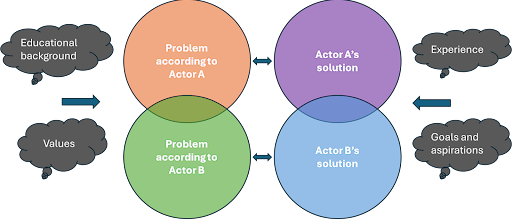
Figure 1: Actors with the factors influencing their understanding of problems and solutions
The role of documentation and evaluation
Among the approaches that have been tried for a given problem – either by the government, corporations or by NGOs – several are not well documented, let alone evaluated. I say this based on what I have observed in the past 15 years as part of the development sector. Strong documentation and evaluation of projects are not the forte of most development actors in the field as often ‘research’ remains disconnected from ‘practice’.
This is in addition to the fact that interventions may not even be well conceptualised due to reasons mentioned earlier, leading to loosely structured theory of change, not-so-robust evaluation framework, weak monitoring along with poor reflective writing. All this is also complicated by the need to ‘sell’ the benefits of interventions to continue to get funding.
I am not saying that most developmental actions are ineffective, but I am suggesting that most of them are less effective than they could be and less is learned through these practices than we should be learning. But I also recognise fully well that the non-governmental actors in the development sector are a stressed group. Figure 2 tries to put some of these thoughts together.
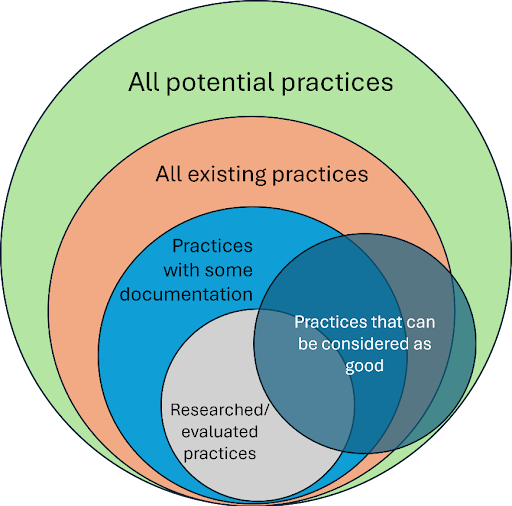
Figure 2: Conceptual diagram — practice, documentation and research in the field of development for a given challenge.
It demonstrates how well-evaluated practices are a small subset of all practices, and that practices that are good, may sometimes not be evaluated. This is a conceptual diagram and not meant to indicate anything quantitatively.
One author has observed that what may be put forth as ‘best practice’ (in rulemaking in that case) is often just whatever the common practice is. Of course, what is common may be good, but not necessarily so. It is known for people working in the development sector to share ideas and experiences informally, and this is one way in which practices diffuse and potentially become common. There are also a growing number of communities of practice which serve as platforms for discussions and documentation. Many NGOs (and government) programme evaluation reports tend to be in the grey literature, and often done using methodologies that are more marginalised (such as narrative and participatory methods), and so outside the scope of what may be considered formal documentation and evaluation from an evidence perspective (where, for example, experimental study designs are privileged).
The pushing of practices: Power and politics
An interesting paper critically looking at practices in teaching discusses how “characterising individual accounts of practice as best undermines the status of particular understanding by holding out the prospect of general application”. This is relevant to development practice too, where “particular understanding” in terms of people, culture, and geography among others, have important implications for planning and implementation.
In addition, the paper discusses that by designating something as “best”, the problem of any subsequent failures would be attributed to its poor adoption rather than in the supposed best practice itself. As a corollary, just because an intervention is well evaluated, it does not guarantee that it is the most useful one – it is just a practice with more evidence of its process and outcomes. A useful example here is the Impact-Failure conference which addresses factors affecting the success of practices, the transience of success itself, and the limitations of approaches in general.
Another paper mentions how some institutions and individuals are more successful in pushing their practice by being ‘louder’. I am able to relate this to examples of some international organisations having pushed for particular approaches based on what they think is good, without considering the perspectives of local partners and context (my colleague says Winners Take All (2018) by Anand Giridhardas emphasises this point, but I haven’t read it yet).
The push may be a technology or a way of financing among other things, and these have (positive and negative) repercussions on the target population. The motivations for pushing a particular practice may be many. Jean Drèze has beautifully argued how policy interventions are often informed by politics rather than (primarily) evidence. He adds the need to critique and expand the narrow evidence that is used to understand relevance and benefits of interventions (the need to think beyond randomised controlled trials).
The role of resources in determining the quality and reach of practices
What else might inform practice in a given context? An important consideration and constraint is the availability of resources. If more resources were available, potentially more could be done, including better planning, intervention quality, and evaluation, and iteratively improving the practice over time, while informing wider practice and policy. What happens in contexts where resources are more limited? Can there be ‘best’ practices for those contexts? Should we accept the resource constraint and still define ‘best practices’? This is particularly relevant for the development sector as it is especially concerned about resource-constrained settings. Of course, effective interventions don’t have to be resource intensive, but availability of resources may increase the scope of possible interventions. There may also be other constraints for particular practices such as political acceptability. Figure 3 provides a preliminary framework to think about broad factors informing good practices.
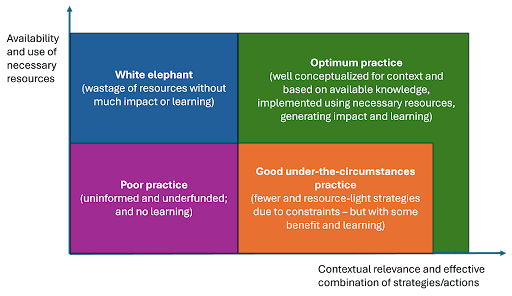
Figure 3: How considerations of context, strategies, and resources together should inform practices.
Using the elements of resources and local relevance, an attempt has been made to see how the goodness of practices can be thought about.
We can expect urbanisation, demographic shifts, migration, epidemiological transition (changing nature of disease profile from predominantly communicable to predominantly non-communicable diseases), technological advancements, climate change, and change in politics to further complicate development challenges, necessitating innovative and nuanced development interventions.
Examples of documentation and evaluation of practices
As part of the MA in Development programme at Azim Premji University, we make efforts in helping students understand how developmental actions are conceptualised, operationalised, and evaluated. This is often done using case studies. For example, I use an article on a process evaluation of an intervention study on Nutrition-Sensitive Agriculture (NSA, facilitating agricultural practices to improve nutritional outcomes) in Odisha. Academicians and development practitioners worked together on this project. Qualitative and quantitative approaches were used to understand the process and impacts of the interventions in that specific context. This is one way in which practices, their benefits, and their limitations in the specific context are documented.
In another case study that I have used, we see that the proposed intervention to address maternal health challenges in a remote area was arrived at using a deep understanding of contextual social, health, and health systems factors. This is a reminder that problem definitions themselves should be informed by principles and context, which then lead to the practices and the learnings that follow. Realist evaluation is also increasingly being used to better understand the role of context and mechanism in leading to the observed outcomes. What these evaluation methodologies recognise is that while a particular rationale was used to justify the intervention, there is a lot to learn about whether and how it worked or did not work, and that straightjacketed quantitative impact evaluation cannot give many of those insights. In addition, just because something has shown to be quantitatively effective in an impact evaluation, it does not mean that the effectiveness was uniformly experienced across groups within the population.
Another example of an effort to understand and document development practice is an initiative called “Stories of Change” at the University that has encouraged NGOs to document and reflect on their interventions – a few volumes of these case studies have been published already. Each of those stories is not implied to be a ‘best practice’, but rather a story of a particular project experience that benefited local people, or those who have faced unique contextual challenges and, if I may invoke the word, praxis (action-reflection or theorising practice by practitioners).
Development challenges are already difficult to address. Now we have a world that is characterised by unprecedented fast-paced change. We can expect urbanisation, demographic shifts, migration, epidemiological transition (changing nature of disease profile from predominantly communicable to predominantly non-communicable diseases), technological advancements, climate change, and change in politics to further complicate development challenges, necessitating innovative and nuanced development interventions. This makes reflective practice all the more important, and more efforts are needed from practitioners and academicians to support this. The guidelines on best practices by the WHO recognises the need for reflection and evaluation as part of – and not separate from – the best practices themselves.
Concluding remarks
Reflecting on ‘best practices’ has compelled me to think about development practice more generally. Any discussion on ‘best practices’ comes with assumptions and limitations, and it is important to recognise and acknowledge them. We should pay greater attention to practices – how they come to be, whether and how they are useful, and how we decide about its usefulness. This implies more work for people in the development sector, but this seems important and necessary. Some efforts are underway to reduce the dichotomy of academia and practice. Such collaborations and action-reflection-documentation-communication cycles will help us more continually towards better practice, and this is essential keeping in mind the rapidly growing complexity of development challenges. We may continue to use the phrase ‘best practices’ for what it is worth, hopefully implying a desire to and recognising the scope for being better in our work, innovating as necessary, and unpacking the diversity of approaches.
Acknowledgement: I thank Mukta Gundi for detailed reviews of two drafts of this paper, Annapurna Neti, Arima Mishra and Manikandan V for their insightful suggestions and references to improve this paper. Thanks also to the Faculty Perspectives webpage team for the wonderful and timely editorial support.
About the author
Adithya Pradyumna is a faculty member of Azim Premji University from 2020. He teaches courses on environmental health, food and nutrition, and evidence and ethics. He is trained in medicine and public health. The content and opinions expressed are that of the author, and do not necessarily reflect the views of Azim Premji University.
Images credit: Adithya Pradyumna