
Social Identities, Institutions, and Economic Development in South Asia
An international conference aimed at exploring the intricate relationships between social identities, institutions, and economic development in South Asia.
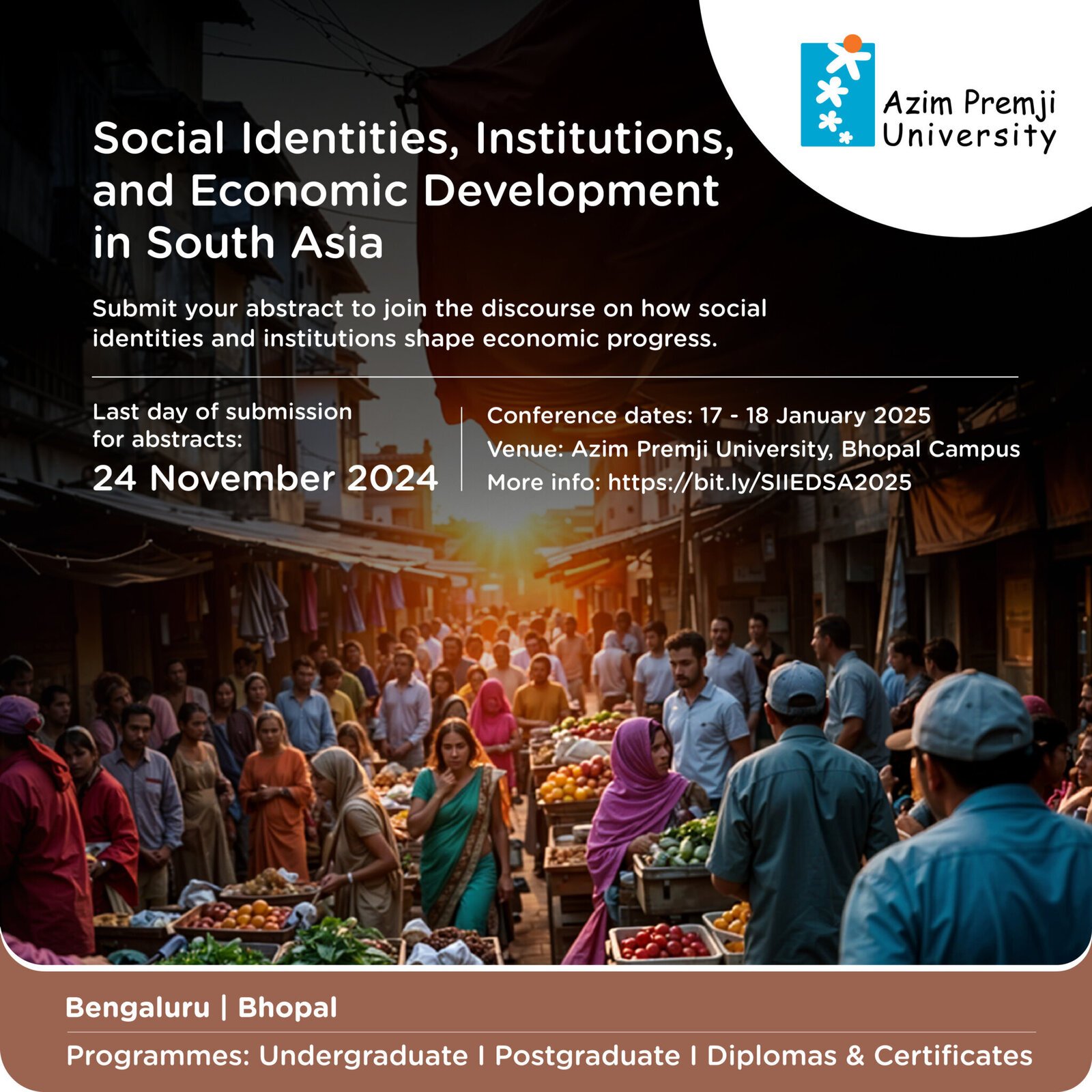
Details
South Asia, a region characterised by profound social diversity and complex economic dynamics, presents multidimensional challenges for both academics and policymakers. To envision more inclusive development and explore alternative approaches to contemporary issues, it is essential to engage with the interplay between social identities and institutions within this region.
Extant literature emphasises the critical relevance of situating and analysing the process of economic development in any part of the world in its region-specific context which is however deeply entangled with global processes, such as globalisation and changing political landscape. Traditionally, the discourse of economic development has been dominated by research entailing theoretical frameworks and methodology distanced, if not de-linked, from region-specific complexities leading to, more often than not, failure of policies in delivering desired outcomes.
Hence, it is imperative to be critical about abstractions devoid of social and political factors such as identities (gender, caste, race, etc.), and institutions and endorse more nuanced theoretical and empirical research concerning the issue of economic development in general and more so for the complex reality of South Asia. Historically, identities and institutions have played decisive roles in both micro and macro changes, an effective understanding of which is not attainable through either a monolithic lens of a single discipline or one school of thought.
We are pleased to announce an international conference in collaboration with the Institute for Economic Thinking and its Young Scholars Initiative (INET — YSI) aimed at exploring the intricate relationships between social identities, institutions, and economic development in South Asia. We welcome both theoretical and empirical research contributions. Papers employing a range of methodologies are encouraged, including quantitative research based on statistical analyses, econometric modelling, and data-driven studies, as well as qualitative research, including ethnographic studies, case studies, interviews, and narrative analyses.
In line with our commitment to promoting and nurturing pluralism in economics, this conference will serve as a critical platform for fostering a more engaging dialogue among alternative theoretical and ideological perspectives and collectively explore the possibilities of new economic thinking, envisioning a better and sustainable future for all.
- To explore the impact of various social identities (for example, caste, gender, religion, race, class) on economic development in South Asia.
- To examine the roles of institutions and policies in shaping economic outcomes and social inequalities.
- To promote a pluralistic approach in economics by integrating both mainstream and heterodox perspectives.
- To facilitate interactions between researchers employing both quantitative and qualitative methods, including ethnographic studies.
We welcome research on issues related to, but not limited to, the following sub-themes:
- Role of Social identities and institutions in economic development
- State — Market interactions including issues related to regulations and public finance
- Inequality along multiple dimensions
- Economic progress and environmental sustainability
- Networks and migration in South Asia
- Theorising the rural in South Asia
- Regional perspectives and trajectories of development
- Challenges of urban development
We encourage doctoral candidates and early career researchers (within five years after PhD) to submit an extended abstract of 2000 – 3000 words and complete the application form to be considered for selection in this conference.
Selected participants will be provided with travel and accommodation to facilitate their participation in the event.
Key dates
Submission of abstract
Notifications to selected participants
Submission of draft papers
- –
Conference
We look forward to your participation and engaging discussions that advance our understanding of these critical issues.
For more information, contact apubhopal@youngscholarsinitiative.org
Organising committee
Organising committee members from INET