
Woes of Waste: A Day in the Life of Many
Thrupthi G N captures the collective frustration of those who diligently segregate waste and strive to follow rules, aiming to ease the burden on landfills.
Details
When I wake up to the sounds of birds, traffic horns, construction melodies in Sarjapura, on the outskirts of Bengaluru, my inner voice asks the same question it asks every morning: “Will the waste collectors grace us today?”
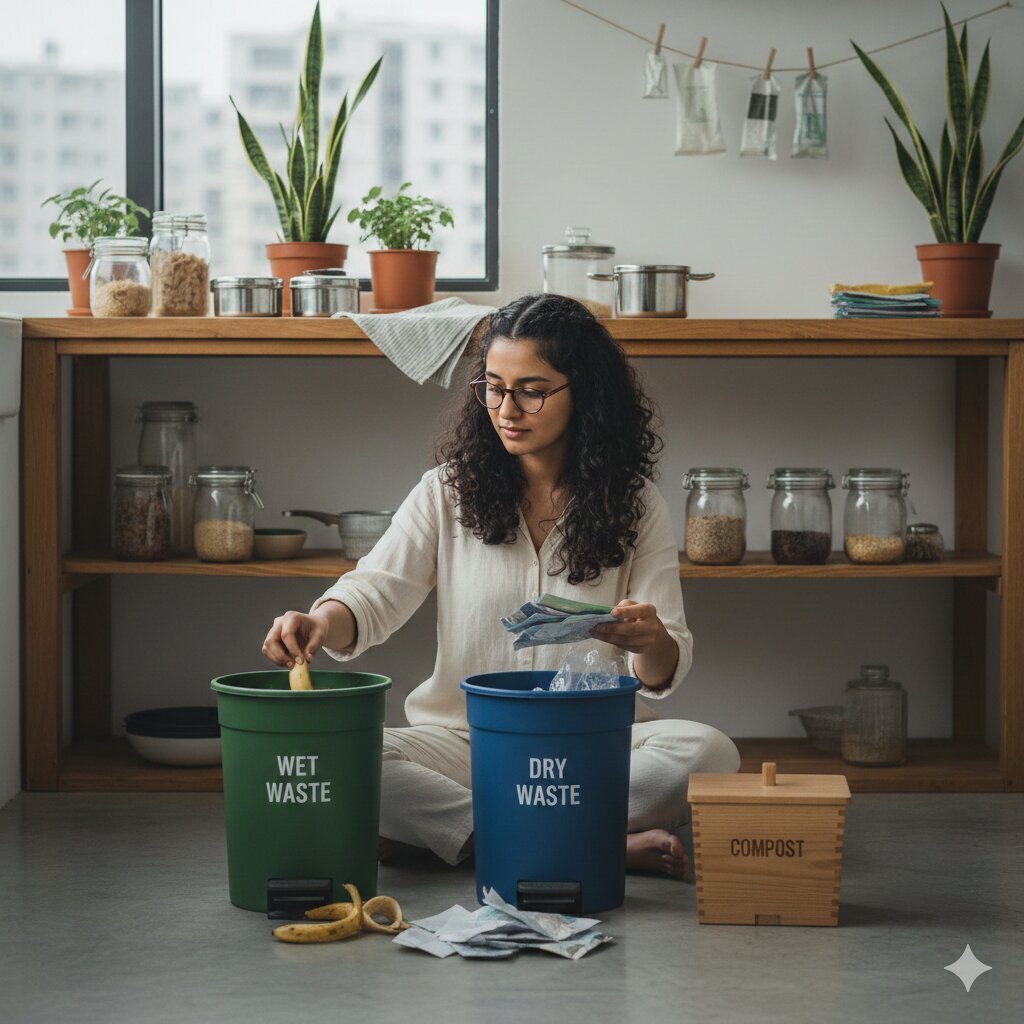
My day starts with the holy grail of segregation: Kitchen scraps? Added to the wet waste bin. Milk packets? Triple washed, flattened and added to my dry waste pile. Reject waste? They are already in exile. Sanitary waste wrapped and packed better than my kitchen china. Everything is washed, dried and sorted like they are about to appear for a viva.
This is not a hobby. This is a lifestyle, and probably borderline obsession.
I am after all, a researcher working on waste at Azim Premji University. Waste is part of my profession, my passion and unfortunately, my lived reality. My sustainability journey didn’t start with Instagram reels, bamboo toothbrushes, or shampoo bars. It started with reading reports, learning the reality of segregation on the ground, attending multiple meetings, and realising that if I didn’t practice what I preached, then karma would come back to bite me.
At home, I am lovingly referred to as the ‘Hitler of segregation.’ Missed rinsing a curd packet before disposing? Be ready for a lecture on why only 3 – 5 percent of such covers are recycled (and mind you, this could be a long session). If husband sneaks a chips packet in the wet waste, he can say goodbye to his munchings for the next six months.
Sounds harsh? But, I am kind. I explain. I educate. I label bins. I give second chances. Sustainability, after all, is about compassion, until someone mixes waste.
I formally broke up with online grocery apps — those beans in covers, guavas swaddled in bubble wraps. Food delivery? No, thank you. I prefer hunger over fighting six layers of plastic and one mysterious pack of ketchup before I can reach the khichdi I ordered. Instead, I grab my cloth bag and march to the market. When my bags bulge with millets, greens, and fruits, vendors grin and say, “No plastic, ma’am.” I nod and walk back home.
Pro tip: Dodging potholes takes care of your leg day workout. Lugging 5 kg onions takes care of your biceps.

I use public transport and walk where I can. I have personally contributed to the reduction of at least three plastic bags per week, which I assume puts me somewhere on the informal list of ‘citizens trying very hard.’
Now here is the plot twist everyone is waiting for — the waste collection truck’s grand entrance. I am ready. My bins are aligned in military precision. This is my moment to shine, my surprise test.
The collector looks at the bins. I look at the collector. We share a brief, but meaningful glance (or so I thought). And then, without any warning, he transfers everything into one container.
Wet, dry, reject: Waste dreams
I watch, frozen, as last night’s carefully washed bread wrapper embraces yesterday’s banana peels in a union neither asked for, nor deserved. My week’s worth of work collapsed in five seconds. Somewhere, a landfill smiles.
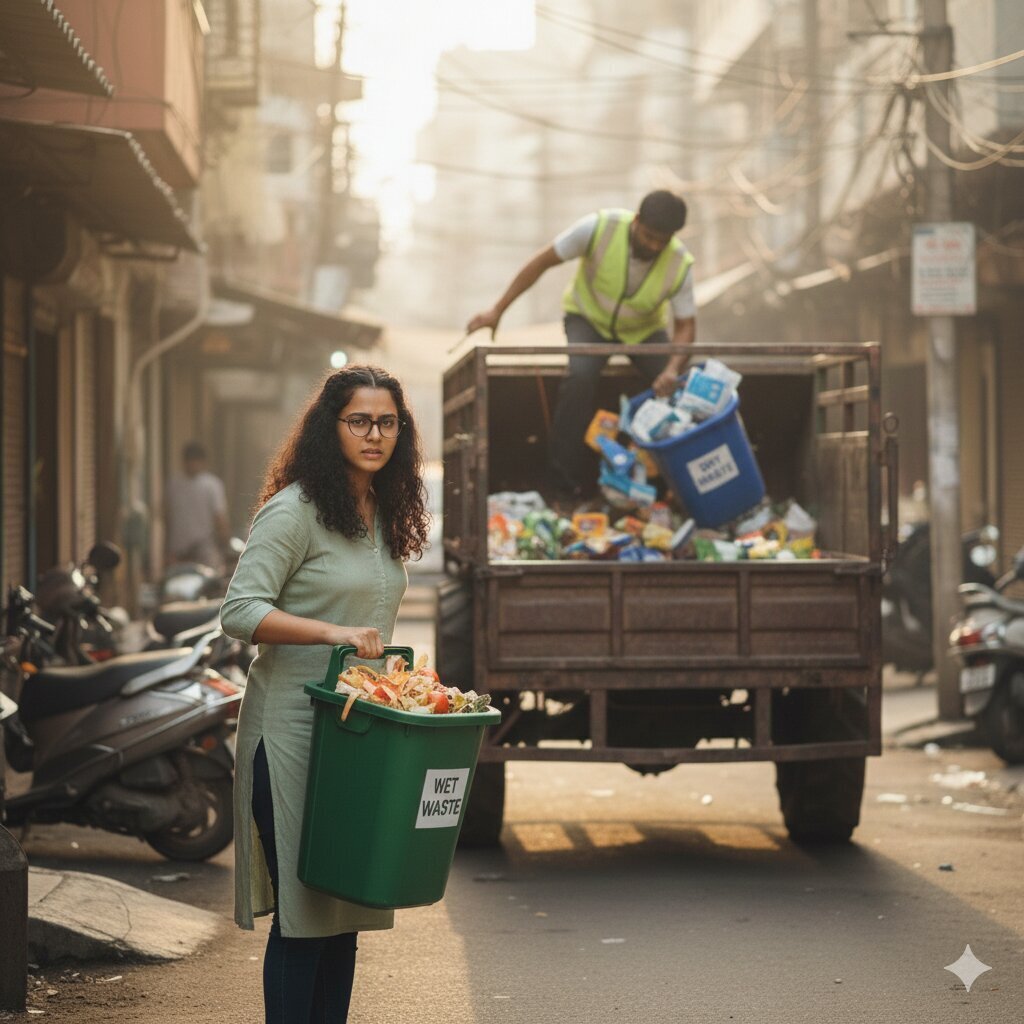
My jaw drops, and pride curdles into rage. “But anna, na…nu kasa na separate madidini!” (But brother, I have segregated the waste).
I stammer, a voice too low to reach the ears of this system. I want to scream. I want to explain four streams of segregation. I want to shout words like ‘circular economy’ and ‘polluter pays principle’ like curses. Instead, I politely ask, “Anna, yake mix madta idira” (Brother, why are you mixing?)
He looks at me with the calm wisdom of someone who has seen too much.
“Madam, gaadi ali ela otige hogutey.” (Ma’am, everything goes together in this vehicle).
Ah, yes! The vehicle of collective betrayal.
Later, as I shuttle to work, I see a familiar sight: a large pile of waste being burnt on the roadside. The smoke curls into the air like a passive aggressive message to my lungs. Somewhere in that fire is probably my meticulously cleaned tetra pack, achieving the highest degree of moksha in the pyre of mixed waste.
At work, I attend meetings where we discuss waste management policies, waste audit portals, and behaviour change. The PowerPoint presentations, models, and policies make me optimistic. Colleagues agree. Everyone is aligned — in theory.
Back home in the evening, another round of segregation begins. Another day of quiet rebellion. We try our best on campus, pat ourselves on the back, but back in the dusty lanes of Sarjapur, the system has the last laugh. As I sit with my coffee, I wonder, despite everything — the mixing, the burning, the landfills — why do I keep repeating it? Not because the system rewards me. Not because it always works. It’s probably because somewhere between the absurdity and the effort, I still believe that individual action matters — even if for now, it mostly builds character.
Tomorrow, I will rinse the milk packet again, and once more, I will hope.
Acknowledgement
This article is a reflection of the shared woes of the Community Engagement Initiative team— Dechamma C S, Anjor Bhaskar, Megha C A and Mansi Patel, who share these experiences with me. It is dedicated to all those who diligently fulfil their civic duties in pursuit of just societal norms.
About the author
Thrupthi G N is a Research Fellow at Azim Premji University. She works with the Community Engagement Initiative on decentralising waste management in peri-urban panchayats of Anekal taluk. Her practice-based work involves engaging multiple stakeholders, including panchayat officials and Swachhata workers.
She analyses policies, ground realities and management practices to identify sustainable solutions for on-ground waste challenges. You can reach out to her at thrupthi.n@apu.edu.in
Note: Images are AI generated and for representational purpose only.