
Publications & Resources
Our faculty, students and researchers work together everyday to contribute to a better world by grappling with urgent problems we are facing in India. We conduct rigorous work to produce high quality learning resources and publications to contribute to public discourse and social change. Here, we feature a sample from our work for everyone to access. You can explore featured resources, policies, and the latest publications from the University.
To explore all the work of our University, please visit our publications repository.

- Published
- Authors
Abstract
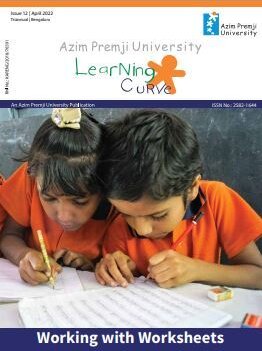
In the list of new teaching methods that teachers quickly thought of for online classes during the pandemic, the worksheet emerged as a learning aid that is creative, and participative, making children want to use their minds more independently. This issue features articles that showcase tried and tested methods of creating and using worksheets.
Links
University Working Paper Series
One Part Farmers: Villages two decades after land acquisition for the Bengaluru International Airport
in Azim Premji University


- Published
- Authors
Abstract
Constitutional measures to ensure fair compensation and livelihood security to the land losing refugees of development processes, overlook the complexity of ‘public purpose’ — the dominant rationale behind operationalizing ‘eminent domain’ of the state. Popular perception of public purpose as urbanization muffles the de facto social citizenship around plural values of agricultural landscapes. Ignoring the enduring public purposes served by agrarian landscapes aids in underestimating the longterm welfare impacts on displaced farmers.
Links
Massive Economic Costs of Biological Invasions Despite Widespread Knowledge Gaps: A Dual Setback for India.
in Springer Nature
Publication
- Published
- Authors
Abstract
Biological invasions are one of the top drivers of the ongoing biodiversity crisis. An underestimated consequence of invasions is the enormity of their economic impacts. Knowledge gaps regarding economic costs produced by invasive alien species (IAS) are pervasive, particularly for emerging economies such as India — the fastest growing economy worldwide. To investigate, highlight and bridge this gap, we synthesised data on the economic costs of IAS in India. Specifically, we examine how IAS costs are distributed spatially, environmentally, sectorally, taxonomically, temporally, and across introduction pathways; and discuss how Indian IAS costs vary with socioeconomic indicators. We found that IAS have cost the Indian economy between at least US$ 127.3 billion to 182.6 billion (Indian Rupees ₹ 8.3 trillion to 11.9 trillion) over 1960 – 2020, and these costs have increased with time. Despite these massive recorded costs, most were not assigned to specific regions, environments, sectors, cost types and causal IAS, and these knowledge gaps are more pronounced in India than in the rest of the world. When costs were specifically assigned, maximum costs were incurred in West, South and North India, by invasive alien insects in semi-aquatic ecosystems; they were incurred mainly by the public and social welfare sector and were associated with damages and losses rather than management expenses.
Our findings indicate that the reported economic costs grossly underestimate the actual costs, especially considering the expected costs given India’s population size, gross domestic product and high numbers of IAS without reported costs. This cost analysis improves our knowledge of the negative economic impacts of biological invasions in India and the burden they can represent for its development. We hope this study motivates policymakers to address socio-ecological issues in India and launch a national biological invasion research programme, especially since economic growth will be accompanied by greater impacts of global change.
Links