
Publications & Resources
Our faculty, students and researchers work together everyday to contribute to a better world by grappling with urgent problems we are facing in India. We conduct rigorous work to produce high quality learning resources and publications to contribute to public discourse and social change. Here, we feature a sample from our work for everyone to access. You can explore featured resources, policies, and the latest publications from the University.
To explore all the work of our University, please visit our publications repository.
CSE Working Paper Series
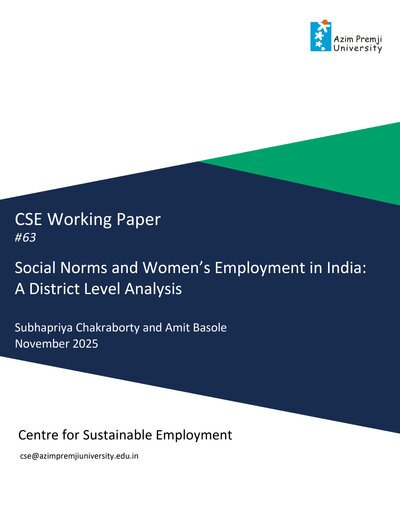
Social norms and women’s employment in India: A district level analysis
in Azim Premji University

- Published
- Authors
Abstract
Reducing gender disparities in workforce participation is an important policy goal in several developing countries. India, in particular, has historically had low levels of women’s workforce participation as compared to men and as compared to peer economies. Prior research has identified both supply and demand-side explanations for low levels of women’s participation in paid work. On the supply side, social norms constraining women’s mobility and autonomy are commonly invoked as one explanation. We test the relevance of such norms in explaining heterogeneity in women’s employment using district-level data from the National Family Health Survey (NFHS) 2015 – 16 and the Sixth Economic Census (2013). Norms indices are constructed using Principal Components Analysis for 640 districts of India. The findings indicate that less restrictive norms related to decision-making, mobility, and asset ownership are positively correlated with higher levels of women’s employment.
Authors:
Subhapriya Chakraborty and Amit Basole
Links

- Published
- Authors
Abstract
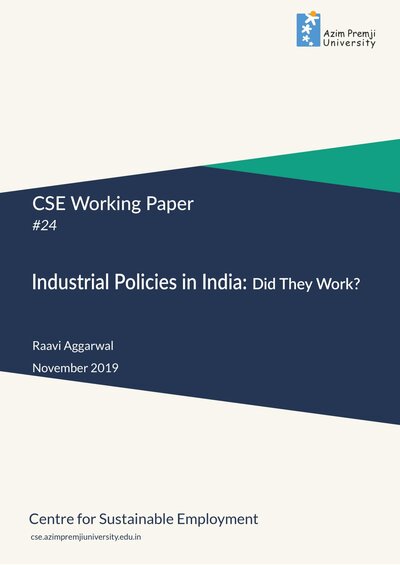
This article analyses relationships between the implementation of state-level industrial policies in India and manufacturing sector economic performance (employment and gross value added), utilising data from the Annual Survey of Industries conducted by the Government of India. I employ panel data fixed-effects regression models to evaluate the associations between the industrial policy and state-industry specific performance over the 2007-08 to 2014 – 15 period, incorporating potential effects of the state government’s political alignment, infrastructure provision and educational expenditure in the state. The results provide evidence of a positive correlation between industrial policy implementation and firm output and employment, by around 12.6 — 14 per cent. However, subsequent introductions of an industrial policy are negatively associated with employment and are uncorrelated with industrial GVA. This analysis has implications for economic policy in light of the Central Government’s plans to implement a revised industrial policy at the national scale.
Author:
- Raavi Aggarwal
Links
- Published
- Authors
Abstract
To contribute to the critical matter of India creating just and sustainable employment, the University has set up the Centre for Sustainable Employment (CSE), which conducts and supports research in areas of work, labour, and employment. The University is attempting to provide empirically grounded, analytical reflections on the state of work and workers in India, as well as to evaluate and propose policies that aim to create sustainable jobs. To this end the University also gives grants to create new knowledge in the above areas. It also hosts a working paper series to which contributions are invited from researchers, policy-makers, civil society actors, and journalists. The University’s CSE website is an important part of this agenda. In addition to research papers and policy briefs, it hosts government reports, as well as data and statistics on the Indian labour market. This also includes executive summary of the report.
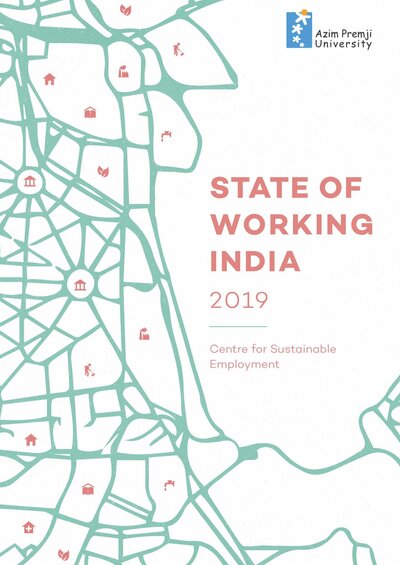
State of Working India 2019 consists of labour market trends between 2016 and 2018, and four policy papers around the theme of employment generation.
Release event: Presentation and panel discussion
State of Working India 2019 Release Event Part One — YouTube
State of Working India 2019 Release Event Part Two — YouTube
Links