
Publications & Resources
Our faculty, students and researchers work together everyday to contribute to a better world by grappling with urgent problems we are facing in India. We conduct rigorous work to produce high quality learning resources and publications to contribute to public discourse and social change. Here, we feature a sample from our work for everyone to access. You can explore featured resources, policies, and the latest publications from the University.
To explore all the work of our University, please visit our publications repository.
Article
Policy Evaluation in the Absence of Survey Data: Customised Border Designs With Satellite Data
in Journal of Agricultural Economics
Article
- Published
- Authors
Abstract
Developing country governments often launch new agricultural programmes without collecting pre-implementation survey data, making it difficult to evaluate the effects of such programmes. Leveraging the flexibility of granular pixel-level satellite panel data and a well-developed quasi-experimental policy evaluation design, we study a programme where pre-implementation data is unavailable. We estimate the effect of cash transfers on agricultural productivity in Telangana, India. Treatment and control regions are within 10 km on either side of the state border. They are identical in all respects except for the difference in exposure to policy treatment. Agricultural productivity increased in the major monsoon cropping season due to the cash transfer programme. The findings also reveal that cash transfers helped reduce productivity gaps between irrigated and rainfed agricultural areas. Our results are robust to two different sources of satellite data, three alternative indicators of productivity, two rounds of full-scale resampling, 100 rounds of small-scale resampling and three alternative border designs. Placebo regressions of two previous years also confirm our results. This approach to policy evaluation is applicable anywhere satellite data are available in the world.
Authors: Muddasir Ahmad Akhoon, Abhishek Shaw, Vidya Vemireddy
Links
Article
‘Songs of the lake’: Understanding cultural expressions of nature through dwindling folk-songs and mythologies in Bengaluru
in South Asia: Journal of South Asian Studies
Article
- Published
- Authors
Abstract
Culture-specific knowledge plays an important role in shaping environmental conservation. Yet we lack a holistic and contemporary understanding of how such local cultural systems interface(d) with ecologies, especially in the fast-growing cities of the Global South which face profound environmental challenges. In this paper, we explore nature-based cultural systems embedded in folk-songs to understand situated social-ecological histories of human-inhabited peri-urban landscapes in the city of Bengaluru in South India. Drawing on empirical observations from the city, we trace local imageries of erstwhile lake-based social systems through folk-songs, mythologies and oral narratives. We demonstrate how many of these cultural narratives, largely embedded within symbolic linkages to the lake ecology, continue to manifest themselves as folk expressions in the city, despite the fact that most of the lakes have been polluted or are managed via restrictions that prohibit village residents from accessing them as they once did for agriculture, livelihoods and domestic use. The songs are also rich reminders of socialities, which, despite being divisive and hierarchical to a large extent, were symbolically and materially embedded in nature.
Links

- Published
- Authors
- School of Education
Abstract
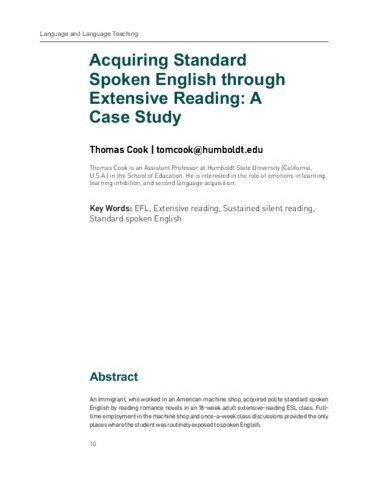
An immigrant, who worked in an American machine shop, acquired polite standard spoken English by reading romance novels in an 18-week adult extensive-reading English as a Spoken Language (ESL) class. Full time employment in the machine shop and once-a-week class discussions provided the only places where the student was routinely exposed to spoken English.