
Education-Development Interlinkages (Part X)
Role of school teachers in addressing the needs of students from poor and marginalised groups
Q&A with Santhakumar V | 5 May 2025
Teaching a child by understanding their family and socioeconomic background should be a part of the regular responsibilities of school teachers. Many teachers who are aware of the need to do something in this regard, take one or the other action, but a well-informed response is largely missing.
Details
Q. What can be the role of school teachers in addressing family-related and socioeconomic factors which impact children’s access to education and their learning?
A: I am not advocating that teachers be made fully responsible if a section of children drop out from school or are not learning adequately in school. Actions for this need to be taken by education functionaries at higher levels and other government officials, politicians (including elected representatives), non-governmental and civil society organisations, and local communities including parents. However, teachers are in a better position to take certain steps in this regard.
First, they may have better information on children who are likely to drop out, and they know about the learning trajectories of each child in their class better than anybody else. The learning of each child can (should) be sensed by teachers even if they do not conduct formal assessments. Secondly, they have the capacity to act, given that they interact with these children almost daily. They may have access to certain information about the condition of the parents. In many contexts (especially in the case of poorer parents), teachers receive a higher level of respect from parents and, hence, they may be able to influence parents. For these reasons, teachers can and should play an important role in ensuring that family and socioeconomic conditions do not affect the schooling of children. Even if teachers realise that they may not be able to do much in some cases, they can take the matter to other education functionaries and government officials, communities or elected representatives to address the challenges of specific groups of children.
Though I have said this as a possibility, in reality, a notable number of school teachers take one or the other action to make sure that children do not drop out and are learning adequately. The colleagues of the Azim Premji University have documented several practices by such teachers. Even historically, many teachers have played the role of social activists to ensure that children from poorer families get an education. Hence, what we discuss in this note is partly based on the actual work of school teachers.
Q. How can teachers ensure that all children of school-going age are enrolled in one or the other school?
A: There are campaigns and house visits by school teachers at the time of admission/enrolment in primary grades. Since almost all children are expected to attend an Early Childhood Education (ECE) centre (mostly Angawadies of the ICDS programme in India) working with the functionaries of these centres is useful to ensure that all their children move to a school. This movement/transition could be almost universal these days (some parents may opt for private schools for their children). However, school teachers can take extra care as in the case of children with disability, to see that they also join school. There is a lot of merit in communicating the benefits of government schools to parents, especially those who cannot afford a private school providing quality education. The tracking of births in the village (and the data available) may help, but family visits may be needed to develop a connect with parents. With an improvement in the use of technology and biometric or other tracking systems, the tracing of children may become relatively easier.
Q. What are the steps that teachers can take to minimise the dropping out of children from schools?
A: There can be steps before and after the event of ‘dropping out’. Most importantly, teachers should form a connection with each child in the class. The large class size could be a major factor in this regard, but my sense is that due to the increase in the number of school teachers in almost all Indian states, and the flow of students from government to private schools, the pupil-teacher ratio is not a severe constraint currently. Most factors which may finally cause dropping out build up gradually, and these may show up in the attendance or interest of students. Many students drop out while transitioning from one grade to the next (including from primary to secondary grades) and here the strategy should be similar to that used at the time of enrolment. There may be a need for house visits and the use of tracking systems to see that all children move from one grade to the next.
Several students may drop out due to a lack of interest in studies, but this is compounded by the school and family/socioeconomic conditions. Since we know that no middle-class family will allow its children to drop out of school due to a lack of interest, dropping out is an outcome of parents’ lack of interest and/or ability to act. However, a student’s lack of interest may start showing up in classes much before they drop out and that is when teachers can take active steps. Making classroom instruction/engagement joyful and inclusive is the most important step. Teachers can help students ‘develop an interest’ in learning. If there are other challenges that a student faces, say, a learning disability or a difficult family situation, these can be sensed by teachers, and they can have interactions/discussions with parents and suggest remedial steps.
There may be cases where the absence of one or both parents (say, due to migration for work) can worsen the situation. There have been school teachers who created temporary residential facilities for such children in schools. Though such actions may not be possible for most school teachers, working with the parents or grandparents or communities to see that such children get adequate attention at home so that they can attend school regularly is an important intervention. In some cases, child marriage may lead to the dropping out of children even though it is illegal and there are government provisions to avoid it. Teachers may get to know such marriage plans from students and can have informal discussions with parents to persuade them to postpone such plans. However, if parents are rigid in this regard, there have to be ways to contact the relevant legal authorities. There are also non-governmental organisations and activists with who schools can collaborate to create awareness among parents and take remedial actions. In all these cases, acting before the event is important.
Q. What should be the approach of school teachers towards children who have already dropped out of school?
A: The RTE Act (Right of Children to Free and Compulsory Education Act, 2009) mandates that every child in the age group of 6 – 14 years has the right to free and compulsory up to grade VIII. Even otherwise, the provision of education to all children is to be treated as a responsibility not only of teachers and education functionaries but also of society as a whole. However, the re-admission of dropped-out children poses significant challenges for which schools and their teachers are not adequately prepared. There are some critical steps that need to be taken to ensure that dropped-out children catch up with the regular education in school. These include developing a strong interest in learning, bridging the gap between the actual learning achievement and the expected grade-level learning and ensuring that they do not drop out again.
Q. What are the steps that teachers can take to improve the learning achievements of those children who lag behind?
A: There are different kinds of problems that may lead to sections of children (or even the majority in many government schools) lagging behind in terms of learning achievements. Though assessment and evaluation are necessary, school teachers can sense the learning laggardness of children even without conducting such assessments.
There can be certain non-educational interventions to see that children learn adequately. Ensuring that children get adequate nutrition and are healthy is important. Making the mid-day meal programme effective (with adequate nutrition) or starting a breakfast programme if possible, can make a difference.
In general, students should have an interest in what they learn. There are pedagogic strategies for this purpose (and I presume that these are part of pre-service or in-service teacher training). Connecting the curriculum to the social context, nature and life of the students can be an important strategy. Since children come from different backgrounds, there may be a need to connect the teaching with diverse social contexts. There is a need to understand that each child may have a specific pace of learning, and catering to this requirement (though it may be difficult in large classes) is also important.
Teachers also need to have an understanding of the family or socioeconomic conditions of their students which may have an impact on their learning. There may be a need for additional academic support in the case of those children whose parents cannot provide such support. There can be provisions for additional academic support in schools, say after regular classes or during holidays. There may be cases where the family environment is not conducive to learning. Though all these problems cannot be solved by school teachers, they can try to understand these issues and think of some remedial actions. In certain cases, working with NGOs/CSOs, community elders or other government functionaries can make a difference, and this has to be attempted.
An important step on the part of school teachers is to ensure that all children in the classroom receive equal attention. Some may take time to develop an interest in learning due to one or other problems. Some children may have one or the other learning disability. Teachers may need basic training to understand/identify such learning disabilities. Or there can be experts who visit schools and discuss these issues with teachers, who in turn can discuss them with the parents and encourage them to take possible remedial actions.
Q. Children from migrant families and urban poor may face additional challenges. What can teachers do to address their learning deficiencies?
A: There are many commonalities between migrant families and urban poor. Most migrant workers go to cities where work is available. They become part of the urban poor. The challenges that they face are somewhat different from those of poor people who live in rural areas. Migrant workers do not live in the same place for a long time and there are other factors which make the education of their children a lot more challenging. Their mother tongue may not be the medium of instruction in schools in the city. They may go back to their native place at times (such as for their local festivals) and this can lead to irregular attendance. Their residence in the city itself may change depending on the changes in work sites (such as construction sites) within the city. This may not enable children to continue in the same school for an adequate period (including a full academic year). In general, these workers may not attend parent-teacher meetings or visit school for other purposes. Teachers may find it difficult to communicate with them. Teachers in government schools in cities may see a significant class difference between them and the parents of students and this can also affect the communication between them. The practice wherein the older girls take care of younger siblings and elder boys start to work early could be common among them and this can affect their schooling. Most of these migrant workers, who are taking up jobs in construction and other such activities and becoming part of the urban poor, may have only a few years of school education and, hence, may not be able to provide any academic support to their children. It may be noted that the number of such parents is increasing continuously in India’s cities as part of the migration for work by the rural poor.
I am not presuming that all these challenges can be addressed by school teachers or that governments and non-governmental organisations have to find appropriate solutions. However, teachers are the ones who interact directly with these children and hence their role can be significant. They should try to mobilise additional resources so that these children get assistance, say in learning the local language/ medium of instruction. There are cases where the school hires volunteers who can facilitate this transition for children. There have to be efforts to connect and communicate with their parents. Certain irregularities in attendance or the frequent shift from one school to another are to be expected in the case of these children. It would be great if teachers can provide additional academic support to them. Teachers can also work with NGOs and philanthropic organisations to mobilise additional academic support to these children either at school or in the community.
Q. We have noted that children from poorer families may need additional academic support from school teachers. Will these children develop an interest in learning merely with this academic support?
A: When children develop an interest in education, they will themselves seek and use academic support from teachers. We have noted in another Q&A about the family and social conditions which enable/disable learning. There can be intangible aspects of interaction between parents and their children which may motivate the latter to learn. Youngsters should develop an interest in education for instrumental and/or non-instrumental reasons. What they want to be in life, could be connected (or disconnected) to education. Certain socioeconomic contexts may not provide the children with the confidence that they too can benefit from education. It is in this context, that teachers who themselves have benefitted from education, and who have certain exposure to different avenues of higher education can play a critical role. They can create education-related aspirations in children whose parents are unable to do so. Teachers can enhance the confidence of children in acquiring higher levels of education. Historically, we have seen many people who guided youngsters from poorer and less-privileged families to do well through education. Since teachers are on the frontline, and they can get information on the (lack of) motivation of each student, they may be able to make a positive change in this regard.
Poorer families may encounter constraints that deviate their focus from their children’s education and school teachers may not be able to address such constraints. However, given the understanding of the impact of family and socioeconomic conditions on the learning achievements of children, there have to be a lot more conscious efforts on the part of governments and non-governmental organisations, and school teachers may have to take a pivotal role in coordinating/facilitating these efforts. Teachers need to be empowered with the knowledge of how to use the different avenues/opportunities which are provided by governmental and non-governmental organisations to help children from difficult backgrounds so that the latter can also progress in terms of education.
Q: Will these not increase the burden on school teachers? Are we not expecting them to take on too much?
A: Yes, there is that danger. Teachers are already burdened in many contexts with non-education-related responsibilities (like collecting different kinds of data). There has to be a conscious effort to reduce their burden. However, teaching a child by knowing her family or socioeconomic background should be a part of the regular responsibilities of school teachers. Currently, this aspect is not given adequate importance in the pre-service or in-service training of teachers. (The preparation of these Q&A notes is made with the expectation that these may help the in-service training.) Many teachers are aware of the need to do something in this regard, and they take one or another action, but a well-informed response may be missing in certain contexts.
Santhakumar V is a former Professor, Azim Premji University, Bengaluru
Photo
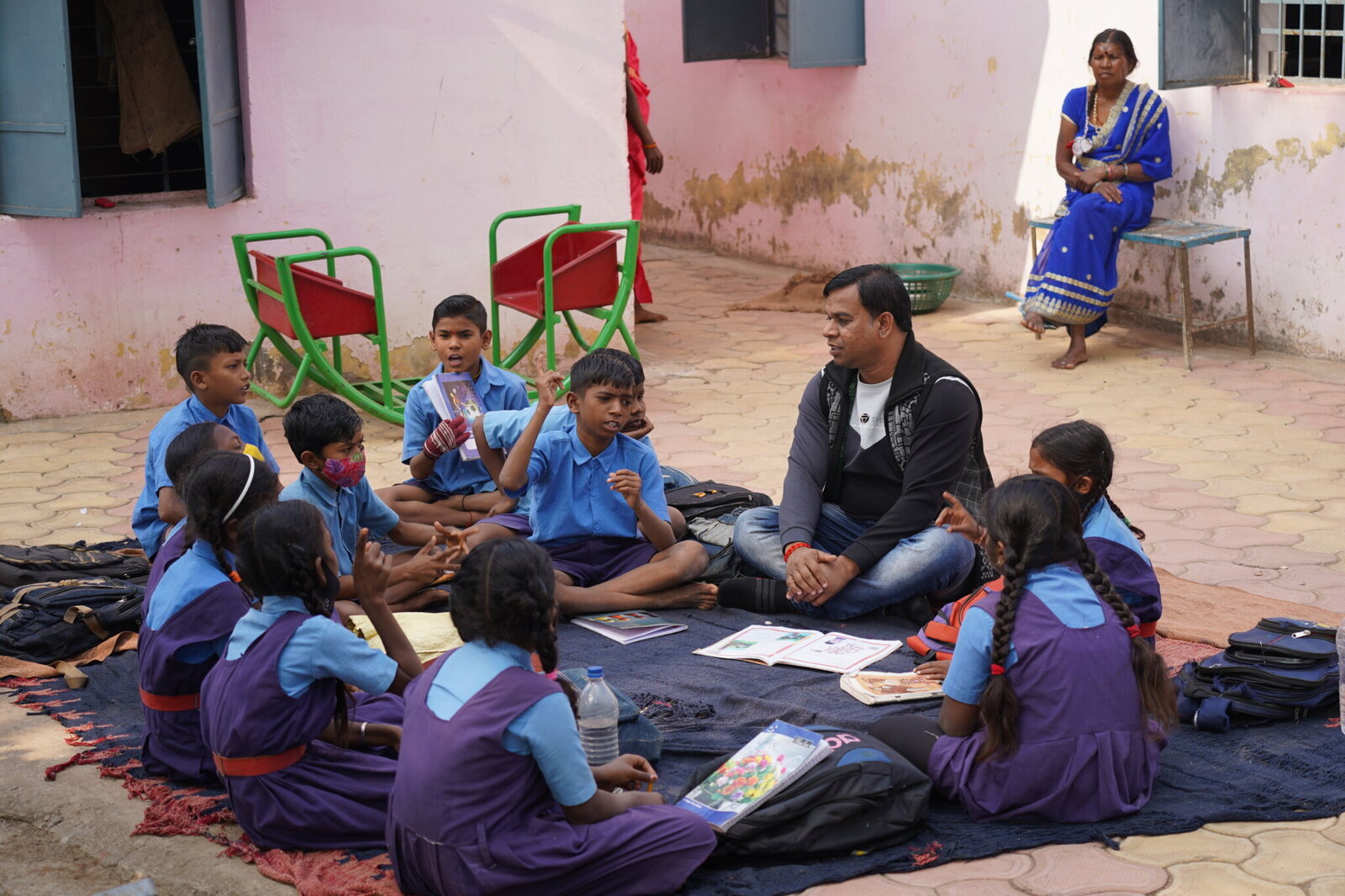
Featured photo credit: Purusottam Singh Thakur, Azim Premji Foundation
Primary reading material
Case Studies of Teachers who do exceptionally well to address the needs of the poor and marginalised:
Rajashree Srinivasan. The Courage to Teach: Going Beyond the Constraints of Contexts. University Practice-Connect. https://azimpremjiuniversity.edu.in/teachers-and-schools-for-inclusive-society-series/the-courage-to-teach-going-beyond-the-constraints-of-contexts
Rajashree Srinivasan. Confidence in Collegiality. University Practice-Connect. https://azimpremjiuniversity.edu.in/teachers-and-schools-for-inclusive-society-series/confidence-in-collegiality
Rajashree Srinivasan. Leading to Achieve the Promise of Education for All. University Practice-Connect. https://azimpremjiuniversity.edu.in/teachers-and-schools-for-inclusive-society-series/leading-to-achieve-the-promise-of-education-for-all
Rajashree Srinivasan. Every Child can Learn. University Practice-Connect. https://azimpremjiuniversity.edu.in/teachers-and-schools-for-inclusive-society-series/every-child-can-learn
Rajashree Srinivasan. Combating Child Marriage, Securing Girls’ Education. University Practice-Connect. https://azimpremjiuniversity.edu.in/teachers-and-schools-for-inclusive-society-series/combating-child-marriage-securing-girls-education
Ankur Madan and Vartul Dhaundiyal. A Primary School Teacher Who Wears Many Hats. University Practice-Connect. https://azimpremjiuniversity.edu.in/teachers-and-schools-for-inclusive-society-series/a‑primary-school-teacher-who-wears-many-hats
Ankur Madan. Teachers Acquire Teaching Skills from Practice. University Practice-Connect. https://azimpremjiuniversity.edu.in/teachers-and-schools-for-inclusive-society-series/teachers-acquire-teaching-skills-from-practice