
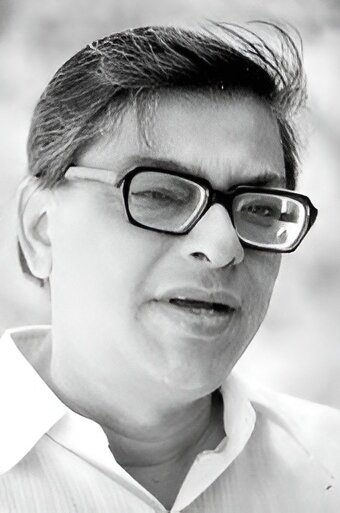
Sukhamoy Chakravarty
Structural Macroeconomist Theorist
By Prabhat Patnaik
Details
Sukhamoy Chakravarty (1934 – 1990) belonged to the first generation of Indian economists that broke away from being primarily concerned with problems of the Indian economy in its colonial setting, and engaged instead with wider issues within the discipline of economics. He was not only among the best of his generation in India, but also acquired a formidable international reputation, because of which he became at one time the Vice-President of the International Economic Association. However, even this reputation did not do him justice, for, quite apart from his brilliance, he was extraordinarily erudite, with intellectual interests ranging from philosophy to mathematics and the natural sciences.
A product of Presidency University, Kolkata (formerly Presidency College, Calcutta), where another well-known economist, Amartya Sen, was his friend and classmate, he completed his doctoral research under the supervision of Jan Tinbergen in the Netherlands. The result of his doctoral research was his book The Logic of Investment Planning. In fact his early work focussed on the theory of planning and the theory of optimal savings.
His first internationally-acclaimed publication was in the latter area. Tinbergen, trying to work out an optimal savings path over an infinite time-horizon for an economy which had to have a certain minimum subsistence level of consumption in every period, found, rather surprisingly, that along the optimal path consumption in every period remained at this subsistence level. Chakravarty’s paper pointed out that this obviously absurd result was because of a mis-specification of the problem. To compare different paths, one needs to calculate the overall utility yielded by each path.This requires integrating the utilities under each path. This in turn requires the integral to be finite (if different paths yield infinite utility, it is not possible to rank them). Mathematically this requires that the integrands must tend to zero as t→∞. Frank Ramsey, the Cambridge economist who first developed optimal savings theory had ensured this by positing a maximum level of utility, called bliss or $$B$$; denoting by $$U(t)$$
the utility in period t; and taking [$$B$$
-$$U(t)$$
] as his integrand he had looked for the path with the minimum integral. This allowed a finite integral, which is why Ramsey was able to generate meaningful results. Tinbergen’s specification, however, did not meet this condition.
Of course, since Chakravarty’s pioneering article, new ways of comparing infinite horizon growth paths, such as by using the “overtaking” criterion, have been developed; but his article still remains a pioneering one for identifying the basic logical problem.
His other major work in this area was to explore an optimal savings programme over a finite time horizon, where he was a pioneer along with Richard Goodwin of Cambridge. To recognize its significance we must remember that optimum growth literature falls into two categories. One is where the initial and terminal stocks of goods are specified, and the problem is to minimize the time taken to transit from one to the other. (Alternatively, the problem can be stated as maximizing the vector of final stocks for a given time horizon). Here, there is no question of any social utility calculus; all comparisons are of physical amounts over time. It is in this range of problems that the “Turnpike Theorem” becomes relevant; that is, the optimal path entails moving close to the Von-Neumann path (which acts like a turnpike, and entails fastest growth along it), and then moving away from the turnpike to reach the specified final goods vector. The Mahalanobis strategy underlying India’s Second Five Year Plan, which emphasized heavy (i.e. machine-building) industry, can be seen as an example of a Turnpike Strategy: even if one wants more consumption goods at a later date, it pays to develop capital goods production at the fastest rate which can then be used later for boosting capacity for producing consumption goods.
The second case of optimizing the growth path is where social utility comparisons are involved. Chakravarty found that even when social utility comparisons were involved, the optimal growth path turned out to be relatively insensitive to how large the terminal stock at the end of the finite time-horizon was targeted to be. A Mahalanobis-type strategy of building up capital goods in other words would be optimal not just on “Turnpike” considerations, but even if we took into account the calculus of social utility that depended entirely on the availability of consumption goods.
His work in this area culminated in his book Capital and Development Planning. Much of this work, including this book, was done when he was occupying the Chair in Mathematical Economics at the Delhi School of Economics, where he had shifted after teaching for a while at the Massachusetts Institute of Technology. In the early seventies however he was asked by the Government of India to join the country’s Planning Commission and he agreed, despite not having had any previous experience with policy-making; he subsequently became the Deputy Chairman of the Planning Commission. Throughout his Planning Commission stint, however, he never gave up teaching at the Delhi School of Economics, which remained his first love.
His analytical prowess was now devoted to the Indian economy and it threw up powerful insights into the working of this economy. His insights can be best understood in terms of the well-known Lewis Model, according to which the reinvestment of the surplus in a newly-created high-productivity modern sector, where the real wages are given because of the existence of vast labour reserves in the traditional sector, would eventually use up these reserves. The typical counter-argument against this Lewisian vision highlights the occurrence of labour-saving technological progress in the course of the growth of the modern sector; such technological progress thwarts the absorption of labour from the traditional sector and hence the exhaustion of such reserves, leading to the creation of a perennial “dualism” in the economy. Chakravarty however highlighted an alternative impediment to the using up of labour reserves, which was as follows.
The modern sector has to engage in exchange with the traditional sector in order to obtain the main wage-good, viz. food grains, to keep its expansion going; growth on the basis of the reinvestment of surplus in the modern sector in other words is conditional upon its ability to obtain wage goods from outside of it at a fixed exchange rate. But if this exchange rate keeps tilting against the modern sector, either because of sluggish agricultural growth, or because of political pressure exercised by the affluent agriculturists, then even for a given real wage (in terms of wage goods) the product wage (in terms of the goods produced by the modern sector) would keep rising. This would keep reducing the share of surplus in the modern sector and hence its rate of accumulation and growth, which would thwart the absorption of labour reserves. A politically engineered shift in the terms of trade in favour of the agricultural sector, leading to a rise in the product wage in manufacturing, which Chakravarty noted, was emphasized also by Ashok Mitra around the same time, as constituting a feature of the Indian economy; Chakravarty, however, while noting that the terms of trade shift could be politically engineered, did not insist upon it. He only noted the effect of a terms of trade shift in favour of agriculture.
At the same time, he also visualized what could happen if the terms of trade kept moving against agriculture. An obvious consequence of it would be not a rise in the real wage in the modern sector but a rise in the share of surplus. This would create a market problem for the modern sector, since the propensity to consume the modern sector’s goods out of the modern sector’s surplus is lower than the propensity to consume such goods out of agriculturists’ incomes. True, in a dirigiste regime, the state in principle can always step in to overcome any deficiency in aggregate demand, but this might not be either immediate or effective; the demand generated by state spending in other words may materialize only over time and would not necessarily be for the goods for which the demand from the agricultural sector would be falling owing to the terms of trade decline.
Chakravarty was thus postulating the existence of a delicate balance in the inter-sectoral terms of trade under a dirigiste regime, of the sort that India had been before the adoption of neoliberal policies. A shift in terms of trade in favour of agriculture would create a rise in product wage that would adversely affect growth in the modern sector; and a shift in terms of trade against agriculture would create a demand deficiency that would also adversely affect growth in the modern sector. The dirigiste regime had to avoid both these problems by treading cautiously.
Chakravarty passed away before the full onset of neoliberalism, but he was a strong critic of what was to come and was already looming on the horizon. He was an advocate of planning, and broadly endorsed the Mahalanobis strategy. His book Development Planning: the Indian Experience which articulates his own intellectual position while giving an account of India’s historical experience with planning, also explains why the Mahalanobis strategy apparently ignored agriculture, as it is often accused of doing. Agriculture in the early 1950s was generally considered a “bargain sector”, in the sense that its output was thought to be capable of being increased through institutional changes such as land reforms that did not require much investment; investible resources therefore could be diverted towards building up heavy industries that could make the country self-reliant without worrying about an agricultural constraint. This thinking was not erroneous per se; if institutional changes were not affected and agriculture did emerge as a constraint, then the blame for it cannot be laid at the door of the Mahalanobis strategy.
Sukhamoy Chakravarty would generally be considered the most distinguished economist in the country in the decades of the 1970s and the 1980s. A brilliant, but very demanding teacher, he left an indelible mark on all his students. At a time when many economists who had returned to India in the post-independence period, were again leaving the country to go back to the metropolis, owing perhaps to their disillusionment with the trajectory of the country’s politico-economic development, his staying on at the Delhi School of Economics was a real source of inspiration for countless students. His contribution to the building up of an academic ambience in India, especially in the discipline of economics, was immeasurable.
Chakravarty, S. (1987). Development Planning: the Indian Experience. MIT Press.
Chakravarty, S. (1972). Capital and Development Planning. MIT Press.
About the author
Prabhat Patnaik is a Marxian economist and political commentator. He taught at the University of Cambridge, U.K. from 1969 to 1974 and at the Centre for Economic Studies and Planning, Jawaharlal Nehru University, New Delhi from 1974 until his retirement in 2010. He served as Vice Chairman of Kerala State Planning Board from June 2006 to May 2011.