
M.J. Manohar Rao
Macroeconomist with a flair for macroeconometric modelling
By Ajit Karnik
Details
M.J. Manohar Rao was an academic researcher par excellence, but he also had many other qualities. He was a superb teacher who brought in droves of students into the classroom. He was also a dedicated and generous PhD supervisor who helped 22 students develop high-quality theses. He had wide-ranging interests covering books, films, World War II, and science. Rao was devoted to the Department of Economics at the University of Mumbai, and contributed immensely to its growth. He had that rare quality of making everyone who came within his orbit feel special.
Rao completed his graduation in Mathematics from Osmania University in Hyderabad before moving to the Department of Economics, University of Mumbai for his master’s degree and PhD which he completed in 1978. The next two years were spent at the Perspective Planning Division (PPD), Planning Commission at the invitation of Yoginder Alagh, who headed the division. Rao returned to the Department of Economics, University of Mumbai as Reader (Associate Professor) and subsequently Professor, where he remained till 2003.
There were academics, policymakers, and researchers who had a significant influence on his research and his career. At the Planning Commission, the most important influences were Jayanta Roy from the World Bank who was at the Planning Commission during 1978 – 80, and Yoginder Alagh who invited Rao to the Perspective Planning Division (PPD), Planning Commission. Vijay Kelkar, who was an adviser to the Government of India when Rao was at the Planning Commission, kindled Rao’s interest in policy making. Michael Intriligator, Professor of Economics at the University of California, Los Angeles was Rao’s faculty adviser when he was a Fulbright Fellow at the University of California, Los Angeles (UCLA). Rao came into contact with David Kendrick, Professor of Economics at the University of Texas at Austin (and the doyen of deterministic and stochastic optimal control) in the late 1980s, when Kendrick visited the Indira Gandhi Institute of Development Research in Mumbai. Vikas Chitre, Professor of Economics and founding Director of the Indian School of Political Economy shared a close bond with Rao. There were many colleagues at the Department of Economics, University of Mumbai who had an influence on Rao and became his friends. Chief among these were P.R. Brahmananda, Dilip Nachane, and Lalit Deshpande.
As a person, Rao was extremely organised who set up a timetable for his research and, indeed, for many a mundane activity, and adhered to it. His research ideas would spring forth in a burst of creativity and brilliance, and then this would be followed by the hard yards as he wrote out his research papers. A typical workday would end with Rao and a colleague playing a round of chess. This was Rao’s way of unwinding and getting himself refreshed for further research deep into the night. Rao was unassuming and humble to a fault. He, of course, enjoyed his work and getting his papers published but he would be equally happy with the success of his colleagues and their publications. He did not create walls around him and was approachable to all. Tragically, Manohar Rao left this world prematurely on 19 April 2003. He was only 51 years of age. He left behind a huge amount of research output — 52 journal papers, four authored books, three edited books, 20 book chapters, 47 conference papers (including invited addresses), and 13 working papers.
Manohar Rao wrote extensively and in a wide variety of areas. However, if one were to put him in a category, it would most certainly be as a macroeconomic modeller par excellence. There are two strands to Rao’s work in macroeconomic modelling. The first strand begins with his PhD thesis, which he completed in the late 1970s (see Rao, 1984a for the published version of his thesis) and continued unabated till the early 1990s and included what is, probably, his most prestigious work, Rao (1987). All of the work during this period focuses on macroeconometric modelling using optimal control techniques. The second strand of his work in this area, which commenced in the mid-1990s, augments macroeconomic modelling by incorporating the financial programming approach.
Given the amount of Rao’s output in this area, it would clearly be impossible to review all his work. I would like to begin by referring to one of his earliest works, Rao (1983). Rao had just returned from a stint at the Planning Commission and, in this work, he makes a strong case for incorporating optimal control techniques (OCT) into macroeconometric modelling. Ray Fair describes a macroeconometric model as a set of equations designed to explain the economy of a country. These equations are either estimated or they are identities (i.e. they are always true). The variables included in the equations are either endogenous (i.e., explained by the equations within the model) or exogenous (i.e., not explained within the model). For instance, consumption would be an endogenous variable while the income tax rate, which is set by the government, is an exogenous variable.
India has had a long history of macroeconometric models before Rao came on the scene. Krishnamurthy lists the models of Narasimham in 1956, Choudhary in 1963, Marwah in 1963, Krishnamurthy in 1964 and Pandit in 1973 among many others. However, Rao pioneered the use of OCT in macroeconometric modelling. OCT has many uses, for example maximising economic growth subject to constraints, such as keeping inflation in check, using a mix of macroeconomic policies. Much of this was very new in the Indian context, and Rao’s was a pioneering contribution (see Rao, 1984a).
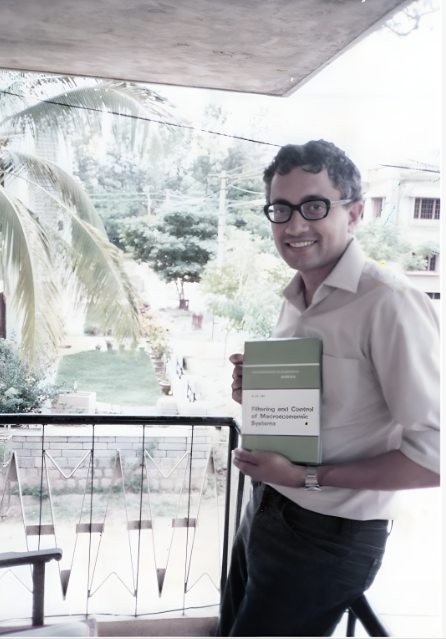
The high point of Rao’s publication chart in the 1980s was the book that he completed during his sojourn as a Fulbright Fellow at the UCLA (Rao, 1987). His study is principally an attempt to use the stochastic control theory for macroeconomic regulation so that the inherent pitfalls of adopting policies of an intuitive nature are ruled out. By using stochastic control, Rao broke with the economic literature of the period, which assumed, rather naively, that the current state of the system was completely known so that all uncertainty tended to be concentrated in the future. Stochastic control theory allowed for the systematic treatment of the more realistic case when information was scarce, contradictory, and inexact. To make the most use of all available information, Rao employed the Kalman filter, probably for the first time in the Indian context. Rao used the Kalman filter to show that noisy “quick estimates” of macroeconomic aggregates, such as the GDP, could lead to overpredicting growth rates. This could be avoided by deriving steady-state Kalman gains which could yield more reliable final estimates of variables from their quick estimates (Rao, 1994).
There were other papers in the area, some extending parts of his earlier work (Rao, 1984b, 1989 and 1990), while others broke new ground (Rao and Nachane, 1988; Rao, 1991; 1992a; 1992b).
The second strand of Rao’s work in macroeconomic modelling incorporates financial programming. His concern with the ongoing Indian economic reforms programme led him to explore the applications of financial programming to the Indian situation, which is described as the “theoretical mainstay of nearly all IMF-supported adjustment programmes” (Rao and Singh, 1995). A financial programme comprises a set of balance sheet accounting identities, which impose the necessary constraints, both in terms of coordination and sequencing, on the desired monetary and fiscal policy measures intended to achieve pre-specified economic targets. The actual iterative process by means of which these desired targets are achieved through the manipulation of the policy variables, subject to the balance sheet constraints, is referred to as financial programming. The starting point of this study was the design of monetary stabilisation and fiscal adjustment for India, which would have to evaluate four elements in order to decide which of these were the most likely to play a central role in the long run success of stabilisation. These four elements were: (1) desired levels of inflation and international reserves, (2) optimal levels of domestic credit and exchange rate, (3) appropriate levels of capital flows and investment, and (4) sustainable levels of fiscal and current account deficits. To anyone who has followed the meandering path of India’s reforms at that time, it will be clear that each of these elements has assumed critical importance. That Rao should have focused on these elements at a time when the economy was performing at its best in the early post-reforms period is a clear indication of his perspicacity and his ability to zero in on the essence of any problem.
Rao continued to work in this area publishing two articles (Rao,1997a and 1997b) which were concerned with speculative attacks on foreign currency markets and the balance of payments crisis. The basic theoretical framework has been applied in the Indian context to ascertain whether the speculative attack on the Indian rupee, which commenced in September 1991, could have been predicted. Rao further goes on to state categorically, in light of the experiences in Southeast Asia, that “any hasty move towards capital convertibility should be avoided at all costs”. Rao (1999) further extended the scope of his work in this area by specifically incorporating exchange rate equilibrium. As he writes, “One of the most fundamental propositions of open-economy macroeconomics is that the viability of any stabilisation programme requires maintaining long-run consistency between monetary and exchange rate policies, because the defence of any given exchange rate regime requires a specific monetary discipline”. The backdrop of the Southeast crisis lent urgency to analysing exchange rate sustainability and incorporating this aspect into the financial programming model.
All of Rao’s work in the area of financial programming culminated in the comprehensive Rao and Nallari (2001) work. Rao completed this book in the course of six months that he spent at the IMF as a Visiting Fellow. The book is a technical introduction to the theory and design of stabilisation and growth-oriented structural adjustment programmes. The area of coverage of the book is, indeed, very wide. Spread over five parts and thirteen chapters, the work covers the following: macroeconomic relationships and policies for developing countries; the analytical framework underlying the concept of growth-oriented structural adjustment programmes; the Bank-Fund model; development macroeconomics; and lessons of adjustment experiences. While the book focuses on India, it still has enough in it for it to be of interest to anyone concerned about structural adjustment programmes that have taken place all over the world.
Rao worked in a variety of other areas of economics as well, but the contributions were not part of his dominant body of work which was essentially in the area of macroeconomic modelling. A taxonomy of his other articles is very difficult, but nonetheless the following may be proposed:
Monetary Policy: Rao was very active in the field of monetary policy with two articles of note (Rao and Rao, 1998; Rao, 2000).
Human Capital Theory: In the period from the mid-1980s to the end of that decade, Rao wrote a few papers in this field (Rao and Datta, 1985; 1988; 1989; 1990).
Chaos Theory: Rao’s fascination with mathematics saw him exploring the applications of chaos theory to economic problems. Business cycles, hyperinflation, and exchange rate volatility offered interesting possibilities and this resulted in numerous papers: Rao (1992c; 1993) and Rao and Bhogle (1990).
Macroeconomic Database: The financial programming models that Rao was working with at this time required considerable use of consistency accounting matrices. Rao et al (1999a; 1999b) estimated the individual elements of a consistency accounting matrix for the Indian economy and then provided a consistent macroeconomic database from 1950 – 51 to 1997 – 98.
Surveys: Rao wrote two survey articles: one in the area of systems modelling in India (Rao, 1994) and the other on Indian planning models (Rao and Karnik, 1994a).
Miscellaneous: Rao did research in numerous other areas that make classification difficult. Rao (1981) made a pioneering attempt in the Indian context to use the Harrod-Domar model to obtain a benchmark value for capital stock for the year 1950 – 51 and employing this benchmark created a time series for capital stock in India. Rao and Karnik (1994b) used human rights indices for 154 countries to identify economic and political factors underlying the variation in these indices across countries. The paper showed that human rights abuses have their genesis in the concentration of economic as well as political power in governments. Rao et al (1990) attempt to derive estimates for potential output for the Indian economy over the period 1950 – 1988 through the use of a locked growth model i.e., a model that would internally generate values for all endogenous variables without the need for any external stimuli.
This note has commented on only about 30 of Rao’s writings out of a total that is more than 100. Though the coverage has been selective, most of his important written work has been commented upon. Rao moved on when he was possibly at the peak of his scholarly powers and one may only wonder how much more was to come from his pen had he not been snatched away.
Rao M.J.M. (1981) A Development Planning Approach to Obtaining Capital-Stock Estimates for India. Indian Journal of Economics, 62.
Rao M.J.M. (1983) Economic Planning and Optimal Control Theory. The Indian Journal of Economics, 63(250).
Rao, M.J.M. (1984). Planning and Control Theory: An Econometric Model for India in an Optimal Control Framework. Himalaya Publishing House.
Rao M.J.M. (1984b). Control Systems and Quantitative Economic Policy. In R. Trappl (ed.) Cybernetics and Systems Research 2. Elsevier Science Publishers B.V.
Rao, M.J.M. (1989). Feedback Control, Development Strategy and Macroeconomic Planning. Cybernetics and Systems, 20(1), 29 – 41.
Rao, M.J.M. (1990). The role of feedback in macroeconomic policy. In R. Trappl (ed.) Cybernetics and Systems: Proceedings of the Tenth European Meeting on Cybernetics and Systems Research. World Scientific.
Rao, M.J.M. (1991). The Recursive Estimation of Time-varying Parameters: A Variation on the Near-neighborhood Search Problem. Journal of Quantitative Economics, 7, 303 – 311.
Rao, M.J.M. (1992a) Stochastic Control of Macroeconomic Models with Measurement Error. Cybernetics and Systems Research ’92, Proceedings of the Eleventh European Meeting on Cybernetics and Systems Research. World Scientific.
Rao, M.J.M. (1992b). The role of Kalman filtering methods in the stochastic control of models with measurement error: Case study for India. J. Manage. Sci. Appl. Cybernet.(SC/MA), 21, 19 – 35.
Rao, M.J.M. (1992c). The Deterministic Counter Revolution: Chaos Theory. Indian Economic Review: Special Number in Memory of Sukhamoy Chakravarty, 27, 231 – 43.
Rao, M.J.M. (1993). Excessive Exchange Rate Volatility: A Possible Explanation Using Chaos Theory. Journal of Foreign Exchange and International Finance, 7(3), 279 – 301.
Rao, M.J.M. (1994). The Systems Approach to Economic Modelling in India. Systems Practice, 7(4), 351 – 366.
Rao, M.J.M. (1999). Macroeconomic Policy Modelling for The Indian Economy using A Financial Programming Approach. Journal of Quantitative Economics, 15(2), 137 – 160.
Rao, M. J. M., & Bhogle, S. (1990). The chaotic dynamics of hyperinflation. Project Document DU, 9004.
Rao, M.J.M. & Datta, R.C. (1985). Human Capital and Hierarchy. Economics of Education Review, 3(2), 67 – 76.
Rao, M.J.M. & Datta, R.C. (1988). Human Capital Theory and Educational Planning: Application of Mathematical Analysis in a Microeconomic Context. Journal of Education and Social Change.
Rao, M.J.M. & Datta, R.C. (1989). Rates of Return in the Indian Private Sector, Economics Letters, 30.
Rao, M.J.M. & Datta, R.C. (1990). Human Capital Recurrent Education and Socio-economic Success. Journal of Education and Social Change.
Rao, M.J.M., & Karnik, A. V. (1994a). An Evaluation of Indian Planning Models and Alternative Design Structures: Theoretical Foundations and Technical Implications. Journal of the Indian School of Political Economy, 6(2).
Rao, M.J.M., & Nachane, D. M. (1988). Varying-parameter models: An optimal control formulation. Journal of Quantitative Economics, 4, 59 – 79.
Rao, M.J.M., & Nallari, R. (2001). Macroeconomic Stabilization and Adjustment. Oxford University Press.
Rao, M.J.M & Singh, B. (1995). Analytical foundations of financial programming and growth oriented adjustment. Department of Economic Analysis and Policy, Reserve Bank of India.
Rao, M.J.M., Fernandes, C.J., & Deshpande, C.S. (1990). Potential rates of growth for the Indian economy: recursive estimation results. Journal of the Indian School of Political Economy, 2.
Fair, R. (2024). US Model Workbook. https://fairmodel.econ.yale.edu/wrkbook/zauwrk.pdf (accessed 18 April 2024)
About the author
Ajit Karnik is Emeritus Professor at Middlesex University, Dubai. Previously he served as Reserve Bank of India Dr. B.R. Ambedkar Professor of Political Economy and Director, Department of Economics, University of Mumbai. His research is in public economics, political economy and applied econometrics.