
I.G. Patel
Civil servant and RBI governor
By Niranjan Rajadhyaksha
Details
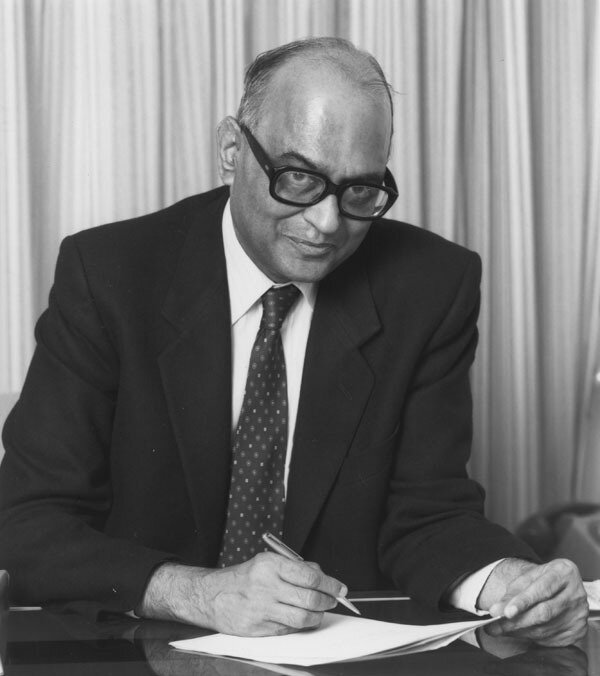
I.G. Patel (1924 – 2005) was part of a stellar cast of Indian economists that chose to serve in government, rather than remain in academia, in the initial decades after Indian independence. His varied career included stints as an economic advisor in the finance ministry (1954 – 67), secretary in charge of economic affairs (1967 – 1972), deputy administrator of the United Nations Development Programme (1972 – 1977), governor of the Reserve Bank of India (1977 – 82), director of the Indian Institute of Management, Ahmedabad (1982 – 1984) and director of the London School of Economics (1984 – 1990).
After a preliminary education in economics at Vadodara and Mumbai, Patel went to the University of Cambridge during World War II, where he won the prestigious Adam Smith Prize for standing first in the Economics Tripos, following in the footsteps of others such as V.K.R.V. Rao and B.P. Adarkar. Among the major influences on him at Cambridge were A.C. Pigou, Gerald Shove, Austin Robinson, and Nicholas Kaldor. The main focus of his education at Cambridge was macroeconomics, partly because of the very presence of John Maynard Keynes but also because the microeconomic problem of resource allocation was being dealt with through government fiat during the years of wartime rationing.
Patel chose to write his PhD dissertation on “Foreign Trade and Economic Development” — a break from the dominant Cambridge tradition in those years of working within the confines of the Marshallian short period in the context of a closed economy. This project took him to Harvard University for a year, where open economy macroeconomics had already struck roots.
His unpublished thesis was not restricted to the obvious issue of whether trade could be an engine of growth. He asked the more unusual question about what economic development would mean for international trade. The widening arc of industrial growth meant that more countries in the future would have economic structures that were similar to those found in the handful of developed countries of the day. Patel asked whether international trade would thrive even as countries began to resemble each other in terms of their economic structure. He used the examples of Japan, Australia and Argentina to show that trade based on comparative advantage would exist even in such a situation.
Patel agreed with his peers that the main purpose of early Indian development planning should be to build a diversified industrial base rather than focus on a few exporting sectors. The growth strategy had to be more extensive. However, Patel also saw that exports were important to earn foreign exchange, and hence reduce dependence on external capital. He also wrote that scarce resources should not be directed only into favoured sectors that replace imports, at a time when import substitution was all the rage.
Patel was neither an ideological free trader nor an ardent protectionist. He believed that protection helped build domestic capacity through a process of learning by doing, but also made a distinction between targeted protection or support for a few industries rather than for the entire economy. He wrote about the risk of the infant industry argument being confused with the infant country argument.
Patel threw the spotlight on the importance of exports in two papers, written in 1964 and 1972. The former paper, where he made a good case for thinking about export promotion as an explicit policy goal rather than a small subset of a broader policy to promote economic growth, was written at around the same time that Manmohan Singh argued, in his 1962 PhD thesis at Oxford, for a greater role for exports in Indian development plans, which had predominantly assumed a closed economy, with an external sector added almost as an afterthought.
Patel cut his teeth as a policy economist at the International Monetary Fund (IMF), where he was mentored by E.M. Bernstein, its research director. Though Patel generally depended more on economic reasoning rather than on mathematical modelling to make his point, one of his earliest papers at the IMF was a statistical examination of the elasticity of the demand for gold in India, specifically the importance of the price effect versus the income effect. Patel showed that the demand for gold is more sensitive to changes in the relative price of the yellow metal rather than changes in the level of income.
His most significant work at the IMF was as one of the authors of a report on the Indian economy that was written after the visit to the country by an IMF team headed by Bernstein in 1953. The main theme of the report was on how to achieve economic development with stability, at a time when the risks from inflation as well as balance of payments pressures were underplayed in the development discourse.
One of the most significant parts of the report was the idea of a safe level of deficit financing, a practical approach that avoided both extremes of financing plans with unlimited monetary expansion or the unreasonable view that even developing countries with inadequate domestic savings need to be reined in with balanced budgets. His eclecticism as an economist preceded his entry into the world of policy making, and Patel generally avoided embracing corner solutions. As early as 1950, Patel wrote about the specific circumstances under which an expansionary monetary policy could help stabilise prices in an economy prone to high inflation, especially when citizens prefer to hold more money in their portfolios when that economy is being stabilised.
Monetary analysis was an important part of the Bernstein report, a counterpoint to the view that whatever is physically feasible is also financially possible. It also made an early call for money supply targeting. However, Patel echoed Bernstein even in his later work by arguing that inflation is eventually the result of a struggle between competing groups for a greater share of the national income. “To talk of inflation without focussing on the distribution of income is to speak of Hamlet without the Prince of Denmark,” he said in his Kale Memorial Lecture in 1983 delivered at the Gokhale Institute of Politics and Economics. That also meant that both the cause as well as the solution to inflation is necessarily a combination of economics and politics.
In his presidential speech to the Indian Economic Conference in 1966, Patel said that economic policy is pursued through three instruments – fiscal and monetary policies that change relative prices and disposable incomes, more direct interventions such as public investment, price controls, and physical allocation when traditional macro policies do not work adequately well, and the establishment of institutions for the better functioning of the market system. He also added that policy economists depend more on simple analytical concepts rather than on sophisticated models that “integrate utilities from here to eternity”. However, the application of such simple analytical tools becomes an art of considerable complexity in a world where economic life unfolds over time in “an infinite variety of contexts”.
The contexts he alluded to here were a smorgasbord of political economy, institutions, and culture. His study of the Japanese development experience as a PhD student left an imprint on his thinking about how unseen structural or cultural factors often lie under the thin layer of economic variables we see on the surface. This backdrop was one reason why Patel was sceptical of simple growth models that drew a straight line from savings to investment to output. Increasing savings, investments and productivity are dependent on a host of factors such as motivation, incentives, institutional arrangements, property rights, and education levels. He also alluded to the fact that the causality from savings to growth could be bidirectional. People are slow to change their consumption patterns when incomes grow rapidly, so savings may increase as a result of more rapid economic growth.
Patel was an influential presence during many key episodes in the early Indian development trajectory. He also wrote and spoke on broader issues to keep in touch with emerging economic ideas outside the government. Patel was the quintessential policy economist, who used his training in technical economics to understand the challenges of a developing economy, and help shape the government response to them. The result was a body of work that was nuanced, calibrated to the changing circumstances, and always rooted in the realities of India.
Patel, I.G. (2012a). Demand for Money During Periods of Inflation and Stabilisation. In D. Khatkhate and Y.V. Reddy (Eds.), Of Economics, Policy and Development: An Intellectual Journey by I.G. Patel. Oxford University Press. (Original unpublished paper for the International Monetary Fund in 1950).
Patel, I.G. (2012b). India’s Elasticity of Demand for Gold. In D. Khatkhate and Y.V. Reddy (Eds.), Of Economics, Policy and Development: An Intellectual Journey by I.G. Patel. Oxford University Press. (Unpublished paper for the International Monetary Fund in 1950).
Patel, I.G. (2002). Glimpses of Indian Economic Policy: An Insider’s View. Oxford University Press.
Patel, I.G. (1986). Inflation — Should it be Cured or Endured?. In Essays in Economic Policy and Economic Growth. MacMillan. (Kale Memorial Lecture at Gokhale Institute of Politics and Economics in 1983).
Patel, I.G. (1986a). Some Reflections on Trade and Development. In Essays in Economic Policy and Economic Growth. MacMillan. (Opening Address at the Ninth Cambridge Conference On Development Problems).
Patel, I.G. (1986b). The Limits of Economic Policy. In Economic Policy and Economic Growth. MacMillan. (Presidential Address to the Indian Economic Society in 1966).
Patel, I.G. (1986c). The Strategy of Indian Planning. In Essays in Economic Policy and Economic Growth. MacMillan. (Original work published in a volume in honour of P.C. Mahalanobis in 1963).
Patel, I.G. (1964). Exports by Countries in the Process of Industrialisation. In New Directions of World Trade: A Chatham House Report. Oxford University Press.
Balasubramaniam, V.N. (2001). Conversations With Indian Economists. MacMillan India.
Chandavarkar, A. (2005). Remembering Inderbhai. Economic and Political Weekly, 40(32), 3572 – 3573.
Khatkhate, D. (2008). Ruminations of a Gadfly: Persons, Places, Perceptions. Academic Foundation.
About the author
Niranjan Rajadhyaksha is executive director of Artha Global, and writes the Cafe Economics column in Mint. He has a PhD in economics from the Mumbai School of Economics and Public Policy. [Full profile]