India’s insects: Disappearing in plain sight?
Haunted by the possibility of an insect decline, ecologists of Azim Premji University are doing their best to overturn India’s severe data deficiency problem.
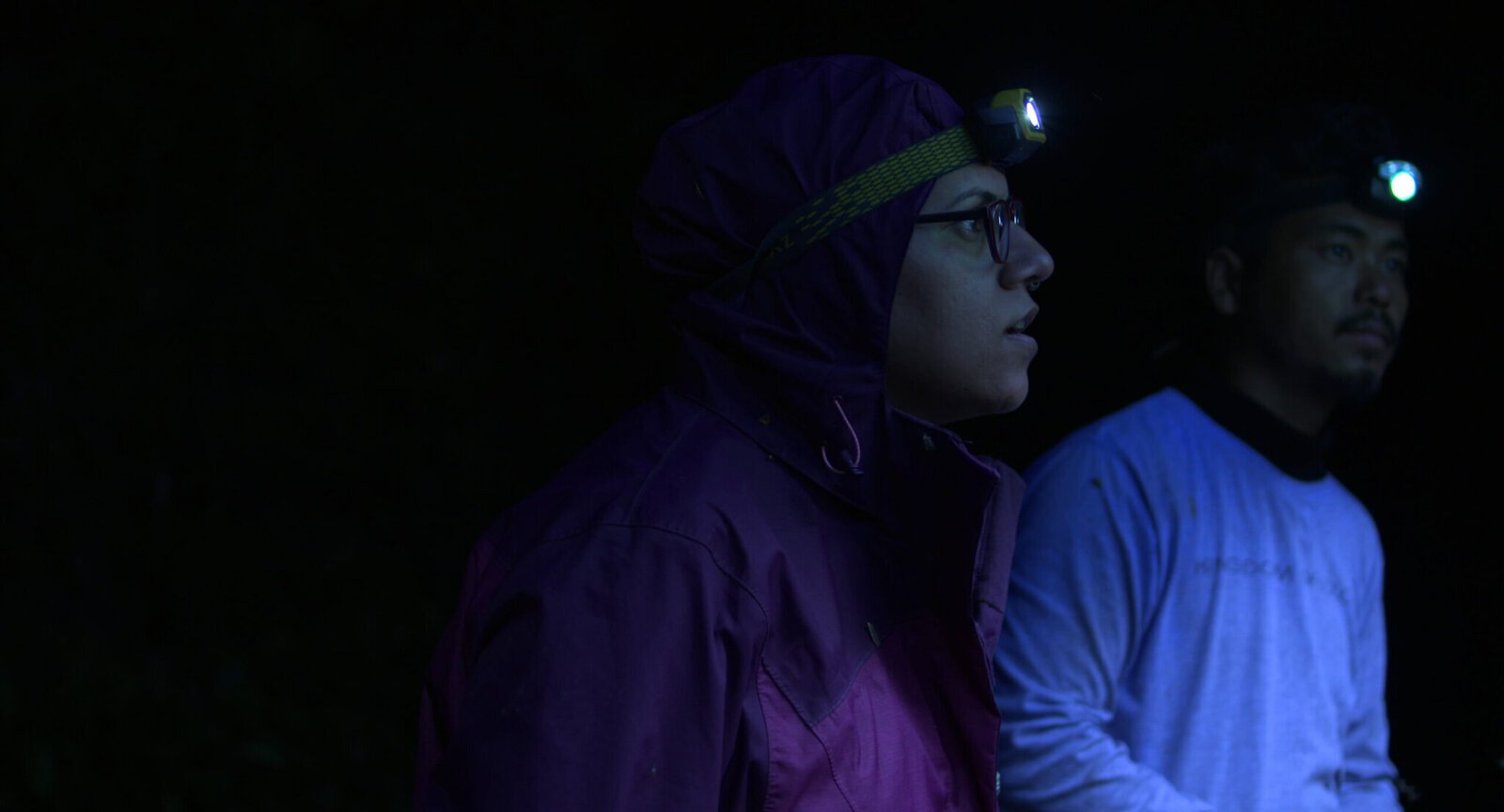
Mansi and her assistant Bicki examine moths in the film Nocturnes. Image Credit: Sandbox Films
Details
In 2017, a research article published in the journal PLOS One revealed that Germany had lost over 75% of its flying insects in 27 years. In the following weeks, insects made it to headlines and cover stories of international media. Scientists vociferously emphasised to the public that the downfall of insects is bad news for humans — for example, our plants wouldn’t get pollinated and our food webs would be devastated. “If we lose the insects then everything is going to collapse,” warned one of the study’s authors in a The Guardian report.
“That was when terms such as ‘insect Armageddon’ and ‘insect apocalypse’ started trending,” noted Mansi Mungee, a quantitative ecologist who teaches biology at Azim Premji University’s Bhopal campus. The next couple of years saw governments across Europe and the US began funding more research into insect declines. One of the universities which proposed projects targeted towards this was the University of Leeds, where Mansi was a postdoctoral scholar.
“It’s well known that the UK is one of the best — if not the best — at record keeping, especially with respect to natural history collections,” she pointed out. At Leeds, Mansi’s job was to gather this data and assess what it said about insect decline in the region. “There were so many datasets,” she recollected, “starting from 50 years of meticulous butterfly counting data from individual backyards to systematic, standardised, government-funded monitoring of aquatic insects.” After pursuing this for nearly three years, her key takeaway was that while there is still a dearth of good quality data, there’s enough to indicate that the time to act is now.
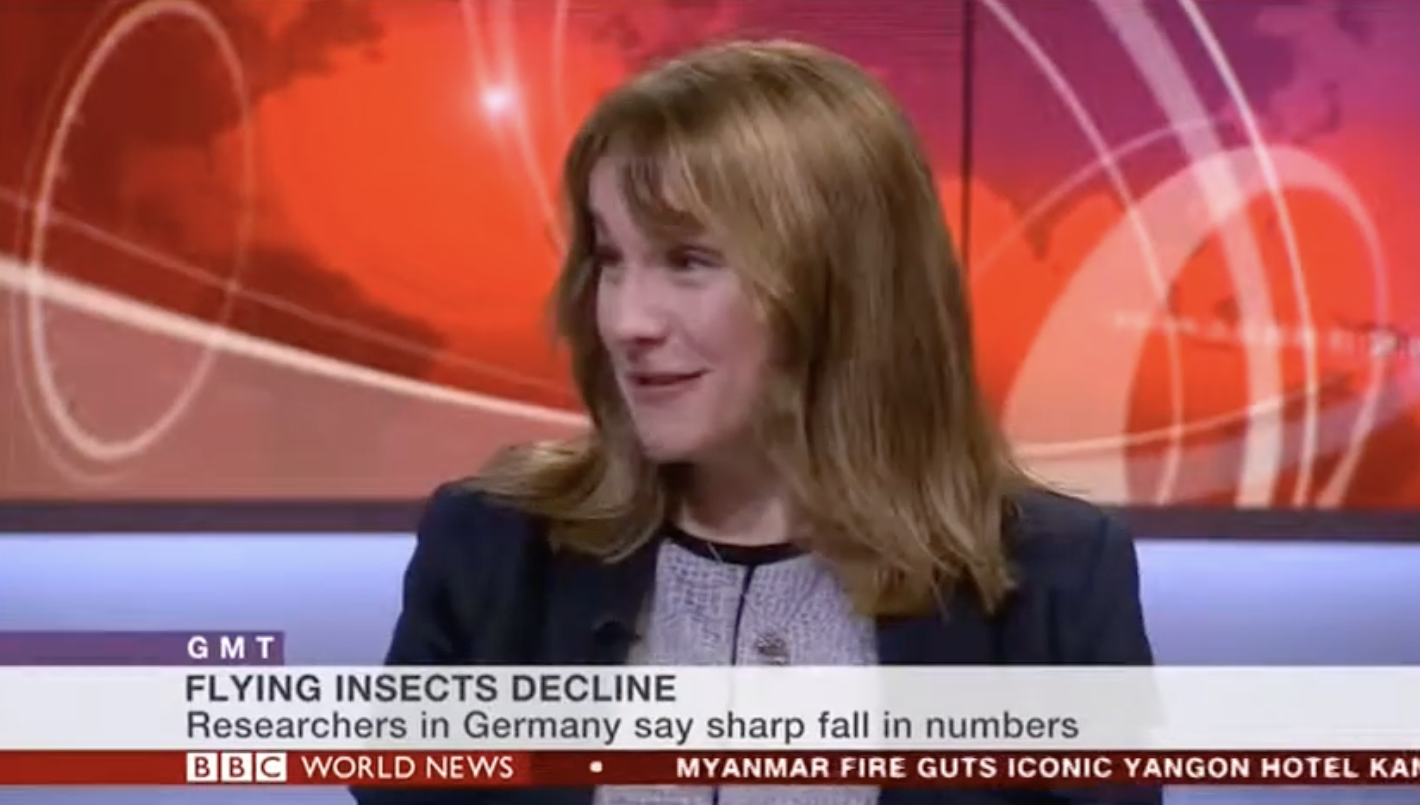
A screengrab of news coverage of the 2017 German study on insect population decline
Bang for the bug
While she was working in Uttarakhand, Mansi saw the signs firsthand. “There were no more bees anywhere. Farmers were using artificial chemical pheromones in their apple orchards, desperately hoping to attract bees which the plants depend on for pollination.”
Now, every time she sees a study reporting a drop in agricultural yield, Mansi can’t help but wonder: “Is it because of the erratic climate, or is it because of insect decline? We don’t know.” As awareness, research and advocacy on climate change increases in India, she believes that we must also keep an eye out on insect populations. “While we are quantifying temperature and precipitation, very few people are quantifying insect populations. But climate change and insect declines are not mutually exclusive,” she insisted
Besides pollination, insects provide a host of other ecosystem services. Divya Uma, a behavioural ecologist at the university’s Bangalore campus pointed out another one: decomposition. Take dung beetles, for example. There are at least 3,000 species of these beetles found in India “Dung beetles process all the poop in the world, literally. If not for them, we would be surrounded by piles of dung everywhere,” said Divya. Insects are also integral to our food webs, acting as natural pest control by consuming other insects. Additionally, they serve as food for innumerable other species. Dung beetles, for instance, are a favourite snack for the endangered great Indian bustard.
“We used to see lots of longhorn beetles. They emerged after rains in large numbers, and we would spot them on our corridors, clumsily walking, often toppling over. Now we hardly see them.”
A very big red flag
To illustrate to her students why we must not delay in addressing the insect decline, Mansi likes to bring up an analogy from the realm of aerospace: “If you happen to look at the wing of an airplane, you will see these flaps that go up and down while taking off and landing. These flaps are connected to the wing by hundreds of small rivets. Engineers design wings with an abundance of rivets to ensure safety and functionality. Even if a few rivets are lost or damaged, the flap will still work because the remaining rivets can handle the load. However, there’s a limit to this resilience. At some point, if too many rivets are lost — or if a single, critical rivet fails — the flap could collapse. This would potentially lead to catastrophic consequences. That’s why, in aviation, every lost or damaged rivet is replaced immediately — because they know the stakes are too high to take chances.”
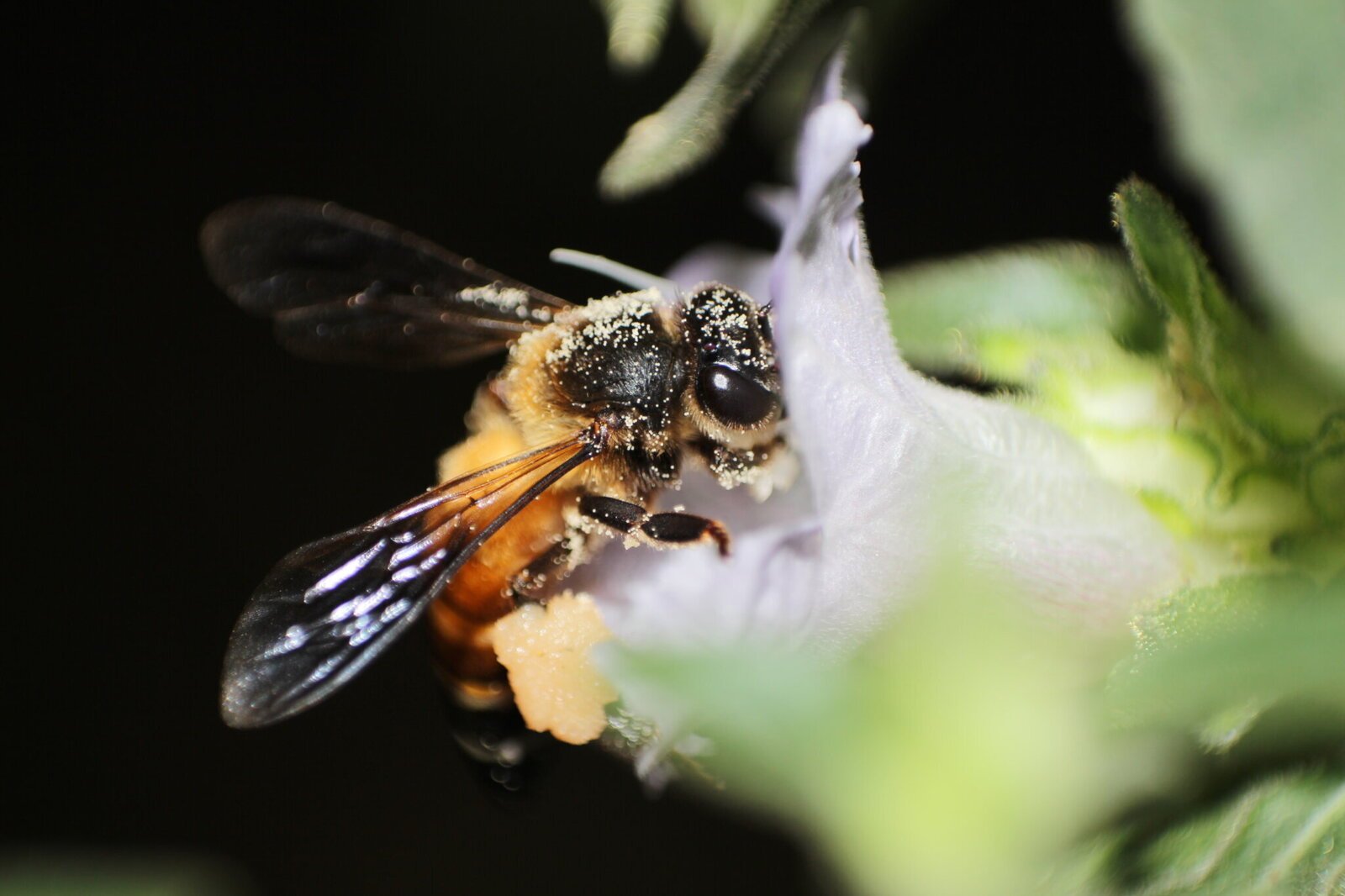

Insects provide a host of ecosystem services such as pollination (honey bees) and waste processing (dung beetles). Image Credit: Wikimedia Commons
“That’s where we are with insects,” Mansi rounded up. “We know we are losing them, but we don’t know how many species we can lose before we reach the tipping point. Or which species may turn out to be that “critical rivet” holding everything together. what the tipping point will be. This is why it’s so urgent to monitor and conserve insect populations right now.”
Insects have been around for 480 million years, and are one of the most hyper diverse and hyper abundant groups in nature. According to scientist Phillip Barden, “If you go to a rainforest, the biomass of ants and termites today is greater than not only all insects, but all insects plus all vertebrates combined.” This is not the first time in Earth’s history that insects are facing danger. Much before humans came to dominate, they survived multiple extinction events.
More recently, Mansi began mining for India-specific data. Tropical regions like ours are where most of the biodiversity in the world is concentrated, so data from here is crucial in order to have a complete picture of the status of Earth’s insects. Unfortunately, Mansi quickly confirmed that there is indeed a severe geographical bias in insect datasets.
Keeping count
What does exist, is anecdotal evidence, like the case of the missing bees in the apple orchards of Uttarakhand. Right in the less than a decade-old Bangalore campus of Azim Premji University itself, Divya has observed disturbing changes. “We used to see lots of longhorn beetles. They emerged after rains in large numbers, and we would spot them on our corridors, clumsily walking, often toppling over. But just in a matter of two or three years, things changed. Now we hardly see them.”
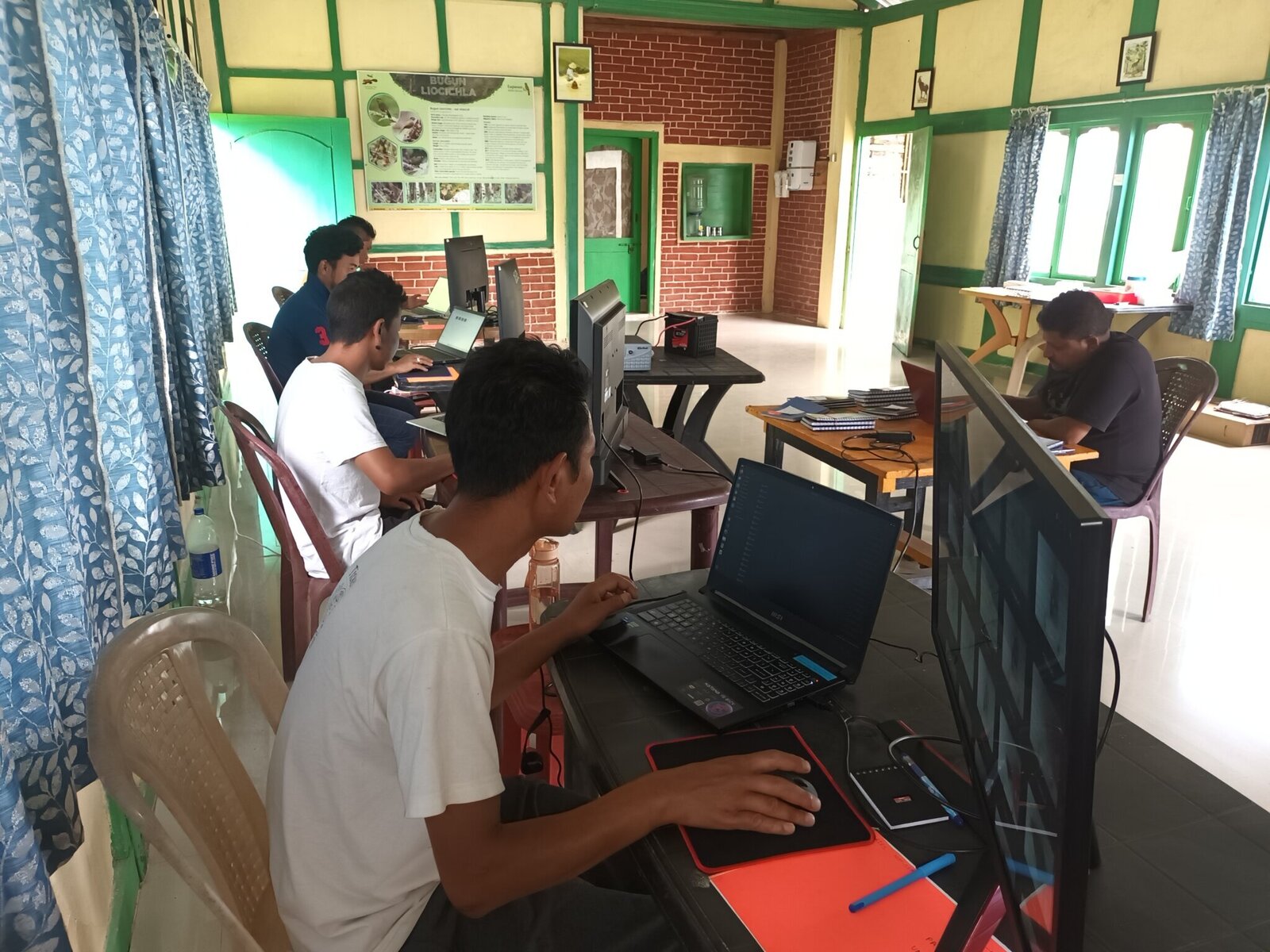
Mansi’s field assistants, all members of the Bugun tribe in Arunachal Pradesh, assist her research by processing images, identifying moths and organising the data. Image Credit: Mansi Mungee
Tracking insect abundance is possible, but extremely challenging. For smaller studies like within the university campus, it is possible to set up traps, design a methodology, and repeat it year after year until patterns begin to emerge. However researchers have to keep in mind breeding cycles, changing habitats, climate and various other factors. For broader areas of study, the number of factors get compounded.
For tracking insects like moths, there is the trusted moth screen. This is nothing but a white sheet that is erected like a wall and illuminated with a light source at night. In just a matter of hours, a variety of moths and other insects would get attracted to this surface, and the white background makes them convenient for the observer to identify and quantify.
Mansi’s first encounter with a moth screen was at the very start of her research career. She had just been offered a PhD position by renowned ecologist Ramana Athreya at IISER Pune, who entrusted her with the responsibility of studying how the diversity of moths changes with elevation. Her field of study was Eaglenest Wildlife Sanctuary in Arunachal Pradesh. She had no trouble getting her screen to attract moths; in fact, her problem was quite the opposite. “The first time I looked at the screen I cried. There were over 5,000 individuals in front of me! And I had no idea how to identify even one of them. I cried because I thought I wouldn’t be able to handle this,” she reminisced.

One of the moth screens Mansi set up at Ramaling, Arunachal Pradesh. Image Credit: Mansi Mungee
Years later, Mansi got the opportunity to set up a screen for a crew of filmmakers who were shooting a documentary about moths. Like her, they too stood in awe and wonder, staring at the screen for several hours. “These were people from Mumbai, who’ve mostly worked in semi-commercial documentaries or Bollywood movies. Witnessing the effect of the jungle and of that sight on them was fascinating for me.”
Storytelling and silver linings
Nocturnes, as the documentary is titled, received rave reviews and was screened in various film festivals. Mansi was one of the two protagonists of the film and also the narrator. This experience impressed upon her the power of storytelling in the mission to protect insects. “Rigorous datasets and statistical analyses are important but so is communicating these findings in a clear and accessible manner to all stakeholders,” she said.
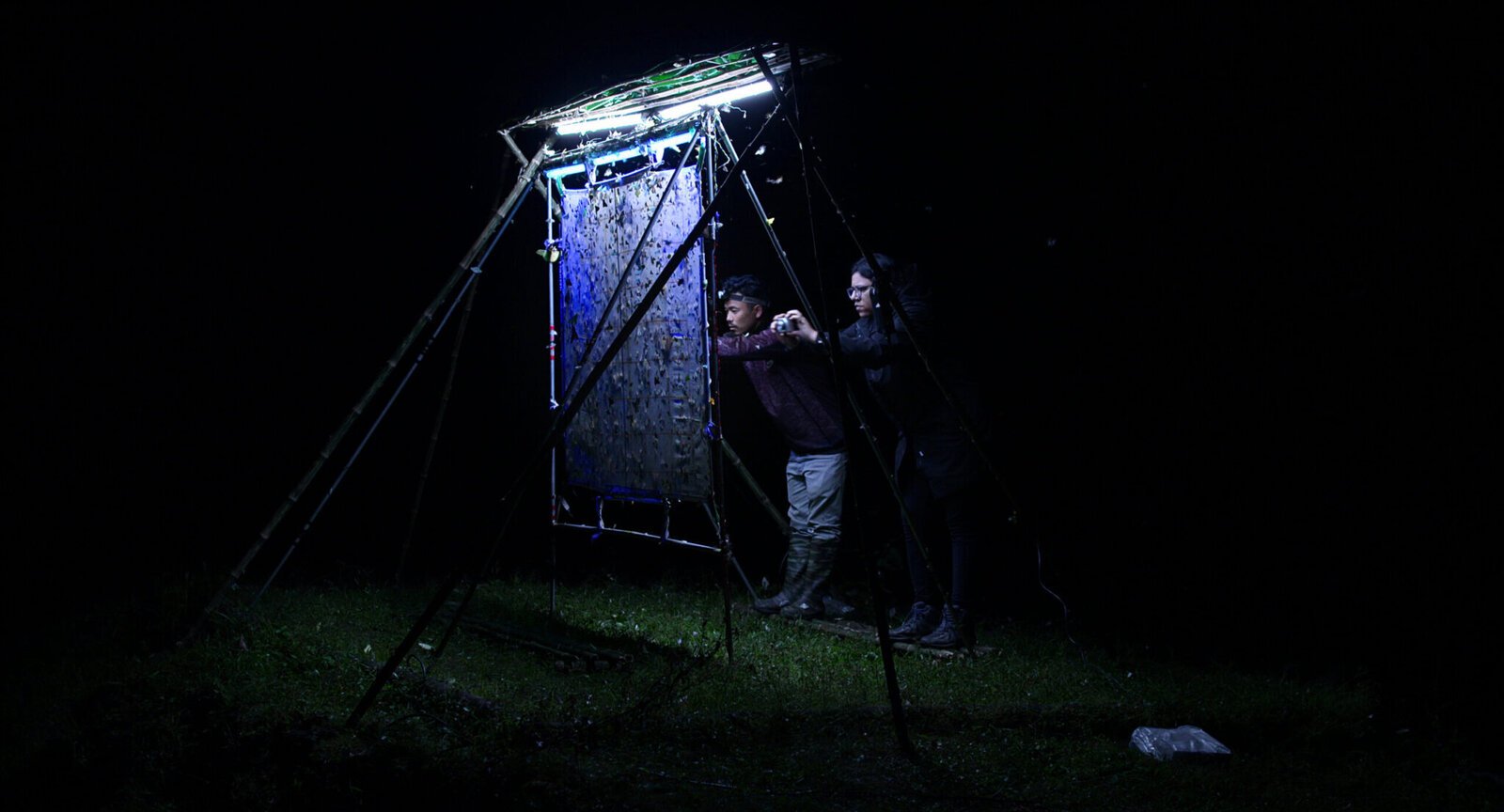
Mansi examines a moth screen during the shooting of Nocturnes. Image Credit: Sandbox Films
Things may look grim, but Mansi is buoyed by one silver lining. Unlike the case of elephants and tigers, there is actually quite a bit we can do on an individual level to save our insects. For example, it’s widely accepted that light pollution messes up insects’ circadian rhythm and is one of the major sources of population declines. So interventions can look as simple as avoiding blue lights on porches and balconies and switching to lighting of warmer wavelengths such as yellows. For those who are willing to go a step further, Mansi suggests getting involved with the municipality and urging them to install street lights that are covered on the top. “These tend to distract the nocturnal migrating populations of insects.”
“While we are quantifying temperature and precipitation, very few people are quantifying insect populations. But climate change and insect declines are not mutually exclusive.”
Even at the university level, the campus ecologists have their own insect monitoring plans. Such projects could not only generate important data about local trends, but also serve as powerful educational tools for the undergraduate science students. Students in the Bangalore campus of the university have been working with insects for close to a decade, and the newer Bhopal campus is following suit. Mansi and her colleagues are already working with students to document the different insects on campus. “There is a group working on ants, a group working on damselflies and dragonflies, and we’ll soon start a moth monitoring project on the campus, hopefully across Bangalore and Bhopal,” she said.
Though she is relatively new at the university, Mansi has made a mark on her students. “Insects just come very organically to me, so it just so happens that whatever concept that I introduce to them, my examples come from the insect world. So yeah, I won’t be surprised if my class is a lot more insect aware than most other classes in India!”
For further reading
- The paper from Germany in 2017 that sparked conversations about an insect apocalypse
- Some data about our pollinator dependence
- On the abundance of insects
- How did insects fare during Earth’s great extinction events?
- On the ecological importance of the dung beetle
- Nocturnes: Trailer
Featured Image: Mansi and her assistant Bicki examine moths in the film Nocturnes; Credit: Sandbox Films
About the author
Nandita Jayaraj is a Science writer and Communications Consultant at Azim Premji University. She may be contacted at nandita.jayaraj@apu.edu.in