Beyond Planting Trees: The Right Way to Restore
More and more young people are getting interested in restoration projects, but not all of them understand how ecosystems work. A recent workshop organised by the university addressed this gap.

Image Credit: Vijay Dhasmana
Details
Image Credit: Vijay Dhasmana
Ever since humans came to dominate the planet, we have been drastically changing how landscapes are used. According to one study, “about three-quarters of the Earth’s land surface has been altered by humans within the last millennium”. This has resulted in the loss of carbon sinks, habitats, and affected food production. Scientists, environmentalists and policymakers have come to realise that unless we work on restoring ecosystems, it will be virtually impossible to tackle global challenges such as climate change, biodiversity loss and food security.
In recognition of this reality, the United Nations kicked off the Decade on Ecosystem Restoration on 5 June 2021. This decade, which runs up to 2030, is an attempt by the international body to encourage governments, organisations and individuals around the world to halt the degradation of ecosystems and ramp up efforts to restore those that have already been destroyed.
Ecologist Vallari Sheel was unaware of this denomination by the UN until she participated in a workshop titled ‘Foundations of Land Ecosystem Restoration’, organised by Azim Premji University in June 2024. Though she was already an experienced ecologist with a growing interest in restoration, the workshop was when it all came together for her. “Restoration connects everything,” Vallari says. “Most larger issues in ecology – whether it’s the loss of tiger and elephant habitats or the spread of invasive species – comes down to degraded habitats. There is a lot of potential in ecosystem restoration.”
Crossing the boundary
The most frequently thought-about land use change is, understandably, deforestation. India suffered the second-highest loss of forests (after Brazil) in the five years between 2015 to 2020, according to a report from the UK. This is the price the country has paid for expanding our transportation lines, infrastructure, mining, irrigation facilities and so on.
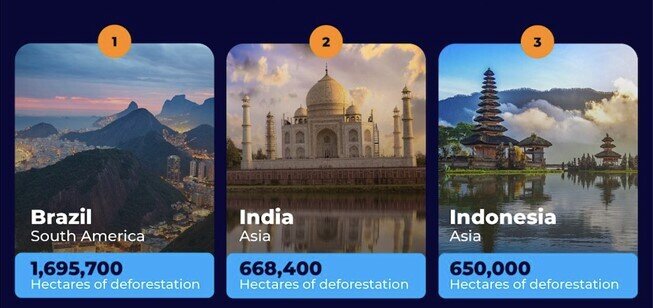
A graphic depicting the three countries with the highest average deforestation between 2015 – 2020. Source: Utility Bidder.
“The planet is facing a disaster of land use change and land transformation, and this is actually affecting biodiversity and the resilience potential of the ecosystems and the planet,” says Jayanti Ray Mukherjee, a biologist at the university, who has been studying this topic for many years. There is growing evidence that our planet has crossed the threshold with respect to land use change and is reaching a tipping point – “beyond this, no returning to the original state”.
In this scenario, it is critical for researchers like Jayanti to study the dynamics of various ecosystems, and work with practitioners to develop sensible and scientific ways to restore lands to a semblance of how they used to be. “We may never be able to restore it to its previous state,” she concedes, “but we can at least try to restore some of the functionality of the ecosystem”.
Restoration vs reforestation
The idea of ‘functionality’ is what sets apart restoration from reforestation. Jayanti explains this with the example of a tree: “Every tree has a function, right?” For example, it captures carbon, thereby regulating the amount of carbon dioxide in our atmosphere. It transports huge amounts of water, impacting the water cycle of the ecosystem. Then there is also the matter of the hundreds of birds, insects and other animals that probably depend on it for shelter and nutrition.
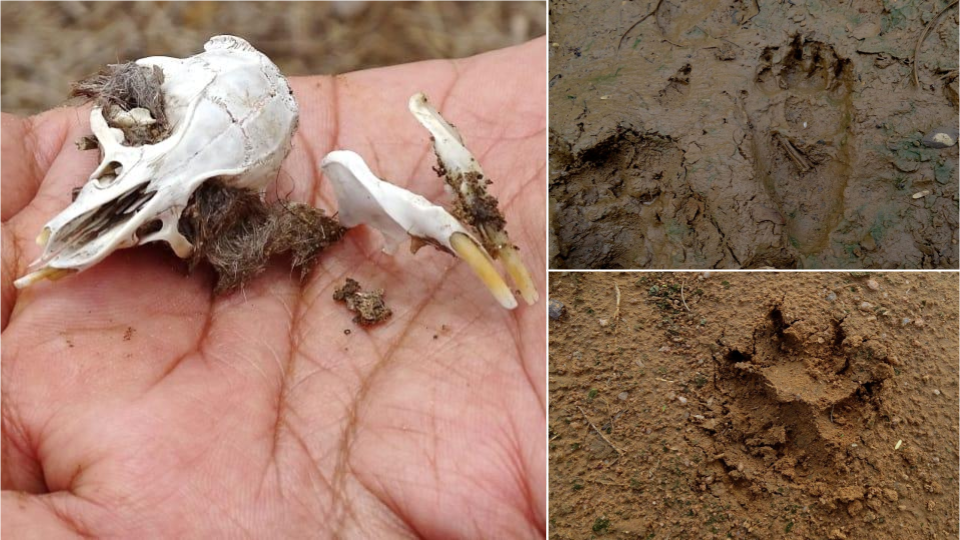
Evidence of wildlife in restoration sites in and around the NCR region. (clockwise from left) Remains of a mouse regurgitated by an eagle owl at Aravali Biodiversity Park; Porcupine pugmark at Aravali Nagar Van; Hyena pugmark at Aravali Nagar Van. Credit: Ishtiyak Ahmed, Karnika Palwa.
At every step of the way, restorers need to have functionality at the top of their minds. “This means you have to understand what that land originally was– a forest system, a grassland or a wetland? That is the form we have to restore it back to. That changes everything. Converting a land that was originally a grassland or a desert into a forest is not sustainable,” clarifies Jayanti.
With growing awareness about land use change and its devastating impacts, governments and corporations are investing more money into restoration projects. This added incentive has enabled the entry of a new generation of people who want to contribute. “So now we have these newcomers, many of them fresh graduates, who are interested in restoration, but lack the understanding of how ecosystems work,” Jayanti says, summarising the rationale behind the ‘Foundations of Land Ecosystem Restoration’ workshop that she organised, with funding support from the University. “We wanted to give participants a holistic understanding of why restoration is important and what should motivate them to take this up as a profession.”
Designing the workshop
Coordinated by Jayanti and her colleague Sunayana Ganguly (with whom she had earlier co-founded Climate Educators Network), and in collaboration with Ecological Restoration Alliance, India (ERA), the workshop got together an experienced crew of resource people including renowned author and environmentalist Pradip Krishen who spearheaded the rewilding project at Rao Jodha Desert Rock Park in Rajasthan, as well as conservationist Manisha Kairaly, who grew up in and with the Timbaktu Collective which has worked on restoration for over 30 years, much before it was a buzzword.
Jayanti was heartened to receive interest from a diverse set of participants. “They ranged from ages 20 to above 50. Some people have been practising for a long time, but they still wanted to come and interact, form a network, as well as know a little bit more about the ecosystem,” she says. One of the participants was Jayanti’s own research associate (RA), Vallari Sheel.
The topics covered over the seven-day long workshop ranged from the fundamentals of restoration and stakeholder engagement to specific challenges such as tackling invasive species and restoring rocky landscapes. Participants were educated on global standards, historical contexts, carbon markets, propagation techniques, and several case studies were examined.
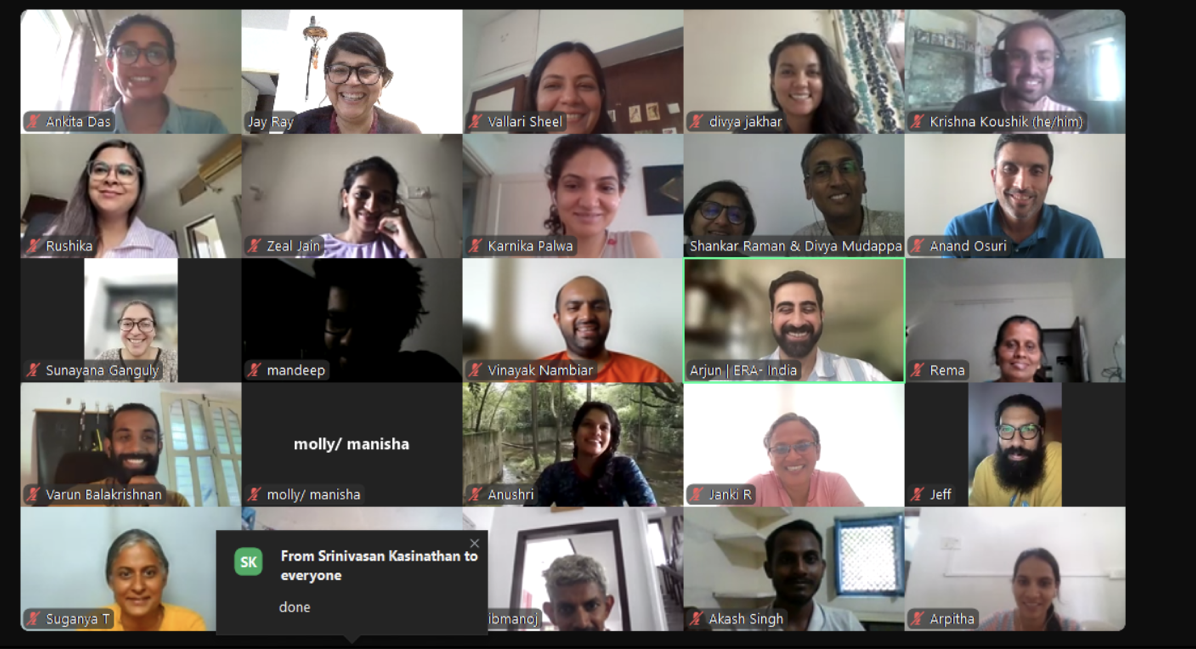
A screenshot during one of the virtual sessions of the workshop. Credit: Jayanti Ray Mukherjee
The workshop was designed to be hybrid, with both online and on-site components. Jayanti reasons that this would be the ideal format for such a workshop since it may not be practical for most resource persons to leave their homes and work sites to come to Bengaluru for a whole week. It also enabled the inclusion of international experts like Bethanie Walder from the Society for Ecological Restoration.
The field component
On the fifth and sixth days of the workshop, participants headed to their designated field sites where they got to experience and learn from ongoing restoration efforts. The field sites were situated in Karnataka, Tamil Nadu, Rajasthan, Haryana and West Bengal. Vallari, being based in Delhi, was assigned to visit a set of restoration sites situated in the Northern Aravallis of Gurgaon, Haryana.
An avid naturalist, Vallari has already been involved in various activities in and around Delhi for over a decade. She is deeply interested in the ecology of the city of Delhi, specifically in understanding which tree species are important food resources for urban vertebrates like birds, squirrels and monkeys. In her role as RA with Jayanti, she has also been conducting a study comparing the ecologies of Delhi and Bengaluru, two cities with very different histories of development.
Though her research and environmental work didn’t centre on restoration, it wasn’t removed from it either. Over the past five years, Vallari had been hearing more and more about various restoration efforts, particularly by her idol Pradip Krishen. Her interest was reinforced during the workshop in June. The group from Delhi had to brave torrential rains to reach their first destination, Aravalli Biodiversity Park (ABP), followed by three other restoration sites. Vallari was already familiar with ABP, but she hadn’t yet visited the others. Thanks to the workshop, she got the opportunity to be led by self-taught ecologist Vijay Dhasmana, under whose leadership a 380-acre abandoned mining site was transformed into a ‘city forest’.
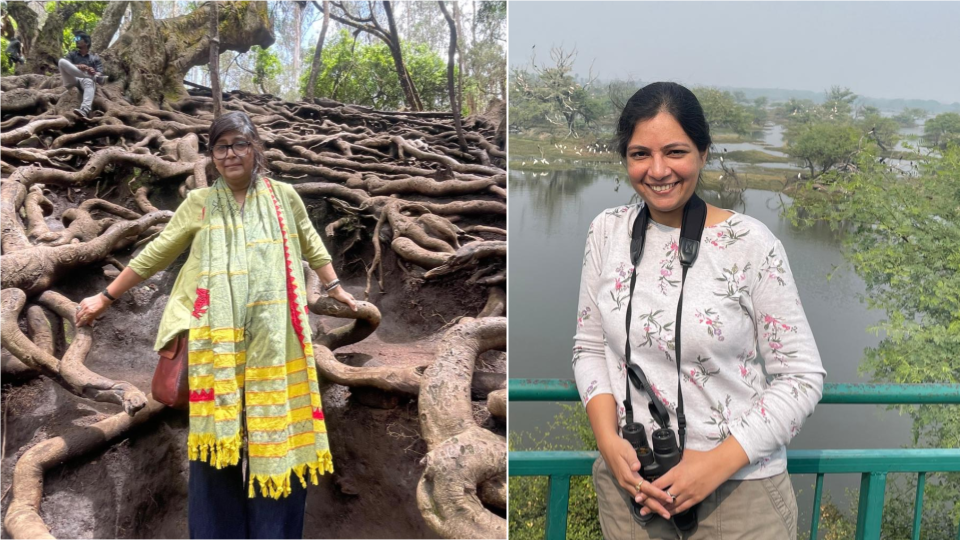
Jayanti Ray Mukherjee and Vallari Sheel
Despite her strong rationale for keeping the workshop hybrid, Jayanti was nervous about how well the virtual sessions would go. “Often with online events, we see hardly any people actually interacting, so I expected that to happen,” she admits. However, she was pleasantly surprised to see an exceptional level of engagement. “Even if participants had their cameras off, they were continuously listening and engaging and asking questions. It was fantastic to see!”
Takeaways for the real world
As far as Vallari was concerned, the virtual sessions were eye-opening, and complemented the field visits really well. She took the example of Pradip Krishen’s session, where he spoke about the phenomenon of ‘biocrusts’. Sometimes referred to as “living skin”, biocrusts or biological soil crusts are communities of living organisms that colonise the soil surface and sometimes coat rocks. They are especially important aspects of biodiversity in arid and semi-arid ecosystems.
Intrigued by Pradip’s descriptions, Vallari was elated to actually come across biocrusts during her field visits. “The sessions didn’t just stay theoretical,” she said. “Seeing what we read and heard about, and being able to translate it in the real world, was special.”
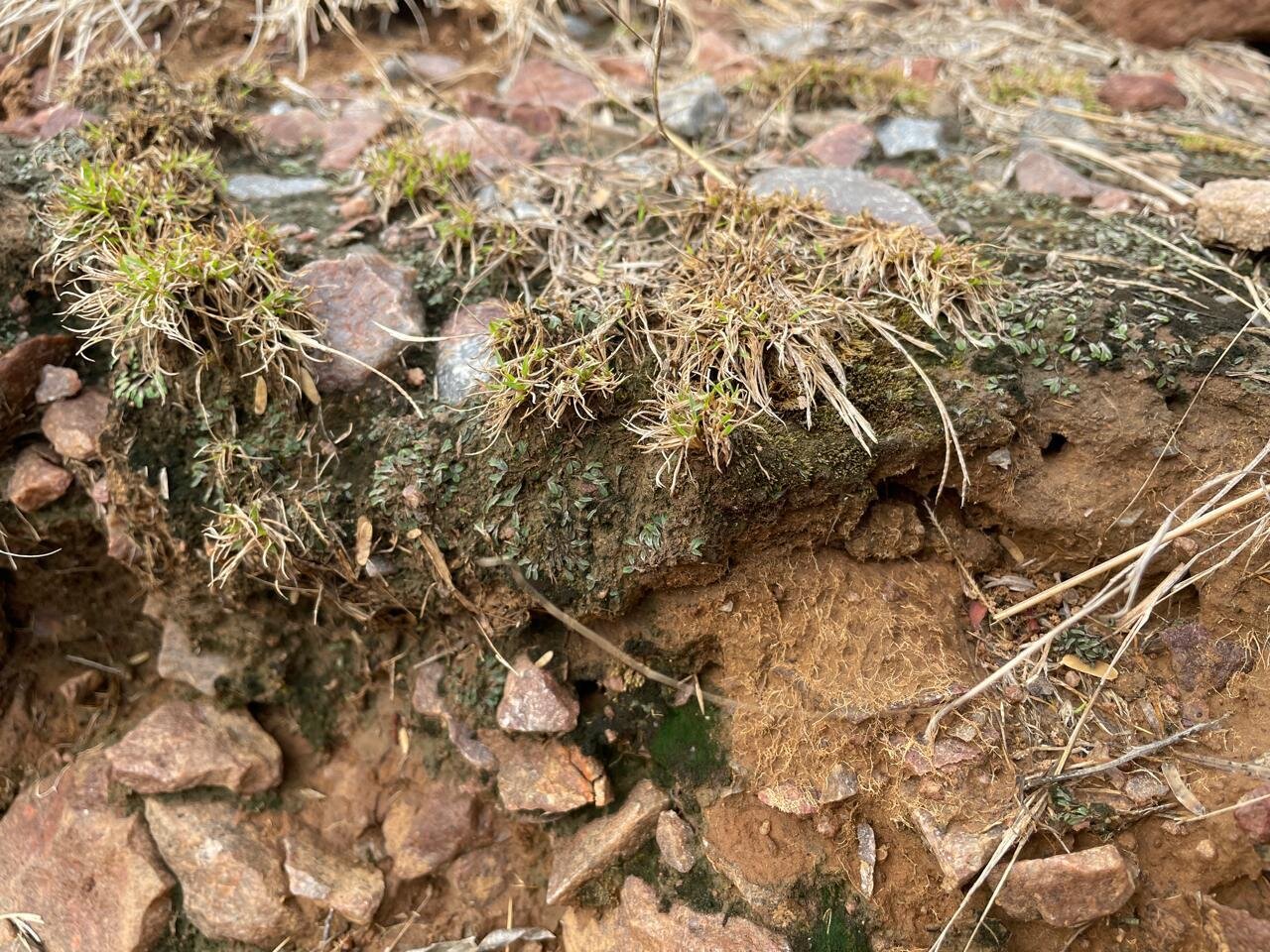
A cross section of biocrust observed by Vallari during the field visit. Credit: Vallari Sheel
Restoration is not something to take lightly. “We have to keep a lot of variables in mind, like soil and water management. It’s not just about planting 10,000 trees, but what we plant and how we plant,” she states. Participants were reminded about the importance of challenging the idea that it’s only trees that we need. “When people plant trees, they are not necessarily thinking about ecological functionality,” Vallari points out. “We need to also plant shrubs, herbs, creepers and other ground cover. We need to think about what will bring back the fauna here, that is the insects, birds, arthropods that also engage with the ecosystem.”
About Jayanti
Jayanti Ray Mukherjee and Sunayana Ganguly are faculty members at Azim Premji University.
About the Author
Nandita Jayaraj is a science writer and communications consultant at Azim Premji University. She may be contacted at nandita.jayaraj@apu.edu.in