
Recasting Power: A Rural Feminist Movement Transforms Gujarat’s Local Democracy
By Sonal Sethia | Dec 2025
Inside the Devgadh Mahila Sangathan’s quiet revolution reshaping local governance and accountability from the village upward.
Details
For decades, the vibrant heart of India’s rural democracy, particularly in the Adivasi and socio-economically marginalised belts, struggled under the weight of patriarchy and systemic exclusion. The landmark 73rd Constitutional Amendment (1992) promised to strengthen grassroots democracy by mandating reservations for women, Scheduled Castes (SCs), and Scheduled Tribes (STs) in Panchayati Raj Institutions (PRIs). Yet, entrenched cultural norms, bureaucratic dominance, and deep-seated social barriers continued to exclude rural women, Dalits, and Adivasis from claiming their guaranteed democratic rights.
Women, especially those from socio-economically disempowered communities, were expected to remain unseen and unheard, constrained by both tradition and systemic discrimination. For years, Leelaben, a 55-year-old Adivasi illiterate woman from eastern Gujarat, lacked the confidence to even step out of her village alone. Her village, Kuva in Devgadh Baria block, was ruled by a wealthy Sarpanch (elected head of the village council) who bought votes and unfairly allocated every precious resource to his own affluent hamlet. The marginalised communities watched as their basic needs — from roads to water — were ignored. But in the 2017 Gram Panchayat elections, everything changed. Realising the apathy of the village Sarpanch and ward members towards the marginalised hamlets, Leelaben decided to step up and contest the election. Leelaben’s courage and tireless groundwork was rewarded with a massive electoral victory. Well aware of the housing struggles of Adivasi women, Leelaben’s first feat as ward member was to ensure that 90 houses were built for Adivasi migrant women in her village. One of her most remarkable achievements was to spearhead a movement for the political division of the large Kuva panchayat, successfully securing a separate panchayat for the marginalised hamlet. Upon being offered to collude on usurping Mahatma Gandhi National Rural Employment Guarantee Scheme (NREGS) funds, she blatantly refused to be co-opted by corrupt political actors. Due to her high ideal of feminist politics and her efforts to ensure service delivery to the most marginalised, Leelaben was re-elected as a ward member in the recent 2025 elections.
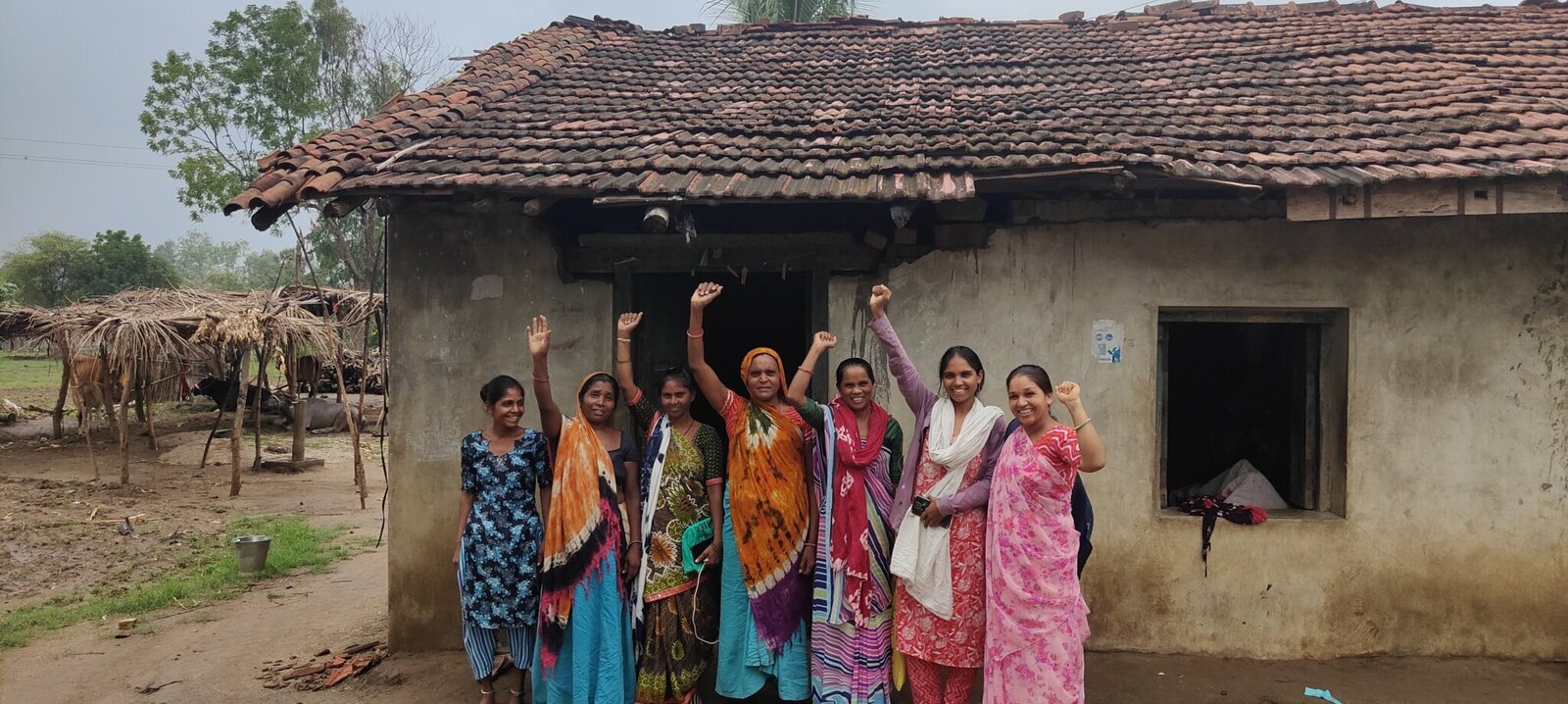
Picture 1: Active Members of Devgadh Mahila Sangathan.
Leelaben’s transformation — from a woman hesitant to travel alone to a fearless political actor who reshaped the very boundaries of her local state, is a microcosm of political transformation dismantling old power structures. This is not led by lofty political manifestos or centralised funding. But a revolution, quiet yet formidable, has been brewing at the absolute margins of society in Devgadh Baria block of eastern Gujarat, transforming not just individual women but the very structure of local governance. At the root of this socio-political transformation is a formidable federation of nearly 6,000 rural marginalised women known as the Devgadh Mahila Sangathan (DMS), systematically mobilised and rooted in feminist principles by the civil society organisation, ANANDI (Area Networking and Development Initiatives). The DMS, like other mahila sangathans faciliated by ANANDI, is an independent grassroots women’s collective, where rural marginalised women collectivise, exercise their choice and fight for their democratic rights. A deep-seated struggle for democratic rights led by DMS and ANANDI has defined the lives of thousands of rural women in Devgadh Baria for three decades.
DMS is a unique testament to the power of sustained collective action, illustrating a twin transformation. Firstly, the profound personal change of thousands of rural women who move from invisibility to visibility, challenging samaaj (society) and sarkaar (state). Secondly, the corresponding systemic transformation of the local state itself, which is being relentlessly pressured to become responsive, accountable, and gender-just. This is the narrative of women claiming their ‘rights, resources and representation’ and redefining the very meaning of local democracy from the margins upward.
Within the sangathan, Leelaben found not just a community, but a collective strength rooted in feminist solidarity that transformed her fear into fierce resolve. Her journey is a microcosm of what ANANDI’s sustained feminist mobilisation achieves, how marginalised women claim authority, choosing integrity and the “people-driven democracy” they were trained to uphold. This transformation — where personal courage meets political will — demonstrates how ANANDI through collectives like the DMS, turns constitutional mandates for decentralisation into a lived reality for the most marginalised citizens.
The democratic deficit: Why collectivisation was essential
The promise of the 73rd Constitutional Amendment Act (1992) has been persistently undermined at the ground level. The challenges faced by rural women were structural and deeply entrenched:
• Proxy politics: The pervasive “sarpanch pati” syndrome meant male family members or dominant community leaders often acted as de facto decision-makers for Elected Women Representatives (EWRs), rendering the reservation mandate ineffective.
• Systemic exclusion: Marginalised groups faced discrimination and social pressure, restricting their ability to assert themselves in Gram Sabhas (village assemblies) or contest elections.
• Lack of capacity: Many EWRs, due to limited formal education or prior knowledge and exposure to local governance, were disempowered when trying to engage with complex State systems.
• Centralised control: True decentralisation was undermined by bureaucratic dominance and state control over ‘funds, functions, and functionaries’.
Jambaben, an Adivasi woman and former Sarpanch of Ruparel, though not literate, studied the NREGA MIS (Management Information System) with assistance. She uncovered significant corruption: wages paid against job cards held by 20 – 25 children under 14, and payment records for works that had never occurred. She filed a formal complaint to the District Development Officer, highlighting this systematic corruption.
ANANDI’s founders recognised that State-created spaces had limitations for the empowerment of marginalised women, especially when the state itself was perpetuating patriarchy. Their vision, starting in 1995, was to organise at the absolute margins — reaching rural women in Dalit hamlets and Adivasi communities with high migration rates, particularly in areas with no prior organising history — to critique the state through a gender-analytical and human rights perspective. This ambition led to the formation of Mahila Sangathans, independent organisations where women could collectively decide the agenda, work on issues that matter to them and foster solidarity.
The genesis of sisterhood: From savings to solidarity
The Devgadh Mahila Sangathan (DMS), seeded by ANANDI in 1997 – 98, did not begin with a pre-designed feminist programme. Initially, women began meeting monthly as a savings and credit group to save money for times of crisis. However, these meetings quickly transcended financial functions, becoming vital spaces of emotional and political sustenance. For women traditionally restricted to their homes, the sangathan provided a safe space outside to bond, share personal stories of enduring violence, feel validated, and articulate their needs. As DMS members unanimously conveyed, the simple act of “stepping out of their homes for sangathan meetings without seeking any permission from traditional power centres of family and local State was the first step in challenging the everyday patriarchy”.
This collective forum transformed individual grievances into shared political understanding. The founders realised that women’s human rights could not be achieved by attacking patriarchy in isolation, as their most pressing issues were fundamental rights: water scarcity, hunger, and lack of livelihoods. This led to ANANDI adopting an intersectional approach, asserting that poverty, caste, state violence, and hunger are as structural as patriarchy and must be dismantled simultaneously to achieve genuine empowerment. Inazben, a senior member of DMS reminisced “In the early days, we conducted Arogya Jagruti Padyatra, a health awareness march in 27 villages (of Devgadh Baria and Ghoghamba). Women from 57 Self-Help Groups (SHGs) joined us. We would spend the night in these villages. Slowly, villagers started to open up to us about corruption in Gram Panchayats, extortion of money by government hospitals, harassment by forest officials, etc.”
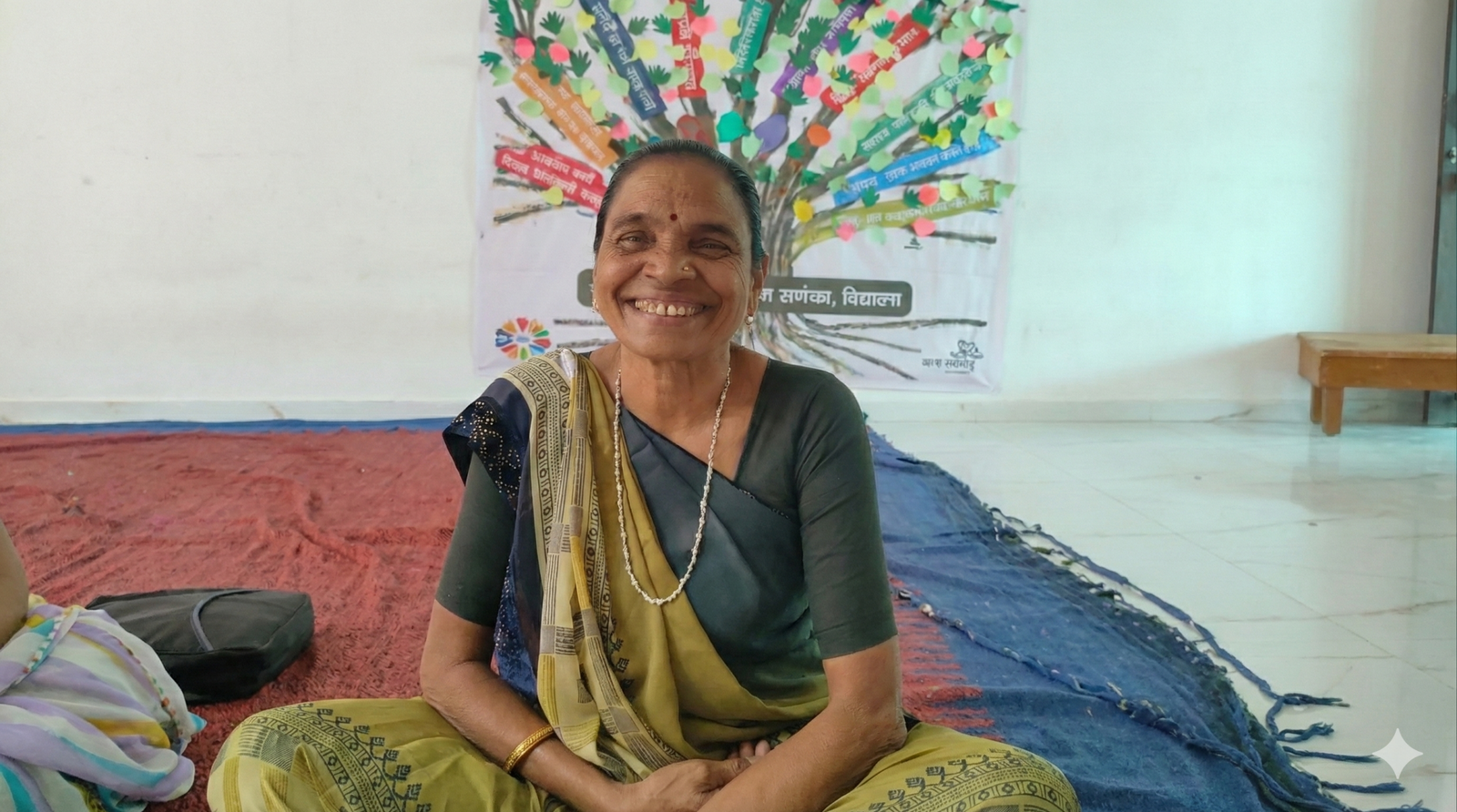
Picture 2: Guliben, leading the Devgadh Mahila Sangathan as its President for over two decades.
The collective strength quickly translated into visible advocacy. Guliben, the sangathan President, vividly recalled the struggle for obtaining cash doles of INR 20 for pregnant women under Food-for-Work program during the 2000 – 2001 drought. When 100 – 150 women rallied at the tehsildar’s office, facing police threats, they asserted their democratic ideal: “sarkaar gunehgar hai, humara adhikaar hai (the government is at fault, we have a right to the cash doles)”. This three-day sustained struggle resulted in the release of cash doles for their district and others, marking an early landmark victory.
In the process of organising themselves for basic rights, once shy and fearful women, began to assert their identities, became more confident, and found courage to speak up at home as well as in public forums. The women of DMS began performing Adivasi songs, theatre and dance in public spaces in order to engage community and counsel them against social evils such as daakan pratha 1 and daawa pratha2. They emerged as community leaders who negotiated with Anganwadi3 workers, health officials, government schoolteachers, ration shop owners, Panchayat members as well as block and district level officials to get the rights and entitlements of marginalised women. Most of all, the women’s identities emerged as “behenein” (sisters) of an organically developed Sangathan, deeply rooted in feminist ideals and their lived realities.
The DMS is a largely Adivasi and Other Backward Classes (OBCs) women’s federation of over 5770 members, across 135 villages in Devgadh Baria and Ghoghamba blocks. Albeit unregistered, DMS has a formal structure with a President, an elected executive body (Karobari Mandal) and defined committees to carry out its functions in a decentralised manner. The sangathan is a space where women across three generations —young girls, experienced women and older leaders — and diverse identities (Adivasi, OBC, Dalit, widows, ekal or single women) come together. Meetings are often held in homes or community spaces, characterised by shared meals, songs of struggle and hope, and open discussions. There is a strong sense of sisterhood and camaraderie, where women feel valued, supported, and safe to share personal and political issues. Many sangathan members are survivors of gender-based violence. In the past, nearly 90% sangathan women were not literate. From a mere 10% about 23% sangathan women are literate now and many of these young women are graduate or post-graduate. Many women who had to drop-out of school or college have resumed further education after joining the sangathan. With respect to livelihoods, Most women are wage workers, forest dwellers, farmers, organic fertilizer and seed producers. Land holdings are very small, and customarily women do not hold land ownership. Due to this, families including women and young girls often migrate to Kutch, Saurashtra or Baroda districts to work as agricultural labour, sharecroppers or construction labour. Nearly 81 of the DMS members are elected representatives in Gram Panchayats, and 131 are members of various local governance committees.
Cultivating articulate voices: The feminist core
ANANDI’s practice is steeped in four fundamental feminist tenets: intersectionality (linking gender discrimination to other structural inequalities), solidarity (bandhuta or “sisterhood”) across caste and ethnic divides, collective struggle against systemic injustices, and the transformation of social relations.
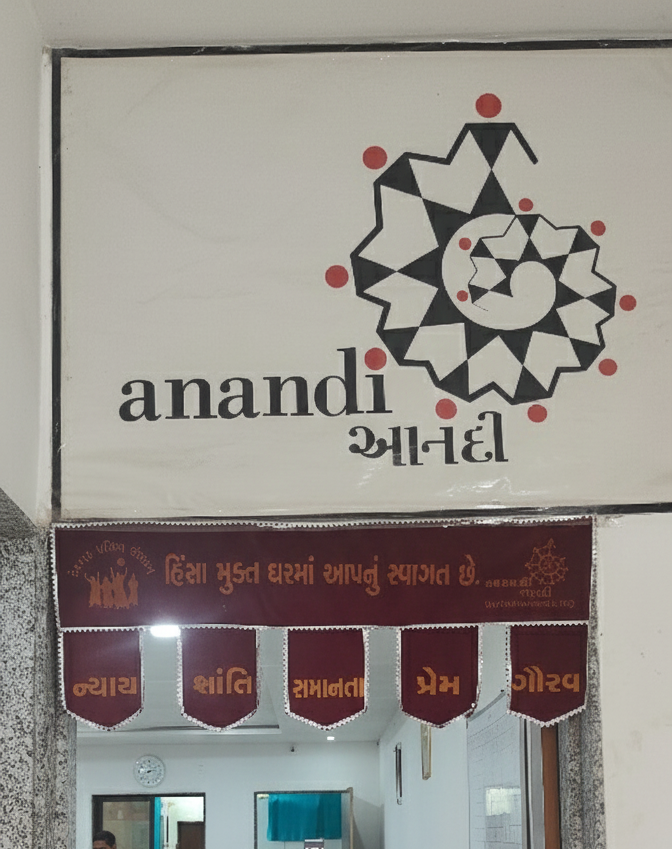
Picture 3: The entrance to ANANDI’s office in Baria holds an impactful banner which reads “You are welcome to a home which is violence-free” sending out a powerful message against gender-based domestic violence.
Central to building this feminist perspective is the process of “conscientisation”. This andragogical approach facilitates critical awareness among women, helping them recognise that issues previously considered private — like domestic violence or reproductive rights — are, in fact, manifestations of unjust political systems and ideologies. Varshaben, a DMS leader, echoed this transformative realisation: “In our training, we engaged with tools like ‘kiska padla bhari’ (whose scales are heavier) which made me realise that the work done by men and women was unequal…”. The feminist perspective cultivated in the sangathan meetings inevitably flows back into the home. Women are trained on gender equality, leading to slow but definite changes in family dynamics. Rekhaben noted that previously her husband did no domestic work, considering it “women’s work.” Now, if she must go out, he offers to participate in the kitchen or with household chores. Such shared lived realities empower women to collectivise against systemic discrimination and move from a passive mindset of ‘we can’t’ to an assertive ‘we can’.
In addition to gender training, the sangathan invests significantly in capacity building, equipping its members — who span three generations and include both non-literate veterans and young post-graduates — to become confident actors.
• Political literacy: Women are trained on constitutional rights, government schemes (food security, pensions, land ownership), and developing essential advocacy skills.
• Evidence-based advocacy: DMS members are skilled in reading data, understanding laws, and building evidence to support their arguments, granting their demands political legitimacy and power.
• Inclusive andragogy: ANANDI employs Participatory Action Learning Systems (PALS), using diagrammatic tools, songs, and street plays to ensure the training is accessible to all, irrespective of literacy status. They also utilise techniques based on the “theatre of the oppressed” to facilitate reflection and collective analysis.
• Leadership model: A key strategy is the “bhaneli-ganeli ni jodi” (a pair between a young literate woman but not experienced in sangathan work and a non-literate but experienced woman). This intentional pairing system bridges knowledge gaps and ensures robust intergenerational leadership development.
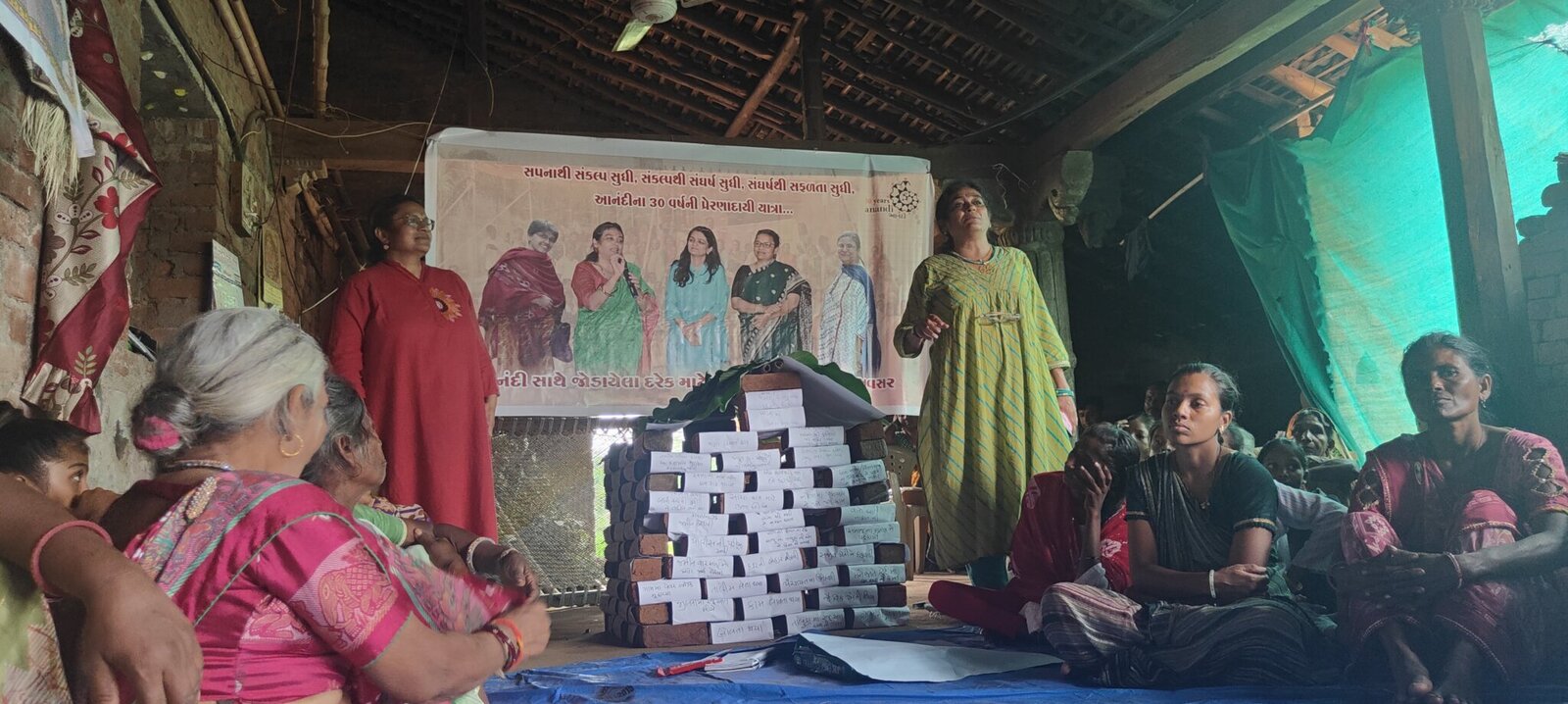
Picture 4: Reflection on sangathan’s struggle of three decades against gender-based violence, of right to food, land and livelihood for the marginalised. Facilitated by ANANDI Founders, Neeta and Sejal.
The result of this systematic training is a tangible shift in self-perception and collective resolve. Komalben summarised the essence of solidarity: “One stick of wood can be broken easily but if we have 10 sticks together it is hard to break them”.
The transformation of the local State: Strategies of change
The DMS, now a federation of over 5770 members across 135 villages, employs a multi-pronged approach to shift power dynamics and enforce accountability within the local state.
1. Visibilising marginalised voices in public forums
Historically, Gram Sabhas remain male-dominated spaces where women’s issues are often ignored. DMS strategically creates and strengthens parallel and formal democratic platforms to ensure women’s agency.
Mahila Yuva Sabhas (MYS): Recognising the need for women to arrive at their agenda separately, ANANDI facilitates these assemblies prior to the official Gram Sabhas. These MYS meetings provide a crucial safe space to discuss needs related to water, safety, education, and fairness in employment, with resolutions formally presented later.
Strengthening Gram Sabhas: The sangathan ensures active attendance at Gram Sabhas, countering historical information inequities where men failed to inform EWRs or members of meetings. Through “Gram Sabha Jagruti Jhumbesh” (awareness campaigns), women are mobilised to attend with “written petitions, ensuring that our issues are formally recorded,” as shared by ward member Niranjanaben. In June 2023, the impact was quantifiable: women made 63% of all oral representations in 32 Gram Sabhas in Devgadh Baria block. The collective strength acts as a powerful deterrent against social violence. Manguben described how the sangathan women rallied in a Gram Sabha to protect an elderly woman enduring years of daakan (witchcraft) violence, asserting, “She is not alone, there are thousands of us, sangathan women with her. You (the perpetrators) will have to answer all of us…”. The public pressure forced the perpetrators to stop the violence.
2. Institutions of accountability: LAK and Nyay Samitis
Vocalising rights is often insufficient; DMS created two essential support structures to navigate bureaucratic resistance and secure justice.
The Lok Adhikar Kendra (LAK): The LAK is a help-desk run twice weekly by trained, certified para-legal volunteers of the sangathan outside the mamlatdar’s (revenue officer) office. It acts as a bridge, overcoming information inequities and assisting right-holders who are often dismissed or asked to pay bribes. Arunaben, a LAK member, detailed the arduous work of securing land ownership rights for 40 widows. This task involved difficult negotiations to obtain death certificates, facing threats from powerful family members, and actively combating the use of daakan violence employed to dispossess the widows of their land.
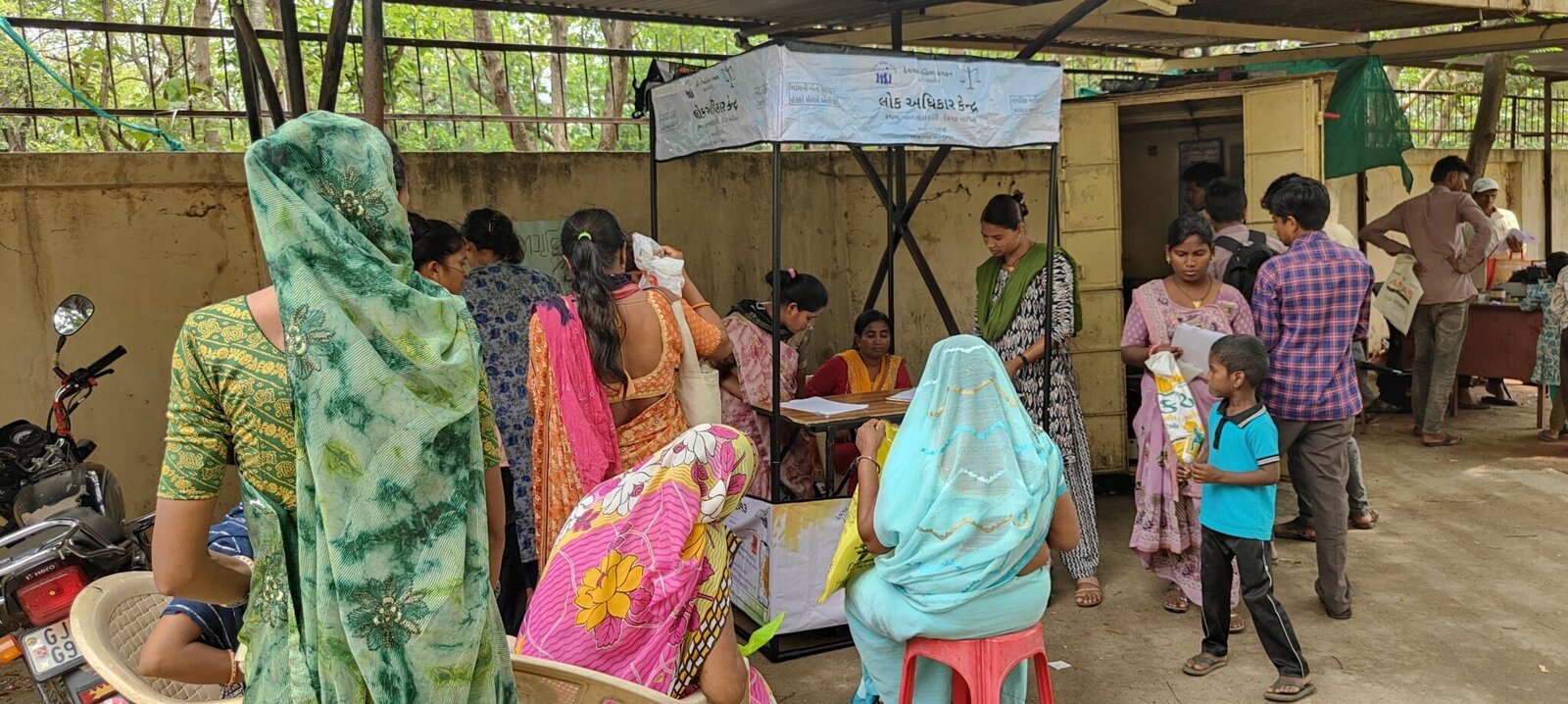
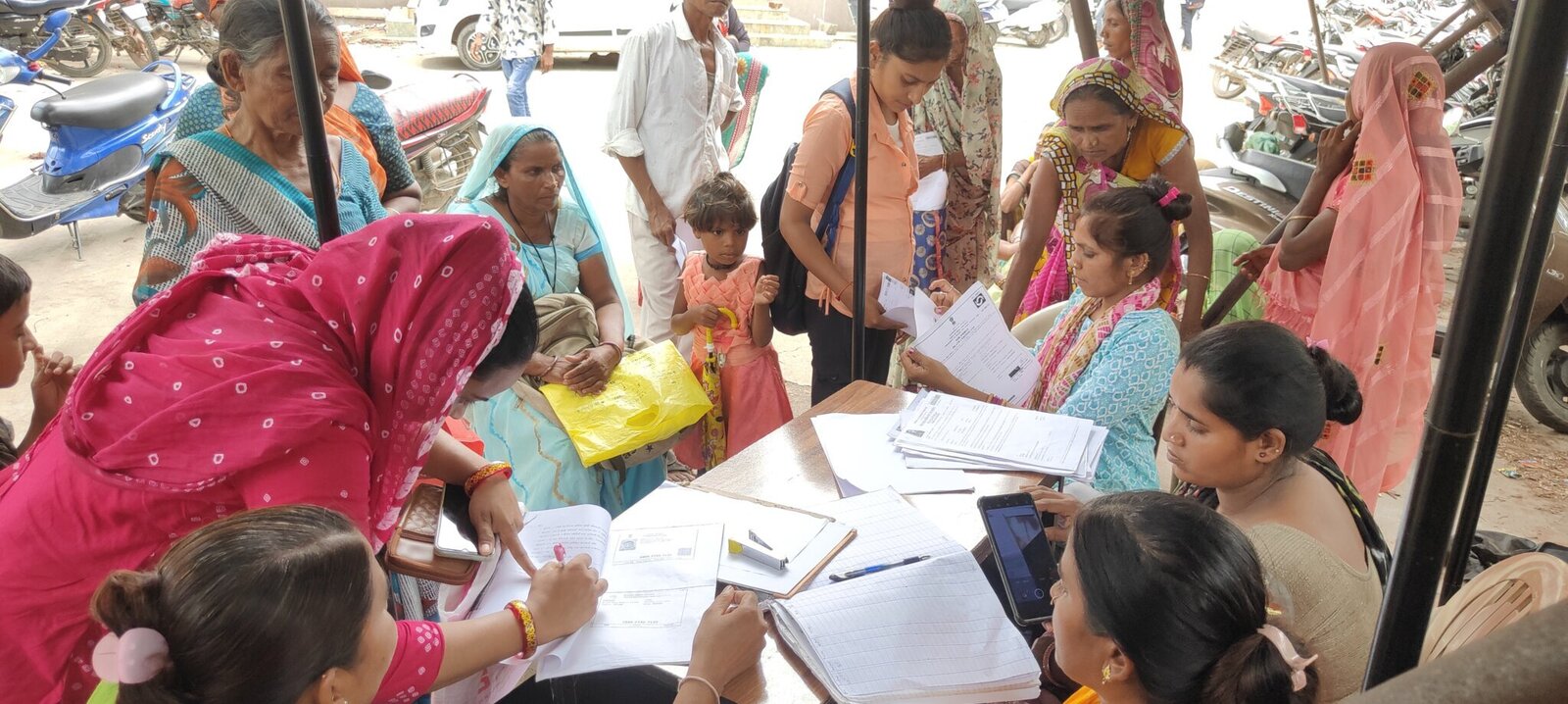
Picture 5: Sangathan’s Lok Adhikar Kendra in action.
LAK members also challenge systemic bureaucratic hurdles. Geetaben recounted how they fought at the state level against the mamlatdar’s office, which had imposed an illegal, unnecessary condition — that young widows must strike their deceased husband’s name off the voter list — before their pension applications could be accepted. Collective advocacy compelled the office to stop the illegal practice and release the pensions.
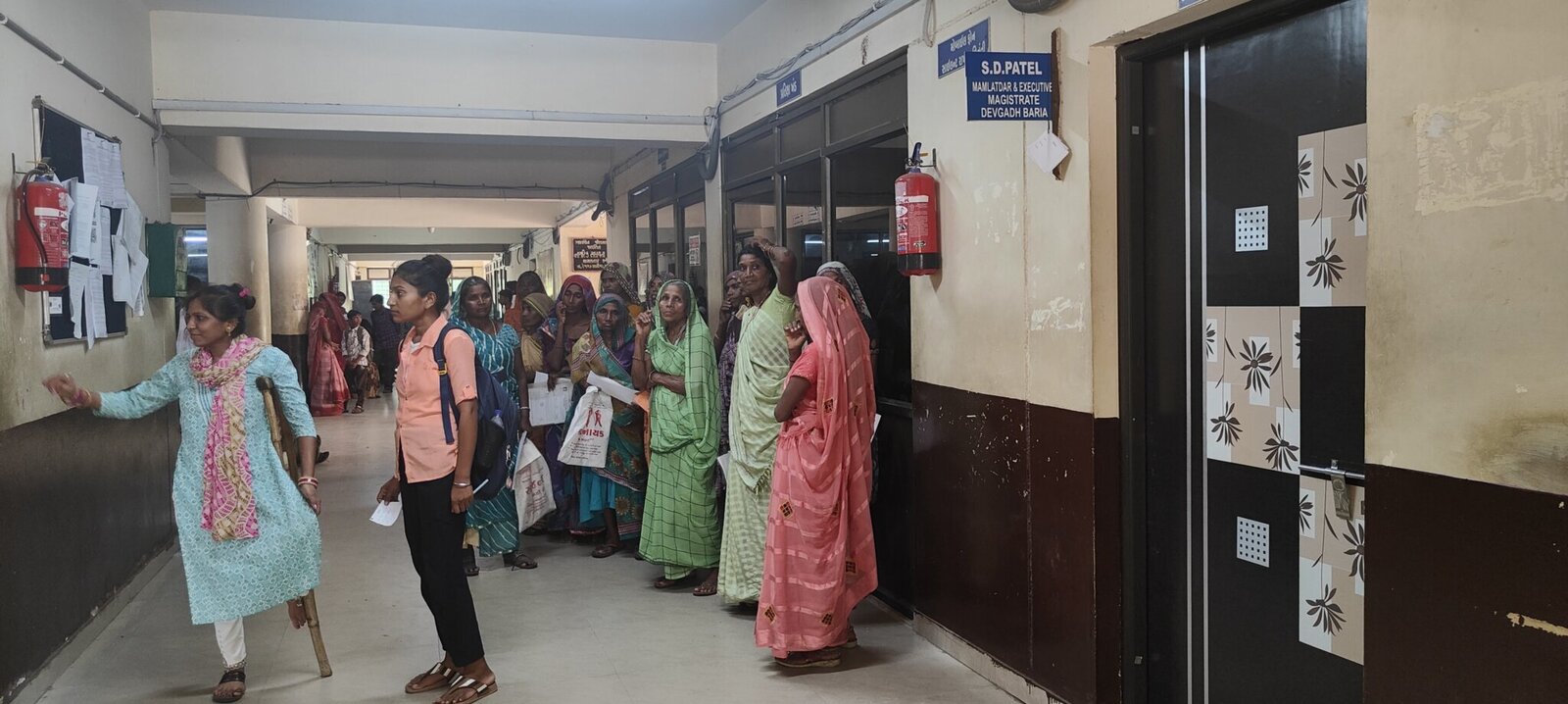
Picture 6: Right-holders and LAK members outside the mamlatdar’s office in Baria advocating for ration rights.
Nyay Samitis (Justice Committees): These committees serve as the sangathan’s forum for alternative dispute resolution, focusing specifically on Gender-Based Violence (GBV). ANANDI supports the Nyay Samitis as a service provider under the Protection of Women from Domestic Violence Act, 2005, empowering survivors to file a Domestic Incident Report (DIR) directly with the court. The case of a young mentally disabled rape survivor exemplifies the unwavering commitment of the Nyay Samitis. Health leader Manguben and Nyay Samiti member Manjulaben worked to obtain the necessary disability certificate and file the rape case, despite immense pressure to withdraw the charges from powerful local actors, including the police, the local MLA’s family, and village elders. They persisted, ensuring justice was sought and that the survivor and her child continued to receive care and entitlements. For many survivors, the collective offers a vital lifeline, confirming the sentiment of one woman who fought domestic violence: “The sangathan helped me so much, even my own (family) would not have”.

Picture 7: Meeting with Nyay Samiti members of sangathan.
3. Claiming political authority and combating proxy rule
DMS systematically facilitates women’s entry into Panchayati Raj Institutions, recognising that political authority is crucial for negotiation power and challenging corruption.
Electoral support: During elections, DMS organises “Matdaan Jagruti Jumbish” (voter awareness campaigns) and sets up the “Ummedwari Sahayata Kendra” (candidate support centers). These centres reduce bureaucratic hurdles and prevent applications from being rejected due to minor issues, ensuring women can effectively compete.
The pursuit of feminist politics: Sangathan members often face intense challenges, including vote-buying and intimidation. However, they maintain high ideals of feminist politics. Kamlaben, who contested the Sarpanch election, refused to buy votes even when her wealthy opponent did, prioritising people-driven democracy over corrupt tactics. Similarly, Leelaben refuses to be co-opted by wealthy, corrupt contractors to win elections.
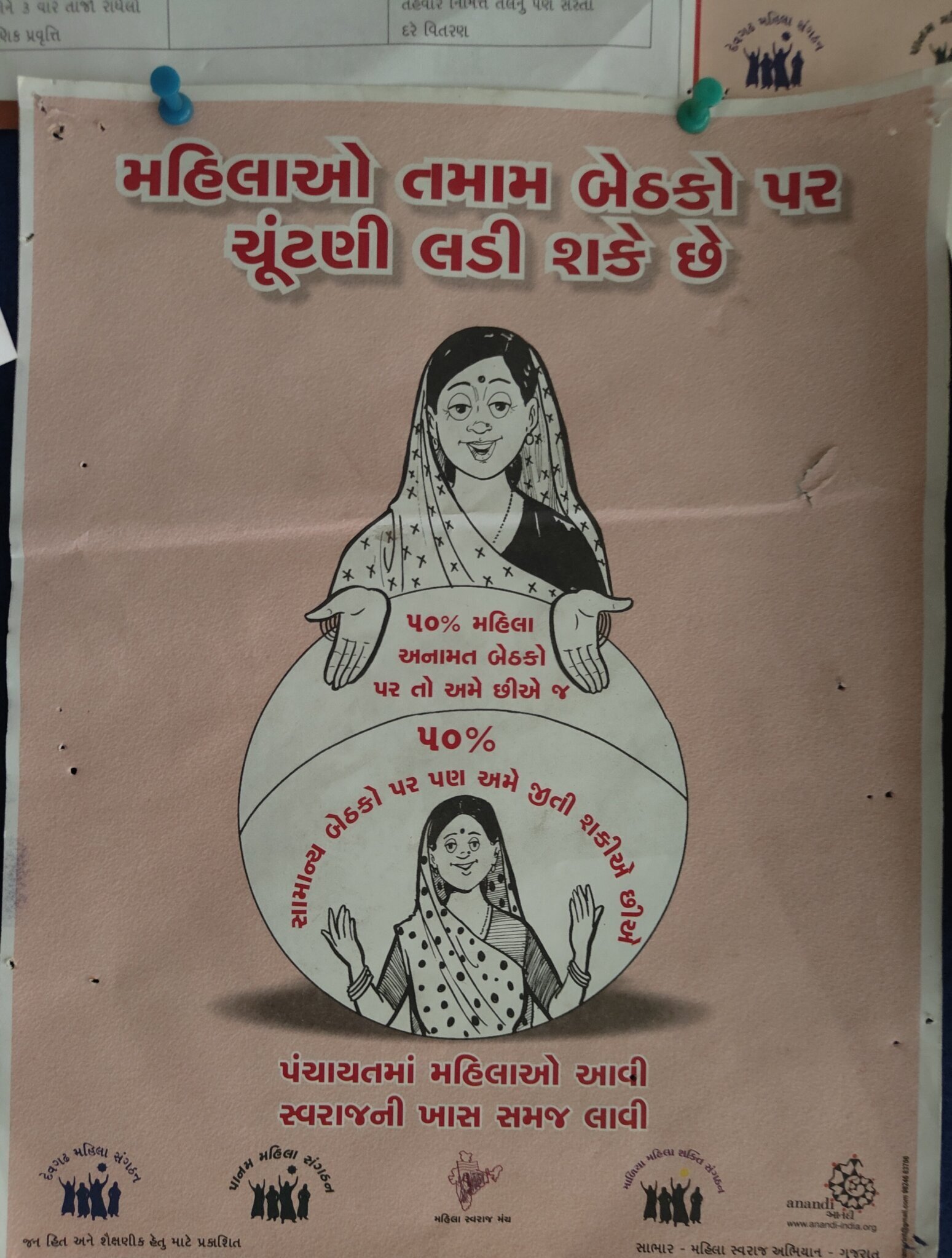
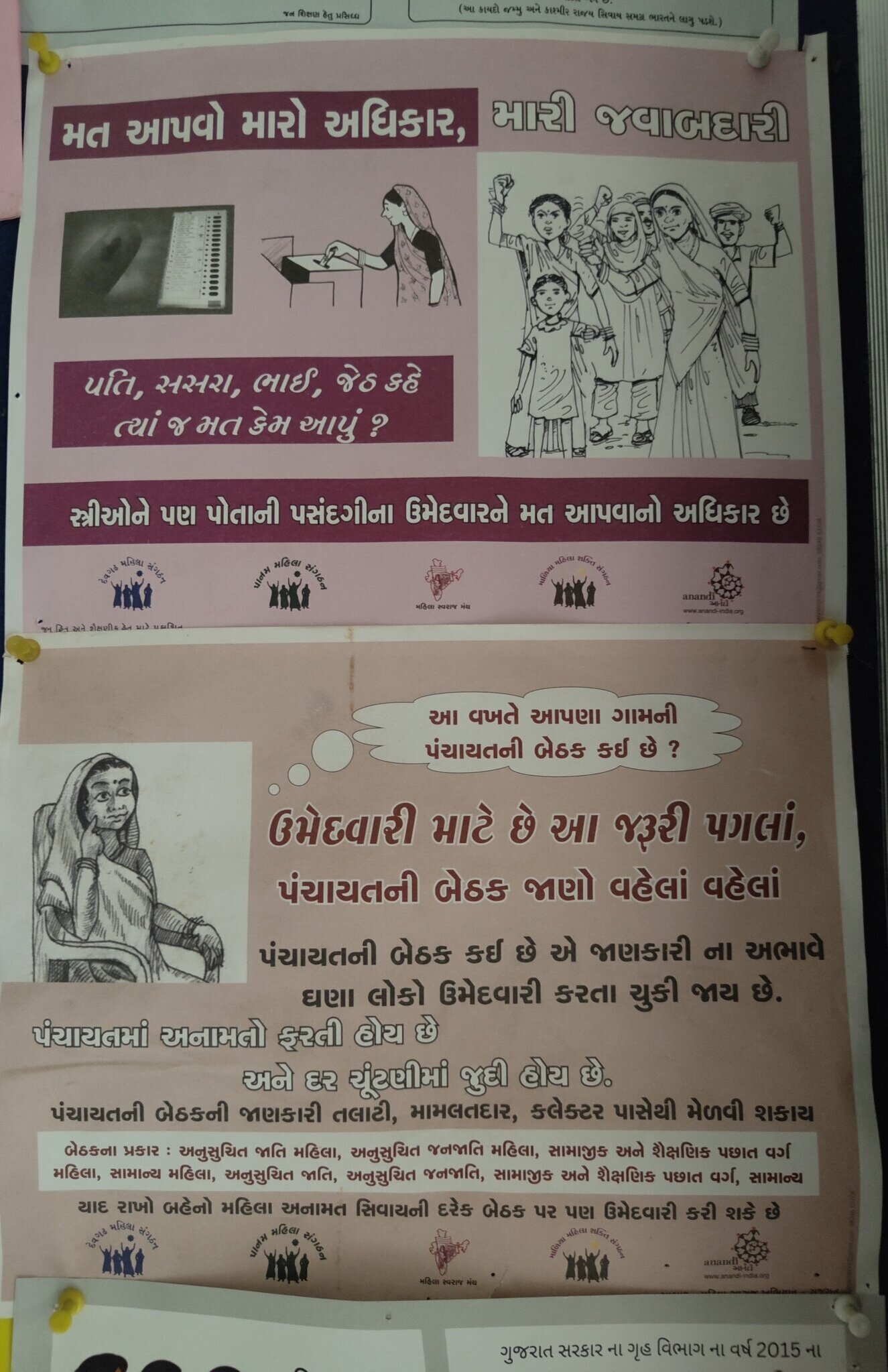
Pictures 8A & 8B: Information-Education-Communication materials designed by ANANDI for electoral awareness to facilitate women candidates.
Empowering EWRs: ANANDI actively works to combat the widespread informal practice of men acting as proxies for elected women. Sangathan members like Niranjana and Urmilaben firmly insist on independently conducting their political duties. The organisation also conducts monthly training for EWRs and sarpanches to familiarise them with their roles, budgets, and legal provisions. Sondiben, a Sarpanch in the first reservation elections, who was initially “too scared to enter the taluka panchayat office and sit on a chair,” eventually gained the confidence to navigate bureaucracy alone and personally ensured the installation of 21 borewells for her village.
4. Demanding transparency and exposing systemic corruption
The sangathan views government officials as public servants and insists on accountability, using evidence-based advocacy to monitor state services and challenge malpractices.
Financial scrutiny: The women actively monitor essential services (health, food security, NREGSA). Jambaben, an Adivasi woman and former Sarpanch of Ruparel, though not literate, studied the NREGA MIS (Management Information System) with assistance. She uncovered significant corruption: wages paid against job cards held by 20 – 25 children under 14, and payment records for works that had never occurred. She filed a formal complaint to the District Development Officer, highlighting this systematic corruption.
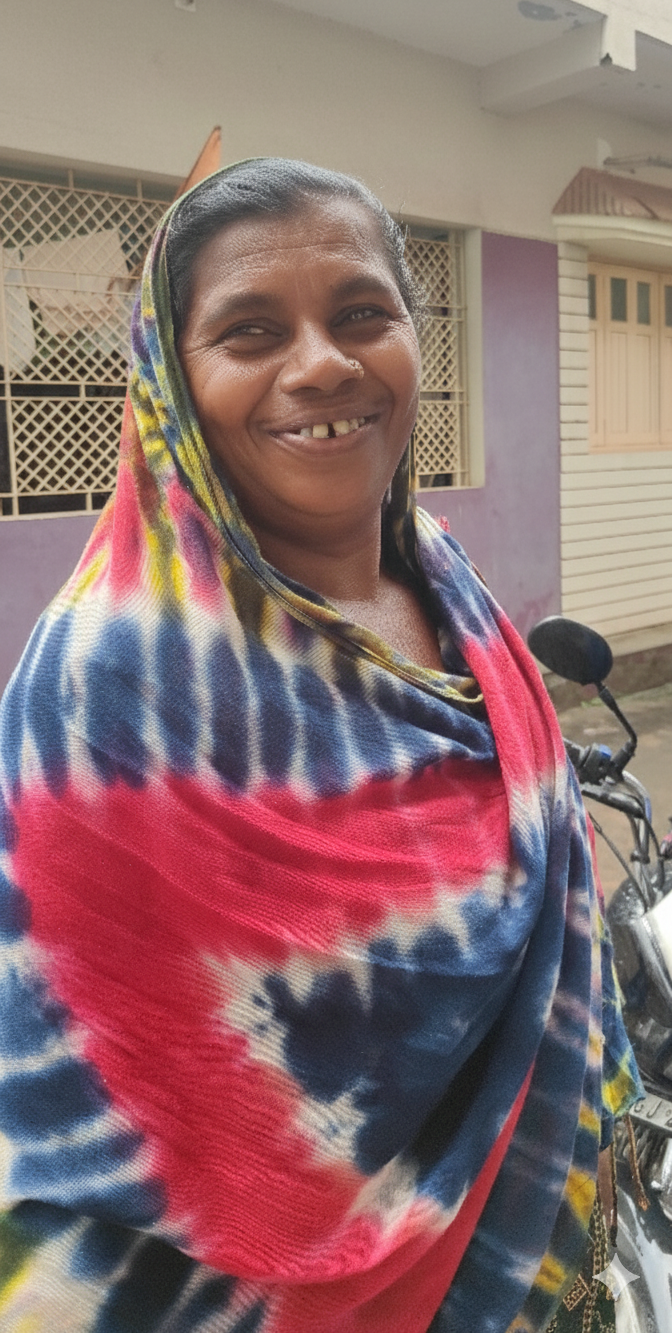
Picture 9: Kusumben, a senior Adivasi leader of the Sangathan continues to lead till date with unending zeal.
The PDS victory: Kusumben, a senior DMS leader, recounted the powerful collective action against a corrupt PDS (Public Distribution System) shopkeeper. When a recently widowed woman was denied ration because the dealer insisted on her deceased husband’s thumbprint, the sangathan escalated the case through the Gram Sabha, the mamlatdar’s court, and to the district office. The sustained pressure exposed widespread irregularities. When the shop was finally forced to operate honestly, one woman remarked that she now needed a bicycle to carry her full, rightful share — a stark measure of how little they had been given previously.
Rekhaben noted that previously her husband did no domestic work, considering it “women’s work.” Now, if she must go out, he offers to participate in the kitchen or with household chores. Such shared lived realities empower women to collectivise against systemic discrimination and move from a passive mindset of ‘we can’t’ to an assertive ‘we can’.
The path ahead
The Devgadh Mahila Sangathan, initiated and facilitated by ANANDI, represents a robust model where rural women are not passive beneficiaries, but active drivers of state transformation. Through ‘conscientisation’ and the cultivation of feminist tenets — social justice, solidarity, freedom, and dignity — women transgress societal boundaries to collectivise against structural violence. This collective power acts as a powerful deterrent against apathy and malpractices by local state actors. As elected representatives, sangathan women disrupt traditional male dominance, forcing local democratic institutions to become more equitable and inclusive.
Many women who had to drop-out of school or college have resumed further education after joining the sangathan
Young women like Payal who joined the sangathan when she was 17, sees ANANDI as having sown a “seed” in her. Brimming with gratitude she testified, “ANANDI is a tree, with the (sangathan) women as its branches bearing flowers that produce more seeds like me”. Many young women joining the sangathan year-on-year demonstrate a self-sustaining ecosystem of empowerment, ensuring that the roots of change go deeper with every passing year.
Ultimately, the sangathan is not merely surviving within the system; it is reclaiming the system. The Devgadh Mahila Sangathan’s success in transforming democracy is like redirecting a powerful river that has historically flowed only toward the affluent farms, bypassing the fields of the marginalised. Through disciplined, collective effort, they have built new channels (LAKs, Nyay Samitis, MYS) and installed floodgates (EWRs) that force the river (resources and rights) to flow equitably, ensuring that every marginalised field is nourished by the democratic process.
Sangathan members singing a tribal song beckoning the women to step out of their homes to come to sangathan meetings, to bring with them other women and to celebrate the movement that ANANDI has started
About the author:
Sonal Sethia is an independent research consultant working in the field of development and public policy. Passionate about education equity and peacebuilding, she has worked in conflict-affected northeast India and currently serves as the Trustee of the northeast-based Sunbird Trust. She holds a Master’s and a PhD in natural sciences, as well as a second Master’s degree in public policy and governance.
About the series
This series will spotlight local democratic practices from across the country that demonstrate innovation, effectiveness and good governance. This work is facilitated by the Centre for Local Democracy, Azim Premji University.
More stories available here.
The Centre for Local Democracy supports the work of Azim Premji Foundation and others working on deepening and widening local democracy across India. The Centre enhances the work done in rural, forest, PESA and urban settings through educational programmes, documentation, dissemination of good practices and research in emerging thematic areas.
A practice where women, particularly widows are accused of witchcraft, ostracised, and abused↩︎
A practice where women, particularly widows are accused of witchcraft, ostracised, and abused
A practice of taking money by the natal family, in exchange of a girl in marriage particularly in choice marriages↩︎
A practice of taking money by the natal family, in exchange of a girl in marriage particularly in choice marriages
A rural childcare centre in India, under the Integrated Child Development Services (ICDS) program of the central government↩︎
A rural childcare centre in India, under the Integrated Child Development Services (ICDS) program of the central government