
‘Jungle is our life’: Indian villages collectivise, harness decades-old laws to protect forests
By Roli Srivastava | Sep 2024
A federation of gram sabhas in Maharashtra is using India’s forest rights laws to guard their green cover and earn steady incomes.
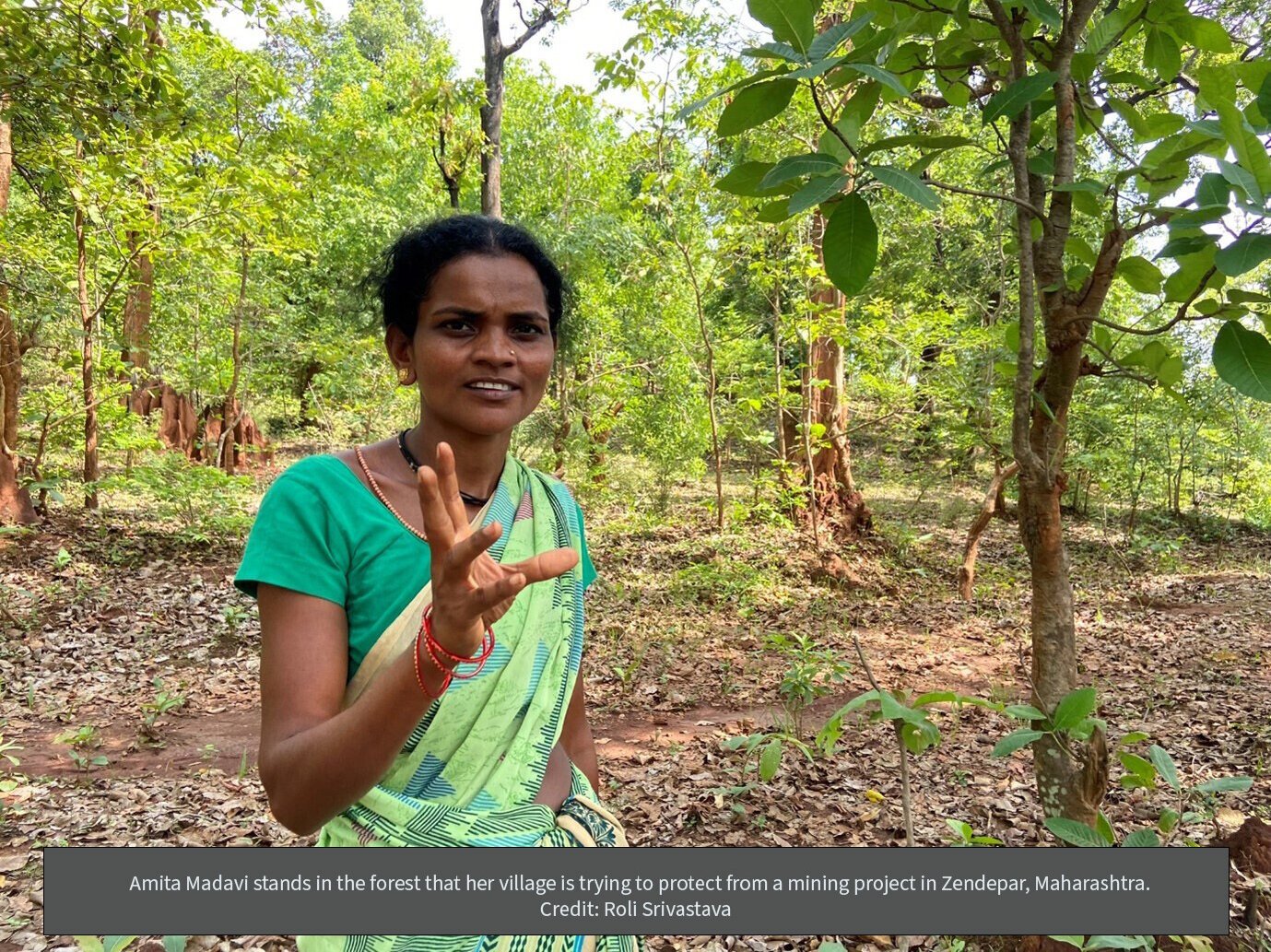
Amita Madavi stands in the forest that her village is trying to protect from a mining project in Zendepar, Maharashtra.
Credit: Roli Srivastava
Details
ZENDEPAR, Maharashtra: Amita Madavi, 38, doesn’t break a sweat as she briskly sprints uphill into the forest in her central Indian village, identifying the herb that can cure a cough, the pointy leaf that works wonders as a bandage to heal a sprain and the mushrooms that taste divine. This forest has been a ‘lifeline’ for villagers who are now preparing for a court battle to protect it from a mining project.
Zendepar is a tiny village of 300 residents in Korchi taluka in the heavily forested Gadchiroli district of Maharashtra. It is the latest village to exert its legal right on the forest.
The move comes on the back of rare wins neighbouring villages have scored in recent years by tapping into decades-old Indian laws that enshrine these forest rights but have remained poorly understood and implemented.
In Korchi, over 90 villages like Zendepar came together in 2017 to form an association of sorts called the ‘Maha Gram Sabha’ or a federation of village assemblies. Together, they found a voice to stake claim on the trees and rocks they have coexisted with for generations but had no ownership of.
“We don’t have temples and idols. We are Adivasis; we worship our trees and rocks. Our trees and animals live with us. Nature is our god,” said Madavi, mother of two, as she paused to pay obeisance to the village deity _ a rock under a canopy of dried leaves.
“The entire village depends on the jungle for its living. We get more produce from the forest than from our farms. We sell the produce and also eat it. Our air and water are clean because of our forest. Jungle hai toh hum hain (We owe our existence to the forest),” she said.
Game Changer Laws
Over 100 million people in India, or nearly 8 percent of the country’s population, are Adivasis, most of them poor, landless and often cut off from public facilities and even connectivity because of their location in forests and hills, government data shows.
They have historically been deprived of ownership of forests that they once lived with, until they were driven away by kings, colonial masters or the political leadership of independent India.
Some of them were settled in specially created ‘forest villages’, where they were paid daily wage labour rates by the forest department for picking, foraging or cutting forest produce to be sold by the department.
Since many of these forested areas are sites of major minerals, and water sources, the Adivasis are often displaced from the forest to make way for mega infrastructure projects, including construction of large dams and mining.
So, when the Forest Rights Act (FRA) was enacted in 2006 — giving forest dwelling communities individual and community rights to the forest — it was hailed as a major ‘pro-Adivasi legislation’ that would correct the historical injustices the communities had suffered.
The Act provided communities with ownership rights to all minor forest produce like tendu leaves (tobacco wrapper leaf), bamboo, saal leaves, including monetising the produce, management of the same, also making them ‘owners’ of all development works in the villages.
This law, coupled with the 1996 Panchayat (Extension to Scheduled Areas) Act or PESA, gave Gram Sabhas the power to govern their resources. Meant for 5th schedule areas having large Adivasi population, Gram Sabhas in PESA areas were legally vested with the ownership of the commons, minor minerals, village markets, biodiversity, intellectual property rights of the people’s knowledge, and all development and social justice works.
Despite being in existence for so many years, the implementation of the two ‘game-changer’ laws remains poor.
According to government data, eight of ten Indian states that have a predominant tribal population have notified state-specific rules under PESA, with states holding awareness sessions even this year on the law’s implementation.
However, as campaigners pointed out, even in places where it was implemented, state governments stopped short of giving complete control — in Orissa and Jharkhand, for instance, forest land has been taken back for various projects, a threat that Zendepar is currently fighting.
Several villages that got community rights over their forest remained unaware of the power of this legislation. “All the rights given to villagers are on paper,” said PESA and forest rights law expert Anil Garg, who has authored books on the two laws and works on community forest rights for tribal communities in the central Indian state of Madhya Pradesh.
Lack of access to resources in the forest — once a livelihood source — has fuelled migration from these villages for years, he said. “There could be one or two examples (of success of the law’s implementation) but that does not tell an entire region’s story.”
“They got the title papers, they won a right, but they didn’t know what to do with it”
Forming a collective
Of the 133 villages in Korchi taluka, 95 won community forest rights in 2015, bringing 80% of the total forest area under the control of villages. This was in addition to the individual forest rights obtained by many members of the Gram Sabha.
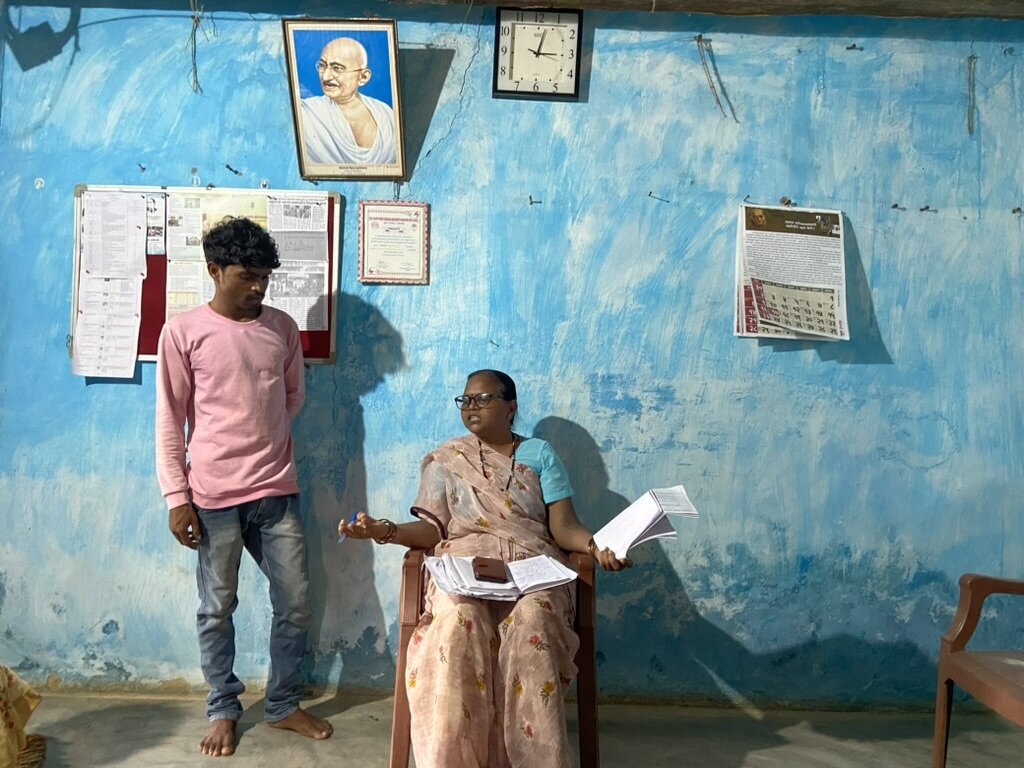
Kumari Jamkatan, secretary of the Maha Gram Sabha, sits in the federation’s office in Korchi, Maharashtra.
Credit: Roli Srivastava
The community forest rights include access, withdrawal and management of all minor forest produce, including the right to its stock and sale as a means of livelihood for members of the Gram Sabha.
In addition, since the Gram Sabha is the custodian of the forest, any need to divert the resource for ‘national development’ would require their consent and a mutually agreed compensation.
Local non-profit Amhi Amchya Arogyasathi (AAA), working on health and sanitation with tribal communities, realised that while the laws had the potential to have a far-reaching impact on lives of people, awareness about it was thin.
“They got the title papers, they won a right, but they didn’t know what to do with it,” said Dr. Satish Gogulwar, who heads AAA.
The non-profit enlisted its volunteers in villages to start holding meetings about the laws to increase awareness, and gradually bring in representatives from each village’s Gram Sabha to form a collective.
Volunteers, who went from one village to another, discussed the potential the two laws held to financially empower them and the strength they would gain from each other if they formed a collective.
The process stretched for nearly three years, with villagers reluctant to join, even disbelieving they held any right to the vast forests, before reaching a robust membership of over 90 Gram Sabhas in the Korchi taluka.
Since then, the Federation has acted as an umbrella organisation to support member Gram Sabhas in implementing these laws.
Member villages of the Maha Gram Sabha are divided into seven clusters, each consisting of 10 – 14 Gram Sabhas. The cluster level association chooses a male and a female representative for the Maha Gram Sabha and each Gram Sabha also elects a president, secretary and treasurer.
The Maha Gram Sabha organises trainings for both member and non-member Gram Sabhas, helping them create norms to protect the forest, rules regarding collection of forest produce and wage rates.
Many of the member villages have come up with a 10-year forest conservation plan — a thick document with maps, pictures and diagrams — a record of their trees, forest produce, water bodies and farms within forests.
The document, along with projections on the kind of work that forests will generate until the next decade, is given to the district collector. The members keep a copy for themselves as a roadmap to protect their forests and livelihoods.
When villages, such as Zendepar, approach them for guidance or information, they are given advice “but not a decision”, an office bearer of the Maha Gram Sabha said.
The Maha Gram Sabha charges an annual membership fee of INR 5,000 from its members. This amount is used to pay rent for their office, where a computer and photocopier is available for all villagers to use.
Rising incomes
Livelihood solutions have since begun to emerge as villagers gain control over the forest, which is resulting in reducing thefts from forests, and yielding a thicker forest cover in some villages.
The members of the Maha Gram Sabha now have an auction of the only forest produce common to all villages - tendu patta. This ensures that Gram Sabhas do not undercut each other to sell to the traders.
The informal collective has brought villagers together in setting a process for the sale of tendu leaves. The Maha Gram Sabha helps villagers place advertisements in local newspapers, inviting tenders, and setting the price themselves.
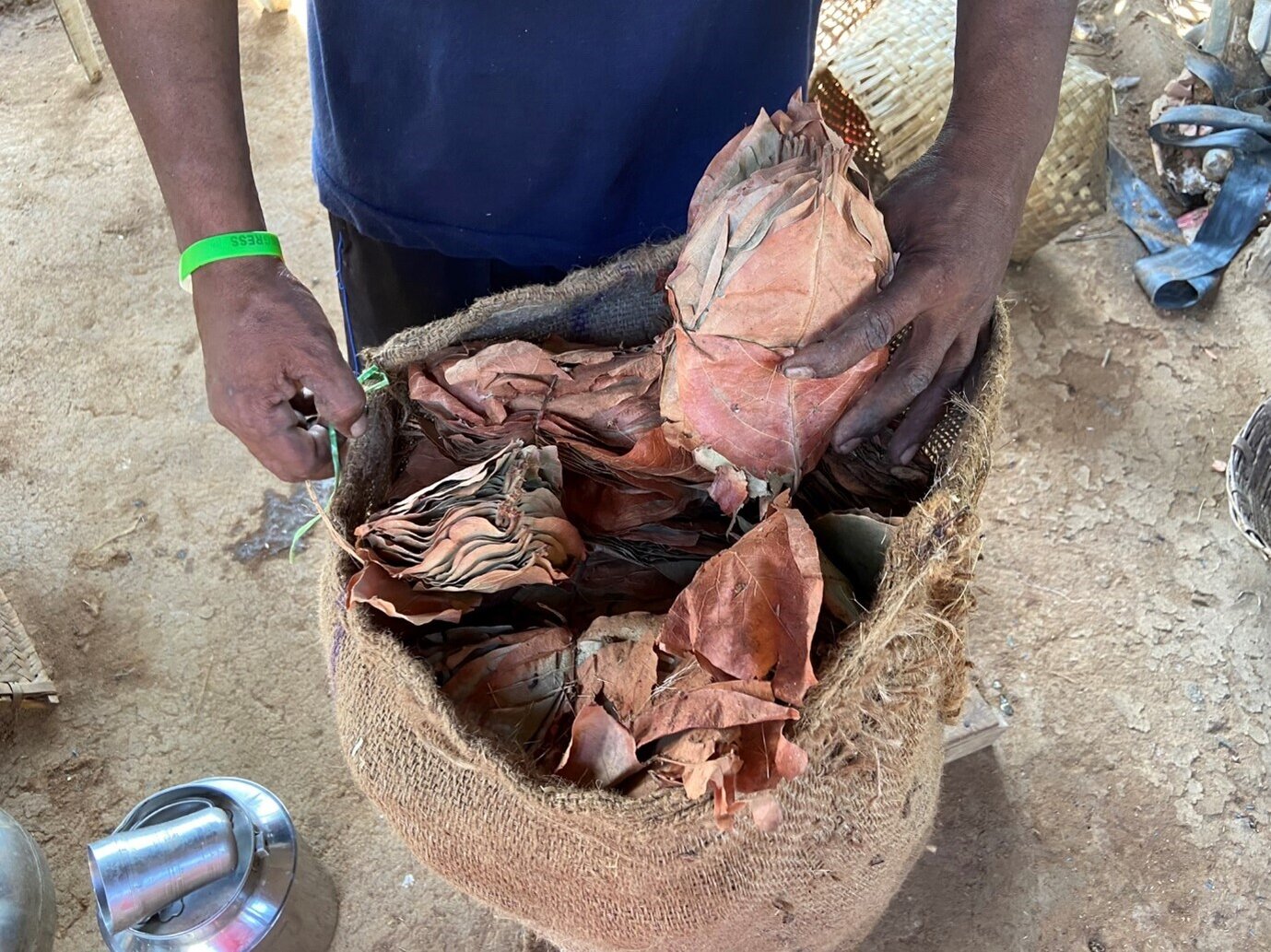
A villager shows a stock of tendu leaves from this season’s collection at Padiyali Job, Maharashtra.
Credit: Roli Srivastava
This is a far departure from when the forest department set the price for the produce and paid villagers who collected the leaves a daily labour charge of about INR 200 to 300.
“Our leaves are as precious as gold. This year we collected 120,000 tendu leaves, selling them for INR 11 lakh. This is our earning,” said Madavi in Zendepar. Each worker who generally collects 70 – 100 bundles of 70 leaves each, now gets a rate of INR 840 for 100 bundles. Each family (an average size of four to five members) collects up to 500 bundles a day during peak collection season and a minimum of 100 bundles as season recedes with fewer leaves left to collect, ensuring a big jump in income from the labour charges they earned earlier.
Selling the produce as a collective has strengthened their bargaining power. The work being created in the village itself, such as digging of lakes, has also helped improve individual earning, arresting migration from Korchi’s villages, Dr Gogulwar said.
In October 2023, for example, a dozen villages formed a collective to sell the fruit of the medicinal hirda trees in their forest, that is used in making Ayurvedic medicines.
Unlike in the past, when people sold the fruit individually and traders had the last word on the price of sale, the collective this year piled all the hirda produce on a big truck, drove it across the border to neighbouring Chhattisgarh where they sold it to traders at INR 18 per kilogram, up from INR 14 to 15 earlier, villagers said.
“There is no doubt their improved awareness is helpful,” said Sanjay Daine, district collector or the administrative head of Gadchiroli district, adding that officials try to “see their reason” and resolve them accordingly as they would do in Zendepar’s case as well.
“We used to feel scared entering a government office, but now we were stronger as a community,”
A big win
The narrow roads connecting the 133 villages of Korchi are flanked by trees with long branches, some bursting with flowers, others bending under the weight of their fruits.
At 70 percent, Gadchiroli district has the highest forest cover in Maharashtra and is commonly referred to as the industrial state’s lung. It was disconnected from information sources until a decade ago, with televisions and mobile phones making an entry into villages only in recent years.
Padyaljob village, about 23 kms from Zendepar, is a member of the Maha Gram Sabha.
In 2018, land in Padyaljob was earmarked for an electric power line that now runs over its ocean-blue skyline through tall transmission towers. Nothing unusual about the power line except that it fetched this small village of 218 people a cash win of INR 29,15,714 (34,734 USD) from the State as compensation for using their land.
Earlier, the towers would have been erected without much fuss from villagers. But since the project came after the village had received its forest right papers, villagers knew the market rate of the foliage that grew on the land where the transmission towers were planned.
The villagers stopped the officials who were overseeing the digging work and showed them their forest right titles. The work stopped for about 20 days, and villagers realised that they would need to submit a formal claim for compensation with evidence to the District Collector.
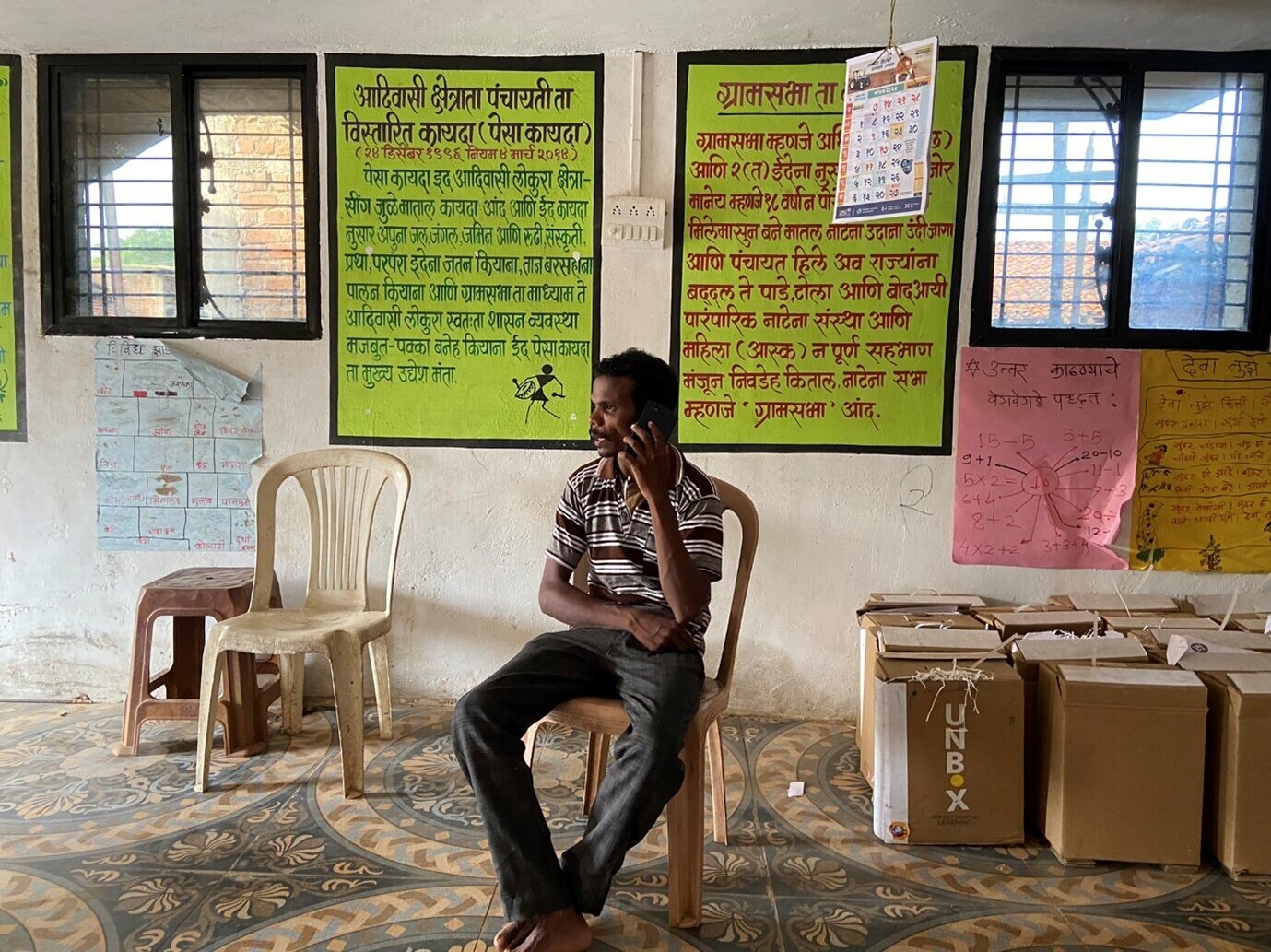
Madanlal Ghani Ram Porethi, head of the Padtiyal Job gram sabha sits in a community hall the village constructed from the compensation money it won for the land used for erecting electric transmission towers in Padtiyal Job village, Maharashtra.
Credit: Roli Srivastava
“I had no experience of writing applications,” said Madanlal Ghani Ram Porethi, 38, who helms Padyaljob’s Gram Sabha. Porethi studied up to 12th grade and had “never entered a government office, leave alone speak to an official”.
Porethi tapped the Maha Gram Sabha network to identify other villages where the transmission lines would run through, garnered support from nine of them over a period of one month and made a collective application for compensation.
“We used to feel scared entering a government office, but we were stronger as a community,” Porethi said.
Each village calculated the loss of bamboo, mahua and tendu trees that had taken over two decades to grow. They then calculated their potential earnings from the produce in the years to come and discussed how to write the letter. Each Gram Sabha pressed their claims in writing and shared it with the Maha Gram Sabha, which fought for the compensation as a collective.
Eventually, the 19 Gram Sabhas that were going to be impacted, claimed and got a whopping INR 8.38 crore as compensation. Each Gram Sabha got between INR 9 to 61 lakh, that many consider to be a record compensation amount paid for putting up transmission towers in India.
Migrant workers are back home
Locals in Korchi divide their months as dedicated to different trees: March and April to the sweet-smelling mahua, when people collect this deciduous tree flower that is used in medicines, food and also for making alcohol; May for tendu, June for jamun (black plum), and July to November to paddy fields that yield one harvest.
The forests in Korchi taluka are rich in mahua, bamboo, jamun and tendu trees among others, the produce from which has economically empowered villages.
Credit: Roli Srivastava
But the period between December and March was always the migration season, when entire families left home to seek work in distant towns and cities, returning by March to pluck mahua.
“People migrated to work at construction sites or on farms. I used to migrate to Andhra Pradesh to pluck chillies but that has stopped now,” said Kumari Jamkatan, secretary of the Maha Gram Sabha.
“We have learnt our right over jal, jungle, zameen (water, forest, land),” Jamkatan said, using the slogan raised by Gond tribal hero Komaram Bheem who fought for the rights of tribal communities on forest land in the early 20th century.
Improved incomes have revived farms, which has helped villagers return home from cities they had migrated to.
Teejan Pemanda Jethumal worked as a daily wage worker on a construction site with her husband in Nagpur for 13 years, about 200 kms away from her village Botekasa, barely 5km from Zendepar. They earned INR 200 a day, which meant they couldn’t farm as they never had money for seeds or fertilisers.
They returned to the village farms during the pandemic lockdown. The following year, they made over INR 11,000 on 100 bundles of 70 tendu leaves each as rates improved due to the collective auction. The earnings along with other state schemes for farming such as interest-free farm loans helped improve their paddy yield to 25 quintal per acre from 5 quintal per acre earlier.
Now, Jethumal and her husband have built a pucca house and are planning for the college education for their three daughters.
“I want my daughters to study more, and I am ready to invest money. I would like them to study science, art or even agriculture,” she said.
The sangharsh continues
But the forests that feed villages are also rich in other reserves.
Iron ore in the case of Zendepar.
Twelve hectares of land has been earmarked for an opencast mining project, and a 10 km surrounding area as a buffer zone, according to the project details submitted by a private mining company for environmental clearance, in one of India’s many contentious projects that locals fear will erode forests, livelihoods and unleash harsh climate conditions on them.
Even on a hot day, locals at Zendepar take pride over the weather, saying they can still sleep without a fan. The villagers believe that this is largely because of the forests they have preserved, which acts as a cushion against the impact of climate change, referring to the north-bound mercury, triggering heatwaves across the country this summer.
Besides, villagers said they have remained self-sufficient because of the forest produce, and never had to migrate for work, like those from neighbouring villages of Botekasa. Zendepar’s villagers said the forest feeds not just their families but villages in a 10 km radius.
“We read about farmers ending their lives in Marathwada (a drought-prone region in Maharashtra) owing to droughts. We don’t want a similar fate. If they mine in these forests, we will lose our livelihoods. We will bring upon a climate crisis upon ourselves, and we will be forced to migrate from one place to another to earn a living,” Zendepar forest crusader Madavi said.
“We don’t want that life,” she said.
According to the project report, the mining project will not harm the groundwater, will create work for 78 people, with the potential for more employment opportunities.
The last public hearing for the project was held in October 2023 and it is awaiting final clearance from the Maharashtra Pollution Control Board for the work to begin, said Umesh Barade, district mining officer at Gadchiroli.
He added that the area marked for mining wasn’t a forest area, “but a private land where trees have grown and villagers have become dependent on it”.
This is in fact a usual case all over the country, where the land record of a physically grown forest shows a private revenue land.
Representatives from several villages – all members of the Maha Gram Sabha — have rallied behind Zendepar. They have visited the collector’s office for public hearings as a group over the years, helped identify a lawyer to represent Zendepar village and are working on the paperwork together.
This coming together of villages is an all-too familiar way of living in tribal areas, as also reflected in the tribal songs of ‘living together’ young girls sing.
“We have no choice. We are strong because we have the support of the Maha Gram Sabha. A single village wouldn’t have that strength”
Moving on
Today, the Maha Gram Sabha has 64 members. The dip in members is largely because many feel confident of that they can work on issues in their villages independently, having learnt and understood their rights from the unique federation.
Maha Gram Sabha officials see it as a good sign.
“Until 2010, the identity of this region was that it was backward with naxal activity,” said AAA founder Gogulwar. “Now all Gram Sabhas have their own funds. Adivasis who didn’t know how to do business earlier, have found the courage to do it as a collective. The tribal tradition is rooted in climate mitigation, and they are connected to their trees. But now they also know their forests’ worth, and they are strong,” he added.
While villages collectively sell tendu leaves, and see both merit and profit in trading together, Maha Gram Sabha officials said they don’t show similar interest to trade in other forest produce together, seeking individual rates on say jamun or bamboo, perceiving better profit.
So instead of forcing a collective approach, the Maha Gram Sabha simply guides them in the sale process. Even villages who are no longer Maha Gram Sabha members attend meetings and approach officials should they need any help or guidance.
But for people like Madavi, the strength of the collective is key to ensuring the rights of the community are protected. She is counting on the collective for the battle ahead.
“We have no choice. We are strong because we have the support of the Maha Gram Sabha. A single village wouldn’t have that strength,” said Madavi, climbing down the forest.
The Sangharsh and Nirmaan continue.
About the author:
Roli Srivastava is a Mumbai-based climate journalist and founder of The Migration Story. This article has also been co-published here.
About the series:
This series will spotlight local democratic practices from across the country that demonstrate innovation, effectiveness and good governance.
This work is facilitated by the Centre for Local Democracy, Azim Premji University.
The Centre for Local Democracy supports the work of Azim Premji Foundation and others working on deepening and widening local democracy across India. The Centre enhances the work done in rural, forest, PESA and urban settings through educational programmes, documentation, dissemination of good practices and research in emerging thematic areas.