
Gram Panchayat Help Desk: Bridging the last mile in welfare delivery to the rural poor
A collaborative initiative between PRADAN and Gram Panchayats in Jharkhand
By Sukanta Sarkar and Ashok Sircar | April 2025
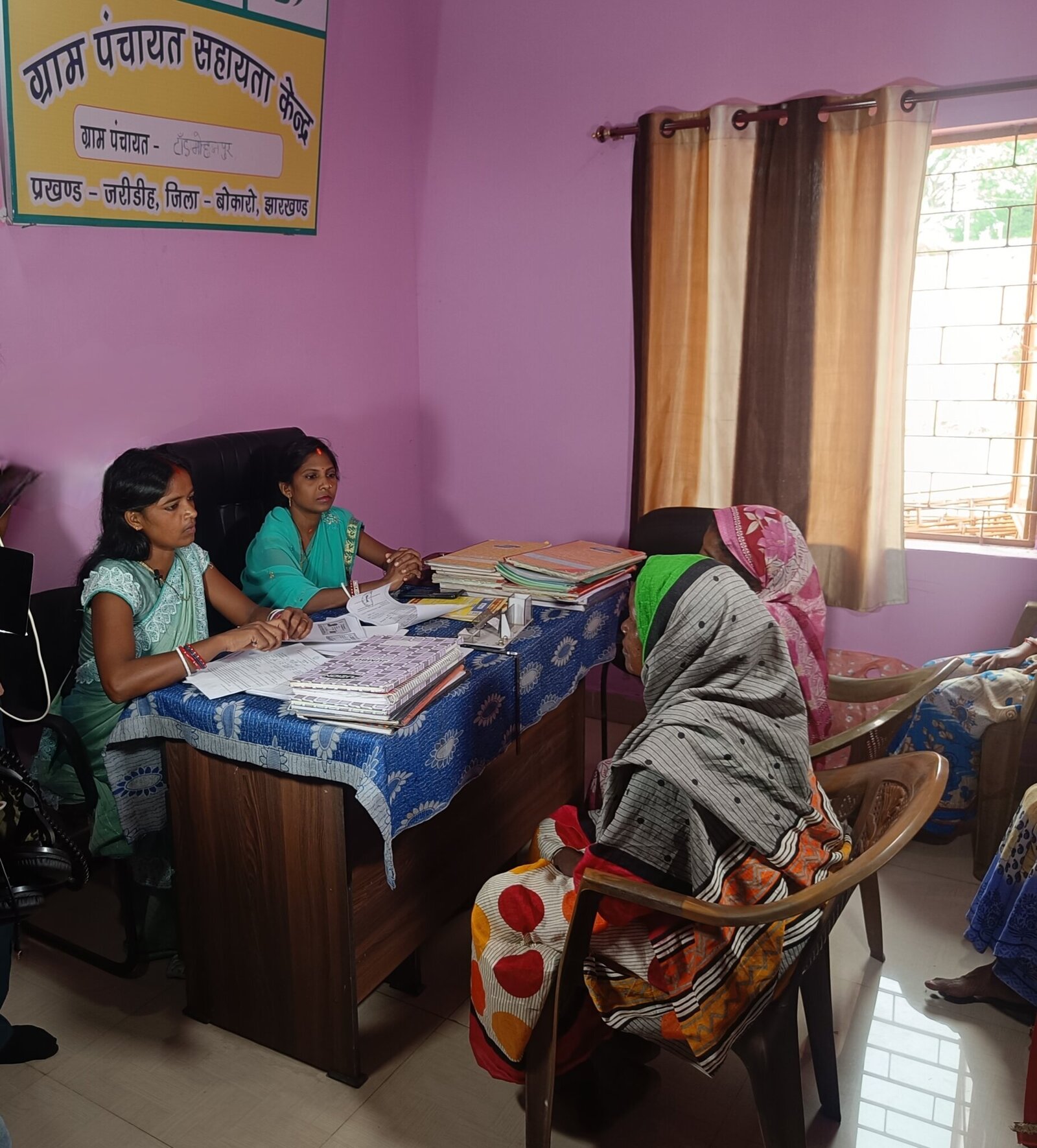
Details
For Geeta Mahil (33) of Tand Balidih Gram Panchayat in Jharkhand’s Bokaro district, the widow pension is her lifeline. This lifeline would not have reached her had it not been for the efforts of the Gram Panchayat Help Desk (GPHD).
Geeta’s husband Ashok’s sudden demise in 2023 left her and her two children in dire straits. Ashok used to work as a landless labourer and was the sole breadwinner, so his death deprived his family of any earnings. Geeta, as a housewife, raised their children and hardly stepped out of the village.
Geeta knew of the widow pension from a couple of other women in her village who received a sum of INR 1,000 a month. When Geeta tried to access the pension, she was asked to first produce the death certificate of her husband. But just the task of obtaining the document was far from easy for a layperson like Geeta. Several people in her village offered to help her— in exchange for money. They insisted that they needed the cash to bribe someone. A helpless Geeta was in no position to fulfil their demand. It also didn’t strike her to seek help from the Gram Panchayat office, about 6 km away from her village, or the Block Office, nearly 10 km away.
“After my husband’s death, I faced numerous challenges, but thanks to GPHD, I started getting my pension without paying a single paisa [in bribe].”
It was sheer happenstance that a certain Sumita didi (‘sister’ in English) visited Geeta’s village for a survey and asked around for those who did not receive ration or pension. When she asked Geeta why she wasn’t getting the widow pension, Geeta said, “I need the death certificate for my late husband.” Geeta’s answer baffled Sumita to an extent. Getting a death certificate wasn’t so difficult after all. She got hold of relevant papers and took them to the GPHD. Sumita clicked Geeta’s photos, got her signature and processed the application for the death certificate issued by the Gram Panchayat (GP). The GPHD also prepared the family benefit pension-related papers for Geeta and processed it through the GP to the Block Office.
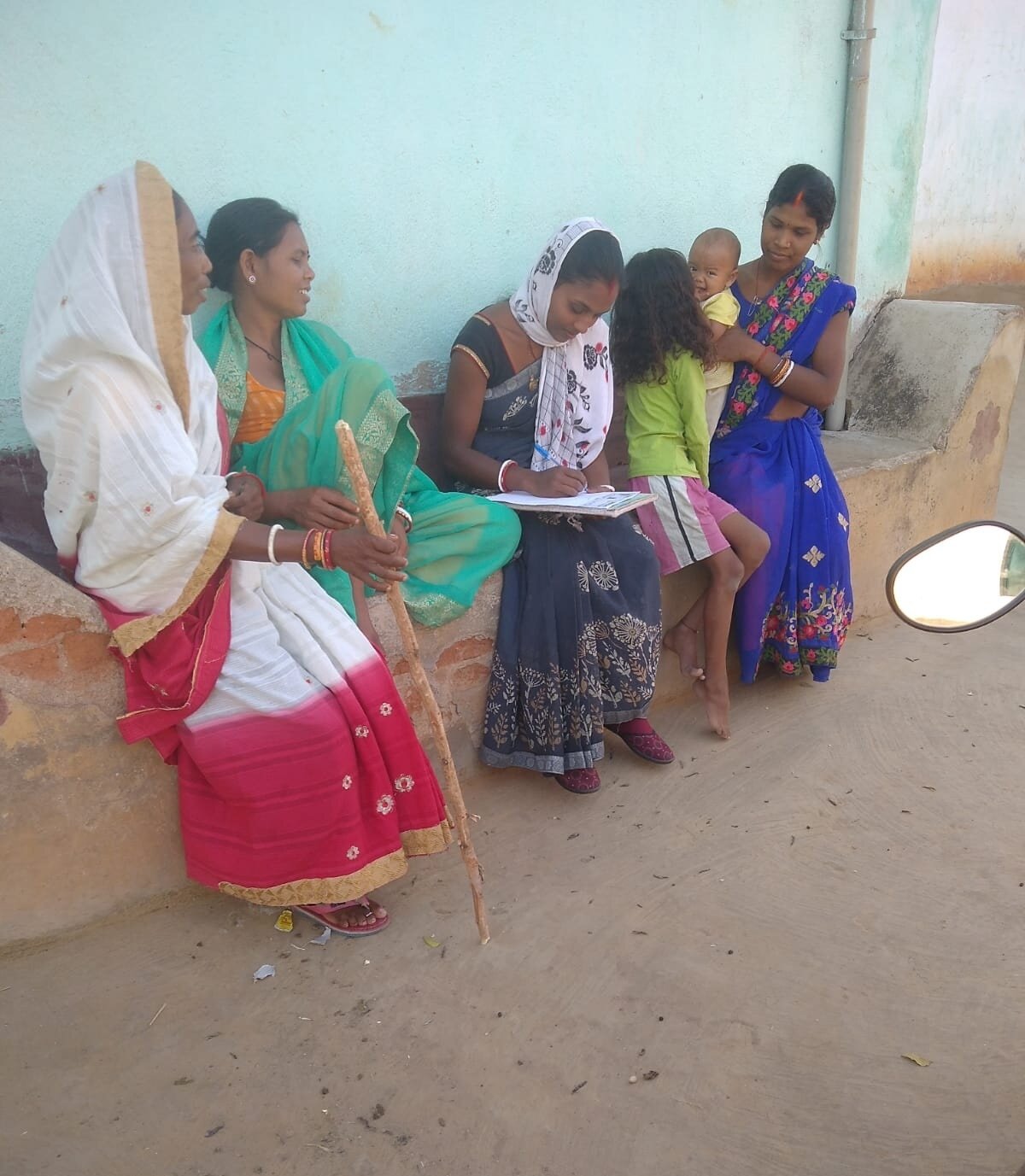
GPHD doing survey
After regular follow-up calls from GPHD, Geeta’s pension application finally went through. And within two months, she started receiving the sum. In Geeta’s words, “After my husband’s death, I faced numerous challenges, but thanks to GPHD, I started getting my pension without paying a single paisa [in bribe].”
Pemoli Tudu’s (38) story from Chilgadda Gram Panchayat of the same district is no different. Pemoli is married to Ramesh, and they have two children. Despite her disability, Pemoli tends to the household while her husband does several odd jobs to make a living. Pemoli is eligible for a disability certificate, which can fetch her a disability pension, but she does not have one. Her several attempts at obtaining one have failed. She wonders why. Was it because of a mistake in the papers, or due to the non-payment of a bribe?
It was at a village meeting conducted by GPHD that Pemoli first narrated her ordeal in public. The GPHD made note of it and started work on the matter. The GPHD made her file a fresh application for the disability certificate by helping her acquire the supporting documents. They also connected her with the Nagarik Sahayata Kendra, a helpdesk at the Block level. The physical verification is usually done at the Primary Health Centre (PHC). The GPHD made the GP write four letters to the district and block authorities, following up on the application. Eventually, the certificate was issued after two months.
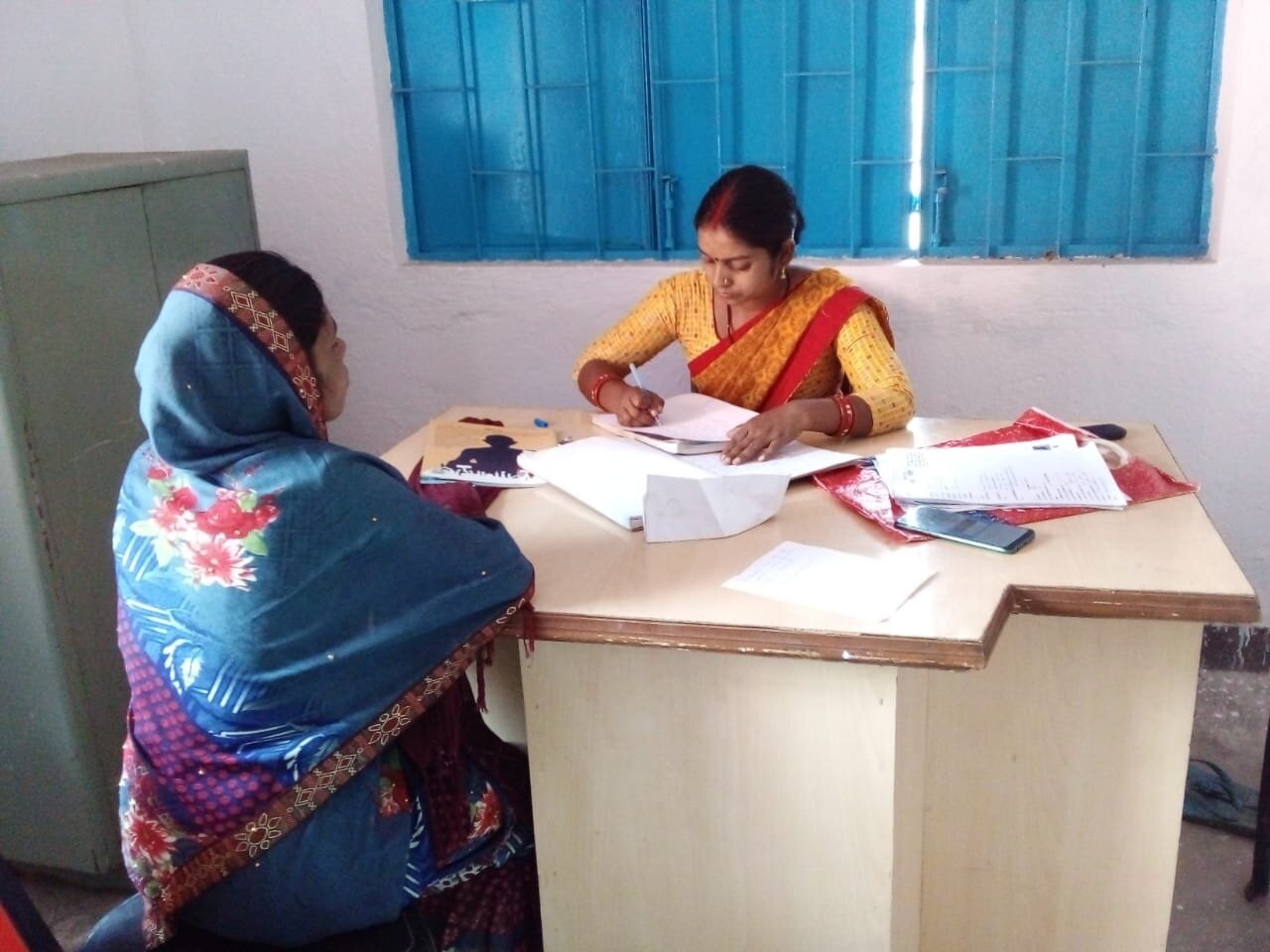
Gram Panchayat Help Desk (GPHD)
Ramesh could not believe his ears when the GPHD called him to say that Pemoli’s certificate had arrived. He went to the GP along with his wife to see the document that the family was so banking on.
Pemoli’s struggle for the pension was only half complete, though. The next step was making a fresh application for the pension. Here again, GPHD took the lead to ready the papers, and had those submitted to the Block Office through the GP. After several follow-ups, the approval letter bearing Pemoli’s name finally arrived after a month.
An overwhelmed Pemoli said, “I had applied for the pension multiple times, but to no avail. However, with GPHD’s support, I finally started receiving the pension.”
These and numerous such stories reveal how a simple institutional mechanism can bridge the yawning gap that exists between the state’s welfare measures and the people’s access to such measures.
The problem
While a plethora of welfare programmes for the poor, the vulnerable and the marginalised are run by the state, the main challenge is improving the people’s access to the full benefits and redressing grievances. The problem of access stems from four distinct deficiencies – information deficit, complicated procedures, unclear mechanism of tracking and grievance redressal. The problem compounds itself for the rural population, particularly for the old, women, neo-literate and illiterate people who face multiple bureaucratic barriers when interacting with the local administration. In addition, the administrative language itself poses a cultural barrier.
Information deficit is well known, but a nuanced understanding of it is often missing. The target population is often unaware of schemes meant for them. In addition, adequate details are often unavailable, processes are unclear, and the decision-making tree is opaque. Information such as relevant administrative persons, their locations, responsibilities, visiting hour, and obligations are also unknown. In other words, information deficit not only refers to public information about a particular welfare programme, but also the details that generate an interest in accessing the same.
Firstly, for the ordinary person, it is difficult to fully grasp the process of grievance redressal. Secondly, with digitisation, without downward transparency and accountability, grievance redressal has become so centralised that going through the process has become increasingly difficult for an ordinary person. For the old, women, neo-literate and illiterate people, the problem of bureaucratic barriers often presents itself the most in the grievance redressal process.
In addition to the information deficit, procedural complications often make it hard for communities to access the benefits. The forms are written in a bureaucratic-cum-technical language. Sometimes the forms have unnecessary elements that make them cumbersome. The list of supporting documents required is often too long and not easily available. Procedural complications include an opaque system of file/case movement, none of which is clear to the person concerned. Getting any work done depends on individual relationships, or occasionally greasing the palm of the staff concerned.
Tracking or the lack of it remains a serious issue in welfare delivery. Tracking of individual case files or a group case file through the decision-making chain usually happens in an informal way. None of the steps involved are transparent. For the ordinary person, it is next to impossible to understand what happens inside the administrative system.
Consequently, grievance redressal is often a casualty of a weak tracking process. Firstly, for the ordinary person, it is difficult to fully grasp the process of grievance redressal. Secondly, with digitisation, without downward transparency and accountability, grievance redressal has become so centralised that going through the process has become increasingly difficult for an ordinary person. For the old, women, neo-literate and illiterate people, the problem of bureaucratic barriers often presents itself the most in the grievance redressal process.
The idea
Addressing the problem stated above requires an institutional mechanism. A mechanism that helps overcome the information deficit, process complications as well as tracking and grievance redressal challenges. To make it serve the poor, the vulnerable and the marginalised, the mechanism has to be physically close to the communities, easily accessible and trusted by them, and its role has to be of a facilitator.
The GPHD or Gram Panchayat Sahayata Kendra was conceived by PRADAN as one such mechanism in a GP office. It drew from the experience of block-level Nagarik Sahayata Kendras (NSKs), which have existed in almost 80 blocks of Jharkhand for some time. It is a collaborative effort between several civil society organisations (CSOs) such as PRADAN and district administrations. The latter provides office space, furniture, relevant papers, and official linkages, while the CSOs manage the staff under a grant. However, being located at the office of the block administration, the NSK still has limitations of access and outreach to remote places in the block. Thus, PRADAN realised that a similar structure at the GP would be better suited for the rural citizenry.
PRADAN has been working with various GP institutions including the Gram Sabha, women’s groups and federations, and other community-based organisations (CBOs) to enhance livelihood outcomes for the poor women and their families. PRADAN enjoyed excellent trust and rapport with several GPs. So, it was not difficult to implement this idea.
Structure and composition of GPHD
The GPHD is located at the GP office itself. The GPHD requires an office space of 200 sq ft. A typical GPHD has one table, adequate lights, three chairs, one almirah, a laptop/desktop computer with internet facility, a printer and a photocopy machine, and a functional toilet. Since much of the workflow of welfare schemes is now digitised and can be accessed through web-based platforms, the computer with internet is essential.
Apart from the above facilities, the GPHDs have information booklets and guidelines in Hindi on various welfare schemes (such as Mahatma Gandhi National Rural Employment Guarantee Act or MGNREGA, National Social Assistance Programme or NSAP, National Food Security Act and Swachh Bharat Mission) relevant forms and other stationery to help dissemination of information, filing of applications, tracking and grievance redressal. These are usually made available to the GPHD by the GP, the block administration or relevant line departments at the block level.
The GPHD has two staff members called Panchayat Sathis. It is open 5 days a week from 10 AM to 4 PM. At least one staff member is always at the desk, while the other is visiting the villages and mohallas (‘Hamlets’ in English) to reach out to potential beneficiaries.
Work of the GPHD
The GPHD works to reduce and overcome the four deficiencies mentioned above. It provides detailed information to potential beneficiaries about various welfare schemes through village meetings, meetings of the village organisations (VOs) of self-help groups or SHG collectives, women’s groups and other CBOs; facilitates formal applications by deserving persons; helps in assembling the supporting documents and completion of due diligence; submits applications either online or physically; keeps a record of the same and follows it up with respective line department staff; collects grievances, analyses and verifies them; follows up with respective administrative persons in the decision chain, and informs the people concerned on the progress and results.
As can be seen, the GPHD’s work is essentially twofold: working with the communities to ensure they receive what is meant for them, and help the GP with evidence to work with the administration at the block, and even district level (if and when required), to ensure that welfare schemes are delivered to the deserving population. The district level engagement is done usually by the mukhia (elected head of the GP) or the GP Secretary, as the GPHD has limited access to the district administration.
The GPHD does act on behalf of the GP, and on some occasions, it is the GP president or secretary who takes the lead. Under no circumstances can the GPHD directly establish any relationship with any line department or block/district administration. While dealing with communities, too, the GPHD acts as a service provider on behalf of the GPs. It positions itself as the welfare secretariat of the GP.
The GPHD is expected to keep records of registrations, applications, grievances and surveys carried out by the office.
Some of the tasks a GPHD typically performs are as follows:
- It acts as the information and facilitation centre for welfare schemes of the governments and various entitlements.
- It helps a potential/eligible beneficiary make applications with appropriate evidence and supporting documents.
- It accepts grievances and helps GPs follow up with relevant line departments and administrative personnel for redressal.
- It helps the GP and often works on its behalf to conduct awareness campaigns and village meetings to provide information, collect applications and also note grievances. Often, the GPHD conducts door-to-door visits to generate demand for a welfare programme, especially for inclusion of the extremely vulnerable families or individuals.
- For ultra-poor households, the GPHD pays special attention to filling up their applications, tracking their benefits and addressing grievances.
- The GPHD visits Sub-Health Centres, PHCs, Anganwadis and schools to understand needs that can be supported by the GP.
- It helps the GP establish linkages with line departments with essential documents and evidence to facilitate welfare benefits for the people.
- For a new scheme or some of the less-known schemes, the GPHD conducts door-to-door surveys to assess the ground situation, including potential need and demand.
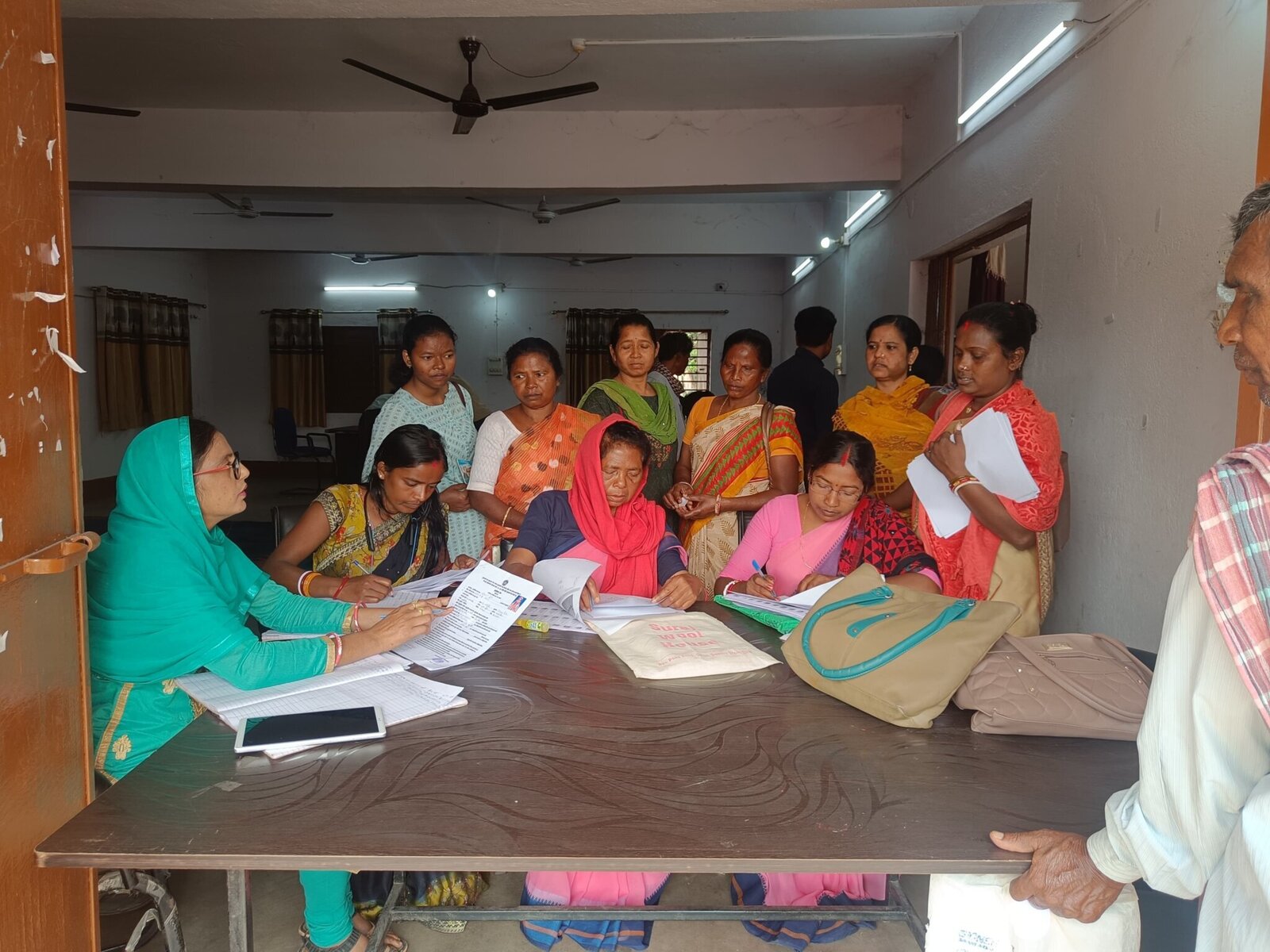
GPHD in Camp
The Panchayat Sathi
The Panchayat Sathi is typically a woman in PRADAN’s work areas. This is because of PRADAN’s long association with women groups and their VOs and Cluster-Level Federations (CLFs). Under a request from the Gram Panchayat, the CLF selects two women for the GPHD. This is done in a public meeting in the presence of VO members. The GP president is mandatorily present in this open meeting to oversee the selection and share views, but the choice remains with the CLF.
Alternatively, the GP organises a recruitment drive in association with the CLF to select suitable candidates from SHGs.
“By working as a Panchayat Sathi at the GPHD, I have been able to help excluded and marginalised families claim their entitlements with the support of the panchayat. A strong coordination has also developed with the panchayat, and now the villagers have started to believe that they can access government schemes without having to pay money.”
The candidates considered for Panchayat Sathis should
- have at least passed Grade X (if the candidate is suitable in all other criteria, then this criterion can be further relaxed).
- have leadership qualities and acceptance in the community.
- preferably know how to ride a bicycle.
- preferably have work experience in social mobilisation or conducting training and surveys.
- preferably have knowledge of computers and internet.
Monitoring the GPHD work
Though the GPHD is established as a collaborative initiative between PRADAN, CBOs of women and GPs, all efforts are made to see that the initiative is integrated within the normal functioning of the GPs. Keeping this in mind, the following monitoring mechanism has been instituted:
- Ward members, on rotation, meet Panchayat Sathis at least three days a week at the GPHD office. They try to understand the work and provide help.
- The GPHD presents its work in the monthly meeting of the Gram Panchayat Coordination Committee or GPCC. They detail out the progress report, constraints and challenges, and where they need the support of the GP.
Training
The work of the GPHD cannot be accomplished without capacity building of the staff, as well as sensitising stakeholders on everything the GPHD does. The Panchayat Sathis need to understand how a GP works, how each of the schemes work, maintenance of various documents, record- keeping as well as tracking and follow-up, besides getting familiar with the forms used in the process. Keeping all this in mind, a training plan was drawn up and the involvement of various stakeholders sought for the training.
The Panchayat Sathis required training to understand the concepts and institutional landscape of the Panchayati Raj, their own duties and responsibilities, the Panchayats’ relationships with line department services at the block and especially at the GP level and the welfare entitlements that they have to work on (MGNREGA, ration, pension and other direct benefit transfers). Further, Panchayat Sathis needed to learn how to maintain registers, generate reports, fill up forms and so on. In addition, they needed to know the institutional structure at the block level for various line departments.
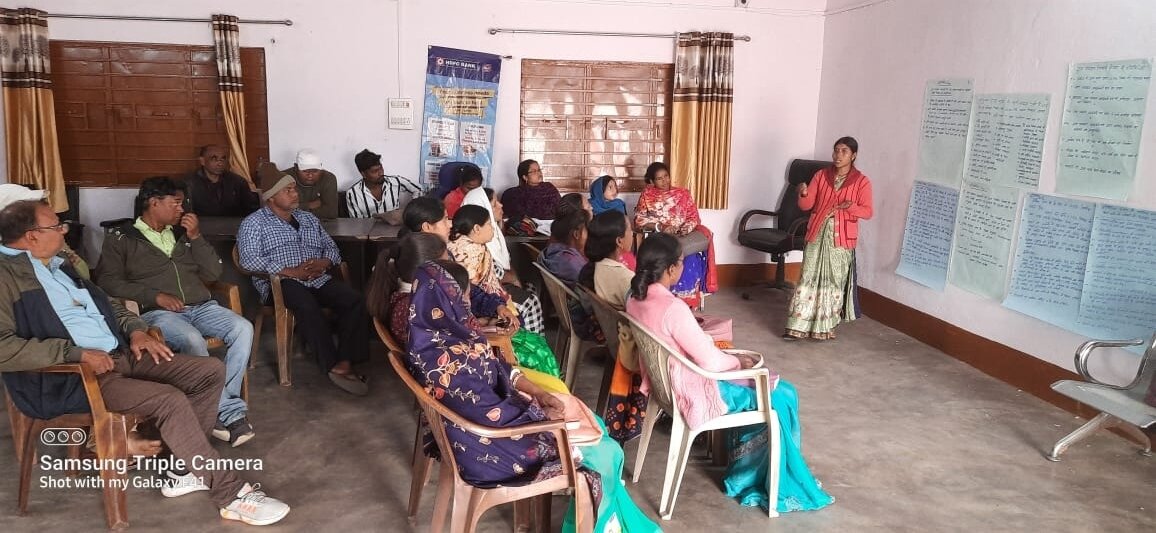
GPHD doing Training
All these cannot be accomplished in one go. So, the plan was to have the Panchayat Sathis undergo basic training on Panchayati Raj, key welfare entitlements and an understanding of their duties. This was done through a three-day induction training.
Once they started work, two more refresher trainings were done in the first year to resolve work-related conceptual and practical issues. In addition, some of the things dealt with in the induction training needed reinforcements, which were also done in these two refreshers.
However, this was not enough. The Panchayat Sathis needed some handholding to work efficiently and also develop credibility among GP representatives and the community. In the first year, each pair of Panchayat Sathis was given eight one-day trainings on the job.
To sum up, Panchayat Sathis received training for 15 – 20 days in the first year. Refresher trainings continued in the second year as well.
The trainings were conducted mostly by PRADAN, with the assistance of selected resource persons. PRADAN asked its staff to remain connected with the GPHDs and the one-day on-the-job trainings were provided by PRADAN members working in the respective local area. PRADAN took special initiatives to ensure that GP representatives are involved in the training, so that they, too, understand and appreciate the seriousness of the work. The GP leadership saw the value and provided more support to the Panchayat Sathis once the results of their work on behalf of the GP started coming in.
Key achievements so far
PRADAN has tracked the work done by the GPHDs in 118 GPs. As is well known, a detailed tracking system and developing analytics out of it is an expensive affair, and neither PRADAN nor the GPs have the wherewithal to make it happen. So, the tracking was done under a simple twofold categorisation – number of requests received under major programmes such as MGNREGA, ration and pension and the number of them closed after due considerations.
“My husband passed away a long time ago, but I wasn’t receiving the widow pension benefits. I used to work in other people’s houses. With the help of GPHD didi at the panchayat, I was able to get the widow pension. Today, I have a lot of trust in the GPHD and my panchayat.”
While the GPHDs started with a focus on MGNREGA, ration and pension, they eventually handled work related to many other programmes of the government — for instance, implementation of Building and Construction Workers’ Act 1996 and E‑Shram portals, Mid-Day Meal, NSAP, Pradhan Mantri Matru Vandana Yojana and others. The issues were diverse, from a new registration to renewal, corrections, additions, addressing rejections and other grievances. Much of the assistance the GPHD provides may appear simple — like filling up the correct form, submitting correct documents, correcting digital entry errors, rejection due to some small errors and inclusion of family members into a scheme. But for those applicants, these small things make or break their access to the welfare provided by the state.
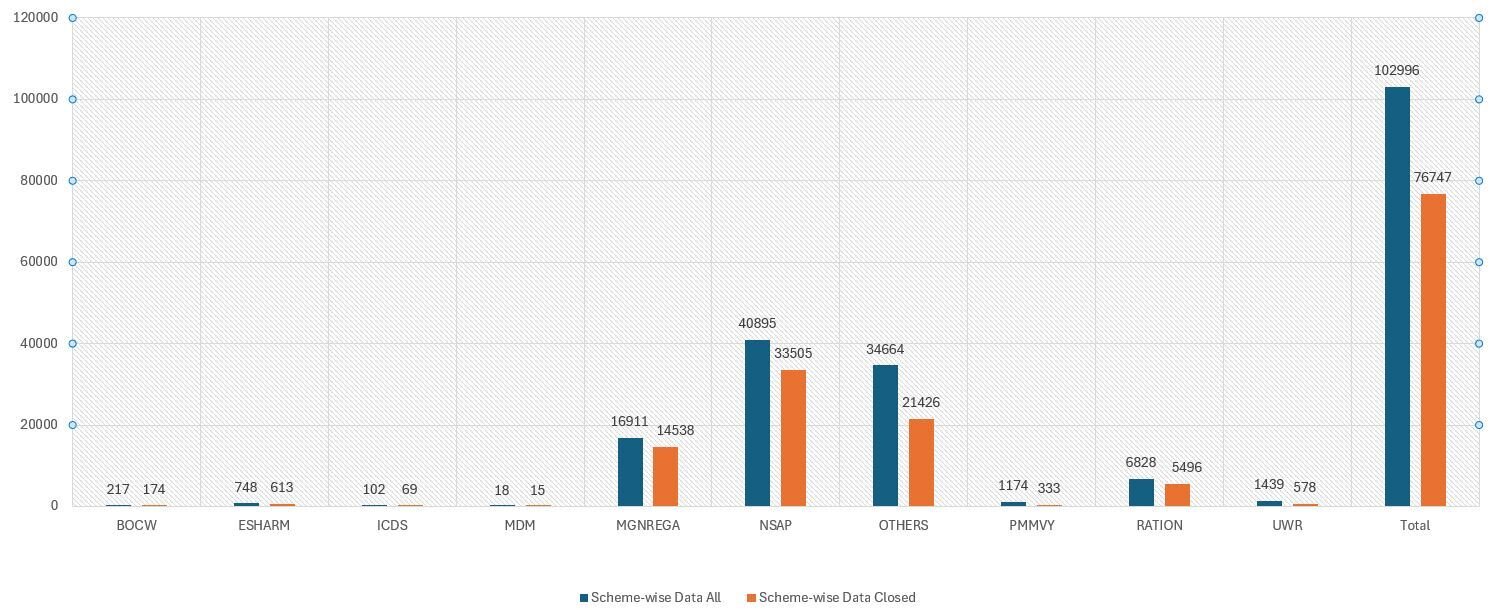
Scheme-wise Data as of Jan 2025
In the graph above, the difference between blue bar and red bar, reflects two aspects — some are under process when the data is generated, and some that could not be satisfactorily closed. The latter is about 20 percent of the requests.
In particular, some grievances could not be resolved satisfactorily due to the complicated nature of the decision-making. The GPHD and the GP have little access to the bureaucracy at the district level. It becomes difficult to proceed if matters get stuck at the district level.
These numbers portray only part of the achievements. One key focus of the GPHD is to make sure that its services reach the ultra-poor, and that they are included in the welfare entitlements. The ultra-poor are largely invisible as they do not voice their needs in public forums like the Gram Sabha. As a result, they remain out of the coverage of most welfare schemes while being the community that needs them the most. PRADAN attempted to track the GPHD services to the ultra-poor and could see that every year about 8,000 to 8,500 such individuals are included across all the 118 GPs. This is no small achievement.
Key challenges
It was not easy to set up these GPHDs and make them run smoothly. Several challenges were encountered along the way. The first and perhaps the foremost was to convince the GP leadership that GPHD is a support mechanism to the GP and not a parallel system. Any initiative coming from a CSO is generally viewed as a parallel effort, thereby creating alternate centers of social power. Special efforts were made to make the GP more assured and confident. It included involving the GP leadership in recruitment, the documents to bear GP’s names (and not of PRADAN), the vocabulary to be used by the Panchayat Sathis to be that of the GP and not of PRADAN, (such as saying, “We are Panchayat Sathis of XXX Gram Panchayat!”) and the Panchayat Sathis’ efforts to be presented as GPs’ efforts, while PRADAN remains only a facilitator. Several GPs took time to understand and appreciate it. Some unease remains in several GPs even today.
Each welfare scheme has complex operational and grievance redressal processes. This involves steps to be carried out at GP, block and even district levels. While broad Standard Operating Protocols are available, the actual process followed in several blocks and GPs are different and are tweaked as per convenience.
Panchayat Sathis needed to fully grasp these processes and steps and make use of it to help extend the benefits to the deserving, and this took time. While some training and handholding did help, a close supervision of each case the GPHD handled was required. While PRADAN and the GP leadership did their best to help, the process was often learnt only by trial and error.
A lesser but significant challenge was to find a physical space inside the GP office. There were two kinds of problems – one related to the actual dearth of a suitable place and a functioning ladies’ toilet; the second was the GPs’ reluctance to provide a space with tables, chairs, almirahs and so on. While all GPs now have a building, often the space is not adequate. Reorganisation of space was necessary. Since the GPHD must store many documents, it needed a space inside a room. However, in some GPs, thanks to some good work by the GPHDs, the GP leadership felt obliged to provide space.
In practice, grievance redressal remained the key challenge for the GPHD. Grievance redressal requires full traceability of the process to understand what and where a correction is needed. Much of the processes are at the block and district levels, where the potential for GPHD/GPs’ intervention is limited. Also, it often requires documentary evidence from the beneficiaries. While the second issue can be addressed by close follow-ups, the first part of problem is a long-drawn process that sometimes negatively impacts the patience of the applicant.
A new challenge emerged with the progress of the GPHD journey. Whose face is the GPHD — the GP or the block administration? Much of the GPHD’s work takes the Panchayat Sathis to the Block Office, and they have to act in accordance to the line departments at the Block Office and the block administration itself. In the process, the Panchayat Sathis often feel more obligated to the block administration or the line departments than the GP itself. There is no easy solution to this identity problem.
The GPHDs continue to face the overall challenge of the ways block administration/line departments and the GPs work in — the lack of a sense of downward accountability. Every welfare scheme is treated as a largesse to the poor, and dealt with casually. Grievances caused by clerical or other administrative errors are treated with neglect and low priority. As a result, the paperwork is often loose, traceability is poor, and the process is convoluted. This often results in undue delays, especially in addressing grievances.
A structural issue remains. The GPHD was conceived as an idea by PRADAN and it worked with the GPs to make it work. PRADAN’s intervention included an honorarium for the Panchayat Sathis, the training, the laptops for GPHDs, and quality time by PRADAN staff to oversee the work. All of these are funded by PRADAN’s project budgets, which are timebound. Therefore, the GPHD’s continuity remains dependent on project support, unless the cost is picked up by the Panchayats and the state together. Fortunately, PRADAN could influence the government to accept this as a mechanism to be continued and spread across all GPs of Jharkhand, including budgetary support for the honorarium for the Panchayat Sathis and other expenses.
About the authors
Sukanta Sarkar
Sukanta Sarkar has been in involved in this sector for last 28 years since he joined PRADAN in 1996. He has done Master’s in Agriculture and thus been involved in ensuring livelihoods of poor and marginalised, especially women. He has been involved in nurturing the idea of recognising the woman as an economic actor in the family while ensuring more control over income by the women members of the family. He has the experience of leading large scale livelihood programme in collaboration with the government and the funding agencies. For the last 9 years, he has been involved in strengthening local governance while promoting citizenship and empowering Gram Sabha and Gram Panchayats. At present he is holding the portfolio of Lead, Centre of Excellence, Local Governance in PRADAN. He has been awarded with “Endeavour Fellowship” by Government of Australia in the year 2009
Ashok Sircar
Ashok Sircar leads the Centre for Local Democracy. He has been with Azim Premji University from 2011, and for the last five years, headed the School of Development. He teaches a course on Political Economy of Land and Development in India, and Local Democracy and Development in India. He also earlier taught a course on Women and Work in India. Ashok has worked in the Electronics industry for 15 years producing very sophisticated electronic components for space and military applications, followed by a stint in the NGO sector working for another 12 years, in grassroots to international organisations, and the last 10 years in academia. [ Full Profile]
About the series
This series will spotlight local democratic practices from across the country that demonstrate innovation, effectiveness and good governance.
This work is facilitated by the Centre for Local Democracy, Azim Premji University.
The Centre for Local Democracy supports the work of Azim Premji Foundation and others working on deepening and widening local democracy across India. The Centre enhances the work done in rural, forest, PESA and urban settings through educational programmes, documentation, dissemination of good practices and research in emerging thematic areas.
Images by PRADAN, Jharkhand